
New Zealand AI Data Center Market Size, Share & Forecast to 2035
Market at a glance
The New Zealand AI Data Center market was worth USD 193.5 million in 2025 and is forecast to reach USD 846.8 million by 2035, growing at a 15.91% CAGR.
 By Amit Jain, Senior Consultant, ICT & Emerging Technologies
 Reviewed by Deepti Agrawal
Last updated 22 Oct 2026
Base year 2025 PDF + Excel
Key findings
Renewable Contracts Pull AI Campuses South: Datagrid's 360 MW at Makarewa
Direct-to-Chip Cooling Becomes the Default Design
Dry-Year Price Spikes
Operations Services for a 356 MW AI Base
What is inside the report
- 01Introduction
- 02Research Methodology
- 03Executive Summary
- 04Market Dynamics
- 05Pricing Analysis
- 06Standards and Regulation
- 07Market Segmentation by Component
- 08Market Segmentation by Buyer
- 09Market Segmentation by Cooling Approach
- 10Market Segmentation by Workload
- 16chapters
- 2020-2024Historical period
- 2026-2035Forecast period
- —Companies profiled
Segmentation
Recent developments
Spark agreed to sell 75% of its data center business to Pacific Equity Partners at an enterprise value of up to NZ$705 million (Source: Spark NZX release).
AWS opened its Asia Pacific (New Zealand) Region in Auckland with three availability zones (Source: AWS).
Spark completed the sale and the business became TenPeaks Data Centres (Source: Spark NZX release).
Datagrid's Makarewa campus received resource consent and a 140 MW, 15-year power option from Mercury (Source: Mercury NZX release).
Mercury bought 12.7% of Datagrid NZ for USD 30 million, with the project at 360 MW (Source: Mercury NZX release).
Contact Energy and CDC announced a study of a 250 MW IT data center at Stratford (Source: Contact Energy NZX release).
Full analysis
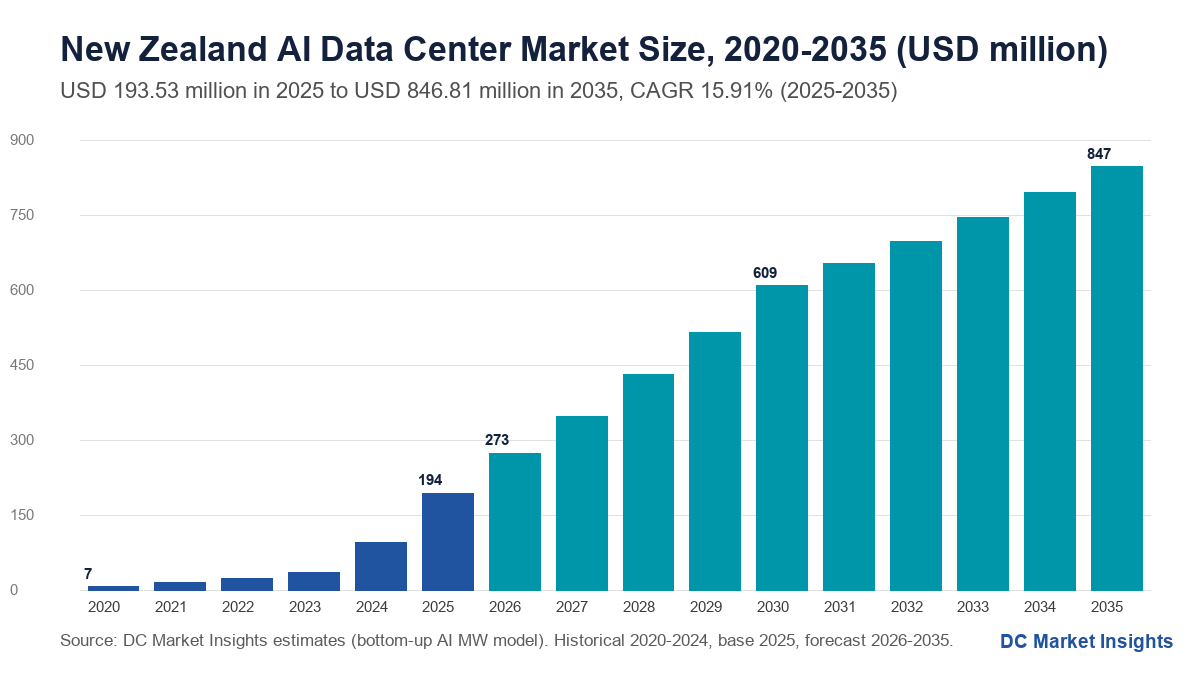
The New Zealand AI Data Center Market is valued at USD 273.46 million in 2026 and is projected to reach USD 846.81 million by 2035, up from USD 193.53 million in 2025, a CAGR of 15.91% from 2025 to 2035 (DC Market Insights estimate). What moves the money in New Zealand is power that is already renewable: 88.5% of the country’s electricity came from renewable sources in 2025, and that is why Mercury took a 12.7% stake in Datagrid’s consented 360 MW campus at Makarewa in Southland in July 2026 and why Contact Energy and CDC Data Centres are studying a 250 MW campus at Stratford in Taranaki (Source: Ministry of Business, Innovation and Employment; Mercury and Contact Energy NZX releases). Auckland still takes 80% of the spend, because the Amazon Web Services (AWS) region that opened on 1 September 2025 with three availability zones and a NZ$7.5 billion plan sits there, beside Microsoft’s New Zealand North region and CDC’s Hobsonville and Silverdale campuses (Source: AWS). The New Zealand AI Data Center Market covers what operators pay for the artificial intelligence (AI) hall itself: power, cooling, shell, fit-out, racks, in-hall network cabling and the services that keep it running, with graphics processing unit (GPU) servers left out. In 2025 that came to USD 178.92 million for 12.60 MW of new AI halls (30% of the 42 MW New Zealand completed, at USD 14.20 million per MW), USD 9.20 million for converting 2 MW of older halls at USD 4.60 million per MW, and USD 5.41 million of services across 15.93 MW already running. Services grow fastest, at 38.75% a year, and Southland and Otago is the fastest-growing region at 38.65% a year as the Makarewa AI factory takes power from 2027.
Key Market Statistics: What Will New Zealand Spend on AI Halls in 2026?
DC Market Insights values the New Zealand AI Data Center Market at USD 273.46 million in 2026, 41.30% above 2025, as new AI IT capacity rises from 12.60 MW to 17.28 MW.
- Market size 2025: USD 193.53 million
- Market size 2026: USD 273.46 million
- Market size 2030: USD 608.55 million
- Market size 2035: USD 846.81 million
- CAGR 2025-2035: 15.91% (low case 11.94%, high case 18.50%)
- Largest component: Electrical Infrastructure, 33.98% of 2025 spend (USD 65.76 million)
- Fastest component: Operations Services and Software, 38.75% a year
- Fastest cooling approach: Immersion Cooling, 27.85% a year; Direct-to-Chip Liquid Cooling reaches USD 491.15 million by 2035
- Leading region: Auckland, 80.00% of 2025 spend; fastest-growing region: Southland and Otago, 38.65% a year
- Largest location: Hobsonville (Auckland), USD 58.06 million in 2025
- Largest buyer group: Hyperscale Cloud Regions, 50% of 2025 spend (DC Market Insights estimate)
Key Takeaways: Three Facts for Anyone Planning AI Capacity in New Zealand
DC Market Insights draws four takeaways from a New Zealand AI data center market that grows from USD 193.53 million in 2025 to USD 846.81 million in 2035.
- The south is where the megawatts are: Southland’s share of spend rises from 3% in 2025 to 18% in 2035, because Datagrid’s 360 MW campus sits next to hydro supply and holds resource consent (Source: Mercury NZX release, July 2026).
- A New Zealand AI hall costs USD 14.20 million per MW of IT load before servers in 2025, because liquid cooling and heavier power trains add about USD 5 million to a conventional megawatt (DC Market Insights estimate).
- Power price swings matter more than tariffs: wholesale prices fell from over NZ$280 per MWh in late August 2025 to an average of NZ$30 in October 2025, so long contracts decide AI tenant economics (Source: Electricity Authority).
- Auckland keeps the cloud work: its spend still grows 12.04% a year to USD 482.68 million by 2035, because latency-sensitive inference stays near users and cable landings.
New Zealand AI Data Center Market Summary: What Did New Zealand Spend on AI Halls in 2025?
New Zealand spent USD 193.53 million on AI data center facility infrastructure in 2025. The New Zealand AI Data Center Market size was valued at USD 6.85 million in 2020, reached USD 193.53 million in 2025, and is anticipated to reach USD 846.81 million by 2035, at a CAGR of 15.91% during the forecast period. From 2020 to 2025 the market grew 95.08% a year from a very small base, as the AI share of capacity built in New Zealand rose from 5% to 30% and the first hyperscale regions opened in Auckland.
| Report attribute | Details |
|---|---|
| Historical period | 2020-2024 |
| Base year | 2025 |
| Forecast period | 2026-2035 |
| Market size 2025 | USD 193.53 million |
| Market size 2026 | USD 273.46 million |
| CAGR 2025-2035 | 15.91% |
| Market size 2035 | USD 846.81 million |
| Segments covered | Component, Buyer, Cooling Approach, Workload |
| Regions covered | Auckland, Wellington, Canterbury, Waikato and Taranaki, Southland and Otago; 12 locations |
Growth runs at 18-41% a year from 2026 to 2030 as Hobsonville, Silverdale, Takanini and Makarewa energise AI halls, then slows to 6.50% by 2035 when annual AI completions level off near 40 MW and services carry more of the total. DC Market Insights estimates that New Zealand holds about 2% of Asia Pacific AI data center facility spend in 2025; the regional picture is in the Asia Pacific AI Data Center Market report.
What Is the New Zealand AI Data Center Market, and Where Does It Stop?
The New Zealand AI Data Center Market measures USD 193.53 million of 2025 spend on the physical and operating layer of AI-dense halls in New Zealand, counted where the hall is built.
Included
- Electrical infrastructure for AI halls: high-voltage intake and substations, transformers, switchgear, uninterruptible power supply (UPS) systems, busways and rack power distribution.
- Cooling for racks above about 30 kW: chillers and dry coolers, coolant distribution units (CDUs), rear-door heat exchangers, direct-to-chip loops and immersion tanks.
- Building shell, fit-out and racks for halls designed for AI densities, including structural floors for liquid-cooled racks.
- AI network fabric inside the hall: structured cabling, fibre trays and the passive plant that links GPU clusters.
- Operations services and software: maintenance, commissioning, data center infrastructure management (DCIM) and monitoring of installed AI halls.
Excluded
- GPU servers, storage, switches and other IT equipment.
- Land, electricity bills, colocation rent and GPU cloud revenue.
- Halls built only for conventional enterprise or cloud racks below about 30 kW.
How the Segments Fit Together
Component values come straight from the model; buyer, cooling and workload splits each divide the same total, so every dimension sums to USD 193.53 million in 2025 and USD 846.81 million in 2035. The boundary with the New Zealand Data Center Market report is clear: that report counts the whole national data center market, while this one counts only the AI hall layer, about 6% of national data center value in 2025 by DC Market Insights estimates.
Why Do New Zealand AI Data Center Numbers Differ Between Sources?
The USD 273.46 million DC Market Insights figure for 2026 counts facility infrastructure only, so it sits well below totals that include servers or cloud revenue.
Broader definitions add GPU servers, which can cost three to five times the hall per megawatt, plus AI cloud services, AI software platforms, machine learning operations tools and edge AI devices. Some estimates also count every hyperscale hall as “AI” whatever its rack density, or add generative AI applications sold to New Zealand firms from data centers in Australia. This report leaves out GPU servers, cloud AI services, AI software, edge devices and overseas capacity, and keeps small and mid-sized enterprises (SMEs), government agencies, iwi-owned businesses and research users in scope when they buy AI hall space in New Zealand.
| Element | In this report | Why |
|---|---|---|
| AI hall power, cooling, shell and fabric | Yes, USD 188.12 million in 2025 | Core physical spend |
| Operations services and software | Yes, USD 5.41 million in 2025 | Recurring spend on installed AI halls |
| GPU servers and storage | No | IT equipment, counted in server reports |
| AI cloud and GPU-as-a-service revenue | No | Service revenue, not infrastructure |
| Conventional halls below 30 kW per rack | No | Counted in the national data center report |
Market Drivers: What Drives AI Data Center Spending in New Zealand?
Three drivers lift New Zealand AI hall spend from USD 193.53 million in 2025 to USD 608.55 million in 2030, each tied to a named project or rule.
Renewable Contracts Pull AI Campuses South: Datagrid’s 360 MW at Makarewa
Datagrid’s Makarewa campus near Invercargill holds resource consent for 360 MW, and Mercury paid USD 30 million for 12.7% of Datagrid NZ on 22 July 2026, with a final investment decision expected later in 2026 (Source: Mercury NZX release). Mercury had already signed a 140 MW, 15-year power purchase option with the project in March 2026, according to the same release. DC Market Insights models the first Southland AI halls from 2027, which is why the southern share of national AI hall spend rises from 3% in 2025 to 18% in 2035. The draw is hydro power near the Tiwai Point smelter, which holds contracts for 572 MW to at least 2044, and that renewable supply is what AI tenants with emissions targets pay for.
Hyperscale Regions in Auckland: AWS’s NZ$7.5 Billion and Microsoft New Zealand North
AWS opened its Asia Pacific (New Zealand) Region on 1 September 2025 with three availability zones, backed by a NZ$7.5 billion investment plan over 15 years (Source: Amazon press release) and renewable power through an agreement with Mercury, according to AWS. Microsoft’s New Zealand North region went live in December 2024, also with availability zones in Auckland, as Microsoft’s Azure notice reported. DC Market Insights counts Hyperscale Cloud Regions at 50% of 2025 AI hall spend, USD 96.77 million, because both regions host AI accelerator instances for New Zealand customers who must keep data onshore.
Colocation Capital: CDC’s Auckland Build-Out and the TenPeaks Sale
CDC Data Centres lists Silverdale Campus One at 22 MW, growing to 60 MW or more, and Hobsonville Campus One and Two at 22 MW and 54 MW (Source: CDC Data Centres). Spark sold 75% of its data center business to Pacific Equity Partners at an enterprise value of up to NZ$705 million, 30.8 times pro-forma earnings before interest, tax, depreciation and amortisation (EBITDA), and completed the sale on 30 January 2026, according to Spark’s NZX releases; the business, now TenPeaks Data Centres, runs 23 MW at 11 sites and plans more than 130 MW. Colocation and Wholesale Campuses grow 19.78% a year to USD 423.40 million by 2035, the fastest buyer group, because new owners are funding AI-ready halls ahead of tenants.
Market Trends: How Are New Zealand AI Halls Changing?
Liquid cooling rises from 30% of New Zealand AI data center hall spend in 2025 to 66% in 2035 by DC Market Insights estimates, the biggest design shift in the market.
Direct-to-Chip Cooling Becomes the Default Design
CDC’s FY2026 results presentation for Infratil states that its design supports liquid cooling, and Datacom said it plans liquid cooling at the East Tamaki hall it bought in 2026, as trade press reported. Direct-to-Chip Liquid Cooling grows 25.11% a year from USD 52.25 million in 2025 to USD 491.15 million in 2035, while Air-Cooled up to 30 kW per Rack grows only 3.36% a year.
Campuses Move to Power Stations: Stratford and the Former Taranaki Combined Cycle Site
Contact Energy and CDC said on 10 August 2026 that they are exploring a 250 MW IT data center, about 350 MW at peak, at Stratford in Taranaki, supplied by Contact under a long-term contract (Source: Contact Energy NZX release). DC Market Insights models Stratford at USD 84.68 million of AI hall spend in 2035, from nothing before 2028, which lifts Waikato and Taranaki to 30.40% growth a year.
Inference Overtakes Training
AI Inference already takes 52% of 2025 spend and reaches USD 525.02 million by 2035, 17.96% a year, because New Zealand demand is mostly cloud AI services used by local firms rather than model training.
Market Challenges: What Limits AI Data Center Growth in New Zealand?
Two constraints could cut 2035 New Zealand AI data center spend to the USD 598.14 million low case: power price volatility and the grid connection queue.
Dry-Year Price Spikes
The Electricity Authority recorded a daily average wholesale price of about NZ$820 per MWh in early August 2024 against a 2018-2023 winter average near NZ$180 per MWh, and prices again topped NZ$280 per MWh in late August 2025 before falling to NZ$30 in October (Source: Electricity Authority). One AI megawatt at a power usage effectiveness (PUE) of 1.3 uses about 11,400 MWh a year, so a NZ$100 per MWh swing moves its power bill by about NZ$1.14 million a year (DC Market Insights estimate).
Grid Connection Queue and Transmission Lead Times
Transpower’s connection pipeline held about 1,010 MW of data center load in 2026 against a national record peak of 7,415 MW on 6 August 2026, according to industry readings of Transpower’s dashboard and a Transpower security-of-supply release. DC Market Insights’s low case cuts new MW by 25% and the AI share by 5 points from 2027, giving USD 598.14 million in 2035, a CAGR of 11.94%.
Market Opportunities: Where Can Suppliers Win in New Zealand AI Halls?
Two openings in New Zealand AI data centers add about USD 159.96 million of yearly spend by 2035 by DC Market Insights estimates.
Operations Services for a 356 MW AI Base
Installed AI capacity rises from 30.29 MW at the end of 2025 to 355.99 MW by 2035, so Operations Services and Software grows from USD 5.41 million to USD 143.14 million, 38.75% a year, the fastest component.
Retrofits of Auckland Enterprise Halls
Datacom’s purchase of an East Tamaki hall of about 8 MW in 2026 shows older Auckland halls being upgraded for AI densities, as trade press reported. DC Market Insights models 2 MW of retrofits in 2025 rising to 4 MW a year by 2028-2030, worth USD 20.32 million in 2030 at about USD 4.60 million per MW in 2025 prices.
Pricing: How Much Does an AI Megawatt Cost in New Zealand?
A New Zealand AI data center hall cost USD 14.20 million per MW of IT load in 2025 before servers, by DC Market Insights estimates, rising 2% a year.
| Year | Facility content per AI MW (USD million) | Electrical | Cooling | Shell, fit-out and racks | Network fabric |
|---|---|---|---|---|---|
| 2020 | 12.86 | 4.53 | 4.12 | 3.62 | 0.59 |
| 2025 | 14.20 | 5.00 | 4.55 | 4.00 | 0.65 |
| 2030 | 15.68 | 5.52 | 5.02 | 4.42 | 0.72 |
| 2035 | 17.31 | 6.09 | 5.55 | 4.88 | 0.79 |
Public anchors bracket that figure. DCI Data Centers put its 40 MW Albany build at about NZ$600 million, roughly NZ$15 million (USD 8.70 million) per MW for a conventional hall, and Datagrid’s roughly NZ$3.5 billion for 280 MW gives about NZ$12.5 million per MW, both as trade press reported. AI halls cost more than those conventional figures because direct-to-chip loops, CDUs and denser switchgear add about USD 5 million per MW. Commercial electricity averaged about 23.0 cents per kWh in 2024, up from 20.9 cents in 2023, according to Ministry of Business, Innovation and Employment (MBIE) price data. Retrofits cost about USD 4.60 million per MW in 2025, and services run USD 0.34 million per installed AI MW a year (DC Market Insights estimates).
Standards and Regulation: Which Rules Shape New Zealand AI Data Centers?
Six sets of rules and standards apply to the USD 273.46 million of New Zealand AI data center work New Zealand will see in 2026.
- New Zealand’s Strategy for Artificial Intelligence, published by MBIE on 8 July 2025, focuses on AI adoption and estimates that AI could add NZ$76 billion to gross domestic product (GDP) by 2038; it offers no compute subsidy, so private campuses carry the build (Source: MBIE).
- The Resource Management Act 1991 governs consents: Datagrid’s Makarewa campus received consent from Environment Southland and Invercargill City Council in March 2026, as Mercury’s July 2026 release confirms the 360 MW project holds resource consent.
- The Fast-track Approvals Act 2024 lists 149 projects in Schedule 2; Auckland Surf Park Stage 2, which includes a large AI data center, was referred under the Act in July 2025, according to the Minister for Infrastructure.
- The Privacy Act 2020 (Information Privacy Principle 12 on cross-border disclosure) and the government’s cloud-first policy and Protective Security Requirements push public-sector AI work into onshore regions.
- The Overseas Investment Act 2005 applied to Datagrid’s land: the Overseas Investment Office approved about 43 ha at Makarewa in February 2022 for an initial 100 MW.
- Design standards: EN 50600 for data center facilities, ASHRAE TC 9.9 thermal guidelines for liquid cooling and AS/NZS 3000 wiring rules for electrical work.
Market Segmentation: Which Segment Leads the New Zealand AI Data Center Market?
Electrical Infrastructure leads with 33.98% of 2025 spend, USD 65.76 million, while Operations Services and Software grows fastest at 38.75% a year.
By Component
Electrical, cooling and shell work make up 93% of 2025 spend because new halls dominate; services rise to 16.90% of the total by 2035 as the installed base grows.
| Component | 2025 (USD million) | Share 2025 | 2035 (USD million) | CAGR 2025-2035 |
|---|---|---|---|---|
| Electrical Infrastructure | 65.76 | 33.98% | 246.90 | 14.14% |
| Cooling Infrastructure | 62.39 | 32.24% | 229.33 | 13.90% |
| Building Shell Fit-Out and Racks | 51.78 | 26.75% | 196.00 | 14.24% |
| AI Network Fabric | 8.19 | 4.23% | 31.44 | 14.40% |
| Operations Services and Software | 5.41 | 2.80% | 143.14 | 38.75% |
By Buyer
Hyperscale Cloud Regions lead with 50% in 2025, and Colocation and Wholesale Campuses take the lead by 2035 with USD 423.40 million, as Datagrid, CDC and TenPeaks build for AI tenants.
| Buyer | 2025 (USD million) | Share 2025 | 2035 (USD million) | CAGR 2025-2035 |
|---|---|---|---|---|
| Hyperscale Cloud Regions | 96.77 | 50.00% | 304.85 | 12.16% |
| Colocation and Wholesale Campuses | 69.67 | 36.00% | 423.40 | 19.78% |
| Sovereign and Public Sector AI | 11.61 | 6.00% | 59.28 | 17.71% |
| Enterprise and Telecom AI | 15.48 | 8.00% | 59.28 | 14.37% |
By Cooling Approach
Air-Cooled up to 30 kW per Rack still leads in 2025 with 44%, but Direct-to-Chip Liquid Cooling becomes the largest approach before 2030 and holds 58% of 2035 spend.
| Cooling Approach | 2025 (USD million) | Share 2025 | 2035 (USD million) | CAGR 2025-2035 |
|---|---|---|---|---|
| Air-Cooled up to 30 kW per Rack | 85.16 | 44.00% | 118.55 | 3.36% |
| Rear-Door and Hybrid Cooling | 50.32 | 26.00% | 169.36 | 12.90% |
| Direct-to-Chip Liquid Cooling | 52.25 | 27.00% | 491.15 | 25.11% |
| Immersion Cooling | 5.81 | 3.00% | 67.74 | 27.85% |
By Workload
AI Inference takes 52% of 2025 spend and 62% of 2035 spend, because local users buy AI services rather than train frontier models in New Zealand.
| Workload | 2025 (USD million) | Share 2025 | 2035 (USD million) | CAGR 2025-2035 |
|---|---|---|---|---|
| AI Training | 92.90 | 48.00% | 321.79 | 13.23% |
| AI Inference | 100.64 | 52.00% | 525.02 | 17.96% |
DC Exclusive: The New Zealand AI Campus Pipeline Tracker, 8 Projects and About 894 MW
DC Market Insights tracks 8 named New Zealand AI data center campuses with about 894 MW of announced IT capacity, worth about USD 6.35 billion of AI hall spend if half becomes AI halls at 2025 prices. This DC Market Insights model uses 10 inputs: each project’s MW, status and date from company and NZX releases, plus the 2025 content per AI MW.
| Project | Operator | Location | IT MW | Status (date) |
|---|---|---|---|---|
| Makarewa AI campus | Datagrid NZ | Southland | 360 | Consented; final decision due late 2026 (Jul 2026) |
| Stratford campus | Contact Energy and CDC | Taranaki | 250 | Concept study (Aug 2026) |
| Hobsonville Campus One and Two | CDC Data Centres | Auckland | 76 | Operating (2026) |
| Silverdale Campus One | CDC Data Centres | Auckland | 60 | 22 MW operating, growing (2026) |
| Takanini and North Shore campuses | TenPeaks Data Centres | Auckland | 75 | Expansion planned (Jan 2026) |
| AKL01 and AKL02 | DCI Data Centers | Westgate and Albany | 50 | AKL01 operating; AKL02 building |
| AK1 | NEXTDC | Auckland | 15 | Planned |
| East Tamaki hall | Datacom | Auckland | 8 | Acquired for AI upgrade (Apr 2026) |
The two non-Auckland campuses hold 610 MW, 68% of the tracked total, which is the main reason DC Market Insights expects Auckland’s share of AI hall spend to fall from 80% in 2025 to 57% in 2035. The modelled 2026-2030 completions of 277 MW of new IT capacity, 127.70 MW of it AI, equal about 31% of the tracked pipeline, so the base case does not assume every project is built.
Regional Insights: Which New Zealand Region Leads AI Data Center Spend?
Auckland leads with 80.00% of 2025 spend, USD 154.83 million, and Southland and Otago grows fastest at 38.65% a year.
| Region | 2025 (USD million) | Share 2025 | 2035 (USD million) | CAGR 2025-2035 |
|---|---|---|---|---|
| Auckland | 154.83 | 80.00% | 482.68 | 12.04% |
| Wellington | 11.61 | 6.00% | 42.34 | 13.81% |
| Canterbury | 13.55 | 7.00% | 59.28 | 15.91% |
| Waikato and Taranaki | 7.74 | 4.00% | 110.08 | 30.40% |
| Southland and Otago | 5.81 | 3.00% | 152.43 | 38.65% |
Auckland
The Auckland region’s USD 154.83 million in 2025 rests on the AWS and Microsoft regions and on CDC’s Hobsonville campuses, the largest single location at USD 58.06 million. Its spend grows 12.04% a year to USD 482.68 million, more in money than any other region, though its share falls to 57%.
Southland and Otago
Invercargill and Makarewa grow from USD 3.87 million in 2025 to USD 135.49 million in 2035, 42.70% a year, the fastest location, as Datagrid’s 360 MW campus takes power through a Transpower substation planned for late 2027, as trade press reported.
Waikato and Taranaki
The central North Island rises from USD 7.74 million to USD 110.08 million, 30.40% a year, with Datacom’s Kapua site in Hamilton and the Stratford concept beside Contact’s former gas plant.
Canterbury
The Christchurch area holds USD 13.55 million in 2025, mostly Christchurch halls serving South Island enterprises and backup for Auckland, growing 15.91% a year.
Wellington
The capital region holds USD 11.61 million in 2025, driven by government agencies that must keep sensitive AI workloads onshore under the Protective Security Requirements, and grows 13.81% a year.
Location Analysis: Which New Zealand Locations Carry the Most AI Hall Spend?
Hobsonville (Auckland) carries the most AI hall spend, USD 58.06 million in 2025, and Invercargill and Makarewa grows fastest at 42.70% a year.
| Rank | Location | Region | 2025 (USD million) | 2035 (USD million) | CAGR 2025-2035 |
|---|---|---|---|---|---|
| 1 | Hobsonville (Auckland) | Auckland | 58.06 | 135.49 | 8.84% |
| 2 | Silverdale (Auckland) | Auckland | 29.03 | 110.08 | 14.26% |
| 3 | Albany and North Shore (Auckland) | Auckland | 25.16 | 84.68 | 12.90% |
| 4 | Takanini (Auckland) | Auckland | 17.42 | 59.28 | 13.03% |
| 5 | Westgate (Auckland) | Auckland | 13.55 | 50.81 | 14.13% |
| 6 | Christchurch | Canterbury | 13.55 | 59.28 | 15.91% |
| 7 | East Tamaki (Auckland) | Auckland | 11.61 | 42.34 | 13.81% |
| 8 | Wellington | Wellington | 11.61 | 42.34 | 13.81% |
| 9 | Hamilton | Waikato and Taranaki | 7.74 | 25.40 | 12.62% |
| 10 | Invercargill and Makarewa (Southland) | Southland and Otago | 3.87 | 135.49 | 42.70% |
| 11 | Dunedin | Southland and Otago | 1.94 | 16.94 | 24.22% |
| 12 | Stratford (Taranaki) | Waikato and Taranaki | 0.00 | 84.68 | new from 2028 |
The top six Auckland locations hold 80% of 2025 spend. Stratford enters from 2028 and reaches USD 84.68 million by 2035 if the Contact and CDC study leads to a build. More on Auckland’s colocation supply is in the New Zealand Data Center Colocation Market report.
Scenario Analysis: How Could the New Zealand AI Data Center Market Look in 2035?
The New Zealand AI Data Center Market reaches USD 846.81 million in 2035 in the base case, within a range of USD 598.14 million to USD 1.06 billion.
| Scenario | 2035 size | CAGR 2025-2035 | Assumption from 2027 |
|---|---|---|---|
| Low | USD 598.14 million | 11.94% | New IT MW 25% lower, AI share 5 points lower (Stratford not built, Makarewa delayed) |
| Base | USD 846.81 million | 15.91% | New IT MW 48 (2026) to 64 (2035), AI share 36% to 62% |
| High | USD 1.06 billion | 18.50% | New IT MW 20% higher, prices 5% higher (Makarewa and Stratford both at full size) |
The swing factor is the Datagrid final investment decision due in late 2026: without it, Southland’s 2035 spend of USD 152.43 million would fall by more than half.
Key Players: Who Builds and Buys New Zealand’s AI Data Center Halls?
The top three buyers in the New Zealand AI data center market, CDC Data Centres, AWS and Microsoft, hold about 64% of 2025 spend by DC Market Insights estimates, measured by AI MW commissioned.
- CDC Data Centres (Infratil): about 28% of 2025 spend (DC Market Insights estimate); 98 MW operating in Auckland in March 2026 by Infratil’s FY2026 results, group EBITDAF of AUD 392.5 million
- Amazon Web Services: about 22% (DC Market Insights estimate); three availability zones opened 1 September 2025 (Source: AWS)
- Microsoft: about 14% (DC Market Insights estimate); New Zealand North region since December 2024 (Source: Microsoft Azure notice)
- TenPeaks Data Centres (Pacific Equity Partners and Spark): about 7% (DC Market Insights estimate); 23 MW at 11 sites (Source: Spark NZX release)
- DCI Data Centers: about 5% (DC Market Insights estimate); AKL01 10 MW, AKL02 Albany 40 MW, according to DCI
- Datacom: about 5% (DC Market Insights estimate); East Tamaki and Hamilton halls
- Datagrid NZ: Makarewa 360 MW, consented (Source: Mercury NZX release)
- Contact Energy: Stratford study with CDC (Source: Contact Energy NZX release)
- Mercury: 12.7% of Datagrid, 140 MW option (Source: Mercury NZX release)
- NEXTDC: AK1 Auckland, 15 MW planned, according to NEXTDC
- Google Cloud: New Zealand region announced in August 2022 (Source: Google Cloud)
- Catalyst Cloud: sovereign GPU cloud
- Schneider Electric: liquid cooling range launched in New Zealand in November 2025, as trade press reported
- Vertiv: power and thermal supplier
- Eaton: UPS and switchgear supplier
- Transpower: grid connections for large loads
CDC’s lead rests on 76 MW at Hobsonville and the Silverdale campus that can grow to 60 MW or more. The rest of the market is split among about 10 smaller operators, so the top three leave about 36% to the rest; Datagrid would become the largest single site if it proceeds. Wider facility suppliers are covered in the New Zealand Data Center Infrastructure Market report.
Recent Developments: What Changed in New Zealand AI Data Centers Since 2025?
Six dated events in New Zealand AI data centers between August 2025 and August 2026 moved 610 MW of southern and Taranaki campus plans forward and opened New Zealand’s second hyperscale region.
- In August 2025, Spark agreed to sell 75% of its data center business to Pacific Equity Partners at an enterprise value of up to NZ$705 million (Source: Spark NZX release).
- In September 2025, AWS opened its Asia Pacific (New Zealand) Region in Auckland with three availability zones (Source: AWS).
- In January 2026, Spark completed the sale and the business became TenPeaks Data Centres (Source: Spark NZX release).
- In March 2026, Datagrid’s Makarewa campus received resource consent and a 140 MW, 15-year power option from Mercury (Source: Mercury NZX release).
- In July 2026, Mercury bought 12.7% of Datagrid NZ for USD 30 million, with the project at 360 MW (Source: Mercury NZX release).
- In August 2026, Contact Energy and CDC announced a study of a 250 MW IT data center at Stratford (Source: Contact Energy NZX release).
Methodology: How the Model Values the New Zealand AI Data Center Market
DC Market Insights built the New Zealand AI Data Center Market from 16 yearly capacity cohorts (2020-2035) and 8 named projects, with every split summing to the total.
The 2025 receipt: 12.60 AI MW × USD 14.20 million = USD 178.92 million, plus 2 MW of retrofits × USD 4.60 million = USD 9.20 million, plus 15.93 MW installed × USD 0.34 million = USD 5.41 million, for USD 193.53 million. New IT capacity follows 28 MW (2024), 42 MW (2025), 48 MW (2026), 62 MW (2030) and 64 MW (2035), against a national base of 104 MW deployed in September 2025 by the NZTech industry survey; the AI share rises from 30% to 62%. Three bound checks:
- Ceiling 1: installed AI capacity of 170.14 MW in 2030 at 60% load and a PUE of 1.3 uses about 1.16 TWh, 65% of MBIE’s 1.8 TWh reference data center demand for 2030 and 25% of its 4.6 TWh high case.
- Ceiling 2: 2025-2026 spend of USD 466.99 million is about 6% of the roughly USD 8.12 billion (NZ$14 billion) announced by AWS, Datagrid and TenPeaks.
- Floor: modelled new AI capacity of 36.04 MW in 2024-2026 is above 30% of the roughly 70 MW CDC added in Auckland between January 2025 and March 2026 (21 MW), by Infratil’s reports.
New Zealand dollars are converted at USD 0.58. The full method is on the research methodology page.
Table of contents
- 01Introduction
- 1.1Market Definition and Scope
- 1.2Included and Excluded Elements
- 1.3How the Segments Fit Together
- 1.4Why New Zealand AI Data Center Numbers Differ Between Sources
- 02Research Methodology
- 2.1Bottom-Up Model: AI MW × Content per MW
- 2.2Bound Checks
- 2.3Source Ledger
- 03Executive Summary
- 3.1Market Snapshot, 2025, 2026 and 2035
- 3.2Key Market Statistics
- 3.3Key Takeaways
- 04Market Dynamics
- 4.1Driver: Datagrid's 360 MW at Makarewa
- 4.2Driver: AWS and Microsoft Regions in Auckland
- 4.3Driver: CDC Build-Out and the TenPeaks Sale
- 4.4Trend: Direct-to-Chip Cooling
- 4.5Trend: Stratford and Power-Station Campuses
- 4.6Trend: Inference Overtakes Training
- 4.7Challenge: Dry-Year Price Spikes
- 4.8Challenge: Grid Connection Queue
- 4.9Opportunity: Operations Services
- 4.10Opportunity: Retrofits of Auckland Halls
- 05Pricing Analysis
- 5.1Cost per AI MW, 2020-2035
- 5.2Public Price Anchors
- 06Standards and Regulation
- 6.1New Zealand Strategy for Artificial Intelligence
- 6.2Resource Management Act 1991
- 6.3Fast-track Approvals Act 2024
- 6.4Privacy Act 2020 and Protective Security Requirements
- 6.5Overseas Investment Act 2005
- 6.6EN 50600, ASHRAE TC 9.9 and AS/NZS 3000
- 07Market Segmentation by Component
- 7.1Electrical Infrastructure
- 7.2Cooling Infrastructure
- 7.3Building Shell Fit-Out and Racks
- 7.4AI Network Fabric
- 7.5Operations Services and Software
- 08Market Segmentation by Buyer
- 8.1Hyperscale Cloud Regions
- 8.2Colocation and Wholesale Campuses
- 8.3Sovereign and Public Sector AI
- 8.4Enterprise and Telecom AI
- 09Market Segmentation by Cooling Approach
- 9.1Air-Cooled up to 30 kW per Rack
- 9.2Rear-Door and Hybrid Cooling
- 9.3Direct-to-Chip Liquid Cooling
- 9.4Immersion Cooling
- 10Market Segmentation by Workload
- 10.1AI Training
- 10.2AI Inference
- 11DC Exclusive: New Zealand AI Campus Pipeline Tracker
- 11.1Eight Named Campuses, About 894 MW
- 11.2AI Facility Value at 50% AI Share
- 12Regional Analysis
- 12.1Auckland
- 12.2Wellington
- 12.3Canterbury
- 12.4Waikato and Taranaki
- 12.5Southland and Otago
- 13Location Analysis
- 13.1Hobsonville (Auckland)
- 13.2Silverdale (Auckland)
- 13.3Albany and North Shore (Auckland)
- 13.4Takanini (Auckland)
- 13.5Westgate (Auckland)
- 13.6Christchurch
- 13.7East Tamaki (Auckland)
- 13.8Wellington
- 13.9Hamilton
- 13.10Invercargill and Makarewa (Southland)
- 13.11Dunedin
- 13.12Stratford (Taranaki)
- 14Forecast Scenarios
- 14.1Low Case
- 14.2Base Case
- 14.3High Case
- 15Key Players
- 15.1CDC Data Centres
- 15.2Amazon Web Services
- 15.3Microsoft
- 15.4TenPeaks Data Centres
- 15.5DCI Data Centers
- 15.6Datacom
- 15.7Datagrid NZ
- 15.8Contact Energy
- 15.9Mercury
- 15.10NEXTDC
- 15.11Google Cloud
- 15.12Catalyst Cloud
- 15.13Schneider Electric
- 15.14Vertiv
- 15.15Eaton
- 15.16Transpower
- 15.17Buyer Concentration
- 16Recent Developments
- 16.1August 2025 to August 2026
- Fig. 11. New Zealand AI Data Center Market Size, 2020-2035 (USD million)
- Table 11. Report Attributes
- Table 22. Scope Comparison
- Table 33. Cost per AI MW, 2020-2035
- Table 44. Market by Component, 2025 and 2035
- Table 55. Market by Buyer, 2025 and 2035
- Table 66. Market by Cooling Approach, 2025 and 2035
- Table 77. Market by Workload, 2025 and 2035
- Table 88. AI Campus Pipeline Tracker
- Table 99. Market by Region, 2025 and 2035
- Table 1010. Top 12 Locations
- Table 1111. Forecast Scenarios, 2035
About this report
Written by Amit Jain and reviewed by Deepti Agrawal, Senior Editor, Research. Figures are built top-down and bottom-up and reconciled before publication, with 2025 as the base year.
Read our methodologyHow we built this
- Historical period2020-2024
- Base year2025
- Forecast period2026-2035
- Sizing approachTop-down + bottom-up
Need more than the report?
Advisory on this market
Due diligence, site selection and market entry work, by the analysts who wrote this report.
See consulting servicesFrequently asked questions
USD 273.46 million in 2026, up 41.30% from USD 193.53 million in 2025, according to DC Market Insights estimates. The market is projected to reach USD 846.81 million by 2035, a CAGR of 15.91% from 2025.
15.91% a year from 2025 to 2035, down from 95.08% a year in 2020-2025, because AI completions level off near 40 MW a year after 2030 while services grow.
USD 14.20 million per MW of IT load in 2025 before servers: USD 5.00 million electrical, 4.55 million cooling, 4.00 million shell, fit-out and racks and 0.65 million network fabric (DC Market Insights estimate).
Southland and Otago, at 38.65% a year to USD 152.43 million by 2035, because Datagrid’s consented 360 MW Makarewa campus uses renewable power from the south.
Operations Services and Software, at 38.75% a year from USD 5.41 million in 2025 to USD 143.14 million in 2035, as installed AI capacity rises to 356 MW.
CDC Data Centres, AWS and Microsoft hold about 64% of 2025 AI hall spend (DC Market Insights estimate). TenPeaks, DCI Data Centers, Datacom and Datagrid follow.
360 MW: Datagrid’s consented AI campus near Invercargill, in which Mercury took a 12.7% stake for USD 30 million in July 2026. A final investment decision is expected later in 2026.
Yes, with 80.00% of 2025 spend, USD 154.83 million. Its share falls to 57% by 2035 as Southland and Taranaki campuses grow.
NZ$1.14 million a year is the bill change for one AI megawatt per NZ$100/MWh price swing; wholesale prices moved from over NZ$280/MWh in August 2025 to NZ$30/MWh in October 2025.
USD 273.46 million in 2026 is the DC Market Insights figure for AI hall facility infrastructure only. Estimates that add GPU servers, AI cloud services or AI software are several times larger.
USD 193.53 million of 2025 spend covers AI hall power, cooling, shell, fit-out, racks, in-hall network fabric and operations services. It excludes GPU servers, storage, land, electricity bills, colocation rent, GPU cloud revenue and halls built only for racks below about 30 kW.
88.5% of electricity generated in New Zealand in 2025 came from renewable sources, according to the Ministry of Business, Innovation and Employment. That renewable supply is why Mercury took a 12.7% stake in Datagrid's consented 360 MW Makarewa campus in July 2026.
USD 608.55 million in 2030, up from USD 193.53 million in 2025 and USD 273.46 million in 2026, according to DC Market Insights estimates. The market is then projected to reach USD 846.81 million by 2035, a CAGR of 15.91% from 2025.
Get this report
How do I get the full report?
Request a quote; we reply by email within one business day.
How and when will I receive the report?
By email, within 24-48 business hours of payment.
How can I pay?
Once you accept the quote, we email you a secure payment link.
Can I see a sample first?
Yes. Request a free sample and we will email it to you.
Can the report be tailored to my needs?
Yes. We can add countries, segments or data cuts. Talk to an analyst about the scope you need.
Can I get an invoice or pay against a purchase order?
Write to sales@dcmarketinsights.com and our team will help.