

Key takeaways
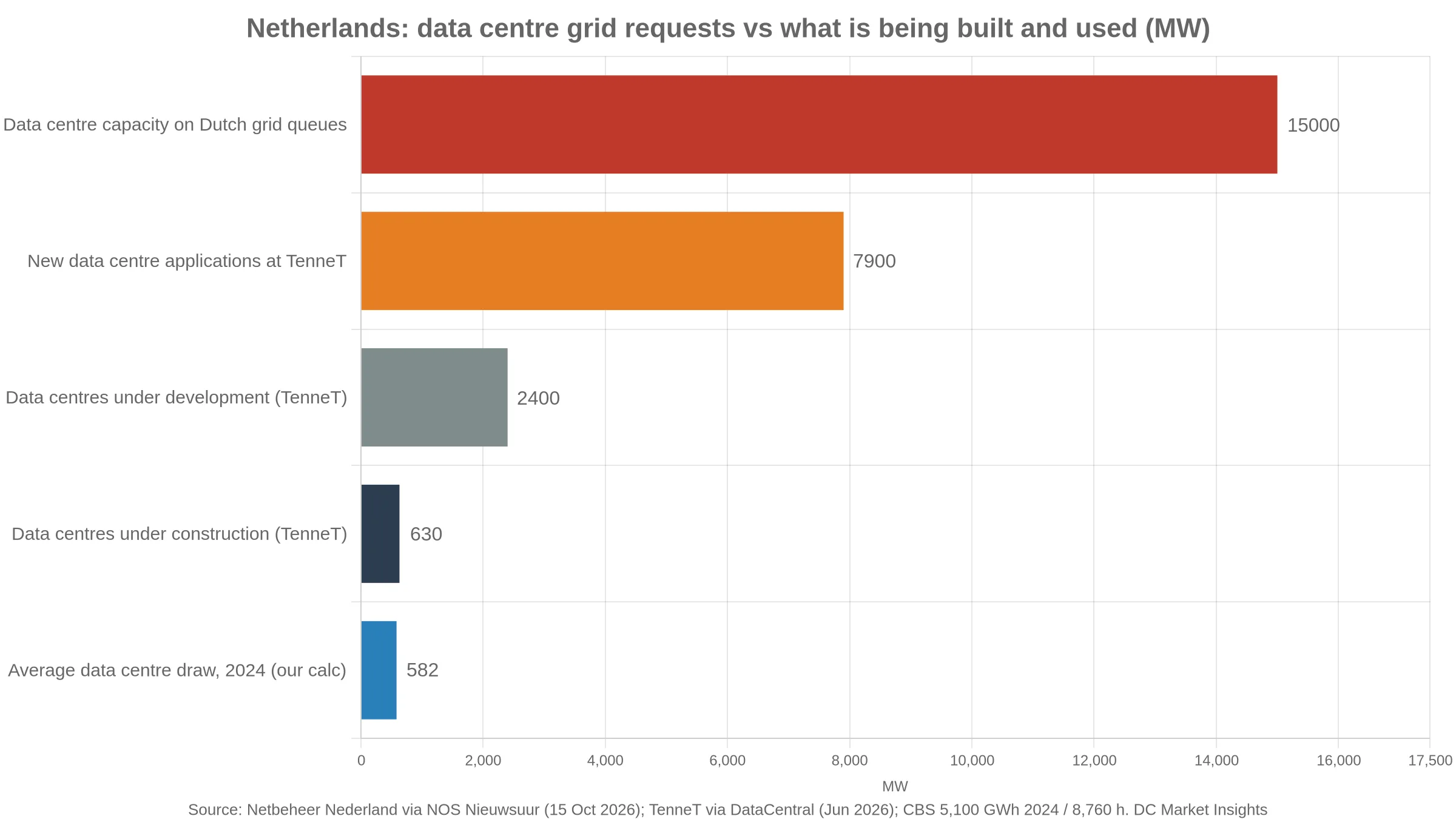
- Data centres account for almost a third of the capacity requested on Dutch grid connection waiting lists, about 15 GW, grid operators told NOS Nieuwsuur on 15 October 2026.
- That is about 26 times the average power Dutch data centres drew in 2024: CBS counted 5,100 GWh, or roughly 582 MW around the clock (our calculation).
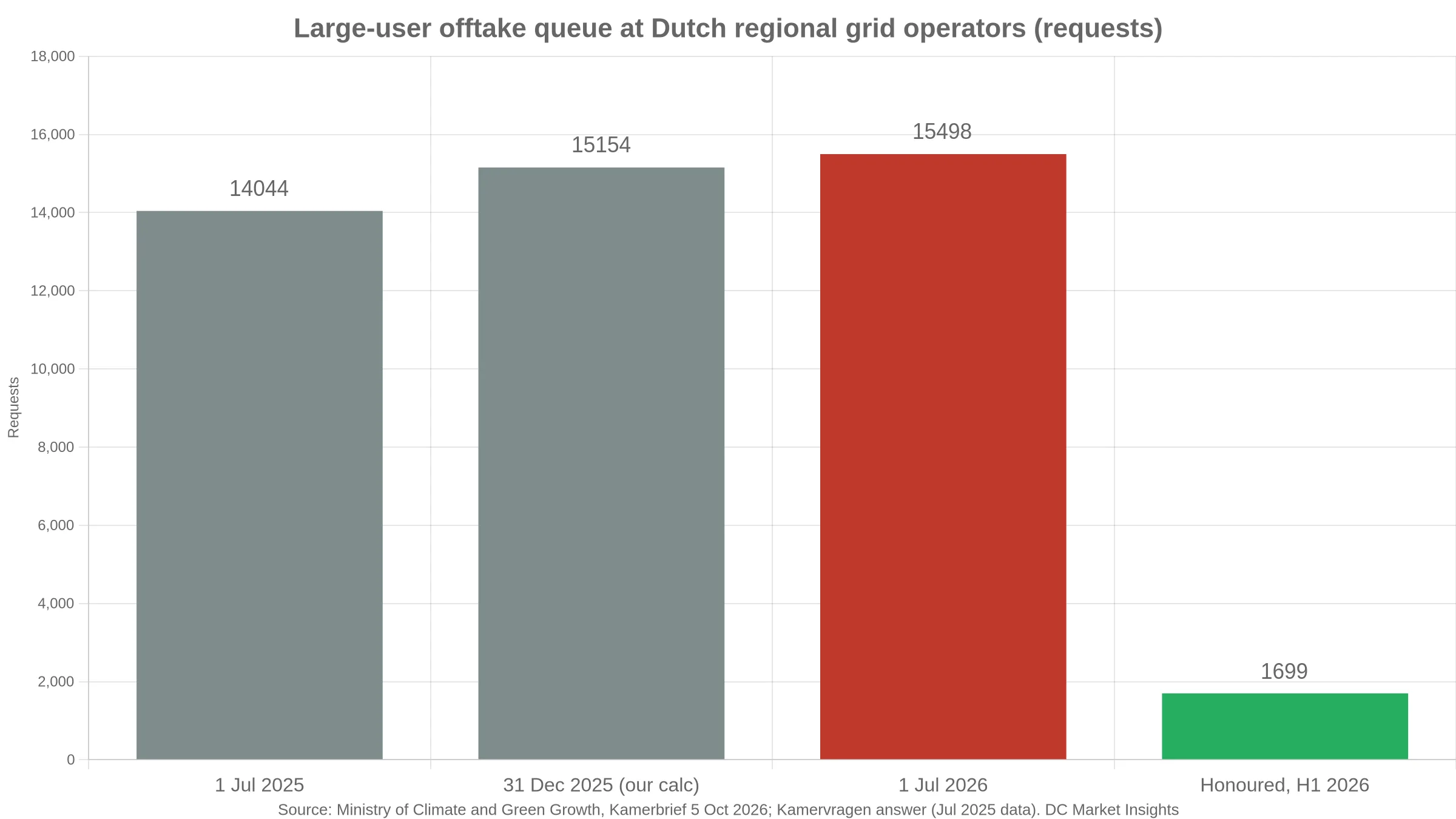
- The large-user queue at regional grid operators reached 15,498 requests on 1 July 2026, up 344 in six months; 1,699 requests were honoured in the first half, the State Secretary for Climate and Green Growth told parliament on 5 October.
- A new applicant now waits about ten years for a connection, the Dutch Data Center Association said, and grid operators put grid expansion to 2040 at more than €200 billion (NOS).
- The cabinet has promised a national data centre letter, “Regie op datacenterontwikkeling”, this autumn; the EU consultation on minimum performance standards for data centres closes on 14 December (Binnenlands Bestuur, iBestuur).
The Netherlands built one of Europe’s largest data centre clusters on the strength of its grid. Now the grid is the reason new projects cannot be built. Dutch grid operators say data centres have asked for about 15 GW of connection capacity, close to a third of everything on the waiting lists, and a new applicant can expect to wait about ten years.
Why now: on 15 October the grid operators’ association Netbeheer Nederland used those figures to ask the cabinet to make “hard choices” about how many data centres the country should host, and where. Two state secretaries answered the same day that they are studying how to steer “more firmly” on scarce space and electricity. With a national data centre letter due this autumn, the pain for developers is no longer only the queue. It is that the rules of the queue are about to be rewritten.
How the Netherlands got here
The Netherlands has been rationing data centres for years. Amsterdam and Haarlemmermeer adopted restrictive siting policies in 2020, and a national rule in force since 1 January 2024 limits new hyperscale data centres to two designated areas, according to the DC Market Insights Netherlands power and policy tracker. When that national line was drawn in 2022, seven hyperscale applications were already in, NOS reported. Amsterdam’s council has said new data centre applications will only be eligible for a building permit again from 2035, because of grid congestion, ING Research noted in October 2025, as Accountant.nl reported.
Demand kept growing inside those limits. Data centre electricity use rose 37% between 2021 and 2024 to 5,100 GWh, 4.6% of national consumption, with the 45 largest sites taking about 90% of that, Statistics Netherlands (CBS) reported, as Binnenlands Bestuur reported in December 2025. The country counts nearly 200 large and 300 smaller data centres, and about 200 more are expected, NOS Nieuwsuur reported.
At the transmission level, TenneT listed 630 MW of data centre capacity under construction, 2.4 GW under development and 7.9 GW of new applications, DataCentral reported in June 2026. TenneT expects data centres to use about 15% of Dutch electricity by 2030, up from roughly 5% today, the same report said. The courts have backed TenneT’s right to say no: in spring 2026 a judge in summary proceedings ruled that TenneT did not have to resume connecting a Goodman data centre project in Noord-Holland, which had asked for 70 MVA, because no connection and transport agreement had been signed; Goodman went onto the waiting list, Solar Magazine reported.
What changed in October
Three things landed within three weeks. On 5 October, State Secretary Jo-Annes de Bat sent parliament the autumn progress report on grid congestion. It showed the large-user offtake queue at regional grid operators at 15,498 requests on 1 July 2026, a net rise of 344 in six months. Growth is flattening because operators are handing out more flexible capacity: 1,699 offtake requests were honoured in the first half of 2026, already more than in all of 2025, according to the letter. But the ministry also said it has no breakdown of the queue by sector or type of company, Solar Magazine reported.
Then the grid operators filled part of that gap themselves. On 15 October they told Nieuwsuur that almost a third of the capacity requested on the waiting lists comes from data centres, about 15 GW, roughly the connection capacity of 15 million households in a country of 8.5 million households.
We live in a time of scarcity: not everything can go everywhere.
The government’s reply came the same day, in a joint statement from Willemijn Aerdts, State Secretary for Economic Affairs, and De Bat, Bright reported.
We are currently examining how we can steer more firmly, in the short term, on the great scarcity of space and electricity.
On 21 October, Aerdts sent a separate letter on three Party for the Animals motions on data centre water use, energy transparency and binding EU standards. The cabinet backs more reporting, including on peak power and grid load, which it called a current problem area. It noted that 104 Dutch data centres reported installed IT capacity of at least 500 kW under the EU Energy Efficiency Directive, and that data centre cooling uses about 1 million cubic metres of drinking water a year, 0.088% of the total, Binnenlands Bestuur reported. The cabinet is waiting for a European Commission proposal on minimum performance standards, expected in the second quarter of 2027, and a national letter on steering data centre development is due this autumn, iBestuur reported.
Requested is not used: reading the 15 GW
The 15 GW figure is requested capacity, not consumption. In our view it overstates what will be built: applicants file for more than they will use, some projects will never be financed, and the same campus can sit in more than one queue.
Even so, the gap is large. Our calculation: Dutch data centres drew 5,100 GWh in 2024, an average of about 582 MW. The 15 GW on the waiting lists is about 26 times that average draw, and about 24 times the 630 MW TenneT listed as under construction. If data centres are “almost a third” of requested capacity, the total requested on Dutch waiting lists is roughly 45 GW or more.
| Measure | Figure | Basis and date |
|---|---|---|
| Data centre capacity on grid waiting lists | About 15 GW | Requested capacity, all operators (Netbeheer Nederland via NOS, 15 Oct 2026) |
| New data centre applications at TenneT | 7.9 GW | Transmission level (TenneT via DataCentral, Jun 2026) |
| Data centres under development (TenneT) | 2.4 GW | Transmission level (TenneT via DataCentral, Jun 2026) |
| Data centres under construction (TenneT) | 630 MW | Transmission level (TenneT via DataCentral, Jun 2026) |
| Data centre electricity use, 2024 | 5,100 GWh (4.6% of national use) | CBS, via Binnenlands Bestuur |
| Average data centre draw, 2024 | About 582 MW | Our calculation: 5,100 GWh / 8,760 hours |
| Requested capacity as multiple of average draw | About 26 times | Our calculation |
Sources: NOS Nieuwsuur, 15 Oct 2026; DataCentral, 17 Jun 2026; Binnenlands Bestuur, 15 Dec 2025. The 15 GW covers requests to all grid operators and is not comparable with the regional large-user offtake queue below, which counted about 9.1 GW in July 2025 across all sectors. Requested capacity is a ceiling on connection rights, not a forecast of demand; do not add these figures together.
Who is hurting, and how much
New data centre projects. A request filed today, with a wait of about ten years, points to a connection around 2036, the year after Amsterdam says it will consider new data centre permits again (our calculation). ING Research warned that grid congestion could push AI start-ups to choose foreign locations.
Anyone who applies for a connection now waits about ten years.
Everyone else in the queue. Since 1 July 2026, the Authority for Consumers and Markets (ACM) prioritisation framework runs one integrated queue for small and large users and lets operators put defined social functions first. The 5 October letter warned that letting small users join the queue in congested areas will make the total number of open requests rise sharply in the second half of 2026. Our calculation: at the first-half pace of 1,699 honoured requests per six months, clearing the 15,498 already waiting would take about 4.6 years even if no one else applied.
Households and taxpayers. Grid operators put grid expansion to 2040 at more than €200 billion, NOS reported. Spread across 8.5 million households, that is about €23,500 each (our calculation, a measure of scale, not a bill). Every gigawatt reserved for a data centre that is never built is capacity that grid operators plan around, and that is why they want the cabinet, not first-come-first-served, to decide who gets it.
Operators already running. Existing sites face rising network tariffs, which the 5 October letter acknowledged, and more reporting. Industrial power cost USD 148 per MWh in the Netherlands in 2025, 11th of 28 EU markets, according to DC Market Insights data. At that price, the sector’s 5,100 GWh in 2024 would cost about USD 755 million a year (our calculation, before network charges).
| Who | Pressure | Size |
|---|---|---|
| New data centre applicants | Wait for a grid connection | About 10 years; request today points to about 2036 (our calculation) |
| Amsterdam projects | No new permits considered | Until 2035 (Amsterdam council, via ING Research) |
| All large users on regional queues | Time to clear today’s queue at H1 2026 pace | About 4.6 years (our calculation) |
| Households | Grid expansion bill to 2040 | Over €200 billion, about €23,500 per household (our calculation) |
| Existing operators | Power cost at 2025 industrial price | About USD 755 million a year for 5,100 GWh (our calculation) |
Our calculations from NOS Nieuwsuur (15 Oct 2026), the 5 October 2026 letter to parliament, CBS via Binnenlands Bestuur and the DC Market Insights Netherlands tracker (Eurostat-based industrial price, converted at 1.13 USD/EUR). The 4.6-year figure assumes the first-half 2026 pace continues and no new requests join; in practice the queue is still growing.
The wider pattern in Europe
The Netherlands is the clearest case of a pattern across northern Europe: grid operators asking governments to rank users, because a first-come queue no longer works. In Britain and Germany, data centre requests run far ahead of peak demand and reserved capacity, as we reported on 19 October. Ireland replaced its de facto Dublin freeze with conditions: new data centres must bring dispatchable generation or storage matching their import capacity, as our Ireland policy page tracks. EirGrid said on 20 October that it can ask data centres to stop using grid power if demand may exceed supply, but has not had to, RTÉ reported. Denmark paused new large-load connection agreements while it built a priority model, as our Denmark policy page records.
The Dutch difference is that the country has already capped hyperscale sites and is still congested. That suggests the next step is not another ban but an allocation rule: who gets the next gigawatt, on what terms, and how much flexibility they must offer in return.
What it means for operators, investors and vendors
Our view, based on the figures above:
- Value Dutch projects by signed connection agreements, not by requests. With 15 GW requested and 630 MW under construction at TenneT, a megawatt with a signed agreement is worth far more than one in the queue; the Goodman ruling shows a request alone gives no rights.
- Plan for a connection around 2036 for a request filed today. A ten-year wait means new Dutch capacity should be modelled as a 2030s option, not a 2028 delivery.
- Offer flexibility to move up. Operators honoured 1,699 requests in the first half of 2026, helped by flexible and off-peak contracts. Sites that can curtail at peak or run on batteries and backup power will get capacity first; the government is studying the use of backup power for congestion relief, with results due in spring 2027.
- Expect reporting on peak power. The cabinet wants data on peak demand and grid load for all 104 sites above 500 kW. Operators should be ready to publish contracted and actual peak MW.
- Vendors: sell what frees capacity. Batteries, onsite generation and load control can turn a ten-year wait into a conditional connection. The Flex-e subsidy will add a strand for large electricity users from 2027, with €35 million available.
- Investors: price the policy letter as a binary event. A national allocation rule this autumn could favour existing hyperscale zones or push growth outside the Randstad. Hold Dutch expansion plans open until it is published.
For market sizing on the capacity at stake, see our Netherlands AI Data Center Market report, which values the market at USD 188.01 million in 2025, rising to USD 953.43 million by 2035. For the cooling and water side of the new rules, see the Netherlands Data Center Thermal Management Market report, and for IT spend in Dutch facilities, the Netherlands Data Center Storage Market report. Our Netherlands power and policy page lists 12 tracked actions, four of them restrictions in force, and the Netherlands data center capacity page tracks facilities by status.
What to watch next
- Autumn 2026: the cabinet’s letter to parliament on steering data centre development (“Regie op datacenterontwikkeling”), linking AI computing demand to grid limits, space and the hyperscale rule (iBestuur).
- Second half of 2026: the total queue is expected to rise sharply as small users in congested areas join it under the ACM framework (letter of 5 October).
- 14 December 2026: the EU consultation on minimum performance standards for data centres closes (Binnenlands Bestuur).
- 2027: the Flex-e subsidy continues with a new strand for large electricity users, €35 million from 2027 (letter of 5 October).
- Spring 2027: results of the study on using (new) backup power for congestion relief (letter of 5 October).
- Second quarter of 2027: the European Commission’s legislative proposal on data centre standards is expected (Binnenlands Bestuur).
Frequently asked questions
How much grid capacity do Dutch data centres want?
About 15 GW, almost a third of the capacity on Dutch grid connection waiting lists, grid operators told NOS Nieuwsuur on 15 October 2026. That is requested capacity, not use: Dutch data centres drew about 582 MW on average in 2024 (our calculation from CBS data).
How long is the wait for a grid connection in the Netherlands?
About ten years for a new request, according to the Dutch Data Center Association. The large-user offtake queue at regional grid operators held 15,498 requests on 1 July 2026, and 1,699 were honoured in the first half of 2026.
Can new data centres be built in Amsterdam?
Amsterdam’s council has said new data centre applications will only be eligible for a building permit again from 2035, because of grid congestion. Nationally, new hyperscale data centres have been limited to two designated areas since 1 January 2024.
What is the Dutch government planning for data centres?
A national letter on steering data centre development is due this autumn. The cabinet also backs binding EU minimum standards; the EU consultation closes on 14 December 2026 and a Commission proposal is expected in the second quarter of 2027.
Sources
- NOS Nieuwsuur, “Een derde aangevraagde stroom komt van datacenters, genoeg voor 15 miljoen huishoudens”, 15 Oct 2026. Link
- Bright, “Netbeheer Nederland: Kabinet moet harde keuzes maken over hoeveelheid datacenters”, 16 Oct 2026. Link
- Ministry of Climate and Green Growth, letter to parliament “Voortgang aanpak netcongestie”, 5 Oct 2026 (via VEMW). Link
- Binnenlands Bestuur, “Kabinet wil strengere Europese regels voor datacenters”, 21 Oct 2026. Link
- iBestuur, “Kabinet werkt aan nationale geïntegreerde aanpak van datacenters”, 1 Sep 2026. Link
- Solar Magazine, “Bijna 15.500 transportverzoeken wachten op stroom: kabinet mist overzicht naar sector en bedrijfstype”, 6 Oct 2026. Link
- Answers to parliamentary questions on grid queues, Feb 2026 (via 1848). Link
- Binnenlands Bestuur, “Stroomgebruik datacenters stuwt netcongestie op”, 15 Dec 2025. Link
- DataCentral, “Dutch grid limits put data centre demand on notice”, 17 Jun 2026. Link
- Solar Magazine, “TenneT wint rechtszaak over weigering aansluiting datacenter”, 1 May 2026. Link
- Accountant.nl, “ING: Zorg over beperkte groei datacenters in Nederland”, 8 Oct 2025. Link
- RTÉ, “Eirgrid forecasts reduced risk of winter power outages”, 20 Oct 2026. Link
- DC Market Insights, Netherlands, Ireland and Denmark power and policy pages, Oct 2026. Link
- DC Market Insights, Netherlands AI Data Center Market report. Link