

Key takeaways
- EuroHPC told every bidder for the EU’s AI Gigafactories tender to recreate and resubmit their bids after a submission-system fault, and moved the medium-site deadline (Lot 1) to 4 February 2027. Large-site bids (Lot 2) still close on 3 December 2026 at 17:00 Luxembourg time (EuroHPC call page, updated 5 November).
- A large site must reach at least 150 MW of IT load and 100,000 H100-equivalent accelerators in Phase 2; a medium site 120 MW and 75,000 (tender specifications via Sullivan & Cromwell). That is about 667 and 625 accelerators per MW, or roughly 1.5-1.6 kW per H100-equivalent all-in (our calculation).
- Using the only fully priced private European AI campus, VOLT Rotterdam (€2.5 billion facility and grid plus €4.5 billion compute for 200 MW, Tech Times), a gigafactory costs about €35 million per MW: €4.2 billion for a medium site and €5.25 billion for a large one (our calculation).
- Because EU money is capped at 17% of computing capex, a 150 MW large site on that cost structure can draw at most about €574 million, not the €1 billion ceiling, or about 11% of total build cost (our calculation).
- Nscale said on 18 November it had brought up its first NVIDIA Vera Rubin NVL72 racks (72 GPUs each, factory-built and liquid-cooled), which Dell called an industry first (Nscale); Nscale is also part of the five-company AI Gigafactory Northern bid announced on 16 November (The Next Web).
Europe’s biggest public AI compute tender now has a price tag that bidders can test. One week before large-site bids close, the numbers say a 150 MW EU AI gigafactory costs about €5 billion to build, and that the EU’s own contribution is likely to cover about a tenth of it, well below the €1 billion headline ceiling.
Why now: on 5 November EuroHPC voided every draft and submitted tender because of a technical fault in the submission system and opened new links for both lots. Medium-site bidders got two more months; large-site bidders did not. In the same fortnight the first Vera Rubin racks were switched on in Europe and a Nordic-Baltic consortium went public with its bid. The 3 December deadline is now the first hard test of who can finance €35 million per MW.
What changed in November: resubmission and a split deadline
The EuroHPC Joint Undertaking runs tender EUROHPC-2026-CEI-AIGF-01, opened on 30 July for up to seven AI Gigafactories in at least seven member states. On 5 November it updated the call page: “for technical reasons” all submissions in the system, drafts and completed bids alike, “will not be considered”, and tenders must be recreated under new submission links. The content of the call documents did not change.
The deadlines did. Lot 1, the medium sites, now closes on 4 February 2027 at 17:00; Lot 2, the large sites, stays at 3 December 2026 at 17:00. HPCwire’s reprint of the EuroHPC notice (6 November) said the Lot 1 extension gives member states time for “national budgetary procedures” and to submit their financial commitments. That matters because every bid needs a co-funding letter from its host state, which must at least match the EU money.
On dates: when we wrote about the tender on 18 October, the Commission and the tender specifications gave 12 November while the call page showed 3 December. The call page, updated 5 November, now gives 3 December for Lot 2 and 4 February 2027 for Lot 1, and we use those. Bidders should confirm on the EU Funding & Tenders Portal.
What the tender asks a site to hold
The compute and power floors come from the tender specifications, as summarised by Sullivan & Cromwell on 8 October. Compute is measured in H100-equivalent accelerators and power in MW of IT load. The call page adds a qualitative test: each facility must integrate “at least three to four times” the most advanced AI processors in Europe’s most powerful AI Factories, with “adequate power capacity infrastructure”.
| Requirement | Lot 1: medium (up to 4 sites) | Lot 2: large (up to 3 sites) |
|---|---|---|
| Bid deadline (17:00 Luxembourg) | 4 February 2027 | 3 December 2026 |
| Phase 1 compute / power | 25,000 H100-eq / 15-30 MW | 40,000 H100-eq / 20-50 MW |
| Phase 2 compute / minimum IT load | 75,000 H100-eq / 120 MW | 100,000 H100-eq / 150 MW |
| Accelerators per MW, Phase 2 (our calculation) | 625 | 667 |
| IT power per H100-equivalent, all-in (our calculation) | 1.6 kW | 1.5 kW |
| EU funding ceiling, Phase 1 / Phase 2 | €100m / €400m | €200m / €800m |
| EU ceiling per site, both phases | €500m | €1bn |
Sources: EuroHPC call page (deadlines, updated 5 Nov 2026); Sullivan & Cromwell, 8 Oct 2026 (compute, power and funding from the 30 July specifications); European Commission via EURAXESS. The EU share is also capped at 17% of each site’s computing-infrastructure capex. Per-MW ratios are our arithmetic; the IT-load floor covers servers, networking and storage, not only accelerators.
The ratio is the engineering story. About 1.5 kW of IT load per H100-equivalent is a liquid-cooling budget, not an air-cooled one: it leaves room for CPUs, networking and storage around each accelerator, but not for low-density halls. Newer accelerators each count as several H100-equivalents, so a bidder using next-generation racks can meet the 100,000 floor with fewer physical GPUs; the tender sets the compute floor and the power floor separately, and both must be met.
The hardware is arriving: Europe’s first Vera Rubin racks
On 18 November Nscale said it had brought up its first NVIDIA Vera Rubin NVL72 systems, each rack holding 72 Rubin GPUs and 36 Vera CPUs, built on Dell PowerEdge XE9812 servers delivered as a factory-integrated rack “complete with switches, power, and liquid cooling”, the release says. It did not name the site, the number of racks or their power draw. Nscale had said in March that it would bring Vera Rubin to Europe in 2027 across sites in the UK, Norway and elsewhere, headlining 100,000+ GPUs.
Nscale’s deployment marks an industry first for a factory built, fully integrated, liquid-cooled networking rack.
For cost, the point is where the money sits. A factory-built liquid-cooled rack moves cost from the building into the IT line: the coolant distribution, manifolds and power shelves arrive with the rack. That pushes up the compute share of capex, which is exactly the share the EU’s 17% cap is measured against.
We have brought up our first NVIDIA Vera Rubin NVL72 racks, and over the coming months we expect to continue a global rollout
The economics: about €35 million per MW, and who pays it
Almost no European AI campus publishes a full cost split. The exception is VOLT’s privately financed Rotterdam project, where Nebius signed in October as anchor tenant for up to 200 MW: about €2.5 billion for civil works and grid and €4.5 billion for chips and compute equipment, €7 billion in total, Tech Times reported. That is €12.5 million per MW for the facility and €22.5 million per MW for compute, €35 million per MW all-in (our calculation).
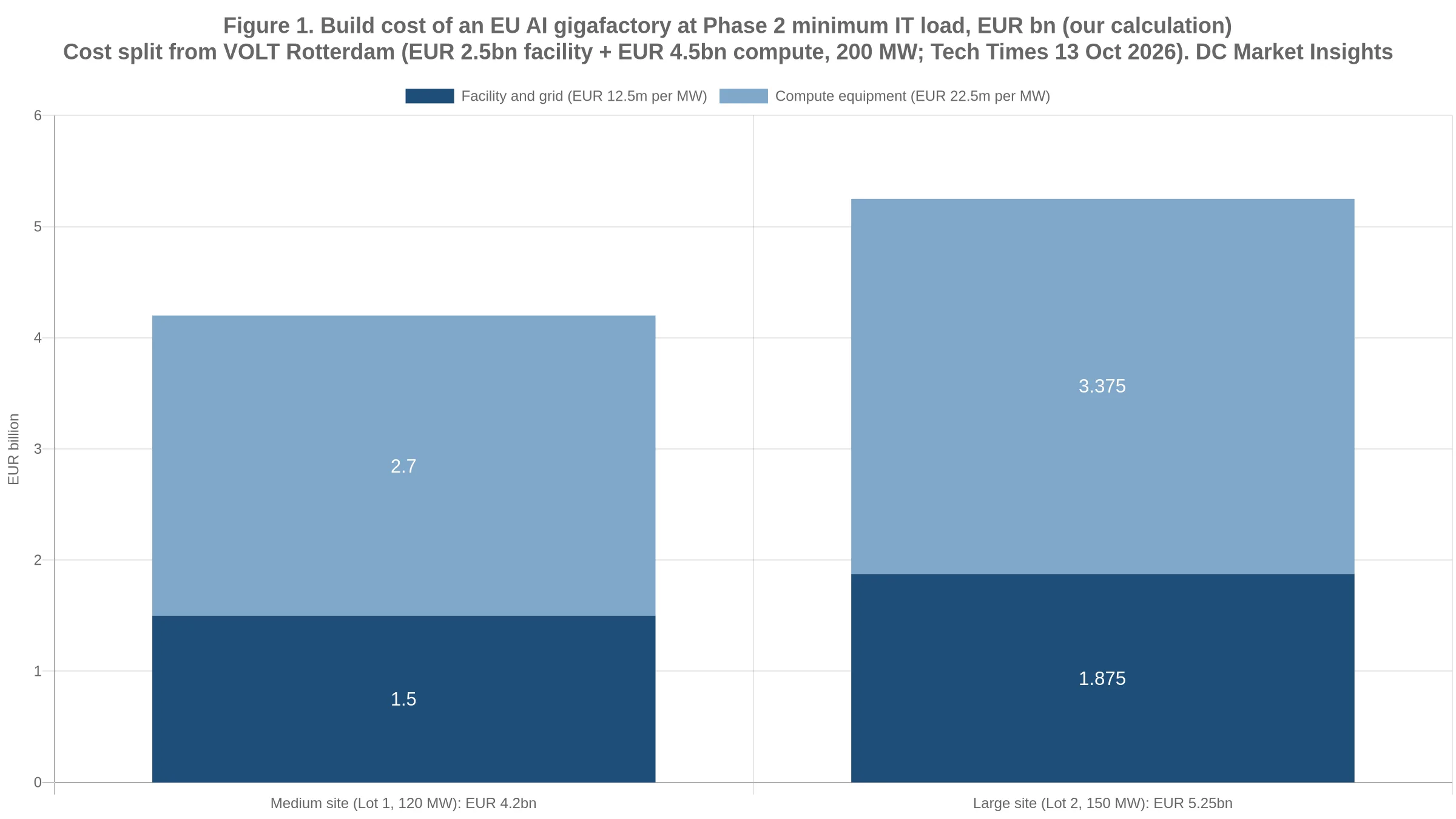
Applied to the tender floors, a medium site at 120 MW costs about €4.2 billion and a large site at 150 MW about €5.25 billion. That sits inside the €4-5 billion per site Sullivan & Cromwell’s summary of the specifications mentions, at its upper end for a large site. Our own Sovereign AI Infrastructure Market model, at US$44.6 million per MW all-in for 2025, points to about US$6.7 billion for 150 MW, a higher figure because it prices a full accelerator refresh into the build.
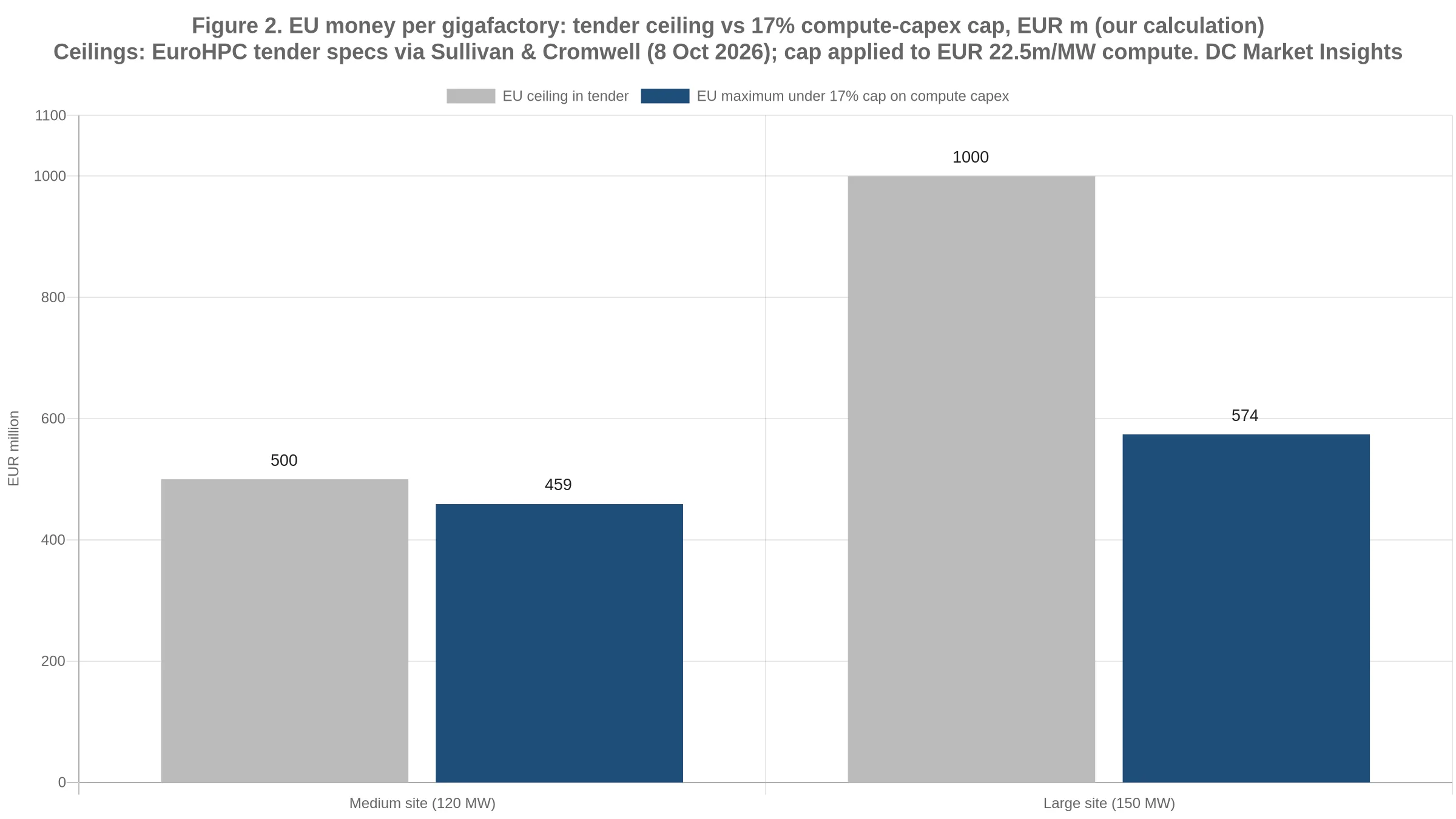
Now apply the EU rule. The EU pays the lower of its ceiling and 17% of computing-infrastructure capex. With compute at €22.5 million per MW, a 150 MW large site has €3.375 billion of computing capex, so the cap allows about €574 million, 57% of the €1 billion ceiling. A 120 MW medium site has €2.7 billion of computing capex and can draw about €459 million against a €500 million ceiling (our calculation).
| Item (our calculation) | Medium site, 120 MW | Large site, 150 MW |
|---|---|---|
| Facility and grid at €12.5m/MW | €1.50bn | €1.875bn |
| Compute equipment at €22.5m/MW | €2.70bn | €3.375bn |
| Total build cost | €4.20bn | €5.25bn |
| EU maximum (lower of ceiling and 17% of compute) | €459m | €574m |
| EU share of total build cost | 10.9% | 10.9% |
| EU plus a matching host state, share of total | about 22% | about 22% |
| Private capital needed if public money is matched | about €3.3bn | about €4.1bn |
| Compute capex needed to unlock the full EU ceiling | €2.94bn (≈131 MW at €22.5m/MW) | €5.88bn (≈261 MW at €22.5m/MW) |
Method: per-MW costs from VOLT Rotterdam (€2.5bn + €4.5bn for 200 MW, Tech Times), applied to the tender’s Phase 2 IT-load floors. One private project is a narrow base: chip prices, rack density and land costs differ by site, and VOLT’s figures are reported, not audited. Host-state matching assumes the minimum match (equal to the EU amount). Full-ceiling thresholds are ceiling ÷ 0.17.
The practical reading is that a large site can only collect the full €1 billion if its computing capex reaches about €5.9 billion. At VOLT’s density that means about 261 MW, well above the 150 MW floor, or much more expensive accelerators per MW. For most bids the binding number will be the 17% cap, not the €1 billion headline.
Who is bidding, and what has changed
The newest public team is AI Gigafactory Northern, announced on 16 November by Nokia, Nscale, Skeleton, Telia and Verda, with VTT and KTH as research partners, The Next Web reported. It proposes one federated gigafactory across Oulu (Finland), Iru (Estonia), Valmiera (Latvia) and a Swedish site not yet chosen. Nokia supplies the network linking the sites, Nscale and Verda the AI platforms, Telia connectivity and operations, and Skeleton power systems, DCD reported. Neither report gave MW, accelerator counts or which lot the team will enter.
Europe’s AI ambitions depend on infrastructure it can trust, control and scale.
A federated design is also a cost choice. Splitting 120-150 MW across four Baltic Sea sites spreads grid risk, but each site carries its own substation, cooling plant and security, which raises the facility share above a single campus. For scale, a whole 150 MW large site would roughly equal the 151.6 MW of live capacity in DC Market Insights’ Finland tracker as of 20 October (DC Market Insights data).
| Public bid or project | Country | Lead partners | Size or money stated | Latest status |
|---|---|---|---|---|
| AI Gigafactory Northern | Finland, Estonia, Latvia, Sweden | Nokia, Nscale, Skeleton, Telia, Verda | Not disclosed | Announced 16 Nov 2026; lot not stated |
| AION | France | Ardian, Bull, Capgemini, EDF, iliad, Orange, Scaleway and others | About US$10bn for one site (reported) | Candidate since May 2026 |
| Italian NewCo | Italy | Eni, Enel, Terna, CDP and others | €1.2bn initial, >€5bn over time (reported) | Being defined (Oct 2026) |
| ÆTHER | France (Strasbourg) | 2CRSi, SiPearl, Axelera AI, OUTSCALE | 42 MW initial, >400 MW long-term | Candidate (Jul 2026) |
| VOLT Rotterdam (outside the tender) | Netherlands | VOLT, Nebius | €7bn; up to 200 MW for Nebius | Private; lease signed Oct 2026 |
Sources: The Next Web; DCD; earlier bids as compiled in our 18 October analysis; Tech Times. EuroHPC does not publish bid lists.
The wider pattern: efficiency rules and power set the running cost
Capex is only half of the test. The same sites will be graded under the EU’s data centre rating scheme, adopted by the Commission as delegated regulation C(2026) 3472 on 21 September and sent to the Council the same day (Council document 13444/26). The regulation says EU data centres used 68 TWh of electricity in 2024 and are projected to use 114 TWh by 2030, 3.2% of EU demand, and that cutting PUE from 1.6 to 1.2 would cut their electricity use by 25%. Labels are generated from 15 August 2027.
On the A-to-G label, a PUE of 1.15 or below or a WUE of 0.1 or below earns an A, and PUE above 1.9 with WUE above 1.0 earns a G, Euronews reported on 24 November. Liquid-cooled AI halls with dry coolers are the easiest way to reach the top grades, which links the tender’s density floor to the rating scheme.
The water debate is real. Europe is suffering serious water scarcity.
The gigafactories also land in a market growing fast without them. EUDCA figures cited by Euronews put Germany at 2,167 MW of IT power in 2026, rising to 4,228 MW by 2031, and Southern Europe at 682 MW in 2024, rising to nearly 5.9 GW by 2031. Seven sites at their Phase 2 floors add at least 930 MW (4 × 120 MW + 3 × 150 MW, our calculation), about 43% of Germany’s 2026 figure. At €35 million per MW that is about €32.6 billion of build, close to the €30 billion-plus the Commission says the programme should mobilise (our calculation).
What it means for operators, investors and vendors
Our view, based on the figures above:
- Model the 17% cap, not the ceiling. At €22.5 million of compute per MW, a 150 MW large site draws about €574 million from the EU, not €1 billion. Underwrite the bid on that figure.
- Plan for about €4 billion of private capital per large site. With EU and host-state money matched, public funds cover about 22% of a €5.25 billion build. The five-year EU compute purchase is what makes the remaining €4.1 billion bankable.
- Design for about 1.5 kW per H100-equivalent. The 150 MW / 100,000 floor implies liquid cooling across the hall. Facility designs that cannot hold Vera Rubin-class racks will fail the density test before the cost test.
- Vendors: the cap rewards integrated racks. Cooling and power content that ships inside the rack counts as computing capex, which raises the base for the 17% subsidy. Expect bidders to push more of the €12.5 million per MW facility cost into rack-level equipment.
- Large-site bidders have seven days. Lot 2 closes on 3 December under the new submission links; Lot 1 teams have until 4 February 2027 and should use the time to secure host-state co-funding letters.
- Price in the label. Labels apply from 15 August 2027, before most gigafactories run. A PUE at or below 1.15 earns an A; every 0.1 of PUE on 150 MW running flat out is about 131 GWh a year of extra power (our calculation).
For the size of state-backed compute, see our Sovereign AI Infrastructure Market report; for AI capacity and spending by all buyers, the AI Data Center Market report; and for the whole industry, the Data Center Market report. Country capacity figures are on our global data center capacity pages. Earlier context: our analyses of the tender’s design and of European build costs per watt.
What to watch next
- 3 December 2026, 17:00 Luxembourg time: Lot 2 (large-site) bids close under the new submission links (EuroHPC).
- 14 December 2026: the Commission’s consultation on minimum performance standards for data centres closes.
- 4 February 2027, 17:00 Luxembourg time: Lot 1 (medium-site) bids close, after host states complete budget procedures (EuroHPC).
- 2027: evaluation and awards by the EuroHPC Governing Board; Phase 1 capacity must be ready within 18 months of signing.
- 15 August 2027: first EU data centre labels generated under delegated regulation C(2026) 3472.
Frequently asked questions
When is the deadline for the EU AI Gigafactories tender?
Large-site (Lot 2) bids close on 3 December 2026 and medium-site (Lot 1) bids on 4 February 2027, both at 17:00 Luxembourg time, according to the EuroHPC call page updated on 5 November. All earlier submissions must be recreated and resubmitted.
How much does an EU AI gigafactory cost to build?
About €35 million per MW on the VOLT Rotterdam cost split, by our calculation: roughly €4.2 billion for a 120 MW medium site and €5.25 billion for a 150 MW large site, including about €22.5 million per MW of compute equipment.
How much will the EU pay for a large AI gigafactory?
Up to €1 billion, but never more than 17% of computing capex. At €22.5 million of compute per MW, a 150 MW site qualifies for about €574 million, roughly 11% of its €5.25 billion build cost, by our calculation.
How much power and compute does an AI gigafactory need?
A large site needs at least 150 MW of IT load and 100,000 H100-equivalent accelerators in Phase 2; a medium site 120 MW and 75,000, per the tender specifications. That is about 1.5-1.6 kW of IT load per H100-equivalent.
Sources
- EuroHPC Joint Undertaking, “Call for tenders for the selection of Artificial Intelligence Gigafactory Consortia and the establishment of AI Gigafactories” (EUROHPC-2026-CEI-AIGF-01), updated 5 Nov 2026. Link
- HPCwire, “EuroHPC Requires Bidders to Resubmit AI Gigafactory Proposals”, 6 Nov 2026. Link
- Sullivan & Cromwell, “EuroHPC Joint Undertaking Launches AI Gigafactories Call”, 8 Oct 2026. Link
- European Commission via EURAXESS, “EU launches AI Gigafactories call to boost Europe’s computing capacity and unlock more than €30 billion in investment”, 4 Aug 2026. Link
- Nscale, “Nscale brings up its first NVIDIA Vera Rubin NVL72 AI supercomputers”, 18 Nov 2026. Link
- Nscale, “Nscale to Deploy NVIDIA Vera Rubin Platform in 2027, Bringing 100,000+ GPUs to Europe”, 16 Mar 2026. Link
- The Next Web, “Nokia, Telia, Verda, Nscale and Skeleton team up for EU AI gigafactory bid”, 16 Nov 2026. Link
- DCD, “Nokia, Nscale, Skeleton, Telia and Verda form gigafactory consortium”, Nov 2026. Link
- Tech Times, “Nebius Signs as First Customer for VOLT’s €7 Billion Rotterdam AI Gigafactory”, 13 Oct 2026. Link
- Council of the European Union, document 13444/26 transmitting Commission Delegated Regulation C(2026) 3472 on a common Union rating scheme for data centres, 21 Sep 2026. Link
- Euronews, “What is the EU doing to regulate data centre expansion?”, 24 Nov 2026. Link
- DC Market Insights, “Sovereign AI Infrastructure Market” report and Finland capacity tracker (20 Oct 2026). Link