

Key takeaways
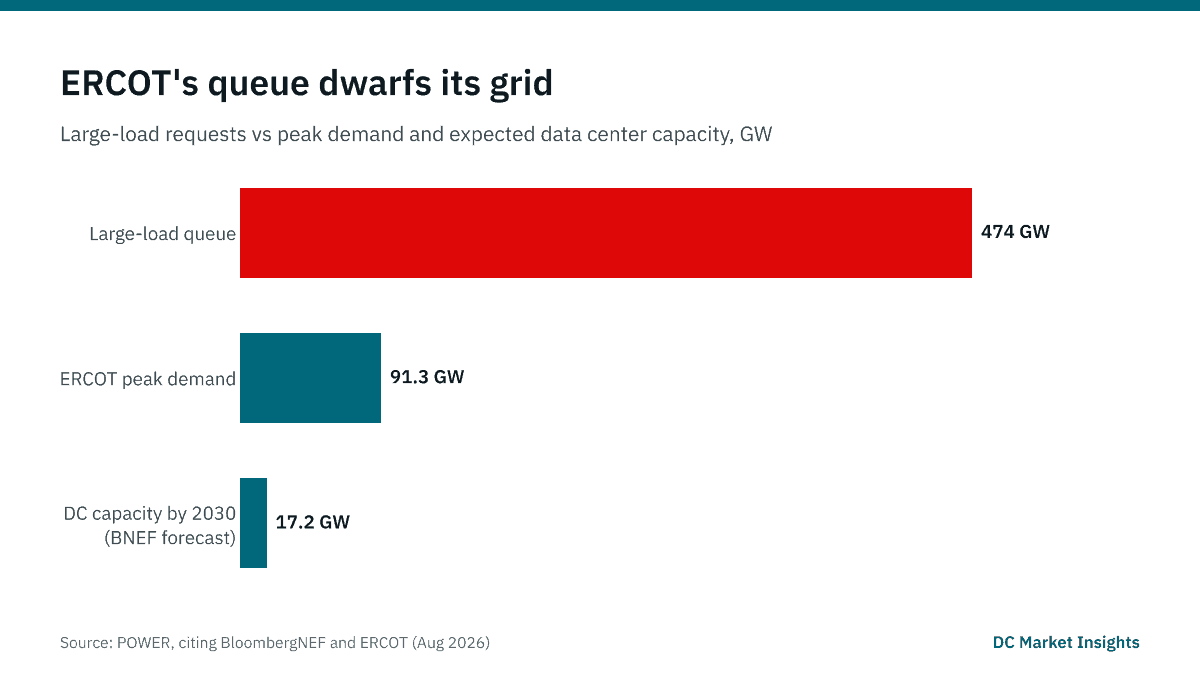
- ERCOT’s large-load queue stands at about 474 GW, and about 90% of it is data centers. BloombergNEF puts ERCOT’s peak demand at 91.3 GW.
- Governor Greg Abbott’s 3 August audit order could delay 49.8 GW of data center demand, nearly 20% of the US pipeline, BloombergNEF estimated.
- On 21 September the pause widened: Abbott told the state environmental regulator (TCEQ) to halt permits sought by data centers until ERCOT finishes its audit.
- Developers of data centers of 25 MW or more must answer ERCOT’s community impact RFI by 12 October. ERCOT plans to report by 10 December.
- BloombergNEF estimated the delay could cost projects just over $8 billion by Q1 2027 if 60% of the delayed capacity is AI-related, and roughly $15 billion at 100%.
Texas had been expected to overtake Virginia as the largest US data center market. That path is now on hold. Since 3 August, every data center seeking a connection to the ERCOT grid has been waiting on a state audit. Since 21 September, many are also waiting on environmental permits. By Monday, 12 October, developers of every data center of 25 MW or more that is seeking an ERCOT connection must hand the grid operator a file on their water use, cooling technology, tax breaks and owners.
This is the pain point of the quarter for the US build-out. The problem is not steel or chips. The queue itself has lost credibility.
How Texas got here: a queue five times the size of the grid
ERCOT said in June that it was tracking more than 438 GW of large-load requests, nearly 90% of them from data centers, Utility Dive reported. By August the figure was about 474 GW. BloombergNEF put ERCOT’s peak demand at 91.3 GW, which makes the queue about five times the size of peak demand, POWER magazine reported.
Few expect that load to arrive. BloombergNEF forecasts 1.2 GW of ERCOT data center capacity additions between Q2 2026 and Q1 2027, and a further 8.25 GW through 2030, for a total of 17.2 GW. Its own tracked Texas pipeline is 50 GW: 36 GW early stage, 9 GW committed and 5 GW under construction. ERCOT officials estimated that 65 GW is most likely to be built between now and 2032, E&E News reported.
| Measure | GW | Source |
|---|---|---|
| ERCOT large-load interconnection queue | 474 | ERCOT, via POWER and Utility Dive |
| ERCOT peak demand | 91.3 | BloombergNEF, via POWER |
| BloombergNEF tracked Texas data center pipeline | 50 | BloombergNEF, via POWER |
| Most likely to be built by 2032 (ERCOT officials’ estimate) | 65 | E&E News |
| ERCOT data center capacity by 2030 (forecast) | 17.2 | BloombergNEF, via POWER |
Sources: POWER, 6 Aug 2026; E&E News, 4 Aug 2026. Figures come from different sources and methods and should not be added together.
ERCOT’s answer was “Batch Zero”, approved in June. It looks at batches of projects of 75 MW or larger in a single study. ERCOT President and CEO Pablo Vegas described the moment this way when the process was approved.
Texas is experiencing an energy transformation unlike anything we have seen before.
Six weeks later, the governor stepped in. Abbott’s 3 August order told the Public Utility Commission of Texas (PUCT) and ERCOT to verify and audit every data center project in the queue before more projects advance. In his letter he said the queue was “more than five times Texas’ record peak electricity demand” and that “unprecedented load growth could endanger the reliability and stability of the Texas electric grid”, POWER reported.
Our top priority is to protect Texans’ safety and quality of life.
What Batch Zero now looks like
ERCOT kept sorting the queue during the pause. At its September board meeting, Jeff Billo, ERCOT’s Vice President of Interconnection and Grid Analysis, reported that conditional classifications went to transmission providers on 3 September. In all, 362 large loads were placed in the base or studied load categories. A further 373 projects, totalling 302.2 GW, were excluded.

| Batch Zero category | Projects | Capacity |
|---|---|---|
| Base load (conditionally included) | 204 | 66.4 GW |
| Studied load (conditionally included) | 158 | 127.9 GW |
| Excluded from Batch Zero | 373 | 302.2 GW |
Source: ERCOT, Item 14: Batch Zero Update, September 2026. The presentation’s takeaways give 127.9 GW for studied load; a chart in the same deck labels it 125.4 GW.
Getting a classification is not the same as getting a study date. ERCOT’s original rules required the Batch Zero study to be finished by 9 April 2027. Chad Seely, ERCOT’s Senior Vice President of Regulatory Policy, General Counsel and Chief Compliance Officer, said in August that this date would slip.
We will not have the study done by April 9, 2027.
September made it worse: permits, RFIs and a new rulebook
The pause has grown in three ways since late August, according to client alerts from Beatty & Wozniak, Beveridge & Diamond and White & Case.
- Verification RFIs. From 9 September, ERCOT began sending Batch Zero verification requests for information to most large-load entities with conditionally included projects. Responses were generally due within 10 business days.
- Community impact RFI. ERCOT’s RFI covers all developers of data centers of 25 MW or more seeking an ERCOT connection. It asks about public financial assistance and tax benefits, grid dependence and on-site generation, water sources and consumption, cooling technologies, noise, light and traffic, and ownership. Responses are due 12 October.
- Permit hold. On 21 September, Abbott directed TCEQ to “halt all permits sought by data centers”. Beveridge & Diamond says the hold reaches authorizations for power generation, water rights and wastewater, and that the directive makes no exception for projects outside ERCOT or those using on-site generation. TCEQ must report compliance by 19 October. No firm end date has been set.
In our view, the permit hold closes the most obvious workaround. If on-site generation also needs a TCEQ permit that is now on hold, bringing your own power does not get a project past the pause.
The new rulebook landed at the same time. On 18 September, the PUCT adopted 16 TAC §25.194, the large-load interconnection rule required by Senate Bill 6. It makes queue positions cost money.
| PUCT large-load rule (16 TAC §25.194) | Requirement |
|---|---|
| Who it covers | New loads of 75 MW or more at a single site, and qualifying expansions |
| Study fee | Flat $100,000 fee plus size-tiered study charges |
| Security under the intermediate agreement | $50,000 per MW of requested peak demand |
| Security under the interconnection agreement (SLLIA) | The greater of $50,000 per MW of contracted peak demand or the allocated transmission upgrade costs |
| Release of security | 20% returned at initial energization, the rest in 20% increments |
| Readiness | Site control and sufficient progress in acquiring necessary permits |
Source: White & Case, 25 Sep 2026.
Who is hurting, and how much
AI developers with near-term capacity. BloombergNEF modelled a three-month delay for capacity due between Q3 2026 and Q1 2027. It estimated the cost at just over $8 billion cumulatively by Q1 2027 if 60% of the delayed capacity is AI-related, and roughly $15 billion if all of it is. The gap comes from revenue per gigawatt. BloombergNEF estimates AI compute capacity could earn around $1.76 billion per GW per month, against up to $175 million per GW per month for a colocation shell for traditional cloud racks in Dallas, based on CBRE data cited by BloombergNEF.
Speculative queue holders. These are the intended targets. BloombergNEF called the queue “speculative” with little project transparency, and 72% of its tracked Texas pipeline is early stage. In our view, the $50,000-per-MW security and the audit together are likely to push out projects that have no land, no customer and no capital.
Land investors and site developers. Troutman Pepper Locke told clients that Texas had been expected to “overtake Virginia as the largest US data center market”, but that “the path to that outcome is now materially less certain”. It advised real estate investors with land under contract to review those agreements.
Utilities and the equipment chain. In early October, Oncor, CenterPoint Energy, AEP Texas, Siemens Energy and Lancium launched the Lone Star Infrastructure Coalition, Texas Scorecard reported. It is led by Jimmy Glotfelty, an energy executive and former public utility commissioner. Its statement said Texas “must accelerate new generation, transmission, pipelines, and energy delivery before capacity constraints limit future opportunity.”
We want to make sure the economic story gets told.
The trust deficit behind the freeze
The audit is partly about grid reliability. It is also about trust, and the industry’s own record here is weak. The Texas Tribune reported that only 28 of 377 companies responded to a PUCT survey. E&E News reported that 17 percent of data centers answered a mandatory water use survey. A poll cited by Texas Scorecard found a little over half of respondents supported a local ban on data centers.
The industry’s trade group has taken a conciliatory line.
Done correctly, this review can showcase the good actors in the data center industry rather than delaying them unnecessarily, ensuring Texas will continue to be the national leader in economic development.
Critics want more. “AI has real promise, but it shouldn’t come at the cost of our water, our air, and our neighborhoods,” said Luke Metzger, executive director of Environment Texas, in the same report. BloombergNEF’s analysts were blunter about the trend: “Community opposition is becoming a material constraint on data center development, even in markets that have actively courted the industry.”
Not just Texas
Texas is the largest example, but other states are also pulling back, according to POWER. New York’s Executive Order 62, signed on 14 July, set the first statewide moratorium on hyperscale data centers of 50 MW and above. On 5 June, Illinois Gov. JB Pritzker directed the state to pause processing of Data Center Investment Program agreements starting 1 July.
What it means for operators, investors and vendors
Our view, based on the timeline above:
- Treat 12 October as a filing deadline that decides your queue position. Complete, consistent answers on water, cooling, on-site power and ownership give regulators a reason to keep a project in line.
- Re-underwrite Texas timelines. ERCOT has said the 9 April 2027 study date will not hold. Lease start dates, GPU delivery schedules and construction loans tied to 2027 energization need buffer or exit clauses.
- Do not count on bringing your own power as a bypass. The TCEQ hold covers power generation permits and makes no exception for projects outside ERCOT or with on-site generation. On-site generation strategies need a permitting plan, not just a turbine slot.
- Budget for capital at risk in the queue. At $50,000 per MW, a 500 MW request means $25 million of security (our calculation from the PUCT figures reported by White & Case). That will thin the queue, which helps credible projects.
- Vendors: expect lumpy Texas orders. Transformer, switchgear and generator orders tied to Texas projects may slip into 2027.
- Investors: watch the gap between 474 GW and what can be delivered. BloombergNEF’s 17.2 GW forecast for 2030 is the more useful benchmark for valuing Texas land and power positions.
For market sizing on the build-out these rules affect, see our Data Center Construction Market report. For on-site and backup power, see the Data Center Generator Market report. For the demand side, see the AI Infrastructure Market report.
What to watch next
- 12 October 2026: responses due to ERCOT’s State and Community Impact RFI from data centers of 25 MW or more.
- 19 October 2026: TCEQ due to report on compliance with the permit directive.
- 10 December 2026: ERCOT’s target date to file its Batch Zero Eligibility Verification Report with the PUCT and publish audit conclusions.
- January 2027: the Texas Legislature convenes, where Abbott said he would work on data center concerns.
- Summer and fall 2027: Batch 1 applications were expected to open in summer 2027, with a Batch Zero transmission plan in the fall. Both dates were set before the audit and may move.
Sources
- POWER magazine, “Texas Audit Could Delay 49.8 GW of Data Center Load, Cost Projects Up to $15 Billion, BNEF Warns”, 6 Aug 2026. Link
- Utility Dive, “ERCOT aims to complete Texas governor’s data center audit by December”, 21 Aug 2026. Link
- Utility Dive, “Texas, facing 438 GW queue, approves initial large-load interconnection process”, 22 Jun 2026. Link
- ERCOT Board of Directors, “Item 14: Batch Zero Update”, September 2026. Link
- ERCOT, “Data Center Impact RFI”. Link
- Beatty & Wozniak, “Texas Expands Data Center Scrutiny: Permit Hold, Final Large-Load Rules, and New ERCOT Audit Requirements”, 28 Sep 2026. Link
- Beveridge & Diamond, “Texas Pauses All Environmental Permitting for Data Centers”, 29 Sep 2026. Link
- White & Case, “PUCT sets financial commitments for data center interconnection as governor pauses permit approvals”, 25 Sep 2026. Link
- The Texas Tribune, “Data center approvals in Texas halted until audits completed, Gov. Greg Abbott says”, 3 Aug 2026. Link
- E&E News, “Texas data center approval halt scrambles grid plans”, 4 Aug 2026. Link
- Texas Scorecard, “Data Center, Energy Companies Form Coalition Amid Texas Backlash”, 6 Oct 2026. Link
- Troutman Pepper Locke, “Data center backlash widens as Texas freezes 474 GW grid queue”, 12 Aug 2026. Link