
Automotive Data Center Market Size, Share & Forecast to 2035
Market at a glance
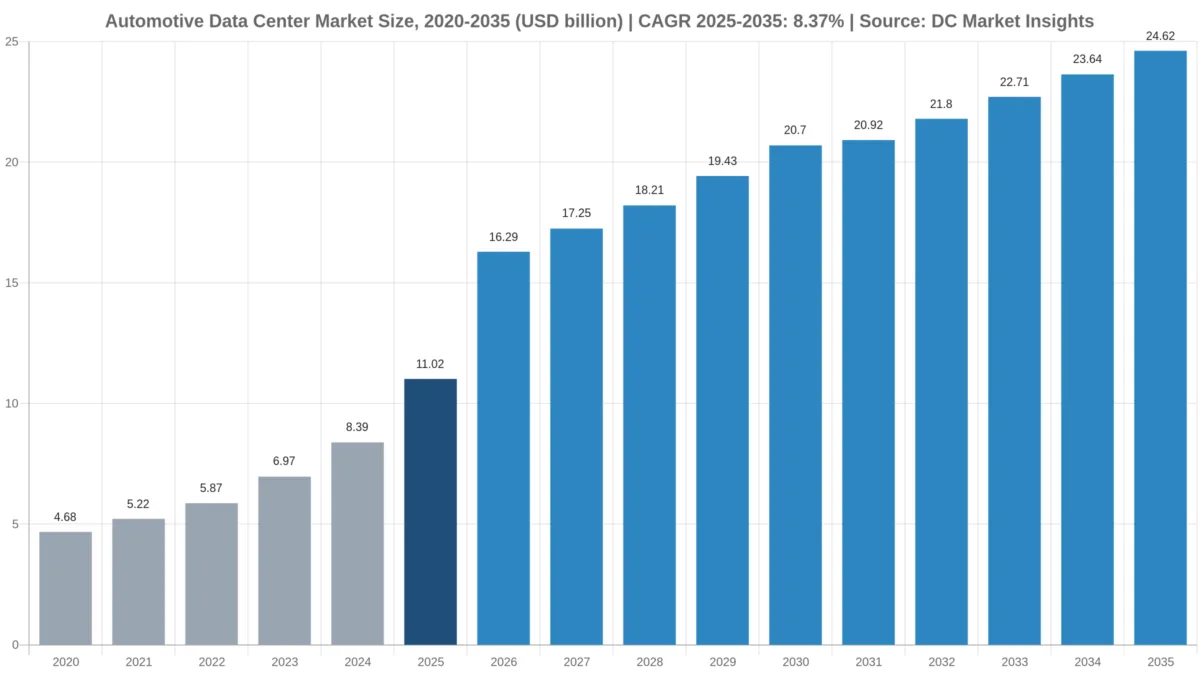
The Automotive Data Center market was worth USD 11.02 billion in 2025 and is forecast to reach USD 24.62 billion by 2035, growing at a 8.37% CAGR.
 By Amit Jain, Senior Consultant, ICT & Emerging Technologies
 Reviewed by Deepti Agrawal
Last updated 2 Nov 2026
Base year 2025 PDF + Excel
What is inside the report
- 01Introduction
- 02Executive Summary
- 03Market Scope
- 04Why Market Estimates Differ
- 05Market Drivers
- 06Market Trends
- 07Market Challenges and Restraints
- 08Market Opportunities
- 09Pricing Analysis
- 10Standards and Regulation
- 18chapters
- 2020-2024Historical period
- 2026-2035Forecast period
- —Companies profiled
Segmentation
Recent developments
General Motors said OnStar had passed 12 million subscribers in 22 markets and Super Cruise had logged more than 1.2 billion hands-free miles (Source: General Motors)
Tesla raised its 2026 capital expenditure plan to more than USD 25 billion, citing compute infrastructure and data centers, and said it continues to expand Cortex (Source: Tesla Form 10-Q)
Xiaomi reported 411,082 vehicle deliveries in 2025 and RMB 12.02 billion of capital expenditure in its smart EV and AI segment (Source: Xiaomi annual results)
Waymo raised USD 16 billion at a USD 126 billion valuation (Source: Waymo)
Wayve closed a USD 1.2 billion Series D with Microsoft and NVIDIA among the investors (Source: Wayve)
MIIT granted China's first two L3 conditional-autonomy product permits (Source: Beijing Municipal Science and Technology Commission)
Full analysis
The Automotive Data Center Market is valued at USD 16.29 billion in 2026 and is projected to reach USD 24.62 billion by 2035, up from USD 11.02 billion in 2025, a CAGR of 8.37% from 2025 to 2035 (DC Market Insights estimate). The money in this market moves with one decision inside each carmaker: whether to own the graphics processing unit (GPU) clusters that train driver-assistance and self-driving software. Tesla brought its Cortex training cluster at Gigafactory Texas to 81,000 H100 equivalents by October 2025 and told investors in April 2026 that capital expenditure would exceed USD 25 billion in 2026, driven by compute infrastructure and data centers (Tesla Form 10-Q, April 2026); Hyundai Motor Group followed with a 50,000-GPU NVIDIA Blackwell AI factory backed by about USD 3 billion (Hyundai Motor Group, October 2025). The 2025 receipt: 1,750 megawatts (MW) of information technology (IT) load used by automakers, suppliers and autonomous-driving developers x USD 6.30 million of yearly spending per MW = USD 11.02 billion, of which USD 8.99 billion is servers, storage and network gear. Training clusters lift spending by 47.77% in 2026, the sharpest one-year step in the series, and autonomous driving and software developers are the fastest company type at 13.14% a year.
Key Market Statistics: How Big Is the Automotive Data Center Market in 2026?
DC Market Insights values automotive data center spending at USD 16.29 billion in 2026, 47.77% above 2025, because the AI training load of carmakers rises from 330 MW to 600 MW in a single year.
- Automotive data center market size 2025: USD 11.02 billion
- Market size 2026: USD 16.29 billion
- Market size 2030: USD 20.70 billion
- Market size 2035: USD 24.62 billion
- CAGR 2025-2035: 8.37% (low case 6.68%, high case 9.99%)
- Largest component: IT hardware, USD 8.99 billion or 81.6% of 2025 value; fastest component: colocation and hosting services at 14.31%
- Largest workload: ADAS and autonomous driving training, USD 4.41 billion in 2025
- Fastest company type: autonomous driving and software developers, 13.14% a year to USD 4.92 billion by 2035
- Leading region: Asia Pacific, USD 4.74 billion or 43.0% of 2025 value, also the fastest region at 9.19%
- Largest country: United States, USD 2.59 billion in 2025; fastest large country: India at 14.6%
- Market leaders: NVIDIA in training accelerators, Dell Technologies, Hewlett Packard Enterprise and Super Micro Computer in servers, and Equinix and Digital Realty in automotive colocation (DC Market Insights assessment)
Executive Summary: Automotive Data Center Market Size, 2020-2035
The Global Automotive Data Center Market size was valued at USD 4.68 billion in 2020, reached USD 11.02 billion in 2025, and is anticipated to reach USD 24.62 billion by 2035, at a CAGR of 8.37% during the forecast period. Spending grew 18.69% a year from 2020 to 2025 as GPU training load for driver assistance went from 40 MW to 330 MW; from 2026 the growth rate settles because new training capacity is added in steps of a few hundred MW a year while each GPU becomes cheaper per unit of compute.
| Attribute | Value |
|---|---|
| Historical period | 2020-2024 |
| Base year | 2025 |
| Forecast period | 2026-2035 |
| Market size 2025 | USD 11.02 billion |
| Market size 2026 | USD 16.29 billion |
| CAGR 2025-2035 | 8.37% |
| Market size 2035 | USD 24.62 billion |
| Segments covered | Component, company type, workload, deployment model, region, 12 countries |
The 2026 jump is a training story: IT hardware for automotive AI rises from USD 5.27 billion in 2025 to USD 10.08 billion in 2026 in the DC Market Insights model, while conventional corporate IT for carmakers stays near USD 3.5-3.7 billion a year. Colocation and hosted private cloud grows from USD 4.12 billion to USD 12.83 billion because few carmakers can get 50-100 MW of grid power at their own sites quickly.
What Counts as an Automotive Data Center?
USD 11.02 billion in 2025: the data center capacity that vehicle makers, Tier-1 suppliers and autonomous-driving developers own or lease for their own work, counted from the server to the building.
Included: servers, GPU systems, storage and network gear in automotive-run sites (USD 8.99 billion); colocation, wholesale and hosted private cloud fees paid by automotive companies (USD 1.24 billion); uninterruptible power supply (UPS), cooling and switchgear in owned sites (USD 627.45 million); and construction and fit-out (USD 162.97 million). Training clusters for advanced driver-assistance systems (ADAS), connected-vehicle and over-the-air (OTA) update back-ends, engineering simulation and product lifecycle management (PLM), plant systems and corporate IT are all counted.
Excluded: public cloud fees paid to Amazon Web Services, Microsoft Azure or Google Cloud, computers inside vehicles (such as NVIDIA DRIVE or Mobileye chips), automotive data management and telematics software, the electricity bill, and robotaxi compute that runs inside a parent group’s hyperscale cloud (Waymo inside Alphabet).
How the segments fit together: every split (component, company type, workload, deployment model, region) sums to USD 11.02 billion in 2025 and USD 24.62 billion in 2035. The model is built in MW: 1,750 MW in use in 2025, of which 560 MW is leased, 350 MW sits at plants and test sites and 330 MW runs on GPU racks. Plant and factory systems overlap with the automotive row of the Manufacturing Data Center Market, which counts USD 4.21 billion for automotive and transportation equipment makers; this estimate adds training clusters, connected-vehicle back-ends, suppliers’ engineering sites and autonomous-driving developers.
Why Do Automotive Data Center Market Estimates Differ?
Published figures under similar names differ several times over because they count different things; the DC Market Insights value of USD 16.29 billion in 2026 covers only capacity automotive companies own or lease for their own operations.
Broader definitions add the public cloud bills of carmakers, automotive data management and connected-car platform software, telematics service revenue and even the chips inside vehicles. Narrower studies count only construction of carmaker-owned halls and miss the GPU training spend, which is the largest single workload in 2025. Automotive cloud, automotive data management and data monetisation are therefore separate markets from this one.
| Element | In this report | Why |
|---|---|---|
| Servers, GPUs, storage, network in automotive sites | Yes, USD 8.99 billion (2025) | Capacity the company buys and runs |
| Colocation and hosted private cloud fees | Yes, USD 1.24 billion | Capacity the company leases |
| Power, cooling, construction of owned sites | Yes, USD 790.42 million | Data center infrastructure |
| Plant and test-site server rooms | Yes, USD 1.38 billion (within the lines above) | Server-class compute at plants and proving grounds |
| Public cloud fees | No | Counted in cloud services markets |
| In-vehicle computers and chips | No | Vehicle hardware, not data center |
| Automotive data management software | No | Software market |
| Robotaxi compute inside a hyperscale parent | No | Counted with the parent’s cloud capacity |
Small and mid-sized suppliers are in scope: a Tier-2 parts maker with two racks of simulation servers in a colocation cage is counted the same way as a carmaker’s 100 MW training campus. Public cloud spending, in-vehicle chips, telematics services and automotive data management software stay out of scope throughout this estimate.
What Is Driving Automotive Data Center Spending?
Three drivers lift spending from USD 11.02 billion in 2025 to USD 20.70 billion in 2030: Tesla’s in-house training build-out, Korea’s first carmaker AI factory and China’s rule that important vehicle data stays in the country.
Tesla’s Cortex Cluster Reaches 81,000 H100 Equivalents
Tesla trained on a 29,000-GPU H100 cluster at Gigafactory Texas in October 2024, brought Cortex to 81,000 H100 equivalents a year later (Tesla quarterly update, October 2025), and is building Cortex 2 at the same site (Tesla Form 10-K, January 2026). Its capital expenditure fell to USD 8.53 billion in 2025 from USD 11.34 billion in 2024, then the April 2026 quarterly filing raised the 2026 plan to more than USD 25 billion, with compute infrastructure and data centers named as drivers. DC Market Insights models automotive AI hardware spending of USD 10.08 billion in 2026, almost double the USD 5.27 billion of 2025, with Tesla the largest single buyer.
Hyundai’s 50,000-GPU AI Factory Puts Korea on the Map
Hyundai Motor Group announced on 31 October 2025 an AI factory of 50,000 NVIDIA Blackwell GPUs for autonomous driving, smart factories and robotics, part of about USD 3 billion of joint investment in Korean physical AI that includes physical AI data centers (Hyundai Motor Group, October 2025). At about 1.9 kilowatts (kW) per installed Blackwell GPU that is close to 95 MW of IT load. DC Market Insights forecasts South Korea’s automotive data center spending to grow from USD 606.32 million in 2025 to USD 1.60 billion by 2035, 10.19% a year.
China Keeps Important Vehicle Data in China
The Cyberspace Administration of China (CAC) provisions on automotive data security, in force since 1 October 2021, require important data to be stored inside China and need a security assessment for any transfer abroad, with yearly reports due by 15 December (CAC provisions, August 2021). The Ministry of Industry and Information Technology (MIIT) and the State Administration for Market Regulation (SAMR) made every OTA software update subject to filing on 25 February 2025 (MIIT and SAMR notice, February 2025). With China producing 34.53 million vehicles in 2025 out of 96.4 million worldwide (OICA, April 2026), every foreign carmaker selling there needs in-country storage and training capacity; China’s automotive data center spending is USD 2.32 billion in 2025 in the DC Market Insights model.
Which Trends Are Changing Automotive Data Centers?
Connected fleets of 14-20 million cars per carmaker and plant platforms spanning dozens of factories are moving automotive workloads into hosted capacity, which grows 12.03% a year.
Connected Fleets Send Billions of Requests a Day
BMW Group’s connected fleet numbered some 20 million vehicles in over 50 countries, sending around ten billion requests a day to its back-end (BMW Group, October 2022), and the Volkswagen Group counts 14 million connected vehicles (CARIAD, November 2023). General Motors’ OnStar passed 12 million subscribers in 22 markets (General Motors, September 2026). Most consumer-facing traffic runs in public cloud, which is excluded here, but the private back-ends, data lakes and OTA signing systems behind it are counted: connected vehicle and OTA back-ends are USD 1.43 billion of 2025 spending, rising 9.93% a year.
Factory Platforms Replace Plant Server Rooms
Volkswagen Group had 43 sites in Europe, North and South America connected to its Digital Production Platform in August 2025 and extended the collaboration with Amazon Web Services for five more years, running more than 1,200 AI applications (Volkswagen Group, August 2025). Mercedes-Benz connects its around 30 passenger car plants to the Microsoft Cloud through the MO360 Data Platform (Mercedes-Benz Group, October 2022). These programmes shift plant workloads off owned halls, which is why corporate data centers grow only 5.09% a year while plant and test-site edge keeps the latency-critical share at USD 1.38 billion in 2025.
Autonomous-Driving Developers Raise Capital for Compute
Waymo raised USD 16 billion at a USD 126 billion valuation in February 2026 while serving more than 400,000 rides a week (Waymo, February 2026), and Wayve raised USD 1.2 billion in a Series D the same month with Microsoft and NVIDIA taking part (Wayve, February 2026). Waymo’s training runs inside Alphabet’s own cloud and is excluded, but independent developers buy or lease clusters: autonomous driving and software developers spend USD 1.43 billion in 2025 and reach USD 4.92 billion by 2035.
What Holds Back Automotive Data Center Investment?
Two limits keep the forecast at 8.37% a year: carmakers stopping robotaxi programmes and supply-chain rules that split one global data stack into regional copies.
General Motors Stops Funding Cruise Robotaxis
General Motors said on 10 December 2024 that it would no longer fund Cruise’s robotaxi development and would refocus on driver assistance for personal vehicles, cutting yearly spending by more than USD 1 billion (General Motors, December 2024). A training cluster sized for driverless fleets can be cut back in one board meeting. In the DC Market Insights low case, fewer robotaxi programmes and slower ADAS upgrades lower 2035 spending to USD 21.05 billion, USD 3.57 billion below the base case.
US Connected-Vehicle Rule Forces Duplicate Software Stacks
The US Department of Commerce Bureau of Industry and Security (BIS) finalised its connected-vehicle rule on 14 January 2025: software from China- or Russia-linked suppliers is banned from Model Year 2027 and hardware from Model Year 2030, or 1 January 2029 for units without a model year (BIS, January 2025). Carmakers that sell in both the United States and China must keep separate code bases, data stores and validation systems, which raises cost per MW without adding vehicles; DC Market Insights keeps spending per MW at USD 6.30 million in 2025, rising to USD 6.90 million in 2030.
Where Are the New Automotive Data Center Opportunities?
The two largest new pools are Japan’s carmaker-telecom AI platform and colocation for training clusters, which together add more than USD 8.71 billion of yearly hosted spending by 2035.
Toyota and NTT Plan Distributed Mobility AI Data Centers
Toyota Motor and NTT expect to invest a total of JPY 500 billion by 2030 in a Mobility AI Platform, with computing resources in data centers installed in distributed locations where renewable power is available and linked by NTT’s IOWN optical network (Toyota Motor, October 2024). DC Market Insights forecasts Japan’s automotive data center spending to rise from USD 1.10 billion in 2025 to USD 2.17 billion in 2035.
Colocation Halls for Automotive Training Clusters
Colocation and hosted private cloud grows from USD 4.12 billion in 2025 to USD 12.83 billion in 2035, 12.03% a year, the fastest deployment model. A 100 MW training cluster needs a grid connection that most plants cannot offer within two years, so carmakers lease liquid-cooled halls from the operators covered in the Data Center Colocation Market; automotive colocation fees alone are USD 1.24 billion in 2025.
How Much Does an Automotive Company Spend per MW of Data Center Capacity?
USD 6.30 million per MW in use in 2025, DC Market Insights estimates, up from USD 3.74 million in 2020 because GPU racks rose from 3.2% to 18.9% of automotive IT load.
| Year | Automotive IT load in use (MW) | GPU training load (MW) | Total spending per MW | AI hardware per new AI MW | Colocation rate (USD per kW-month) |
|---|---|---|---|---|---|
| 2020 | 1,250 | 40 | USD 3.74 million | USD 24.0 million | USD 168 |
| 2025 | 1,750 | 330 | USD 6.30 million | USD 31.0 million | USD 185 |
| 2030 | 3,000 | 1,510 | USD 6.90 million | USD 26.0 million | USD 196 |
| 2035 | 4,300 | 2,360 | USD 5.73 million | USD 22.0 million | USD 204 |
Public anchors: Hyundai’s USD 3 billion for 50,000 Blackwell GPUs works out to USD 60,000 per GPU, or about USD 31.6 million per MW at 1.9 kW per GPU, the basis of the USD 31.0 million per MW used for 2025 training hardware.
Which Rules Decide Where Carmakers Keep Vehicle Data?
Seven named rules decide where vehicle data is stored and how software updates are logged, and they push carmakers to run at least one data stack per major market, part of the reason 37.4% of 2025 spending is already in leased capacity.
- UN Regulation No. 155 (cybersecurity management) and No. 156 (software updates): in force 22 January 2021 in the 54 parties to the 1958 Agreement; mandatory in the EU for new vehicle types from July 2022 and all new vehicles from July 2024 (Source: United Nations Economic Commission for Europe)
- China Several Provisions on Automotive Data Security Management (Trial): in force 1 October 2021; important data stored in China, security assessment for export (Source: Cyberspace Administration of China)
- China OTA filing notice: every OTA upgrade filed with MIIT and SAMR from 25 February 2025 (Source: Ministry of Industry and Information Technology)
- China L3 access permits: first two conditional-autonomy models approved on 15 December 2025, limited to 50 km/h and 80 km/h on set roads (Source: Beijing Municipal Science and Technology Commission, relaying MIIT)
- EU Data Act, Regulation (EU) 2023/2854: applies from 12 September 2025; access-by-design duty for connected products placed on the market after 12 September 2026 (Source: EUR-Lex)
- US connected-vehicle rule, 15 CFR part 791: effective 17 March 2025; software bans from Model Year 2027, hardware from Model Year 2030 (Source: Federal Register)
- EU AI Act: in force 1 August 2024, most rules apply from 2 August 2026; high-risk AI in regulated products such as vehicles from 2 August 2028 under the amended timeline (Source: European Commission AI Act Service Desk)
The EU Data Act gives vehicle owners and third parties access to connected-car data (Regulation (EU) 2023/2854), so carmakers must keep that data in a form they can share on request, adding storage and interface load to European back-ends worth USD 2.87 billion in 2025.
Automotive Data Center Market Segmentation: Where Does the Money Go?
The largest component is IT hardware at USD 8.99 billion in 2025, passenger vehicle makers the largest company type at USD 6.39 billion, and ADAS and autonomous driving training the largest workload at USD 4.41 billion.
By Component
Servers, GPU systems, storage and network gear hold 81.6% of 2025 value; colocation and hosting services grow fastest at 14.31% a year.
| Component | 2025 (USD million) | Share 2025 | 2035 (USD million) | CAGR 2025-2035 |
|---|---|---|---|---|
| IT Hardware | USD 8,990.40 million | 81.6% | USD 17,990.40 million | 7.18% |
| Colocation and Hosting Services | USD 1,243.20 million | 11.3% | USD 4,736.88 million | 14.31% |
| Electrical and Mechanical Infrastructure | USD 627.45 million | 5.7% | USD 1,432.15 million | 8.60% |
| Construction and Fit-Out | USD 162.97 million | 1.5% | USD 460.63 million | 10.95% |
By Company Type
Passenger vehicle makers spend USD 6.39 billion in 2025; autonomous driving and software developers grow fastest at 13.14% a year because their whole product is trained software.
| Company Type | 2025 (USD million) | Share 2025 | 2035 (USD million) | CAGR 2025-2035 |
|---|---|---|---|---|
| Passenger Vehicle OEMs | USD 6,393.93 million | 58.0% | USD 13,541.04 million | 7.79% |
| Commercial Vehicle and Two-Wheeler OEMs | USD 881.92 million | 8.0% | USD 1,723.40 million | 6.93% |
| Tier-1 and Component Suppliers | USD 2,315.04 million | 21.0% | USD 4,431.61 million | 6.71% |
| Autonomous Driving and Software Developers | USD 1,433.12 million | 13.0% | USD 4,924.01 million | 13.14% |
By Workload
ADAS and autonomous driving training is 40.0% of 2025 value; connected vehicle and OTA back-ends grow fastest at 9.93% a year as the EU Data Act and OTA filing rules add retained data.
| Workload | 2025 (USD million) | Share 2025 | 2035 (USD million) | CAGR 2025-2035 |
|---|---|---|---|---|
| ADAS and Autonomous Driving Training | USD 4,409.61 million | 40.0% | USD 10,832.83 million | 9.40% |
| Connected Vehicle and OTA Back-Ends | USD 1,433.12 million | 13.0% | USD 3,693.01 million | 9.93% |
| Engineering Simulation and PLM | USD 1,543.36 million | 14.0% | USD 2,954.41 million | 6.71% |
| Manufacturing and Supply Chain Systems | USD 1,653.60 million | 15.0% | USD 3,446.81 million | 7.62% |
| Enterprise IT and Other Workloads | USD 1,984.32 million | 18.0% | USD 3,693.01 million | 6.41% |
By Deployment Model
Corporate data centers still hold 50.1% of 2025 value, but colocation and hosted private cloud grows 12.03% a year and becomes the largest model by 2035.
| Deployment Model | 2025 (USD million) | Share 2025 | 2035 (USD million) | CAGR 2025-2035 |
|---|---|---|---|---|
| Corporate Data Centers | USD 5,523.11 million | 50.1% | USD 9,076.38 million | 5.09% |
| Plant and Test-Site Edge | USD 1,380.78 million | 12.5% | USD 2,711.13 million | 6.98% |
| Colocation and Hosted Private Cloud | USD 4,120.13 million | 37.4% | USD 12,832.56 million | 12.03% |
DC Exclusive: Autonomous-Driving Training Cluster Teardown, Build vs Lease for 100 MW
A DC Market Insights model built on 9 inputs shows that a carmaker spends about USD 6.38 billion over five years to build and run a 100 MW ADAS training cluster in its own hall, against USD 6.69 billion to place the same hardware in a leased colocation hall, electricity excluded in both cases.
| Cost line, 100 MW of GPU IT load | Build (own hall) | Lease (colocation) | Input and basis |
|---|---|---|---|
| Training hardware (GPU servers, network, storage) | USD 3,100 million | USD 3,100 million | USD 31.0 million per MW, from Hyundai’s USD 3 billion for 50,000 GPUs at 1.9 kW each |
| Electrical and mechanical plant | USD 700 million | Included in rent | USD 7.0 million per owned MW |
| Construction and fit-out | USD 100 million | Included in rent | USD 1.0 million per MW |
| Up-front total | USD 3,900 million | USD 3,100 million | Sum of the lines above |
| Hardware refresh, years 2-5 | USD 2,480 million | USD 2,480 million | 20% of the fleet replaced each year |
| Colocation rent, 5 years | n/a | USD 1,110 million | USD 185 per kW-month x 100,000 kW x 60 months |
| Five-year total | USD 6,380 million | USD 6,690 million | Lease costs 4.9% more |
Reading the teardown: owning saves about USD 310 million over five years, 4.9% of the leased total, but needs USD 800 million more up front and a 100 MW grid connection, which is why the DC Market Insights model has carmakers leasing 32% of their MW in 2025 and 45% by 2035. Tesla is the clearest build case, with Cortex inside its own Gigafactory Texas site; the 81,000 H100 equivalents in Cortex correspond to roughly 110-120 MW of IT load at 1.4 kW per H100-class GPU. Hardware is 89% of the five-year cost in both cases, so the GPU price, not the building, decides the budget.
Which Region Leads the Automotive Data Center Market?
Asia Pacific leads with USD 4.74 billion, 43.0% of 2025 value, and is also the fastest region at 9.19% a year, because China, Japan, South Korea and India hold most of the world’s vehicle output and training build-out.
| Region | 2025 (USD million) | Share 2025 | 2035 (USD million) | CAGR 2025-2035 |
|---|---|---|---|---|
| Asia Pacific | USD 4,740.33 million | 43.0% | USD 11,416.56 million | 9.19% |
| Europe | USD 2,866.25 million | 26.0% | USD 5,460.10 million | 6.66% |
| North America | USD 2,756.01 million | 25.0% | USD 6,204.65 million | 8.45% |
| Latin America | USD 385.84 million | 3.5% | USD 893.47 million | 8.76% |
| Middle East and Africa | USD 275.60 million | 2.5% | USD 645.28 million | 8.88% |
Asia Pacific
Asia Pacific spends USD 4.74 billion in 2025. XPeng reported an AI computing power reserve of 2.51 exaflops (EFLOPS) in July 2024 (XPeng, July 2024), and Xiaomi delivered 411,082 electric vehicles in 2025, up 200.4% (Xiaomi annual results, March 2026), two examples of Chinese carmakers that train their own driver-assistance models.
Europe
Europe spends USD 2.87 billion in 2025, growing 6.66% a year, the slowest region because German carmakers use public cloud for many workloads. BMW Group’s D3 data-driven development platform stored more than 230 petabytes for automated driving (BMW Group, March 2019), and BMW chose Amazon Web Services for its next automated-driving platform in September 2023.
North America
North America spends USD 2.76 billion in 2025 and grows 8.45% a year. Tesla’s Cortex in Austin, Texas is the largest single automotive training site disclosed, and General Motors’ OnStar back-end serves more than 12 million subscribers.
Latin America
Latin America spends USD 385.84 million in 2025, growing 8.76% a year, led by Mexico at USD 176.38 million because its assembly plants for US and Asian brands run plant systems on local servers.
Middle East and Africa
Middle East and Africa spends USD 275.60 million in 2025, the smallest region, growing 8.88% a year to USD 645.28 million by 2035 as new vehicle programmes in Saudi Arabia, Morocco and Turkey add plant and engineering systems.
Top 12 Countries in the Automotive Data Center Market
The United States is the largest country at USD 2.59 billion in 2025, 23.5% of the global total; India is the fastest large country at 14.6% a year, and China passes the United States by 2035.
| Rank | Country | Region | 2025 (USD million) | Share 2025 | 2035 (USD million) | CAGR 2025-2035 |
|---|---|---|---|---|---|---|
| 1 | United States | North America | USD 2,590.64 million | 23.5% | USD 5,785.72 million | 8.37% |
| 2 | China | Asia Pacific | USD 2,315.04 million | 21.0% | USD 5,908.82 million | 9.82% |
| 3 | Germany | Europe | USD 1,212.64 million | 11.0% | USD 2,215.81 million | 6.21% |
| 4 | Japan | Asia Pacific | USD 1,102.40 million | 10.0% | USD 2,166.57 million | 6.99% |
| 5 | South Korea | Asia Pacific | USD 606.32 million | 5.5% | USD 1,600.30 million | 10.19% |
| 6 | France | Europe | USD 286.62 million | 2.6% | USD 517.02 million | 6.08% |
| 7 | United Kingdom | Europe | USD 264.58 million | 2.4% | USD 467.78 million | 5.86% |
| 8 | India | Asia Pacific | USD 220.48 million | 2.0% | USD 861.70 million | 14.60% |
| 9 | Mexico | Latin America | USD 176.38 million | 1.6% | USD 443.16 million | 9.65% |
| 10 | Brazil | Latin America | USD 165.36 million | 1.5% | USD 356.99 million | 8.00% |
| 11 | Canada | North America | USD 154.34 million | 1.4% | USD 332.37 million | 7.97% |
| 12 | Italy | Europe | USD 143.31 million | 1.3% | USD 270.82 million | 6.57% |
China ranks second at USD 2.32 billion and grows 9.82% a year to USD 5.91 billion because the CAC data rules and the first L3 permits of December 2025 keep training and validation inside the country. Germany ranks third at USD 1.21 billion, the home market of Volkswagen, BMW and Mercedes-Benz and of suppliers such as Bosch and Continental.
How Large Could the Automotive Data Center Market Be in 2035?
Between USD 21.05 billion and USD 28.56 billion in 2035, with USD 24.62 billion as the DC Market Insights base case.
| Scenario | 2035 (USD million) | CAGR 2025-2035 | What it assumes |
|---|---|---|---|
| Low | USD 21,050.16 million | 6.68% | Fewer robotaxi programmes, GPU training load at 1,900 MW in 2035, more workloads in public cloud |
| Base | USD 24,620.07 million | 8.37% | 4,300 MW in use in 2035, 2,360 MW of it on GPU racks, 45% leased |
| High | USD 28,559.28 million | 9.99% | L3 and L4 approvals spread across China, Europe and the US, training load near 2,900 MW |
Low Scenario
USD 21.05 billion in 2035 if more carmakers follow General Motors’ December 2024 exit from robotaxi funding and buy driver-assistance software instead of training it.
Base Scenario
USD 24.62 billion in 2035, with automotive IT load rising from 1,750 MW to 4,300 MW and spending per MW easing to USD 5.73 million as GPU prices per unit of compute fall.
High Scenario
USD 28.56 billion in 2035 if the first Chinese L3 permits of December 2025 are followed by wide L3 and L4 approvals and every large carmaker runs a Tesla-scale training cluster.
Who Are the Key Companies in the Automotive Data Center Market?
NVIDIA supplies most of the accelerators in the USD 5.27 billion of 2025 automotive AI hardware, and the four largest server makers hold about 45% of the USD 8.99 billion of IT hardware value (DC Market Insights estimate); colocation supply is spread across global and regional operators.
- NVIDIA
- Dell Technologies
- Hewlett Packard Enterprise
- Super Micro Computer
- Lenovo
- Inspur
- Huawei
- Cisco Systems
- Pure Storage
- NetApp
- Schneider Electric
- Vertiv
- Equinix
- Digital Realty
- NTT DATA
- Deutsche Telekom (T-Systems)
- Fujitsu
Company facts: NVIDIA’s automotive revenue, mostly in-vehicle computers, rose 39% to a record USD 2.3 billion in fiscal 2026 (NVIDIA, February 2026), while the same company’s GPUs fill the Tesla and Hyundai training clusters. Deutsche Telekom and NVIDIA are building an Industrial AI Cloud in Munich with up to 10,000 Blackwell GPUs (Deutsche Telekom, November 2025), hosted capacity that German carmakers and suppliers can rent. NTT is Toyota’s partner for the JPY 500 billion Mobility AI Platform.
Accelerator and Server Supplier Concentration, 2025
Dell Technologies, Hewlett Packard Enterprise, Super Micro Computer and Lenovo together hold about 45% of automotive IT hardware value in 2025 (DC Market Insights estimate); in China, Inspur and Huawei supply most carmaker training clusters.
Recent Developments in the Automotive Data Center Market
Six dated events from the last twelve months changed the 2026 outlook of USD 16.29 billion.
- In September 2026, General Motors said OnStar had passed 12 million subscribers in 22 markets and Super Cruise had logged more than 1.2 billion hands-free miles (Source: General Motors)
- In April 2026, Tesla raised its 2026 capital expenditure plan to more than USD 25 billion, citing compute infrastructure and data centers, and said it continues to expand Cortex (Source: Tesla Form 10-Q)
- In March 2026, Xiaomi reported 411,082 vehicle deliveries in 2025 and RMB 12.02 billion of capital expenditure in its smart EV and AI segment (Source: Xiaomi annual results)
- In February 2026, Waymo raised USD 16 billion at a USD 126 billion valuation (Source: Waymo)
- In February 2026, Wayve closed a USD 1.2 billion Series D with Microsoft and NVIDIA among the investors (Source: Wayve)
- In December 2025, MIIT granted China’s first two L3 conditional-autonomy product permits (Source: Beijing Municipal Science and Technology Commission)
Research Methodology: How DC Market Insights Sized the Automotive Data Center Market
The USD 11.02 billion 2025 value is a bottom-up DC Market Insights model of 1,750 MW of automotive IT load in use, about 3.8% of the roughly 46 gigawatts (GW) of enterprise and colocation capacity inside the 116 GW installed base, priced component by component; see the DC Market Insights research methodology.
Model Inputs
Automotive IT load in use of 1,250, 1,750, 3,000 and 4,300 MW in 2020, 2025, 2030 and 2035; GPU training load of 40, 330, 1,510 and 2,360 MW; leased share 25%, 32%, 40% and 45%; plant and test-site share 18%, 20%, 22% and 23%. Conventional IT costs USD 2.62 million per MW-year in 2025; training hardware costs USD 31.0 million per new AI MW plus a 20% yearly refresh, so 2025 AI hardware is (130 + 0.2 x 200) MW x USD 31.0 million = USD 5.27 billion. Colocation averages USD 185 per kW-month, so 560 leased MW x USD 185 x 12 = USD 1.24 billion. Owned-site electrical and mechanical spending is USD 627.45 million and construction and fit-out USD 162.97 million. Sibling estimates use the same base: the AI Data Center Market for accelerator pricing and the Edge Data Center Market for plant and test-site rooms.
Bound Checks
Ceiling 1: USD 11.02 billion is 1.9% of the DC Market Insights global data center market of USD 570.04 billion in 2025, below retail (3.0%) and manufacturing (3.7%). Ceiling 2: automotive AI hardware of USD 5.27 billion in 2025 is less than Tesla’s total 2025 capital expenditure of USD 8.53 billion, which also paid for factories and vehicles. Floor: Tesla added 52,000 H100 equivalents to Cortex between October 2024 and October 2025; at Hyundai’s USD 60,000 per GPU that is USD 3.12 billion, under the USD 5.27 billion modelled for all automotive AI hardware in 2025. Every split sums to the total in every year, and the CAGR is recomputed from the 2025 and 2035 endpoints.
Table of contents
- 01Introduction
- 1.1Report Description
- 1.2Key Market Statistics, 2025, 2026, 2030 and 2035
- 02Executive Summary
- 2.1Market Snapshot, 2025, 2026 and 2035
- 2.2Market Size Chart, 2020-2035
- 03Market Scope
- 3.1Included
- 3.2Excluded
- 3.3How the Segments Fit Together
- 04Why Market Estimates Differ
- 4.1Scope Table: In and Out of This Estimate
- 05Market Drivers
- 5.1Tesla's Cortex Cluster Reaches 81,000 H100 Equivalents
- 5.2Hyundai's 50,000-GPU AI Factory Puts Korea on the Map
- 5.3China Keeps Important Vehicle Data in China
- 06Market Trends
- 6.1Connected Fleets Send Billions of Requests a Day
- 6.2Factory Platforms Replace Plant Server Rooms
- 6.3Autonomous-Driving Developers Raise Capital for Compute
- 07Market Challenges and Restraints
- 7.1General Motors Stops Funding Cruise Robotaxis
- 7.2US Connected-Vehicle Rule Forces Duplicate Software Stacks
- 08Market Opportunities
- 8.1Toyota and NTT Plan Distributed Mobility AI Data Centers
- 8.2Colocation Halls for Automotive Training Clusters
- 09Pricing Analysis
- 9.1Spending per MW, 2020-2035
- 9.2Public Price Anchors
- 10Standards and Regulation
- 10.1UN Regulations No. 155 and No. 156
- 10.2China Automotive Data Security Provisions
- 10.3China OTA Filing Notice
- 10.4China L3 Access Permits
- 10.5EU Data Act
- 10.6US Connected-Vehicle Rule
- 10.7EU AI Act
- 11Market Segmentation
- 11.1By Component
- 11.2IT Hardware
- 11.3Colocation and Hosting Services
- 11.4Electrical and Mechanical Infrastructure
- 11.5Construction and Fit-Out
- 11.6By Company Type
- 11.7Passenger Vehicle OEMs
- 11.8Commercial Vehicle and Two-Wheeler OEMs
- 11.9Tier-1 and Component Suppliers
- 11.10Autonomous Driving and Software Developers
- 11.11By Workload
- 11.12ADAS and Autonomous Driving Training
- 11.13Connected Vehicle and OTA Back-Ends
- 11.14Engineering Simulation and PLM
- 11.15Manufacturing and Supply Chain Systems
- 11.16Enterprise IT and Other Workloads
- 11.17By Deployment Model
- 11.18Corporate Data Centers
- 11.19Plant and Test-Site Edge
- 11.20Colocation and Hosted Private Cloud
- 12DC Exclusive: Autonomous-Driving Training Cluster Teardown
- 12.1Build in an Own Hall, 100 MW
- 12.2Lease in a Colocation Hall, 100 MW
- 12.3Five-Year Cost Comparison
- 13Regional Insights
- 13.1Asia Pacific
- 13.2Europe
- 13.3North America
- 13.4Latin America
- 13.5Middle East and Africa
- 14Country Analysis
- 14.1United States
- 14.2China
- 14.3Germany
- 14.4Japan
- 14.5South Korea
- 14.6France
- 14.7United Kingdom
- 14.8India
- 14.9Mexico
- 14.10Brazil
- 14.11Canada
- 14.12Italy
- 15Forecast Scenarios, 2035
- 15.1Low Scenario
- 15.2Base Scenario
- 15.3High Scenario
- 16Competitive Insights
- 16.1Accelerator and Server Supplier Concentration, 2025
- 16.2NVIDIA
- 16.3Dell Technologies
- 16.4Hewlett Packard Enterprise
- 16.5Super Micro Computer
- 16.6Lenovo
- 16.7Inspur
- 16.8Huawei
- 16.9Cisco Systems
- 16.10Pure Storage
- 16.11NetApp
- 16.12Schneider Electric
- 16.13Vertiv
- 16.14Equinix
- 16.15Digital Realty
- 16.16NTT DATA
- 16.17Deutsche Telekom (T-Systems)
- 16.18Fujitsu
- 17Recent Developments
- 17.1GM OnStar 12 Million Subscribers, September 2026
- 17.2Tesla 2026 Capital Expenditure Plan, April 2026
- 17.3Xiaomi 2025 Results, March 2026
- 17.4Waymo USD 16 Billion Round, February 2026
- 17.5Wayve Series D, February 2026
- 17.6China First L3 Permits, December 2025
- 18Research Methodology
- 18.1Model Inputs
- 18.2Bound Checks
- Fig. 1Automotive Data Center Market Size, 2020-2035 (USD million)
- Table 1Market Snapshot, 2025, 2026 and 2035
- Table 2Scope Table: In and Out of This Estimate
- Table 3Spending per MW, 2020-2035
- Table 4Market by Component, 2025 and 2035
- Table 5Market by Company Type, 2025 and 2035
- Table 6Market by Workload, 2025 and 2035
- Table 7Market by Deployment Model, 2025 and 2035
- Table 8Training Cluster Teardown, Build vs Lease, 100 MW
- Table 9Market by Region, 2025 and 2035
- Table 10Top 12 Countries, 2025 and 2035
- Table 112035 Forecast Scenarios
About this report
Written by Amit Jain and reviewed by Deepti Agrawal, Senior Editor, Research. Figures are built top-down and bottom-up and reconciled before publication, with 2025 as the base year.
Read our methodologyHow we built this
- Historical period2020-2024
- Base year2025
- Forecast period2026-2035
- Sizing approachTop-down + bottom-up
Need more than the report?
Advisory on this market
Due diligence, site selection and market entry work, by the analysts who wrote this report.
See consulting servicesFrequently asked questions
USD 16.29 billion in 2026, up 47.77% from USD 11.02 billion in 2025, according to DC Market Insights estimates. The market is projected to reach USD 24.62 billion by 2035, a CAGR of 8.37% from 2025.
8.37% a year from 2025 to 2035, after 18.69% a year from 2020 to 2025, as automotive IT load in use rises from 1,750 MW to 4,300 MW and GPU training load from 330 MW to 2,360 MW.
USD 11.02 billion in 2025 was spent on data center capacity that carmakers, suppliers and autonomous-driving developers own or lease: training clusters, connected-vehicle back-ends, simulation, plant systems and corporate IT. Public cloud fees and in-vehicle chips are not counted.
81,000 H100 equivalents at Tesla’s Cortex cluster in Texas by October 2025, and Hyundai Motor Group plans 50,000 NVIDIA Blackwell GPUs. DC Market Insights puts automotive GPU training load at 330 MW in 2025 and 600 MW in 2026.
About USD 6.38 billion over five years for 100 MW built in an own hall, against USD 6.69 billion leased, electricity excluded, in the DC Market Insights teardown. Hardware at USD 31.0 million per MW is 89% of the cost.
Colocation and hosting services grow fastest among components at 14.31% a year; autonomous driving and software developers lead company types at 13.14%, reaching USD 4.92 billion by 2035.
Asia Pacific, with USD 4.74 billion or 43.0% of 2025 value, is both the largest and the fastest region at 9.19% a year. The United States is the largest country at USD 2.59 billion.
Since 1 October 2021 the CAC automotive data provisions require important data to be stored in China, with a security assessment before any export. China’s automotive data center spending is USD 2.32 billion in 2025, growing 9.82% a year.
Both: 32% of automotive MW was leased in 2025, rising to 45% by 2035, so colocation and hosted private cloud grows from USD 4.12 billion to USD 12.83 billion. Tesla builds in its own Texas factory site.
USD 16.29 billion in 2026 counts only capacity automotive companies own or lease for their own operations. Estimates that add public cloud fees, automotive data management software, telematics services or in-vehicle chips come out several times larger.
Get this report
How do I get the full report?
Request a quote; we reply by email within one business day.
How and when will I receive the report?
By email, within 24–48 business hours of payment.
How can I pay?
Once you accept the quote, we email you a secure payment link.
Can I see a sample first?
Yes. Request a free sample and we will email it to you.
Can the report be tailored to my needs?
Yes. We can add countries, segments or data cuts. Talk to an analyst about the scope you need.
Can I get an invoice or pay against a purchase order?
Write to sales@dcmarketinsights.com and our team will help.