Executive summary:
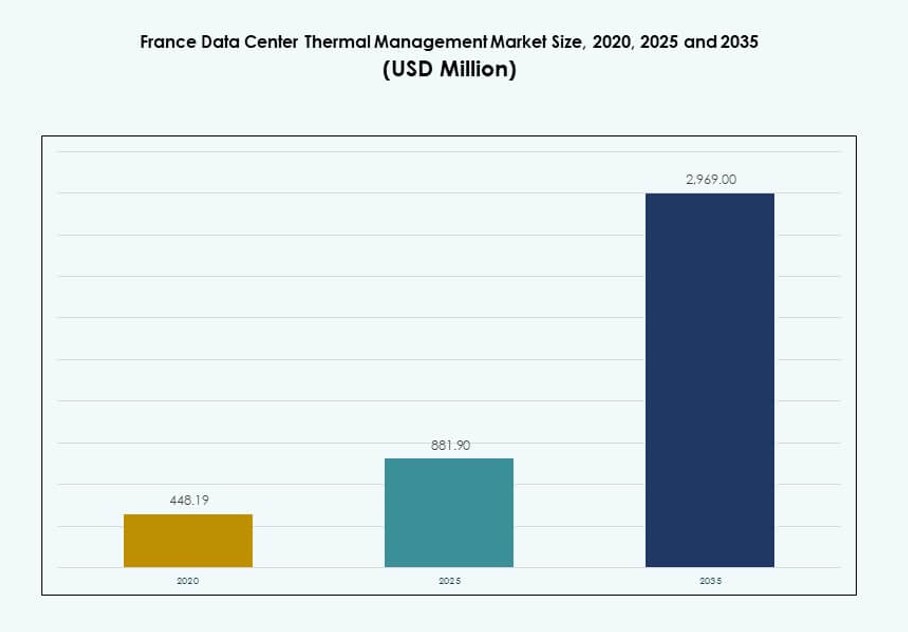
The France Data Center Thermal Management Market size was valued at USD 448.19 million in 2020 to USD 881.90 million in 2025 and is anticipated to reach USD 2,969.00 million by 2035, at a CAGR of 12.83% during the forecast period.
| REPORT ATTRIBUTE |
DETAILS |
| Historical Period |
2020-2023 |
| Base Year |
2024 |
| Forecast Period |
2025-2035 |
| France Data Center Thermal Management Market Size 2025 |
USD 881.90 Million |
| France Data Center Thermal Management Market, CAGR |
12.83% |
| France Data Center Thermal Management Market Size 2035 |
USD 2,969.00 Million |
Rising demand for AI workloads, cloud computing, and hyperscale deployments is driving innovation in thermal infrastructure. Operators adopt liquid cooling, hybrid systems, and AI-driven thermal optimization to manage increasing rack densities. The push for sustainability, along with regulatory compliance, is accelerating the shift toward high-efficiency and low-emission technologies. The market serves as a strategic focal point for vendors, investors, and hyperscale operators aiming to balance performance and environmental targets.
Paris and the Île-de-France region lead due to dense data center concentration, advanced connectivity, and cloud demand. Marseille and surrounding southern areas are emerging hubs, driven by subsea cable connectivity and hyperscale expansions. Eastern regions like Lyon also see traction due to industrial digitalization and edge deployments. The combination of infrastructure readiness and regional incentives shapes thermal strategies across France.
Market Dynamics:
Market Drivers
Rising AI Workloads and High-Density Server Deployments Driving Cooling Infrastructure Upgrades
AI adoption and high-performance computing workloads are increasing power density across French data centers. Many facilities now handle racks exceeding 20 kW, creating pressure on legacy cooling systems. This demand shift accelerates adoption of liquid cooling and direct-to-chip technologies. Operators prioritize thermal efficiency to maintain uptime and service levels. Businesses require scalable cooling solutions to support fluctuating compute loads. The France Data Center Thermal Management Market responds by integrating next-gen cooling designs. Data center developers now design facilities with cooling-first strategies. This transformation aligns with AI-driven growth across hyperscale and enterprise campuses. Thermal systems play a strategic role in ensuring performance and sustainability.
- For example, OVHcloud’s latest Smart Datacenter cooling uses direct‑to‑chip waterblocks in a closed‑loop water circuit to cut cooling electricity consumption by up to 50%. The system integrates AI‑driven controls and compact cooling modules to improve efficiency and lower energy use across its servers and racks.
Strict Sustainability Targets and Energy Efficiency Standards Shaping Design Strategies
France enforces energy efficiency goals under the EU’s climate policy and data center sustainability roadmap. Operators must meet stringent PUE and WUE thresholds to comply with carbon neutrality objectives. This pushes facilities to adopt free cooling, renewable-powered chillers, and heat reuse models. Energy regulations affect colocation firms, hyperscale builders, and government-backed data zones. The France Data Center Thermal Management Market grows as firms race to integrate low-emission technologies. Regulatory frameworks support transition from air-based cooling to hybrid and liquid systems. Data centers aligning with green targets benefit from tax advantages and public funding. Energy efficiency becomes a competitive differentiator across facilities.
- For instance, Equinix PA10 in Saint-Denis uses six 2.4 MW water-cooled chillers with hot aisle containment to support efficient thermal performance, aligning with French regulations that mandate annual energy reporting for data center sites exceeding 500 kW capacity.
Rapid Growth in Colocation and Cloud Expansion Across Key Metro Areas
Demand for colocation and cloud infrastructure continues rising across Paris, Marseille, and Lyon. Global cloud providers and domestic operators expand footprints to serve 5G, fintech, and content workloads. Thermal systems must scale rapidly to match IT power upgrades. The France Data Center Thermal Management Market sees growth from edge-ready and modular setups. Thermal resilience becomes vital as workloads migrate to high-density racks. Vendors offer AI-assisted thermal optimization for variable environments. Data centers targeting enterprise and AI segments view cooling as a core infrastructure investment. Resilient cooling ensures service continuity during power surges and climate events.
Investment Surge from Hyperscale Operators Creating Pressure on Legacy Systems
France has become a hotspot for hyperscale investments by Amazon, Microsoft, and Meta. Large facilities demand advanced thermal control, often integrating both air and liquid systems. Traditional air-based solutions no longer meet density or sustainability goals. The France Data Center Thermal Management Market supports facility redesigns and greenfield projects with high-performance cooling modules. These sites require 24/7 uptime, N+1 or 2N redundancy, and scalable thermal assets. Equipment vendors focus on predictive maintenance and machine-learning thermal analytics. Investors see thermal management as key to futureproofing data centers. High-capacity cooling unlocks revenue potential across AI, SaaS, and machine learning clusters.
Market Trends
Adoption of Liquid and Hybrid Cooling Systems in Next-Generation Facility Designs
Operators are moving beyond traditional air systems toward liquid-based and hybrid cooling models. Direct-to-chip and rear-door liquid heat exchangers gain adoption across dense server environments. Hybrid solutions allow switching between free cooling and liquid when thermal loads peak. The France Data Center Thermal Management Market evolves with modular configurations that integrate multiple technologies. Vendors now provide turnkey racks with embedded cooling units. Facilities seek adaptive systems that auto-tune based on thermal loads. This improves energy efficiency while reducing operational risks. Modular cooling supports phased expansions and lowers capex for new entrants.
Integration of Smart Monitoring and AI for Predictive Cooling Optimization
AI and ML-based thermal control tools are gaining traction across French facilities. DCIM platforms now offer real-time airflow analytics and predictive load mapping. This allows operators to preemptively adjust cooling setpoints based on forecasted demand. The France Data Center Thermal Management Market supports these advancements through AI-integrated software layers. Cooling energy savings of up to 30% are achieved through data-driven insights. Sensors and digital twins model airflow dynamics across rooms and aisles. Facility managers rely on continuous performance visibility to adjust fan speeds, coolant flow, and containment barriers. Software is becoming as vital as hardware in cooling strategies.
Reclaimed Heat Systems and District Heating Integration in Urban Hubs
Cities like Paris and Lyon promote district heating using waste heat from data centers. Operators deploy water-based heat reuse systems that feed municipal networks. This aligns with government-backed carbon reduction goals and net-zero targets. The France Data Center Thermal Management Market enables heat recovery by retrofitting legacy facilities. Projects are eligible for green bonds and public infrastructure grants. Firms capture surplus thermal energy from server exhausts through heat pumps. Reclaimed heat serves residential or industrial loads, generating recurring revenue. Strategic positioning in urban zones increases facility value and ESG appeal.
Custom Cooling Modules for Edge, AI, and GPU-Based Micro Data Centers
AI-driven use cases like autonomous systems and real-time analytics fuel demand for edge data centers. These sites often operate in constrained environments with variable temperature profiles. The France Data Center Thermal Management Market supports edge growth through compact and ruggedized cooling modules. Liquid-based mini-systems are deployed to support GPUs and ASICs at the edge. Integrated cooling units manage high-density loads with minimal noise and space. Vendors provide pre-engineered units for fast deployment. These systems handle fluctuations in workload and climate with autonomous controls. Edge-ready thermal solutions open new verticals in manufacturing, retail, and telecom sectors.
Market Challenges
High Capital Costs for Advanced Cooling Systems Limit Adoption Across Smaller Data Centers
Installing liquid cooling, AI-controlled systems, and hybrid designs involves large upfront investments. Small and mid-size data center operators struggle to justify these costs. Retrofitting legacy rooms requires structural modifications and specialized labor. The France Data Center Thermal Management Market sees delayed adoption among traditional operators with tight margins. Budget constraints limit experimentation with new thermal models. Even where ROI is strong, upfront spending remains a key obstacle. Public incentives often favor large hyperscale projects, sidelining medium operators. Cost barriers also affect edge facilities in rural zones lacking economies of scale.
Regulatory and Infrastructure Complexity Slows Thermal Modernization
France enforces detailed energy regulations and environmental guidelines for data centers. Navigating compliance during equipment upgrades adds time and cost. Power availability, water access, and urban zoning influence cooling strategies. The France Data Center Thermal Management Market faces regional disparities in permitting and energy grid access. Infrastructure gaps in rural zones limit deployment of free cooling or reclaimed heat systems. Delays in connecting to renewable sources can postpone commissioning of energy-efficient cooling. Coordination between local authorities, utility providers, and operators complicates fast deployment. These barriers increase project risk and timeline uncertainty.
Market Opportunities
Accelerated Hyperscale and AI Infrastructure Builds Support Thermal System Innovation
France hosts a rising number of hyperscale and AI-focused data centers. These sites demand advanced thermal systems for managing dense compute nodes. The France Data Center Thermal Management Market can scale through integrated cooling modules, predictive software, and waste heat reuse. Operators seek resilient and modular cooling designs that support phased deployment. AI workloads push need for liquid cooling and system-wide heat optimization. Vendors with custom solutions see strong sales growth in high-density builds.
Policy-Driven Sustainability Targets Create Demand for Eco-Friendly Cooling
Government mandates push data centers to adopt green cooling technologies. This opens opportunities for vendors of free cooling, groundwater systems, and energy-efficient software. The France Data Center Thermal Management Market supports firms aiming for LEED or ISO certifications. Investments in reclaimed heat, AI optimization, and thermal innovation qualify for public support. ESG-focused firms position thermal upgrades as part of broader decarbonization strategies.
Market Segmentation
By Data Center Size
Large data centers dominate the France Data Center Thermal Management Market due to hyperscale expansions and cloud growth. These sites require scalable cooling systems capable of handling 20–50 kW racks. Medium-sized centers follow, especially in edge and regional deployments. Small data centers contribute a modest share, focused on enterprise IT rooms and local cloud providers. Larger sites benefit from modular, hybrid cooling to ensure flexibility and uptime.
By Cooling Technology
Air-based cooling remains widely used, with direct air and aisle containment dominating legacy setups. Liquid-based cooling is growing rapidly in high-density facilities, especially direct-to-chip systems. Hybrid systems, combining air and liquid, are gaining adoption for phased retrofits. The France Data Center Thermal Management Market also explores phase-change and thermoelectric systems for specialized needs. Demand shifts toward systems that balance efficiency with operational simplicity.
By Component
Hardware dominates the market by revenue, as chillers, fans, and distribution components form the foundation of cooling systems. Software is expanding faster due to AI and digital twin integration. Services, including retrofits and remote monitoring, are growing with edge and colocation expansion. The France Data Center Thermal Management Market benefits from bundling hardware with smart software and service layers.
By Hardware
Cooling units and chillers lead, supporting both legacy and next-gen infrastructure. Fans, airflow devices, and heat exchangers hold significant shares, especially in room- and row-based systems. Piping and distribution infrastructure gains relevance in liquid-cooled environments. Other components include sensors and valves for dynamic control. Vendors innovate to reduce footprint and noise levels in urban deployments.
By Software
DCIM dashboards and BMS modules remain core platforms for thermal monitoring. AI optimization tools are emerging as critical for real-time cooling adjustments. CFD simulations support design and airflow planning in new builds and retrofits. The France Data Center Thermal Management Market emphasizes software for energy efficiency and predictive performance. Software is now central to thermal infrastructure strategies.
By Services
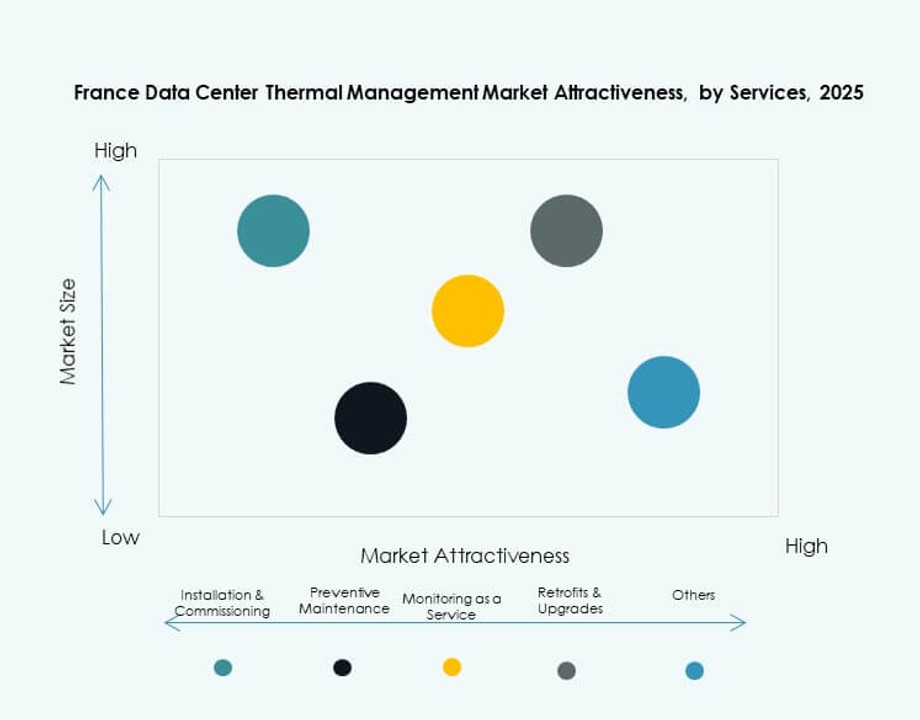
Preventive maintenance and installation services dominate due to recurring demand. Monitoring-as-a-Service is growing as facilities outsource thermal oversight. Retrofits and upgrades support migration from air to hybrid or liquid systems. The France Data Center Thermal Management Market offers packaged services aligned with modular expansion. Efficient servicing ensures long-term asset performance and compliance.
By Data Center Type
Hyperscale centers lead due to size, density, and growth rate. Colocation and cloud facilities follow, driven by enterprise outsourcing and SaaS demand. Edge/micro centers grow fast in telecom and retail zones. Enterprise IT rooms still exist but shrink in market share. The France Data Center Thermal Management Market aligns with this shift toward shared and distributed computing models.
By Structure
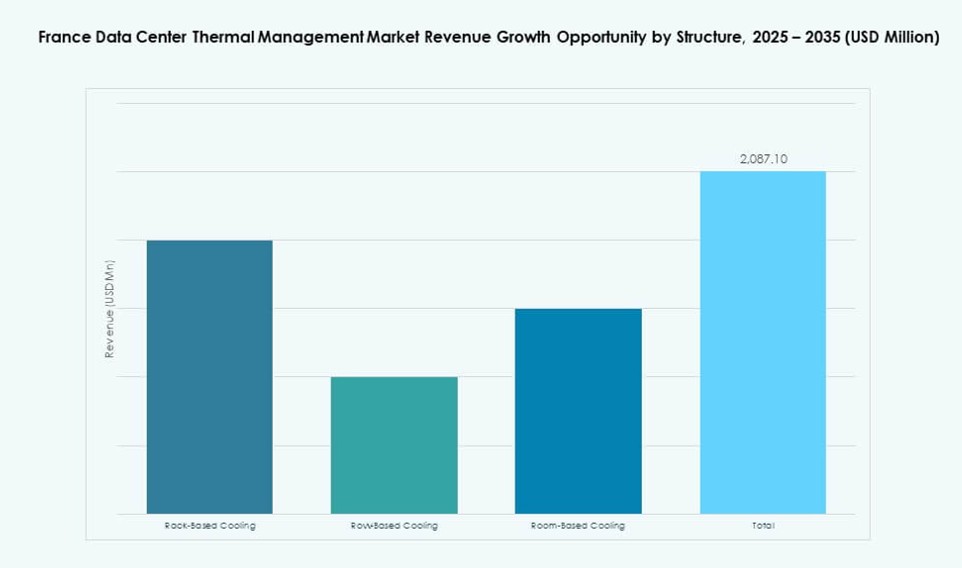
Room-based cooling dominates legacy sites but sees slower growth. Row-based and rack-based models rise with density and modularity. Rack-level cooling supports AI and GPU deployments. The France Data Center Thermal Management Market shifts toward rack-level innovation to meet power and space constraints. Contained systems reduce waste and improve thermal control.
Regional Insights
Paris Region Commands Over 55% Share Due to Density and Hyperscale Clusters
Île-de-France leads the France Data Center Thermal Management Market with over 55% share. Paris and its surrounding zones host the largest concentration of colocation, enterprise, and hyperscale data centers. High real estate costs push operators to build upward, increasing rack density and cooling demand. Facilities here use advanced air containment, groundwater cooling, and AI-based airflow control. The region’s fiber network and cloud hub status make it a preferred zone for global players. Cooling innovation often begins in this region before reaching secondary cities.
- For instance, Equinix’s PA10 data center in Saint-Denis spans 5,775 m² and features six 2.4 MW water-cooled chillers with hot aisle containment, supporting power densities of 4–8 kVA per cabinet. These specifications enable efficient thermal management across high-density deployments.
Southern France Holds Around 25% Share Fueled by Marseille and Occitanie Developments
Southern regions like Provence-Alpes-Côte d’Azur and Occitanie account for 25% of the market. Marseille’s role as a subsea cable landing point makes it a strategic connectivity hub. Hyperscale providers choose these areas for lower land costs and access to renewables. Cooling strategies here include seawater heat rejection and high-efficiency chillers. Facilities benefit from stable climate zones allowing longer free cooling windows. The France Data Center Thermal Management Market sees growth in this region from both greenfield builds and edge expansion.
- For instance, Interxion’s MRS2 and MRS3 data centers in Marseille use an innovative river cooling system that routes water through about 3 km of buried pipework and 27 heat exchangers, helping the facilities achieve a power usage effectiveness (PUE) of around 1.2.
Eastern and Western Regions Together Contribute 20% with Edge and Industrial Deployments
Eastern zones including Auvergne-Rhône-Alpes and Grand Est see growing deployment of edge and enterprise data centers. Western areas like Brittany and Pays de la Loire support industrial IT workloads and small-scale colocation. These regions together make up about 20% of the France Data Center Thermal Management Market. Cooling needs vary due to climate and facility size. Vendors offer compact and modular cooling setups for these sites. Regional governments provide incentives for clean energy integration into thermal systems. Growth remains stable with targeted investments in digital infrastructure.
Competitive Insights:
- Vertiv Group Corp.
- Schneider Electric
- Daikin Industries Ltd.
- Trane Technologies plc
- Johnson Controls International plc
- Mitsubishi Electric Corporation
- Eaton Corporation
- Delta Electronics, Inc.
- Airedale International Air Conditioning Ltd.
- Asetek, Inc.
The competitive landscape in the France Data Center Thermal Management Market reflects strong participation from global HVAC and power‑thermal specialists. Vertiv and Schneider Electric maintain high shares through broad portfolios covering hardware, software, and services. Daikin, Trane, and Johnson Controls push innovation in energy‑efficient chillers and containment systems for dense compute environments. Delta and Eaton focus on power‑cooling orchestration and modular units for hyperscale and enterprise clients. Airedale and Asetek lead in precision and liquid cooling technologies tailored for high‑density racks. Mitsubishi and other players compete on integrated systems that balance performance and sustainability targets. Partnerships and regional service networks strengthen positions. Competitive dynamics drive price optimization and faster deployment cycles, benefiting end users. Firms investing in intelligent thermal solutions gain strategic advantage in a maturing market.
Recent Developments:
- In December 2025, Trane Technologies plc entered an agreement to acquire Stellar Energy Digital’s business, enhancing liquid-to-chip cooling for data centers.
- In January 2024, DATA4 partnered with OVHcloud to implement OVHcloud’s liquid cooling solution at DATA4’s site in Marcoussis, Paris, enhancing cooling efficiency in the France data center thermal management market.