

Key takeaways
- More than 100 groups in 15 European countries are protesting on 6 and 7 November and calling for “an immediate moratorium on new large-scale projects” until clearer rules exist (Euronews, 5 Nov 2026).
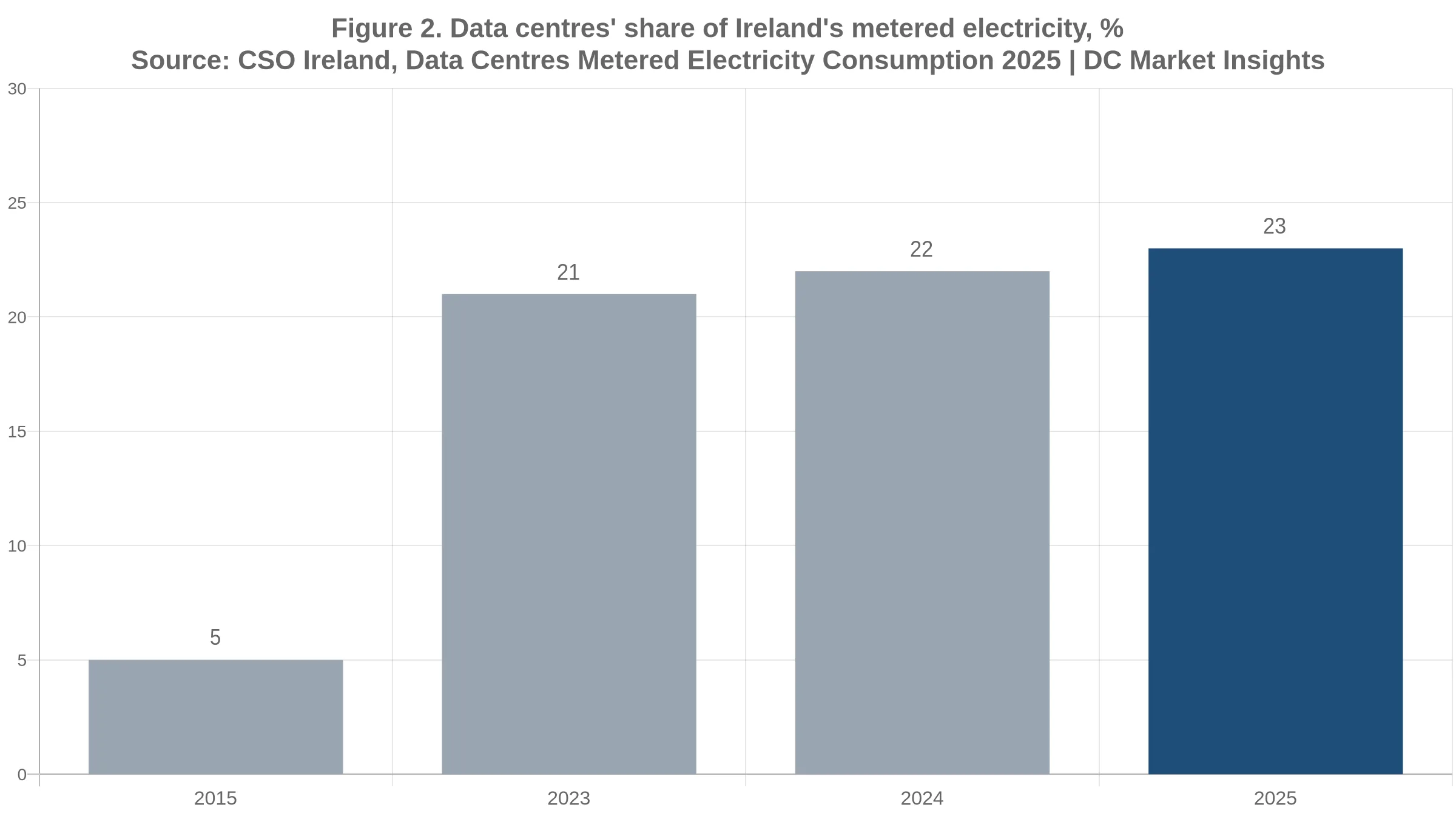
- Ireland is the warning case the campaigners cite: data centres used 23% of its metered electricity in 2025, up from 5% in 2015, or 7,663 GWh (CSO Ireland, 7 Jul 2026).
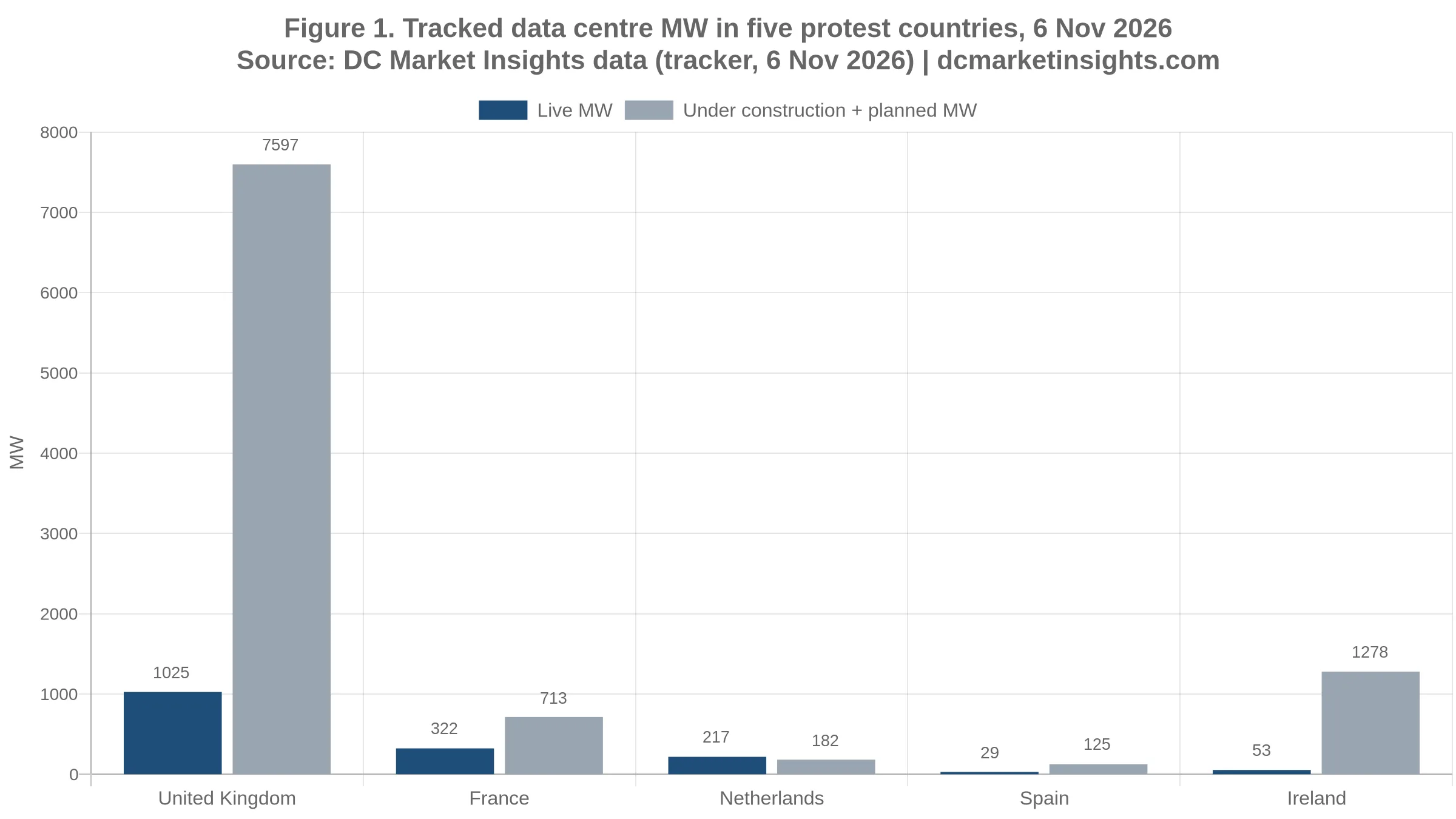
- In five of the protest countries (UK, France, the Netherlands, Spain, Ireland), DC Market Insights tracks 1,646 MW live and 9,895 MW under construction or planned: about 6 MW in the pipeline for every MW running (DC Market Insights data, our calculation).
- The UK carries most of that pipeline: 7,597 MW under construction or planned against 1,025 MW live, a ratio of 7.4 (DC Market Insights data).
- The first formal test of the “clearer rules” demand is the European Commission’s consultation on minimum performance standards for data centres, which closes on 14 December 2026 (European Commission).
Europe’s data centre build-out met organised street opposition this week. On Friday and Saturday, campaigners in Ireland, the UK, the Netherlands, Spain, France, Poland, Denmark, Finland and other countries are marching, holding teach-ins and leading walking tours past data centre sites under one demand: a pause on large new projects until governments set rules on power, water and land.
Why it matters now: the protests come as the pipeline in our tracker keeps growing faster than the capacity that is actually running, and as Brussels writes the first EU-wide performance floor for data centres. Investors and operators now face a political question, not just a grid one. This week’s Market signal reads the protests against our data and sets out the dates that will show whether the pressure turns into rules.
What happened this week
The Stop Dirty Data Centres campaign called “Days of Action” across Europe for 6 and 7 November 2026. Its site states the demand plainly: “We’re calling for an immediate moratorium on large data centres in Europe!” It defines the moratorium as a temporary pause until social and environmental concerns are addressed. Euronews reported on 5 November that more than 100 rights groups in 15 countries would take part, with actions named in Ireland, Poland, Denmark, Finland, Spain, the Netherlands, France and the United Kingdom.
They are calling on political leaders to implement moratoria on large-scale data centres at European, national and local levels.
The event list on the campaign site is long and local. On 6 November there was a photo call outside the UK energy department in London, a march in Leeds, a protest at Avonmouth in Bristol, a gathering at Amsterdam Sloterdijk aimed at a Microsoft hyperscale site, a protest against Microsoft’s planned data centre in Alcalá de Henares near Madrid, a rally in front of the Polish parliament in Warsaw and a teach-in at Trinity College Dublin. On 7 November the list adds a march in Dublin, a national conference in Berlin, a protest in Zaragoza in Aragón, actions in six Finnish cities and a protest at a Microsoft data centre at Lille Skensved near Køge in Denmark.
Counts differ by source. Euronews gives more than 100 groups in 15 countries. Solace Global, a UK risk consultancy, wrote on 4 November that “at least 80 organisations” back the campaign and listed 10 countries. The campaign site lists more than 100 supporters. We use the Euronews figure in the headline because it is the latest and the most widely reported.
Note: protest counts come from organisers and media, not an official tally. The country lists in the three sources do not match exactly.
What the campaigners want, and where
The demands are not the same everywhere. In Warsaw, two local groups asked for “clear and effective regulations for the data center sector”. In Zaragoza, organisers demanded a moratorium on large data centres and a national decree with limits on water access. In Germany, AlgorithmWatch says more than 160,000 people have signed its petition “Climate Protection Instead of AI Mania”. In Nottinghamshire, a coalition protesting at County Hall said proposed campuses at Cottam and Radcliffe on Soar are each “expected to consume 1 Giga Watt of electricity”. That is the organisers’ figure, not a grid operator’s.
| Country | Example action (6-7 Nov 2026) | Stated demand |
|---|---|---|
| Ireland | Dublin march from the Garden of Remembrance; Trinity College teach-in | Moratorium on new data centres |
| United Kingdom | London photo call at the energy department; Leeds march; Bristol, Blackpool, Nottinghamshire | Moratorium; local opposition to named campuses |
| Netherlands | Amsterdam Sloterdijk gathering and university teach-in | Opposition to a Microsoft hyperscale site |
| Spain | Alcalá de Henares; Zaragoza (Aragón); Fuenlabrada | Moratorium; national decree with water limits |
| France | Vitry-sur-Seine “Toxic Tour”; Tigery (Stop DC Sénart 91) | Opposition to large campuses |
| Poland | Rally in front of Parliament, Warsaw | “Clear and effective regulations” |
| Denmark | Protest at a Microsoft data centre, Lille Skensved | Moratorium |
| Finland | Helsinki, Oulu, Tampere, Turku, Lahti, Jyväskylä | Moratorium on all data centre projects in Finland |
Source: Stop Dirty Data Centres event list, accessed 6 Nov 2026; Euronews, 5 Nov 2026.
What our data shows: the pipeline the protests are aimed at
The campaigners are not protesting against the data centres Europe already runs. They are protesting against what is coming. Our tracker shows why that distinction matters. Across the five protest countries where we hold the most facility data, DC Market Insights tracks 1,646 MW of live capacity and 9,895 MW that is under construction or planned. That is about 6 MW in the pipeline for every MW running (our calculation).
The UK dominates. We track 191 UK facilities with 1,025 MW live, 332 MW under construction and 7,265 MW planned, so the pipeline is 7.4 times what runs today. France’s pipeline is 2.2 times its live capacity. The Netherlands is the exception: we track 182 MW under construction or planned against 217 MW live, a ratio of 0.8, after years of local limits on hyperscale sites.
| Country | Facilities tracked | Live MW | Under construction MW | Planned MW | Pipeline ÷ live |
|---|---|---|---|---|---|
| United Kingdom | 191 | 1,025 | 332 | 7,265 | 7.4x |
| France | 54 | 322 | 216 | 497 | 2.2x |
| Netherlands | 103 | 217 | 78 | 104 | 0.8x |
| Spain | 10 | 29 | 65 | 60 | 4.3x |
| Ireland | 39 | 53 | 248 | 1,030 | n/m |
| Five countries | 397 | 1,646 | 939 | 8,956 | 6.0x |
Source: DC Market Insights facilities tracker, 6 Nov 2026 (our calculation). MW is the figure each facility discloses; only part of the tracked sites state MW (Ireland: 17 of 39), so live MW understates the installed base, most of all in Ireland and Spain. Ireland’s ratio is marked not meaningful (n/m) for that reason.
Ireland shows why the live figure in a tracker is a floor. Ireland’s national statistics office measured data centre electricity use at 7,663 GWh in 2025. Spread over the year’s 8,760 hours, that is an average draw of about 875 MW (our calculation), far above the 53 MW that Irish operators disclose site by site in our tracker. Set against that 875 MW, the 1,278 MW we track as under construction or planned in Ireland would add about 1.5 times today’s average load if it all ran.
Ireland: the case every campaign cites
The CSO’s figures, published on 7 July 2026, are the most precise national measure of data centre power use in Europe. Data centres used 23% of all metered electricity in Ireland in 2025, up from 22% in 2024 and 5% in 2015. Consumption rose 10% in a year, from 6,973 GWh in 2024 to 7,663 GWh in 2025.
Ireland already has the rules the campaigners in other countries ask for, in part. Our Ireland power and policy page tracks nine government actions, eight of them in force. They include EirGrid’s 2022 position on new data centre connections in the greater Dublin area, the regulator’s December 2025 large energy user connection policy, which lets data centres connect with on-site or private-wire supply, and EirGrid’s May 2026 constrained-area overview. The Irish case shows that rules do not stop the pipeline: we still track 1,278 MW under construction or planned there. They change where it goes and who pays for the power.
The rules already on the books
The protests ask for “clearer rules”. Our policy tracker shows these five countries are not starting from zero. We hold 50 government actions on data centres and power across them. Seven are moratoria or restrictions that are in force today: four in the Netherlands, two in Ireland and one in the UK.
| Country | Actions tracked | Moratoria or restrictions in force | Most recent action |
|---|---|---|---|
| Netherlands | 12 | 4 (incl. Noord-Holland data centre strategy 2025-2027; national hyperscale siting rule, Dec 2023) | Cabinet position on EU AI gigafactories (31 Mar 2026) |
| Ireland | 9 | 2 (EirGrid Dublin connections position, 2022; constrained-area overview, May 2026) | Connection offer process v3 (20 May 2026) |
| United Kingdom | 13 | 1 (West London electrical capacity constraints, 2022) | Proposed data centre connection reforms (29 Jul 2026) |
| France | 9 | 0 | Data centres eligible as projects of major national interest (26 May 2026) |
| Spain | 7 | 0 (draft royal decree with 80% hourly renewable matching, proposed) | Draft data centre royal decree (27 Aug 2026) |
Source: DC Market Insights power and policy tracker, 6 Nov 2026. “Restrictions” are siting, grid or planning limits recorded as type moratorium or restriction. The UK count does not yet include the Data Centre Covenant in the 28 October Budget.
Governments are moving in two directions at once. France and the UK are speeding up permits and grid connections: France made data centres eligible for “projects of major national interest” in May, and the UK offered grid priority to “strategic” sites through its Data Centre Covenant. The Netherlands, Ireland and Denmark are rationing grid access instead: Denmark put data centres in the last of four categories in its grid queue, as we reported on 2 November. Spain sits in between, with a draft decree that would tie grid access to hourly renewable supply.
The wider pattern: money is still arriving
The protests do not reflect a slowdown in investment. Euronews, citing PwC’s Global Data Centre Outlook, reported that annual European data centre investment rose from €12 billion in 2020 to €25-26 billion this year, and that PwC expects €176 billion of spending over 2026-2031. That is about €29 billion a year on average (our calculation). The IEA wrote in a 2025 commentary that Europe held 15% of global data centre capacity in 2024 and that data centres “are expected to account for 10% of electricity demand growth in the European Union to 2030”.
The political mood is shifting on both sides of the Atlantic. In the United States, Democrats won control of both the House and the Senate in the 3 November midterm elections, according to the Associated Press tally cited by Al Jazeera on 4 November. Euronews linked the European protests to that result. For European operators, the more direct signal is local: the campaign’s event list names specific campuses in Bristol, Blackpool, Nottinghamshire, Amsterdam, Alcalá de Henares, Zaragoza and the Paris region. Each is a planning file that now has an organised opposition.
Solace Global, which sells security risk assessments, told clients on 4 November that coordinated demonstrations were “almost certain” and that some activists were likely to try to reach data centre perimeters and construction sites. That is a risk firm’s view, not a report of incidents.
What it means for operators, investors and vendors
Our view:
- Operators: treat planning risk as a cost line. In the UK, where the pipeline is 7.4 times live capacity, a project named on a campaign list should budget for longer consultation and judicial review risk before counting on its energisation date.
- Operators: answer the water and power questions with numbers. Ireland’s 23% share is the figure every campaign quotes; a site that publishes its expected PUE, WUE and grid draw in MW before consultation is harder to oppose on assumptions.
- Investors: discount planned MW. Of the 9,895 MW we track as under construction or planned in five protest countries, only 939 MW (9%) is under construction; the rest depends on permits and grid offers that protests can delay.
- Investors: favour markets with clear rules over markets with none. The Netherlands, with four restrictions in force, has a smaller but more certain pipeline (0.8 times live) than markets where rules are still being written.
- Vendors: expect efficiency specs to tighten. The EU’s minimum performance standards, open for comment until 14 December, will set the floor that cooling, power and heat-reuse equipment is sold against from 2027.
For the numbers behind this analysis, see our Europe Data Center Infrastructure Market report (US$20.78 billion in 2026, DC Market Insights estimate), the Netherlands AI Data Center Market report and the AI Data Center Market report. Country rules are on our power and policy pages for Ireland, the Netherlands and Spain. Our earlier analysis of the Dutch grid queue and of EMEA’s new plans gives more context.
What to watch next
- 7 November 2026: the second day of action, with marches in Dublin, Zaragoza and six Finnish cities and a protest at a Microsoft data centre near Køge in Denmark (Stop Dirty Data Centres).
- 11 November 2026: Siemens Energy reports fiscal 2026 results; its grid and gas turbine orders are a direct read on European and US data centre power demand (Siemens Energy).
- 14-15 November 2026: Friends of the Earth Scotland march to the Scottish Parliament (14 Nov); 55 groups gather in Móra d’Ebre, Catalonia, against an AI gigafactory plan (15 Nov) (Stop Dirty Data Centres).
- Late November 2026: Denmark’s Energinet is due to answer data centre grid requests under its new priority order (DC Market Insights, 2 Nov).
- 3 December 2026: deadline for large-scale (Lot 2) bids in the EuroHPC AI Gigafactories tender; the medium-scale lot was extended to 4 February 2027 (EuroHPC).
- 14 December 2026: the European Commission’s consultation on minimum performance standards for data centres closes; a proposal is expected in 2027 (European Commission).
- Not yet scheduled: Germany’s grid connection bill (Drucksache 21/7866) awaits its second and third readings in the Bundestag after a hearing on 7 October (Bundestag).
Frequently asked questions
Why are people protesting against data centres in Europe?
More than 100 groups in 15 countries say large data centres strain power, water, land and housing, and push up bills. On 6-7 November 2026 they called for “an immediate moratorium on new large-scale projects” until clearer rules are in place (Euronews).
How much electricity do data centres use in Ireland?
Data centres used 23% of Ireland’s metered electricity in 2025, or 7,663 GWh, up 10% from 6,973 GWh in 2024 and up from a 5% share in 2015 (CSO Ireland). That equals an average draw of about 875 MW (our calculation).
How big is the data centre pipeline in the protest countries?
In the UK, France, the Netherlands, Spain and Ireland, DC Market Insights tracks 1,646 MW live and 9,895 MW under construction or planned, about 6 MW in the pipeline per MW running. The UK alone has 7,597 MW in the pipeline against 1,025 MW live.
What is the next EU decision on data centre rules?
The European Commission’s consultation on minimum performance standards for data centres, launched on 21 September 2026, closes on 14 December 2026. The Commission is expected to propose the standards in 2027, alongside a common EU rating scheme and label.
Sources
- Protesters across Europe to call for freeze on energy hungry data centres, Euronews, 5 Nov 2026.
- Stop Dirty Data Centres – Days of Action 6-7 Nov 2026, Stop Dirty Data Centres campaign, accessed 6 Nov 2026.
- Anti-Data Centre Protests Planned Across Europe, Solace Global, 4 Nov 2026.
- Data Centres Metered Electricity Consumption 2025: Key findings, Central Statistics Office (Ireland), 7 Jul 2026.
- Minimum performance standards for data centres in Europe: public consultation launched, European Commission (DG Energy), 21 Sep 2026.
- Data centres in Europe – minimum performance standards (Have your say), European Commission, open to 14 Dec 2026.
- Making data centres energy efficient thanks to new EU rating system, European Commission, 21 Sep 2026.
- Investor Relations: Q4 FY2026 results, 11 November 2026, Siemens Energy.
- Call for tenders: AI Gigafactory consortia, EuroHPC Joint Undertaking, accessed 6 Nov 2026.
- Anhörung zur Änderung des Energiewirtschaftsrechts (Netzanschlussverfahren), Deutscher Bundestag, 7 Oct 2026.
- Overcoming energy constraints is key to delivering on Europe’s data centre goals, International Energy Agency, 2025.
- Democrats win control of House and Senate: key US midterms takeaways, Al Jazeera, 4 Nov 2026.
- Real Decreto de centros de datos (nota de prensa), Government of Spain, 27 Aug 2026.
- Data Center Power & Policy in Ireland and facilities tracker, DC Market Insights, 6 Nov 2026.