

Key takeaways
- Denmark’s grid priority order (BEK 892) has been in force since 19 October 2026. It puts data centres in category 4, the last of four, unless they serve a critical public function (Retsinformation).
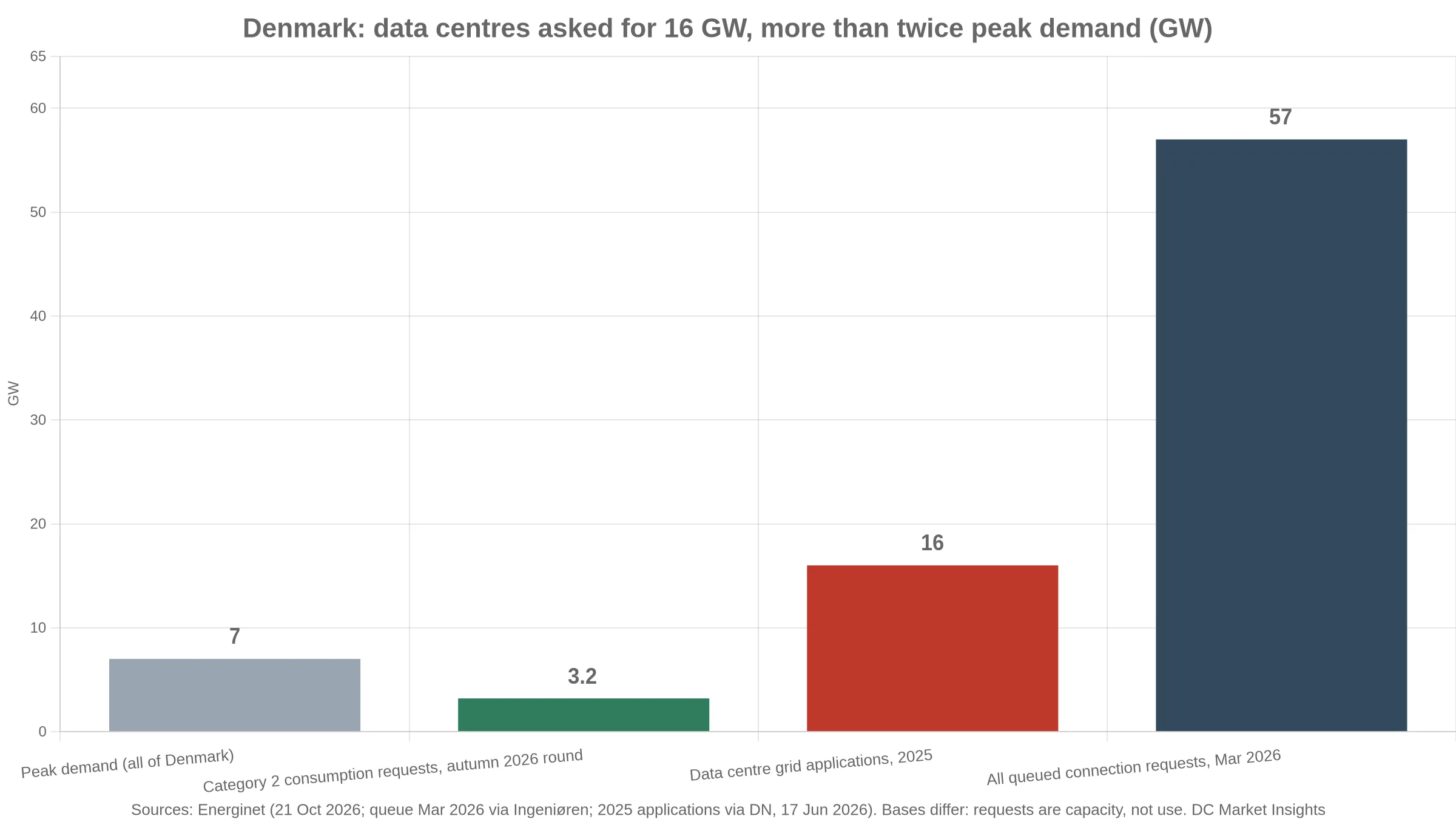
- Data centres asked Energinet for about 16 GW of grid capacity in 2025 applications, more than twice Denmark’s peak demand of about 7 GW (DN, Energinet).
- Energinet will answer category 3 and 4 applicants, batteries and data centres, later in November. Its preliminary calculations show full grid access will be difficult for them (Energinet, 21 Oct).
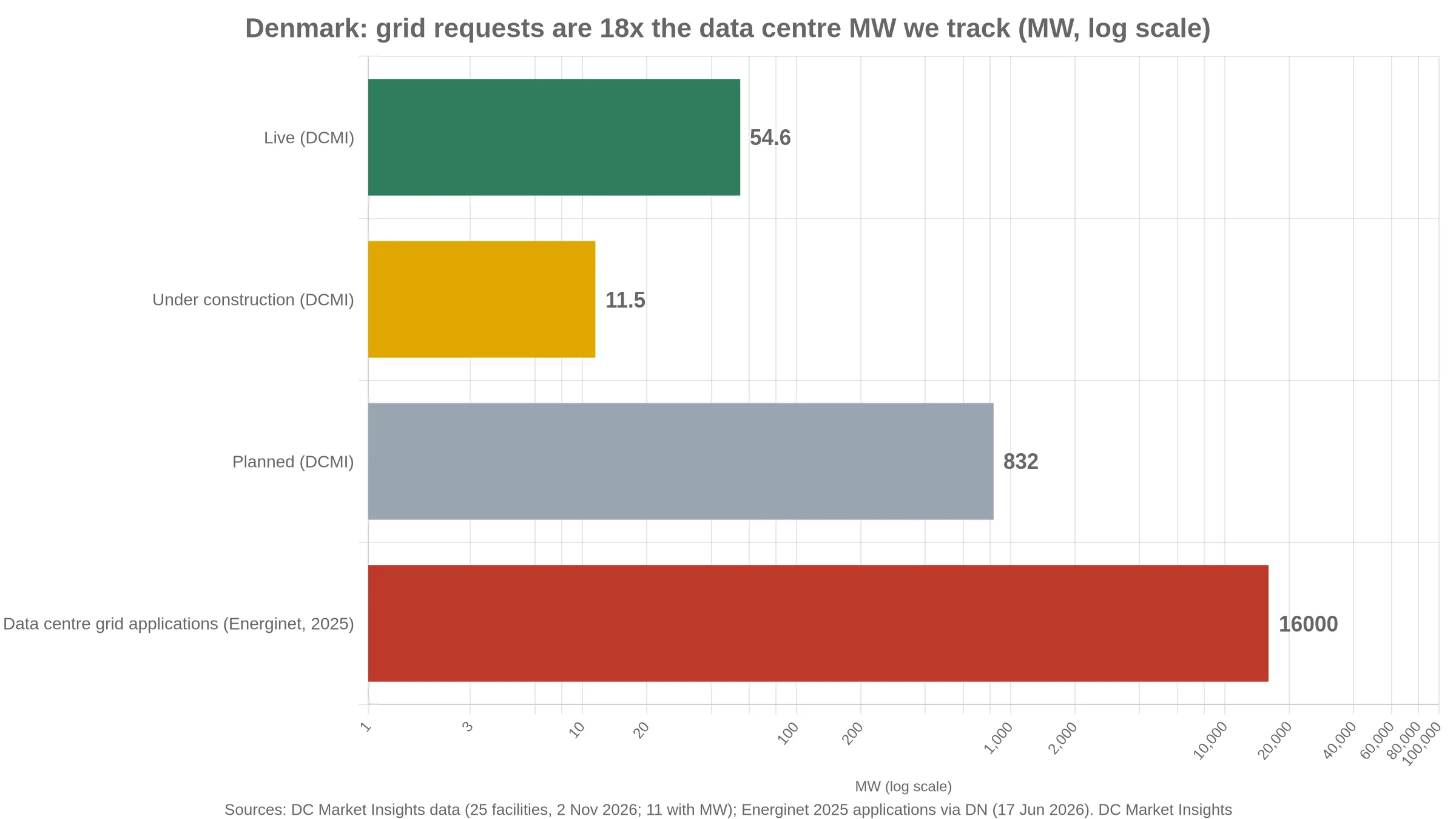
- DC Market Insights tracks only 898 MW of Danish data centre capacity live, under construction or planned. The grid requests are about 18 times that (our calculation).
- Accepting limited grid access cuts Energinet’s transmission capacity tariff by two thirds, from DKK 59,187 to DKK 19,729 per MW a year (Energinet tariff catalogue 2026).
Denmark has now written into law that most data centres wait at the back of the grid queue. Under an order that took effect on 19 October, Energinet and the local grid companies must serve households, critical services, electrification and batteries before they give a single megawatt to a data centre that is not critical to society. Later this month Energinet will tell data centre developers whether they get any capacity at all.
This is the pain point of the week for the European build-out. Denmark sold itself for a decade as a green, well-connected home for hyperscale campuses; DC Market Insights tracks Danish sites for Microsoft, Google, Apple and Meta. The country now has more data centre grid requests than grid. Developers that applied in 2025 face a refusal, a long wait, or a connection that can be switched off when the grid is tight.
How Denmark got here: a queue eight times the grid
On 2 March 2026, Energinet, the state-owned transmission system operator, stopped signing new grid connection agreements for large customers. Its director of system operations said demand “exceeds the capacity that we can realistically make available in the short term”. The pause was meant to last about three months. When it formally ended on 3 June, Energinet moved large customers into pooled processing with stricter maturity rules, and said new agreements would only be signed in the autumn.
The queue behind the pause is very large. Ingeniøren reported in March that applications had passed 57 GW, about eight times Denmark’s maximum consumption. By 20 October it put the figure at nearly 60 GW. In June, Energinet published a map of the queue and said it was many times larger than Denmark’s current total electricity consumption.
Data centres are the largest single block. Danmarks Naturfredningsforening (DN), citing Energinet, reported that of 33.5 GW of new capacity requested in 2025, data centres accounted for 16 GW. That is about 48% of last year’s applications (our calculation) and more than twice national peak demand. DN also cited reports of more than 30 planned data centres. One near Holbæk could use about six times the municipality’s expected 2030 electricity consumption.
The minister responsible framed the plan as protection for domestic users, not a ban.
This is not a ban on data centres. But Danish companies must not end up without room in the grid.
What changed: four categories, and data centres last
Nine parties signed the “akutplan for elnettet”, the emergency plan for the grid, on 1 October. The Folketing passed the enabling amendment to the Electricity Supply Act as Act 866 of 7 October. The Ministry of Climate, Energy and Utilities then issued Order 892 of 9 October, published on 15 October and in force from 19 October. The order replaces first come, first served with four categories that grid companies must serve in turn.
| Category | Who is in it | What the order says |
|---|---|---|
| 1. Protected needs and critical functions | Households, businesses up to 3 MW, health, defence, water, emergency services, and data centres that serve such functions | Served first; requests under 3 MW handled continuously |
| 2. Green transition and electrification | Everything not in 1, 3 or 4: industrial electrification, heat pumps, transport, renewables, biogas, CCS, hydrogen, Power-to-X | Must be included in grid planning |
| 3. Energy storage | Batteries and other storage beyond a user’s normal needs | Must be refused where capacity is short and higher needs would be displaced |
| 4. Data centres | Requests whose main purpose is network-based data processing, storage and related IT functions | Must be refused where capacity is short and higher needs would be displaced |
Source: Bekendtgørelse nr. 892 af 9. oktober 2026, §§ 8-18; Aftale om akutplan for elnettet, 1 Oct 2026.
Three details matter most for developers. First, refusal is mandatory, not optional: a grid company must turn down a category 3 or 4 request when capacity is constrained and the request would crowd out a higher category (§ 18). Second, requests of 3 MW or more are handled in regional pools at least twice a year, run by Energinet (§ 16). The order sets no pool dates. Third, a “grid-friendly” project, one that accepts limited or interruptible access, can rank better, but a category 4 project only counts as grid-friendly if it fits capacity without displacing higher needs (§ 15).
Projects that already hold a binding connection agreement are outside the model (§ 3). A refused applicant can appeal to Forsyningstilsynet, the Danish Utility Regulator, within four weeks (§ 22). The political agreement adds one exception to watch: if an EU AI gigafactory is located in Denmark, the government will “return to” its priority.
Not everyone thinks the plan is enough. Brian Vad Mathiesen, professor of energy planning at Aalborg University, called it “a half emergency plan” and argued that the more urgent need is to use existing grid capacity better, Installatør reported on 19 October.
Who is hurting, and how much
Data centre developers in the 2025 queue. Energinet said on 21 October that its preliminary calculations show it will be difficult to give categories 3 and 4 full grid access in the short term. Answers for those categories come later in November, after category 1 and 2 answers in the first half of the month. A refused data centre waits for the next regional pool. With pools at least twice a year, that is roughly six months later, around May 2027 at the earliest (our reading of § 16).
The scale gap. DC Market Insights data shows 25 tracked facilities in Denmark with 54.6 MW live, 11.5 MW under construction and 832 MW planned, where MW is disclosed (11 of 25 sites). The 16 GW of 2025 applications is about 18 times that 898 MW and about 290 times the live figure (our calculation). Much of the queue will never be built. But the projects most likely to be built, the ones with land and customers, sit in the same category as the speculative ones.
Hyperscalers with announced West Denmark plans. Microsoft announced a second Danish cloud region on two sites in Varde and Esbjerg in December 2025, on top of a planned US$3 billion of Danish capacity in 2023-2027. It gave no MW figure or timeline for the West Denmark region. Prime Data Centers has proposed an Esbjerg campus that has been reported at 550 MW of IT load; DC Market Insights currently records 160 MW for it. Unless a site already holds a connection agreement, it now competes from category 4.
Batteries too. Storage sits one rung above data centres and faces the same refusal rule. That matters for data centre operators who planned to use co-located batteries to look grid-friendly: under § 13 a battery counts as storage when it goes beyond the user’s normal needs.
Who gains. Category 2 asked for 3.2 GW of new consumption and 4.2 GW of new production in this round, Energinet said. The 3.2 GW alone is almost half of peak demand, and Energinet expects most mature, grid-ready consumption projects in that group to get capacity. Data centre requests are five times that category 2 consumption figure (our calculation).
| Measure | GW | Source |
|---|---|---|
| Denmark peak electricity demand | ~7 | Energinet, 21 Oct 2026 |
| Category 1 consumption: signed agreements / reserved for future | 7 / 8 | Energinet, 21 Oct 2026 |
| Category 2 requests: consumption / production | 3.2 / 4.2 | Energinet, 21 Oct 2026 |
| Consumption connected 2020-2025 | 3.8 | Energinet, 21 Oct 2026 |
| Data centre applications in 2025 | 16 | DN, citing Energinet, 17 Jun 2026 |
| All queued connection requests | 57 (Mar) to nearly 60 (Oct) | Ingeniøren, 16 Mar and 20 Oct 2026 |
Sources: Energinet release of 21 Oct 2026 as reported by OPS-Indsigt and NordsøPosten; DN; Ingeniøren. Other reports put data centres at 14-15 GW of the whole queue rather than 16 GW of 2025 applications; the bases differ, so we do not add or compare these figures directly. Requested capacity is not consumption.
The way in: limited grid access, and what it is worth
Energinet is not telling data centres no outright. It says it wants to connect more batteries and data centres than today, through connections that can be curtailed when the grid is strained. It has filed one new flexibility product with Forsyningstilsynet and plans to file five more before the end of the year. It is also open to overbooking capacity and is asking existing customers to release capacity they do not use.
We are chasing every megawatt.
The price signal for flexibility already exists. Energinet’s 2026 tariff catalogue sets the transmission grid tariff at DKK 59,187 per MW a year of capacity, plus a grid-loss charge of 1.42% of the spot price. A customer on limited grid access pays DKK 19,729 per MW a year, one third of the standard rate.
| 100 MW data centre on the transmission grid, per year | Standard access | Limited access |
|---|---|---|
| Capacity tariff (DKK per MW a year) | 59,187 | 19,729 |
| Capacity tariff for 100 MW (DKK) | 5.92 million | 1.97 million |
| Saving from limited access (DKK) | – | 3.95 million (about €0.53 million) |
| Energy at 80% load: 700.8 GWh × US$133.7/MWh | about US$93.7 million | |
Our calculation from the Energinet tariff catalogue 2026 and the 2025 Danish industrial power price in DC Market Insights data (US$133.7/MWh). Euro figure at the fixed central rate of DKK 7.46 per euro. Excludes the system tariff (DKK 0.072/kWh, or 0.0072 above 100 GWh a year) and the grid-loss charge.
In our view, the discount is not what decides the choice. The saving is under 1% of the energy bill of a 100 MW site. What matters is how often and for how long Energinet would cut supply, how much notice it gives, and whether there is compensation. Energinet has not yet published those terms. A data centre that accepts curtailment needs on-site generation or storage to ride through it, and both have their own permit and grid questions in Denmark.
The wider pattern: Europe is ranking grid users
Denmark is the sharpest case, but not the only one. Ireland’s data centres used 23% of national electricity in 2025 and more than half in Dublin, according to the Central Statistics Office figures cited by The Parliament Magazine. Since December 2025, Ireland has required new data centres to bring their own generation or storage. Finland’s draft Electricity Market Act puts data centres above 10 MW in a lower priority group from 1 January 2027 unless they offer flexibility, as we reported on 20 October. In the Netherlands, data centres want about 15 GW of grid, 26 times what they use, as we reported on 26 October. In Britain, Ofgem has proposed a security fee for large demand connections.
At EU level, energy ministers held their first policy debate on 29 October on a Commission proposal to amend the electricity market regulation (EU) 2019/943. The Council’s background note says the proposal covers tariff design and also “grid connection prioritisation”. The Commission’s December 2025 guidance urged a move from first come, first served to first ready, first served, The Parliament Magazine reported. Denmark has gone further: it ranks users by purpose, not just readiness.
No matter how fast and efficiently we expand, we won’t be able to meet all the demand the market reports.
Energinet says it is investing more than DKK 100 billion in nearly 200 transmission projects. Grid build of that size takes years. Until it lands, the priority order, not the queue date, decides who connects.
What it means for operators, investors and vendors
Our view, based on the rules and figures above:
- Operators: prepare for a category 4 answer later in November. Have an appeal file ready; the window to Forsyningstilsynet is 4 weeks from notification.
- Price curtailment, not the tariff. Limited access saves DKK 39,458 per MW a year, about DKK 3.95 million for 100 MW. Model the cost of the hours you lose and the on-site power you need before you sign.
- Test the critical-function route. Data centres serving health, defence or emergency services can move to category 1. Public-sector and sovereign workloads should be ring-fenced into separate requests (§ 9 allows split assessment).
- Investors: value Danish sites by connection agreement, not by queue position. Against 898 MW tracked, 16 GW of requests means most queue positions have little value until a pool allocates capacity.
- Vendors: expect demand for flexibility kit. Six Energinet flexibility products are due by year-end. Batteries, generators and load-control systems become the price of entry for category 4 projects.
- Look across the border. Southern Sweden, Norway and Finland compete for the same Nordic projects, with their own queue rules. Finland’s priority law starts 1 January 2027.
For market sizing on Danish facilities, see our Denmark Data Center Thermal Management Market report. For the on-site power that curtailed connections will need, see the Data Center Generator Market and the Data Center Energy Storage Market reports. Denmark’s rules are tracked on our Denmark power and policy page, alongside the Data Center Power & Policy Tracker.
What to watch next
- First half of November 2026: Energinet answers category 1 and 2 consumption applicants on the transmission grid.
- Later in November 2026: Energinet answers category 3 and 4 applicants, including data centres, directly and through the grid companies.
- 4 weeks after each refusal: the deadline to appeal to Forsyningstilsynet.
- By 31 December 2026: Energinet plans to file five more flexibility products with Forsyningstilsynet.
- 1 January 2027: Finland’s new grid priority procedure is due to take effect.
- 2027: review of Denmark’s grid-friendliness criteria. End of 2027: first evaluation of the priority model, then every two years.
Frequently asked questions
Has Denmark banned data centres?
No. Since 19 October 2026, Order 892 puts most data centres in category 4, the last of four grid priority groups. Grid companies must refuse them only where capacity is short and higher categories would be displaced. Data centres serving critical functions go into category 1.
How much grid capacity have Danish data centres requested?
About 16 GW in 2025 applications, out of 33.5 GW requested that year, according to DN citing Energinet. Denmark’s peak demand is about 7 GW, so the requests are more than twice the peak.
When will data centre developers get an answer?
Later in November 2026. Energinet answers category 1 and 2 applicants in the first half of November, then category 3 and 4, which covers batteries and data centres. A refusal can be appealed to Forsyningstilsynet within 4 weeks.
What does limited grid access cost in Denmark?
Energinet’s 2026 transmission capacity tariff is DKK 59,187 per MW a year, or DKK 19,729 with limited grid access. For a 100 MW site that saves about DKK 3.95 million a year, under 1% of its energy bill (our calculation).
Sources
- Klima-, Energi- og Forsyningsministeriet, “Bekendtgørelse om prioritering af kapacitet og afslag ved kapacitetsbegrænsninger i det kollektive elforsyningsnet” (BEK nr. 892), 9 Oct 2026. Link
- Klima-, Energi- og Forsyningsministeriet, “Aftale om akutplan for elnettet”, 1 Oct 2026. Link
- OPS-Indsigt, “Elnettet genåbner, men batterier og datacentre må fortsat vente”, 29 Oct 2026. Link
- NordsøPosten, “Energinet åbner igen for nye tilslutninger til elnettet”, 22 Oct 2026. Link
- Energinet, “Energinets tarifkatalog 2026”. Link
- Energinet, “Kø til transmissionsnettet: Sådan ser den ud”, 15 Jun 2026. Link
- Danmarks Naturfredningsforening, “Datacentre sluger strøm: grønne projekter må vente”, 17 Jun 2026. Link
- Installatør, “Nye regler for elnettet træder i kraft: Her er konsekvenserne for virksomhederne”, 19 Oct 2026. Link
- Ingeniøren, “Efter måneder med totalt stop: Energinet er tæt på at åbne elnettet igen”, 20 Oct 2026. Link
- Ingeniøren, “Virksomheder slås om pladsen i elnettet: Datacentre kommer sidst i køen”, 16 Mar 2026. Link
- Microsoft, “Accelerating Europe’s Digital Future: Microsoft Announces Plans for a New Datacenter Region in West Denmark”, 12 Dec 2025. Link
- The Parliament Magazine, “The plug fight: who gets to plug into Europe’s energy supply first”, 29 Oct 2026. Link
- Council of the European Union, Presidency background note ST 14016/1/26 REV 1, 16 Oct 2026. Link
- Irish Presidency of the Council, “Results of the TTE Energy Council, 29 October 2026”. Link
- DC Market Insights, Denmark data center power and policy data, 2 Nov 2026. Link