

Key takeaways
- AirTrunk signed an A$4.25 billion (about US$3 billion) green loan on 27 October for SYD3, a 400 MW campus in Huntingwood, Western Sydney, backed by 32 lenders and due for completion by mid-2028 (AirTrunk, Mingtiandi).
- The same day, STTGDC signed a JPY 93 billion green loan for the fit-out and operation of its 70.8 MW Tokyo campus in Inzai, with Standard Chartered as lead coordinator (STTGDC).
- That is about US$7.5 million of debt per MW in Sydney and about US$8.3 million per MW in Tokyo, against mid-range build costs of US$10.0 million and US$16.0 million per MW (our calculation; Cushman & Wakefield).
- The policy rate under that debt is 4.60% in Australia and 1.25% in Japan after hikes in September (RBA, Bank of Japan). At those rates the base cost alone is about US$345,000 per MW a year in Sydney and US$104,000 in Tokyo, before bank margins (our calculation).
- The Bank of Japan announces its next decision on 30 October and the Reserve Bank of Australia on 3 November.
The cost of an AI data centre in Asia-Pacific is now set as much by bankers as by builders. On 27 October two operators closed green loans on the same day: AirTrunk raised A$4.25 billion for a single 400 MW campus in Western Sydney, and STTGDC raised JPY 93 billion for a 70.8 MW campus outside Tokyo. Put on a per-megawatt basis, lenders are now writing US$7.5 million to US$8.3 million of debt for each MW of capacity.
Why now: both loans were signed after central banks in both countries raised rates in September, and both land days before the next decisions. The Bank of Japan announces on 30 October and the Reserve Bank of Australia on 3 November. For a developer, a quarter-point move on loans of this size is no longer a rounding error. On SYD3 alone it is about A$10.6 million a year (our calculation).
What was signed on 27 October
AirTrunk, Sydney. AirTrunk said it had secured an A$4.25 billion green loan for the development of SYD3 in Western Sydney, its release said. Thirty-two local and international institutions joined. Fourteen lead banks underwrote the facility, including Banco Santander, BNP Paribas, DBS, Deutsche Bank, ING, Mizuho, MUFG, National Australia Bank and Royal Bank of Canada, with SMBC, HSBC and UOB as green loan coordinators. Construction, led by A W Edwards, is under way, and completion is expected by mid-2028. Margin savings from meeting the green terms go to AirTrunk’s social impact programme. The company did not disclose tenor or pricing.
The release did not give SYD3’s capacity. Mingtiandi reported it as a 400 MW campus in Huntingwood, about 30 km west of central Sydney, and put the loan at about US$3 billion. The facility came in just below the A$4.3 billion, five-year loan that AirTrunk was reported to be discussing with banks in June, The Next Web reported at the time. AirTrunk’s committed debt now totals about A$38.4 billion (about US$26.9 billion) worldwide, more than A$19.8 billion of it in Australia, where it runs five campuses with more than 1.2 GW of capacity.
a flight to quality in an increasingly selective capital market
STTGDC, Tokyo. ST Telemedia Global Data Centres said it had secured a JPY 93 billion green loan facility to finance the fit-out and operation of STTGDC TYO1 and TYO2, the two buildings of its campus at Goodman Business Park in Inzai City, its release said. The campus has a combined IT capacity of 70.8 MW. Standard Chartered is lead coordinator and green loan coordinator, Société Générale is green loan coordinator, and Mizuho, OCBC and UOB are lenders. The loan is tied to the buildings reaching an agreed green certification and a design power usage effectiveness (PUE) of 1.3 or below.
The structure matters for the cost comparison. Goodman develops the shell and core and leases the buildings long-term to STTGDC, which fits them out and runs them, Mingtiandi reported when the first building opened. So the JPY 93 billion pays mainly for power, cooling and fit-out, not land and concrete.
This financing reflects the strength of our Japan platform and the confidence of our banking partners
What a megawatt costs, and how much of it lenders fund
Our calculation: A$4.25 billion over 400 MW is about A$10.6 million, or US$7.5 million, of debt per MW at SYD3. JPY 93 billion over 70.8 MW is about JPY 1.31 billion per MW, or about US$8.3 million at JPY 158 to the dollar.
Set those against what it costs to build. Cushman & Wakefield’s 2026 Asia-Pacific construction cost guide puts a mid-specification build at a mid-range US$10.0 million per MW in Australia and US$16.0 million in Japan, the most expensive market in the region, the firm said on 1 April. Japan’s costs rose 20.9% in a year; Australia’s rose 3.8%.
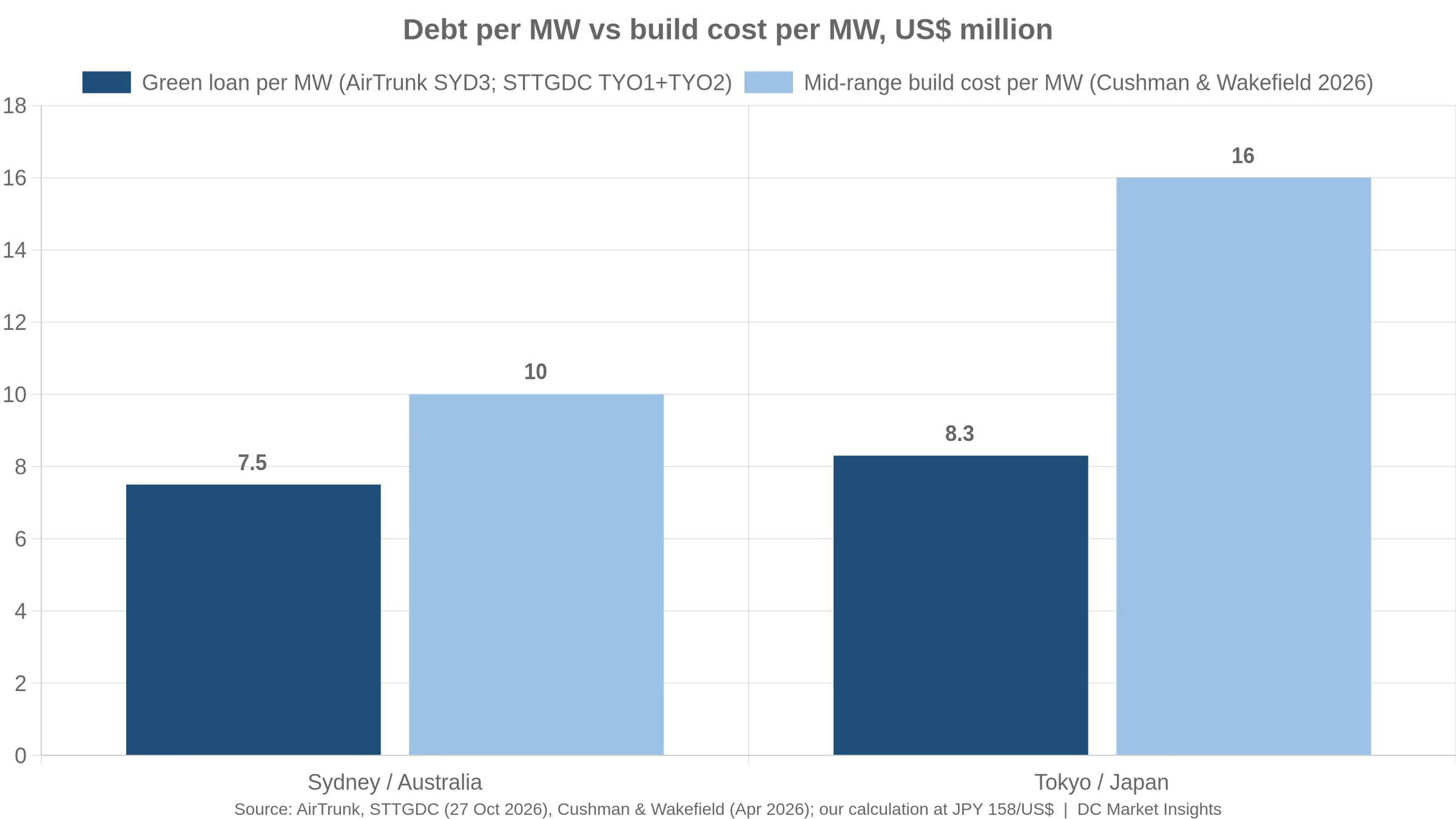
On those numbers the Sydney loan covers about 75% of a mid-range Australian build, and the Tokyo loan about 52% of a mid-range Japanese build (our calculation). The two ratios are not like for like. SYD3 is a ground-up hyperscale campus, while STTGDC leases its shell from Goodman, so a fit-out loan should cover less of a full build cost. Even so, the gap shows how much of Japan’s cost premium sits in the building itself.
The bigger number is what goes inside. DC Market Insights values the global AI data centre market at US$390.19 billion in 2025 for 9.04 GW of AI IT load deployed, or about US$43 million per MW once servers, accelerators and networking are counted (our calculation). On that basis, the facility debt in these two deals is only about 17-19% of the full cost of an AI megawatt. The rest, mostly chips, is paid for by the tenant.
| Measure | Sydney (SYD3) | Tokyo (STTGDC TYO1 + TYO2) |
|---|---|---|
| Loan | A$4.25 billion (~US$3.0 billion) | JPY 93 billion (~US$0.59 billion) |
| Capacity | 400 MW | 70.8 MW IT |
| Debt per MW | A$10.6m (~US$7.5m) | JPY 1.31bn (~US$8.3m) |
| Mid-range build cost per MW (C&W 2026) | US$10.0m (Australia) | US$16.0m (Japan) |
| Debt as share of mid-range build cost | ~75% | ~52% (fit-out only; shell owned by Goodman) |
| Green conditions | Green loan with margin adjustments | Green certification; design PUE 1.3 or below |
| Timing | Completion by mid-2028 | TYO1 open; TYO2 due early 2027 |
Sources: AirTrunk and STTGDC releases, 27 Oct 2026; Mingtiandi (SYD3 400 MW, US$3 billion); Cushman & Wakefield, 1 Apr 2026. Our calculation; yen converted at JPY 158 per US dollar, the level in mid-October, so the US dollar figures move with the exchange rate. SYD3 capacity is from Mingtiandi, not AirTrunk’s release. Build costs are national mid-range figures for a mid-specification build, not the cost of these two sites.
The rate under the debt
Both central banks moved in September. The Reserve Bank of Australia raised its cash rate target by 25 basis points to 4.60% on 29 September and said it would keep doing what was needed, “including increasing the cash rate target further if needed”, its statement said. The Bank of Japan raised its guideline for the overnight call rate to around 1.25% from around 1.0%, effective 24 September, by a 7-2 vote, its statement showed. In January the Japanese rate was 0.75%.
Data centre project loans are usually priced as a bank margin over a floating benchmark, and neither company disclosed its margin or hedging. So the figures below are a floor, not the loans’ real interest bill. Our calculation at today’s policy rates: SYD3’s A$4.25 billion carries about A$196 million a year of base-rate cost, or about US$345,000 per MW. STTGDC’s JPY 93 billion carries about JPY 1.16 billion a year, or about US$104,000 per MW. One more quarter-point rise adds about A$10.6 million a year to SYD3 and about JPY 233 million a year to the Tokyo campus.
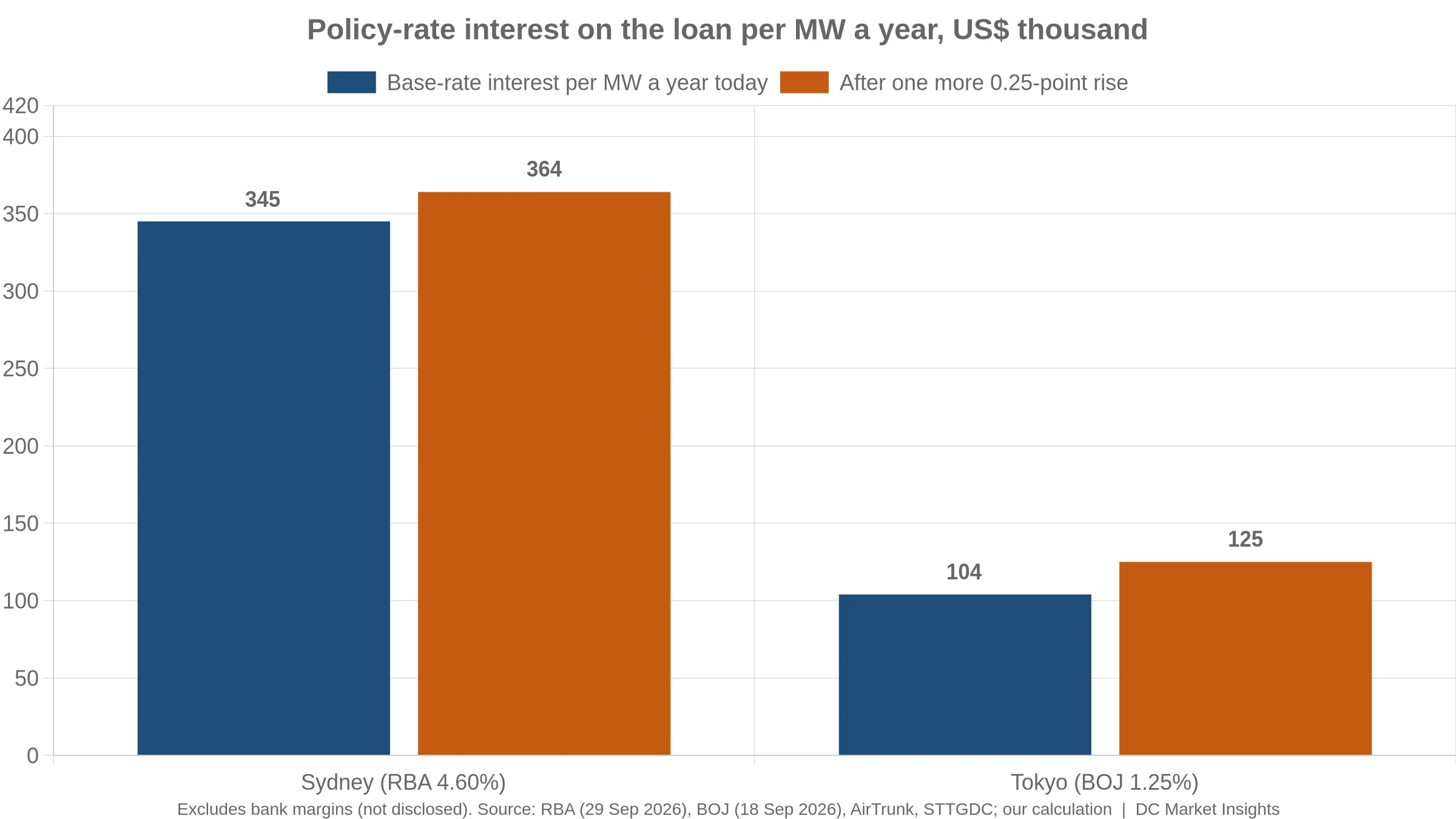
The gap between the two markets is the point. Japan builds at the region’s highest cost but borrows at its lowest rate; Australia builds for less but pays almost four times the base rate. On our numbers a Sydney megawatt carries about US$240,000 more base-rate cost a year than a Tokyo one, despite needing less debt. Japanese banks are in both deals: Mizuho lends to both campuses, and SMBC and MUFG are among the lead banks on SYD3.
Technology: what the green terms ask for
The green conditions are about how the buildings are cooled and powered. STTGDC said TYO1 is designed for an annualised PUE below 1.25 and uses closed-loop cooling with no ongoing water use in normal operation, while TYO2 is built for high-density AI workloads with provision for liquid cooling. The loan’s own bar is a design PUE of 1.3 or below. AirTrunk’s US$2.325 billion Johor loan in July set a design PUE of 1.37, AirTrunk said.
Liquid cooling is the cost driver lenders are now funding. Japanese equipment makers are scaling up the hardware. Nidec showed a 3.2 MW in-row coolant distribution unit with 800 VDC input at the OCP Global Summit on 12-15 October, the largest in its range, and aims to start mass production in the first half of 2027, Nidec said. Cushman & Wakefield ties the region’s cost inflation to the same shift.
Each new generation of high-performance hardware demands more power, more cooling and greater structural resilience.
The wider pattern: a year of single-asset loans
The 27 October deals cap a run of large single-campus financings in the region this year. AirTrunk alone has signed four: JPY 191.6 billion (US$1.24 billion) for TOK1 in Tokyo in March, AirTrunk said; US$2.325 billion for JHB2 in Johor in July from about 30 lenders, its first with the International Finance Corporation; a further US$1 billion green loan for TOK1 this month, as Mingtiandi reported; and now SYD3. With STTGDC’s Tokyo loan, that is about US$8.2 billion of single-asset data centre debt across three countries in 2026 (our calculation).
| Date (2026) | Borrower and campus | Loan | US$ equivalent |
|---|---|---|---|
| Mar | AirTrunk TOK1, Tokyo | JPY 191.6 billion | US$1.24 billion |
| Jul | AirTrunk JHB2, Johor | US$2.325 billion (RM9.5 billion) | US$2.325 billion |
| Oct | AirTrunk TOK1, Tokyo (further green loan) | About US$1 billion | US$1.0 billion |
| 27 Oct | AirTrunk SYD3, Sydney | A$4.25 billion | About US$3.0 billion |
| 27 Oct | STTGDC TYO1 + TYO2, Tokyo | JPY 93 billion | About US$0.59 billion |
| Total | About US$8.2 billion | ||
Sources: AirTrunk releases (Mar, Jul and 27 Oct 2026); STTGDC release (27 Oct 2026); Mingtiandi (October TOK1 loan, US$ equivalents). The October TOK1 loan is reported by Mingtiandi and not confirmed in an AirTrunk release we found. Our calculation; the total adds loans, not project costs, and the STTGDC yen figure is converted at JPY 158 per US dollar.
Scale tells the story. SYD3’s US$3 billion loan is about half the US$5.81 billion that DC Market Insights estimates was spent on Australian data centre infrastructure in all of 2025 (our calculation). Lenders are also choosing. AirTrunk’s own Singapore REIT listing, which we covered on 21 October, was deferred after investors pushed for a higher yield, and NEXTDC cut guidance after a power delay in Melbourne. Banks are backing large, contracted campuses run by established operators; equity markets are asking harder questions.
What it means for operators, investors and vendors
Our view, based on the figures above:
- Budget US$7.5-8.3 million of facility debt per MW as the current market for a large, contracted campus in Sydney or Tokyo, and expect that to cover 50-75% of a mid-range build, not all of it.
- Price the rate path into Australian projects. Each 0.25-point rise adds about US$19,000 per MW a year at SYD3’s leverage; at 4.60% the base rate alone is about US$345,000 per MW a year before margins.
- Use yen debt where the asset allows. Even after the September hike, Japan’s 1.25% base rate costs about US$104,000 per MW a year on US$8.3 million of debt, less than a third of Sydney’s.
- Design to the loan’s PUE line. Green terms of a design PUE of 1.3 or below (Tokyo) and 1.37 (Johor) are becoming the default; a design that misses them can lose margin discounts.
- Vendors: liquid cooling gear is now debt-funded. Liquid-cooling provision is written into the Tokyo campus; 3.2 MW-class CDUs reach volume production in the first half of 2027.
- Investors: separate the shell from the chips. Facility debt is about 17-19% of the roughly US$43 million an AI megawatt costs with IT equipment (our calculation), so the tenant’s credit matters more than the building’s.
For market sizing, see our Australia Data Center Infrastructure Market report, the Australia AI Data Center Market report, which values the market at US$924.59 million in 2025, and the global AI Data Center Market report for cost per AI megawatt. For transactions, see the Deal Tracker, and for power rules in the markets above, our Japan power and policy page and Malaysia power and policy page.
What to watch next
- 30 October 2026: Bank of Japan decision and quarterly Outlook Report; the policy rate is now around 1.25%.
- 3 November 2026: Reserve Bank of Australia decision, 2:30 pm AEDT, with the Statement on Monetary Policy; the cash rate is now 4.60%.
- 20 November 2026: NEXTDC annual meeting and capex review after its Melbourne power delay.
- Early 2027: STTGDC TYO2 due to start operation, with provision for liquid cooling.
- First half of 2027: Nidec’s 3.2 MW in-row CDU due to enter mass production.
- Mid-2028: SYD3 completion, according to AirTrunk.
Frequently asked questions
How much did AirTrunk borrow for SYD3?
A$4.25 billion, about US$3 billion, in a green loan signed on 27 October 2026 with 32 lenders. For a 400 MW campus that is about A$10.6 million, or US$7.5 million, of debt per MW (our calculation). Completion is expected by mid-2028.
How much does it cost to build a data centre in Japan and Australia?
Cushman & Wakefield puts a mid-range build at US$16.0 million per MW in Japan, the region’s highest, and US$10.0 million in Australia. Japan’s costs rose 20.9% in a year, Australia’s 3.8%.
What is STTGDC’s Tokyo green loan?
A JPY 93 billion facility, signed on 27 October 2026, for the fit-out and operation of the 70.8 MW TYO1 and TYO2 buildings in Inzai. It requires a design PUE of 1.3 or below. That is about US$8.3 million per MW at JPY 158 to the dollar (our calculation).
How do interest rates affect data centre costs in Asia-Pacific?
At Australia’s 4.60% cash rate, base-rate interest on SYD3’s loan is about US$345,000 per MW a year, against about US$104,000 in Tokyo at 1.25%, before margins (our calculation). The BOJ decides on 30 October and the RBA on 3 November.
Sources
- AirTrunk, “AirTrunk Secures A$4.25B Green Loan For SYD3 Western Sydney Expansion”, 27 Oct 2026. Link
- STTGDC, “STTGDC secures JPY93 billion green loan to support expansion of Tokyo data centre campus”, 27 Oct 2026. Link
- Mingtiandi, “AirTrunk Secures $3B Green Loan to Expand Sydney Data Centre”, 27 Oct 2026. Link
- Mingtiandi, “STT GDC opens Greater Tokyo data centre at Goodman Business Park”. Link
- The Next Web, “Blackstone’s AirTrunk seeks $3bn loan for one Sydney data centre”, 18 Jun 2026. Link
- Reserve Bank of Australia, “Statement by the Monetary Policy Board: Monetary Policy Decision”, 29 Sep 2026. Link
- Bank of Japan, “Change in the Guideline for Money Market Operations”, 18 Sep 2026. Link
- Bank of Japan, “Statement on Monetary Policy”, 23 Jan 2026. Link
- Cushman & Wakefield, “APAC DC market faces structural cost shift amid rising AI requirements”, 1 Apr 2026. Link
- AirTrunk, “AirTrunk secures US$2.325b green financing to support sustainable digital infrastructure growth in Malaysia”, 29 Jul 2026. Link
- AirTrunk, “AirTrunk secures largest financing for a data centre in Japan with US$1.2 billion green loan”, Mar 2026. Link
- Nidec, “Nidec unveils NIR3.0 prototype, a 3.2MW 800VDC-compatible in-row CDU”, Oct 2026. Link
- DC Market Insights, AI Data Center Market, Australia Data Center Infrastructure Market and Australia AI Data Center Market reports. Link