

Key takeaways
- Statnett, Norway’s grid operator, stopped reserving new grid capacity for data centres on 9 November 2026. It expects to lift the halt by 1 August 2027 at the latest (Statnett).
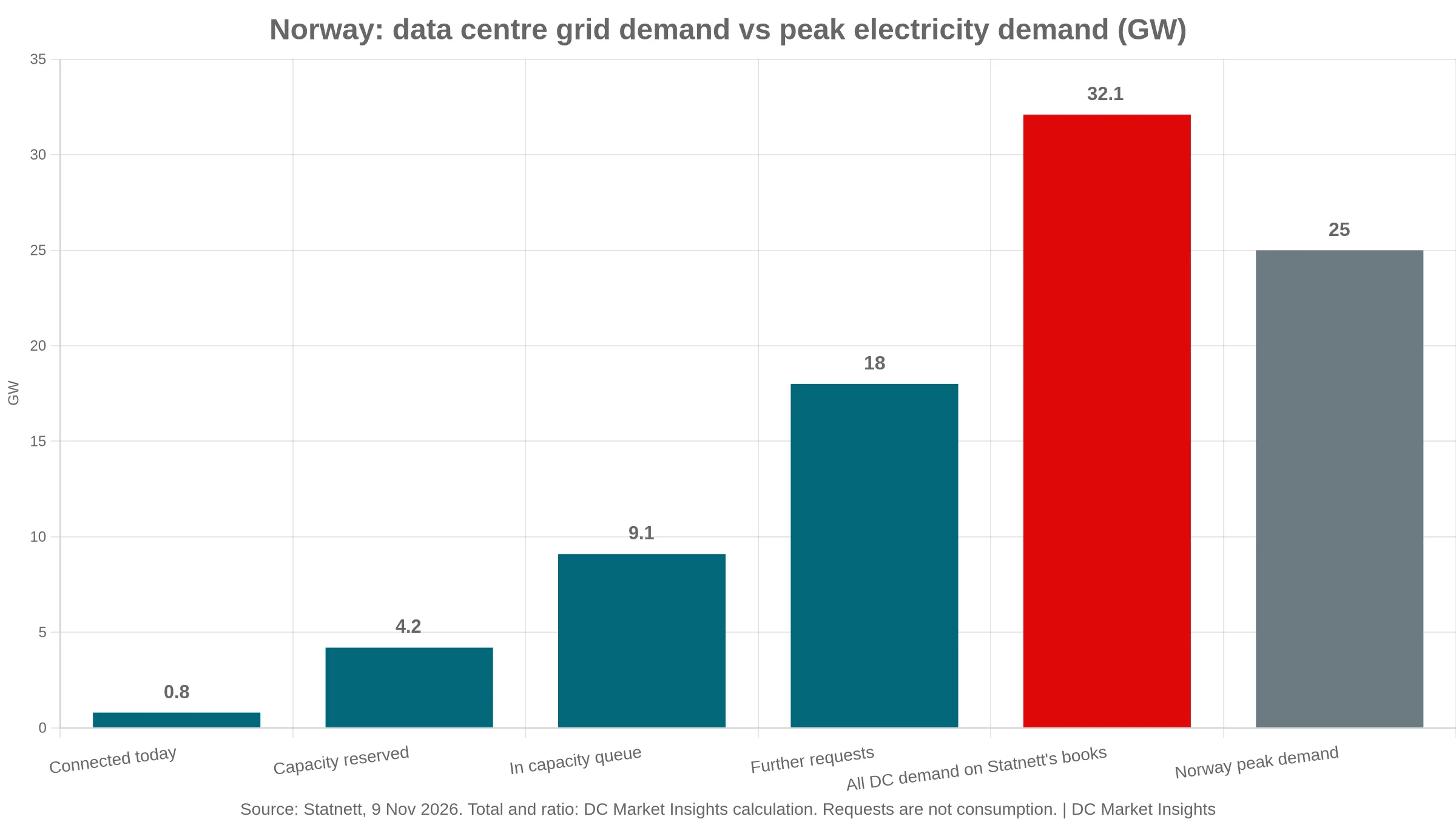
- Data centres hold 800 MW of connections, 4,200 MW of reserved capacity, 9,100 MW in the capacity queue and requests for a further 18,000 MW, against peak demand of just over 25,000 MW (Statnett).
- That is 32.1 GW of data centre demand on Statnett’s books, about 1.28 times national peak demand and 40 times what is connected today (our calculation).
- The 4.2 GW already reserved would use about 29 TWh a year at 80% load, roughly three times the 9 TWh that Thema Consulting projected for all Norwegian data centres in 2030 (our calculation; Norwegian Board of Technology).
- The government plans a licensing scheme that would favour defence, preparedness, health and AI capacity and treat crypto mining as outside the public interest. An NHH professor says the scheme is due towards the end of 2027 (CMS, NHH).
Norway has stopped handing out grid capacity to new data centres. Since Monday 9 November, Statnett no longer takes new capacity reservations from data centres and has stopped processing their applications to connect directly to the 420 kV transmission grid. Projects already connected, or already approved, are not affected. Everyone else waits for new technical rules that Statnett has not yet written, and the halt can run until 1 August 2027.
This is the pain point of the week for Europe’s build-out. Norway sold itself on cheap hydropower and spare grid. The numbers Statnett published show the spare grid is gone on paper: data centres have asked for more capacity than the whole country uses on its coldest day. The pause lands one week after Denmark ranked data centres last in its grid queue, and as Ireland’s connection rules face a High Court challenge this week.
What Statnett decided on 9 November
Statnett’s release, “Midlertidige tiltak for fortsatt forsvarlig systemdrift” (temporary measures for continued responsible system operation), was published at 08:45 on 9 November. It does three things, according to the release and a same-day summary by law firm CMS:
- No new reservations. Statnett will not reserve further grid capacity for data centres.
- No new functionality approvals. It has stopped processing new applications for approval of plant functionality under section 14 of the system responsibility regulations (fos § 14).
- 420 kV applications frozen. Applications already received under fos § 14 for plants that would connect directly to the 420 kV grid are also on hold. Statnett says this covers large customers with a distinctive load profile, “typically data centres”.
There are carve-outs. Existing connections are untouched. Plants whose functional requirements are already approved can connect. Statnett will keep processing applications for plants due in service soon that are being considered for the regional grid, and it will look at some smaller plants with planned connection before 1 August 2027.
The reason is grid stability, not energy supply. Statnett says it needs functional requirements for how large computing loads behave during grid faults and how fast they change consumption. Those requirements must be drafted, sent out for consultation and approved by the energy regulator RME. Statnett will also align them with the other Nordic system operators and ENTSO-E. Statnett has not pointed to a specific disturbance caused by a Norwegian data centre, Bytes Europe reported.
[Data centres] have technical characteristics that are of great importance for safe and stable system operation.
Østli also stressed that the decision is not a general stop on connecting data centres. In practice, for any project without a reservation today, it works like one until the new rules exist.
How Norway got here: a queue bigger than the grid
Statnett gave the scale in four numbers. 800 MW of data centres are connected today. 4,200 MW have been given reserved capacity. 9,100 MW are in the capacity queue. And Statnett has received requests to connect a further 18,000 MW. Norway’s maximum power consumption is slightly over 25,000 MW.
| Stage | MW | Share of peak demand (our calculation) |
|---|---|---|
| Connected today | 800 | 3% |
| Capacity reserved | 4,200 | 17% |
| In the capacity queue | 9,100 | 36% |
| Further connection requests | 18,000 | 72% |
| Total on Statnett’s books | 32,100 | 128% |
| Norway maximum power consumption | ~25,000 | 100% |
Source: Statnett, 9 Nov 2026. Shares use 25,000 MW; Statnett says peak is slightly above that, so shares are upper bounds. Requested capacity is not consumption, and Statnett itself says the figures do not represent committed construction (Bytes Europe).
The queue has grown fast. Our Oslo Data Center Market report, citing Statistics Norway, recorded 794 MW in operation, 4,350 MW allocated and 6,833 MW waiting for a Statnett connection as of April 2026. Statnett now puts the queue at 9,100 MW, about a third higher in seven months (our calculation). Reserved capacity barely moved, from 4,350 MW to 4,200 MW. The two sets of figures come from different publishers and may not use identical definitions, so we treat the change as a direction, not a precise rate.
The gap between what is reserved and what is used is the core of the problem. The Norwegian Board of Technology says data centres use around 2% of Norway’s electricity today, and cites Thema Consulting’s estimate that consumption could reach about 9 TWh, around 6% of national use, by 2030. The 4,200 MW already reserved would use about 29.4 TWh a year if it ran at 80% load (4,200 MW × 8,760 hours × 0.8, our calculation). That is more than three times Thema’s 2030 projection. Either much of the reserved capacity will never be used, or the 2030 forecasts are far too low. Both readings are a problem for a grid operator.
The licensing plan behind the pause
On the same day, the government set out its own line. It wants “controlled growth of data centres that benefit society”, the title of its press release. As summarised by CMS, the government will pursue a licensing scheme, has said that data centres engaged in cryptocurrency operations will not be regarded as serving the public interest, and aims to present the main principles of the scheme in the autumn. It also plans to make large new power consumers contribute more to grid expansion and system operation costs, and to explore state ownership in some projects.
Bytes Europe reported that the scheme would prioritise defence, emergency preparedness, healthcare, digital security and computing capacity for Norway and Europe, and that ways to add new generation, including offshore wind and gas with carbon capture, are being examined. The NHH business school’s bulletin, reporting on the plan led by Torgeir Micaelsen, Minister of Digitalisation, said the scheme is due to be ready towards the end of 2027.
Timing differs across sources: CMS says main principles “in the autumn” with no year; Bytes Europe says autumn 2027; NHH says the scheme is due “towards the end of 2027”. We could not open the government release itself, so we use only what is reported consistently: a licensing scheme, crypto excluded, higher grid cost contributions.
Not everyone agrees with the method.
As an economist, I would rather use prices and taxation than try to regulate the scale of development through a licensing scheme.
Who is hurting, and how much
Developers in the 9.1 GW queue. These projects have applied but hold no reservation. They now wait for Statnett’s functional requirements, a consultation and RME approval, with 1 August 2027 as the expected latest date for reservations to restart. From 9 November that is 265 days (our calculation). The industry body warned about what that does to investment decisions.
If investors and customers do not have a grid connection date they can plan around, some may defer investment or choose another country.
The capital waiting behind them. Our Oslo report puts the 2025 build cost at about US$9.41 million per MW of IT load for a conventional hall and US$12.6 million for an AI hall (DC Market Insights estimates). Applied to the 9.1 GW queue, that is roughly US$86-115 billion of build capex that cannot be scheduled until the queue moves (our calculation). This is an upper bound: queue MW is grid capacity, not all of it is IT load, and much of it will never be built. The point is the order of magnitude. Norway’s entire Oslo-region data centre market was worth US$423.9 million in 2025, by our estimate.
| Measure | Value | Basis |
|---|---|---|
| Halt starts / expected latest end | 9 Nov 2026 / 1 Aug 2027 | Statnett |
| Days of halt if it runs to the end date | 265 | Our calculation |
| Reserved capacity at 80% load | ~29.4 TWh a year | Our calculation from Statnett |
| Thema projection for all data centres, 2030 | ~9 TWh (~6% of use) | Norwegian Board of Technology |
| Build capex implied by the 9.1 GW queue | US$86-115 billion (upper bound) | Our calculation; DCMI cost per MW |
| Oslo data centre market, 2025 | US$423.9 million | DC Market Insights estimate |
Sources: Statnett; Norwegian Board of Technology; DC Market Insights, Oslo Data Center Market. Cost per MW is a 2025 estimate for the Oslo region; northern sites may differ.
Large AI campuses. Norway’s best-known AI project shows how much rides on grid timing. In April, OpenAI walked away from the “Stargate Norway” campus in Narvik that Nscale was developing, and the site is now being leased to Microsoft instead, Bisnow reported. Statnett named no projects, so it is not clear which campuses already hold reservations. Any expansion that needs new 420 kV capacity now waits.
Who gains. Operators with connected or reserved capacity now hold a scarce asset. So do sites on the regional grid that are near completion, which Statnett will still process. Mature Nordic alternatives also gain, though as the next section shows, the neighbours are tightening too.
A data gap we flag. DC Market Insights’ facilities tracker holds only two Norwegian sites today, with 350 MW planned (atNorth) and no MW disclosed for live capacity. Statnett’s 32.1 GW is about 92 times that. Our data line will add Norwegian sites; until then, we use Statnett’s and Statistics Norway’s figures.
The wider pattern: Europe’s grids are rationing data centres
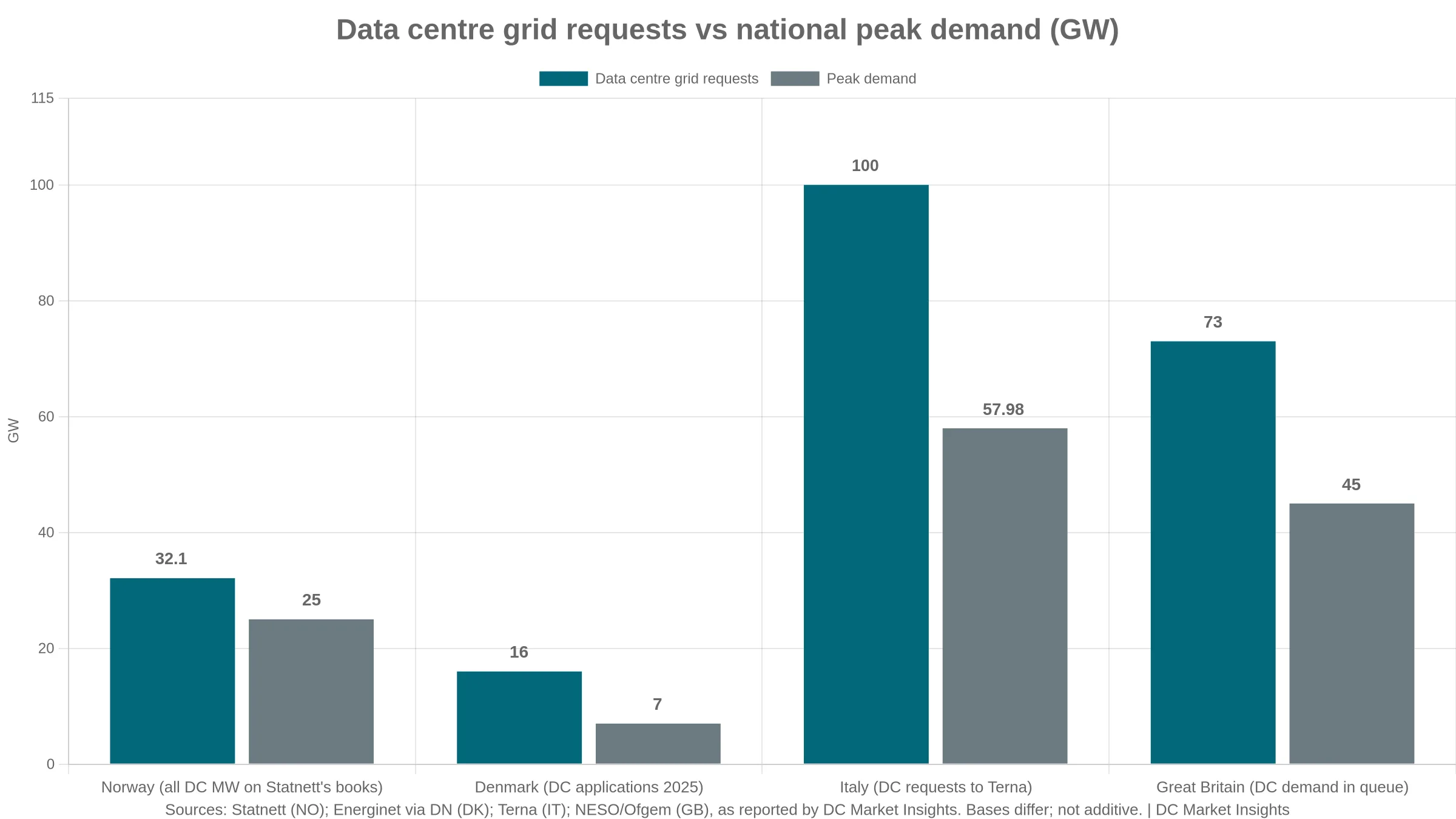
Norway is the fourth large European market in two months where data centre requests have run past what the grid can carry. The ratio is lower than elsewhere, but Norway’s starting point was the most generous.
| Market | Data centre requests | Peak demand | Ratio | Response |
|---|---|---|---|---|
| Norway | 32.1 GW (all stages) | ~25 GW | 1.3x | Reservations halted to 1 Aug 2027; licensing scheme planned |
| Denmark | 16 GW (2025 applications) | ~7 GW | 2.3x | Data centres ranked last of four categories since 19 Oct; answers due later in November |
| Italy | >100 GW | 57.98 GW | 1.7x | Terna queue reform; Lombardy 1.6 GW in final phase |
| Great Britain | ~73 GW | ~45 GW | 1.6x | Ofgem security fee proposed; Data Centre Covenant |
| Ireland | 23% of metered electricity used in 2025 | n/a | n/a | New sites must bring dispatchable generation or storage for 100% of import capacity; rules challenged in High Court |
Sources: our analyses of Denmark (2 Nov), Italy (9 Nov) and Great Britain (19 Oct), with primary sources listed there; Ireland: Bloomberg via Energy Connects, 15 Nov 2026 and KPMG Ireland. Each market counts requests on a different basis; ratios are indicative and must not be added or ranked precisely.
Ireland is the clearest preview of where Norway’s licensing could go. Its regulator, the CRU, ended a de facto moratorium in December 2025 with rules that require new data centres of 10 MVA or more to provide dispatchable on-site or nearby generation or storage covering 100% of their maximum import capacity, and to meet at least 80% of annual demand from additional Irish renewables within six years of energisation, KPMG Ireland summarised. Environmental law charity ClientEarth, Friends of the Irish Environment and Friends of the Earth Ireland are now challenging that policy in the High Court, Bloomberg reported on 15 November. Data centres used 23% of Ireland’s metered electricity in 2025.
In the Netherlands, data centres want about 15 GW of grid, 26 times what they use, as we reported on 26 October. Finland moves data centres above 10 MW into a lower grid priority group from 1 January 2027 unless they offer flexibility. The direction across the region is the same: first come, first served is ending, and data centres are being asked to prove they are useful, flexible and grid-friendly before they get a megawatt.
What it means for operators, investors and vendors
Our view, based on the rules and figures above:
- Operators: value a Statnett reservation as the asset. With 4.2 GW reserved and 9.1 GW queued, a reservation is now worth more than land. Projects with one should move to approval of functional requirements quickly; approved plants can still connect.
- Plan for ride-through requirements. Statnett’s new rules will cover behaviour in grid faults and ramp rates. Ireland’s draft standard asks large demand to ride through faults of up to 1 Hz per second and return to 90% of load within 500 milliseconds; budget UPS, controls and studies for something similar.
- Re-date Norwegian projects without a reservation to after August 2027. 265 days is the minimum if Statnett’s end date holds; licensing principles may come later still.
- Investors: stress-test the 9.1 GW queue at zero. Up to US$86-115 billion of build capex is implied, but none of it is schedulable today. Price Norwegian land and options accordingly.
- Vendors: expect a shift to grid-forming kit. Batteries, fast load control and on-site generation become the entry ticket in Norway, Denmark and Ireland alike.
- AI tenants: prefer connected capacity. With 800 MW connected nationally, contracted, energised halls will carry a premium through 2027.
For sizing the Norwegian build-out, see our Oslo Data Center Market and Norway Data Center Infrastructure Market reports. For the on-site power that new grid rules increasingly demand, see the Data Center Generator Market report. Grid and policy rules across Europe are tracked in our Data Center Power & Policy Tracker, including the Denmark power and policy page.
What to watch next
- Week of 16 November 2026: Ireland’s High Court hears the challenge to the CRU’s large energy user connection policy.
- Later in November 2026: Energinet answers Danish data centre (category 4) grid applicants.
- Date not yet set: Statnett sends its draft functional requirements for data centres out for consultation; RME must then approve them.
- Autumn 2027 (reported): the government presents the main principles of a data centre licensing scheme; NHH reports the scheme is due towards the end of 2027.
- 1 August 2027: latest date Statnett expects to lift the halt on new reservations.
Frequently asked questions
Has Norway banned new data centres?
No. Since 9 November 2026 Statnett has stopped reserving new grid capacity for data centres and paused new fos § 14 approvals, including 420 kV applications. Existing connections and plants with approved functional requirements can still connect. Statnett expects to lift the halt by 1 August 2027.
How much grid capacity do Norwegian data centres want?
About 32.1 GW in total: 800 MW connected, 4,200 MW reserved, 9,100 MW in the queue and 18,000 MW of further requests, according to Statnett. Norway’s peak demand is just over 25 GW, so the total is about 1.28 times peak (our calculation).
How much electricity do data centres use in Norway?
Around 2% of national consumption, according to the Norwegian Board of Technology, which cites a Thema Consulting estimate of about 9 TWh by 2030. The 4.2 GW already reserved would use about 29 TWh a year at 80% load (our calculation).
Why did Statnett pause data centre connections?
For grid stability. Statnett says large data centres have technical characteristics that matter for safe operation, such as how they behave in faults and how fast they change load. It will set functional requirements, consult on them and seek RME approval before new reservations resume.
Sources
- Statnett, “Midlertidige tiltak for fortsatt forsvarlig systemdrift”, 9 Nov 2026. Link
- Government of Norway, “Government seeks controlled growth of data centres in Norway”, 9 Nov 2026. Link
- CMS, “Statnett halts new grid reservations for data centres and the government plans a licensing regime”, 9 Nov 2026. Link
- NHH Bulletin, “NHH professor critical of data centre measures”, 9 Nov 2026. Link
- Enerdata, “Statnett pauses new grid capacity for data centres in Norway”, 10 Nov 2026. Link
- Bytes Europe, “Norway slams brakes on AI data center boom over grid fears”, 13 Nov 2026. Link
- Norwegian Board of Technology (Teknologirådet), “Data centres in Norway”. Link
- Bisnow, “OpenAI Pausing Stargate Projects In 3 Countries As Key Execs Depart”, 15 Apr 2026. Link
- Energy Connects (Bloomberg), “Ireland’s Data-Center Lawsuit Puts Energy Policy Under Scrutiny”, 15 Nov 2026. Link
- KPMG Ireland, “Ireland’s data centre policy reset”. Link
- DC Market Insights, “Denmark put data centres last in its grid queue”, 2 Nov 2026. Link
- DC Market Insights, “Data centres have asked Italy’s grid for 100 GW”, 9 Nov 2026. Link
- DC Market Insights, “Data centres want 73 GW of Britain’s grid”, 19 Oct 2026. Link
- DC Market Insights, Oslo Data Center Market report and facilities data (NO), 16 Nov 2026. Link