


Key takeaways
- PJM’s 2028/2029 capacity auction cleared at the $325/MW-day cap and still fell 6,831 MW short of its reliability requirement, PJM’s auction report shows.
- PJM’s one-time fix, a reliability backstop procurement for that 6,831 MW, was due to open on 30 September. FERC suspended it on 29 September over cost allocation, transmission owner exit rules and collateral.
- On 7 October the US Department of Energy told FERC that the costs of serving data centers and other large loads should not be shifted to existing customers. PJM plans to refile by 29 October.
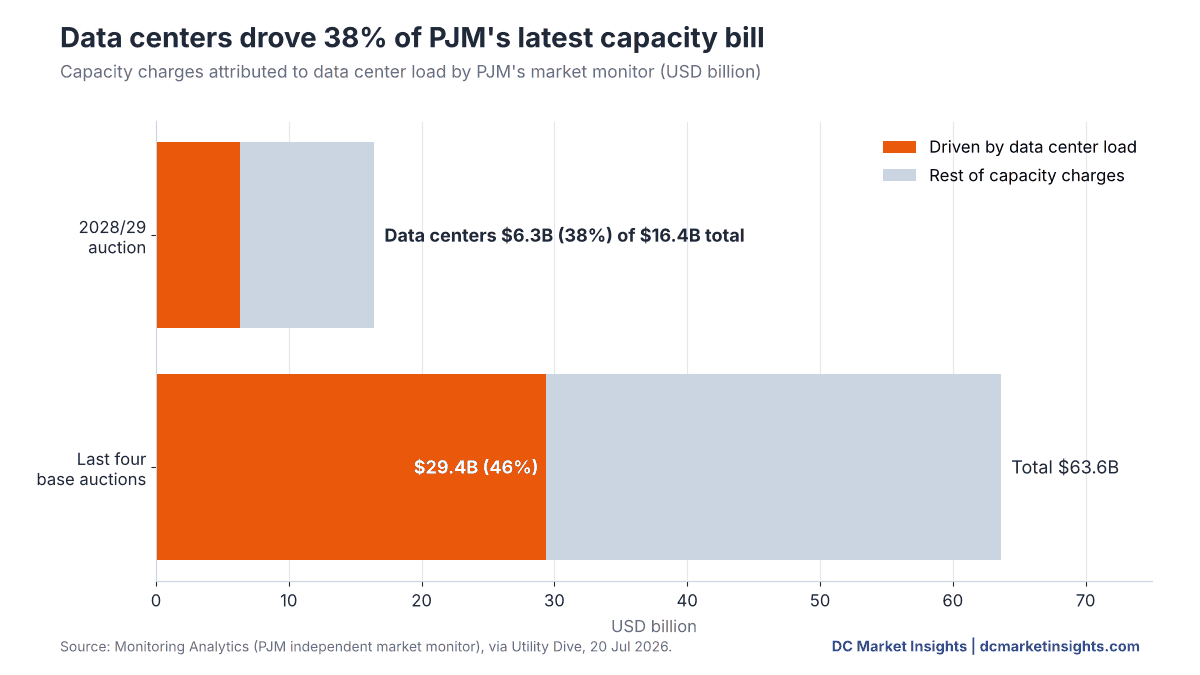
- PJM’s market monitor says data center load drove $6.3 billion, or 38%, of the $16.4 billion in charges from the latest auction, and $29.4 billion across the last four.
- Our calculation: at its $555/MW-day price ceiling, the backstop could cost up to about $1.38 billion a year, or about $20.8 billion over 15-year contracts.
The largest US grid market has run out of spare capacity, and the plan to buy more is stuck on one question: who pays. Until PJM answers it, every data center seeking power in its 13 states and the District of Columbia faces higher bills, a later connection date, or both.
The question is live this month. FERC’s 29 September order put PJM’s backstop procurement on hold. The Department of Energy weighed in on 7 October with what Utility Dive described as its first FERC filing in at least five years. PJM’s members meet on 22 October, and PJM plans to file a revised proposal by 29 October.
How PJM got here: two auctions at the cap, two shortfalls
PJM buys capacity about three years ahead in its Base Residual Auction. The last two auctions both cleared at the price cap set by a FERC-approved price collar: $333.44/MW-day for 2027/2028 and $325/MW-day for 2028/2029. Both still came up short. In the 2028/2029 auction, held in July, PJM procured 149,181.6 MW of capacity including Fixed Resource Requirement commitments, against a reliability requirement of 156,013 MW. That left a shortfall of 6,831.3 MW, up from 6,516 MW a year earlier, PJM’s results report shows.
The total reserve margin came in at 14.7%, against a 20% target. The auction cost $16.4 billion. Without the cap, PJM estimated the bill at $29.7 billion, and the price would have cleared near $555/MW-day across PJM and $777/MW-day in the ComEd zone, Utility Dive reported. PJM attributed a forecast load increase of 1,374.5 MW “largely” to additional large loads.
The supply side is not keeping up. Only 524.7 MW of new, uprated and reactivated capacity cleared in the 2028/2029 auction, down from 774.3 MW the year before. By our calculation, the shortfall is about 13 times the new supply that cleared.
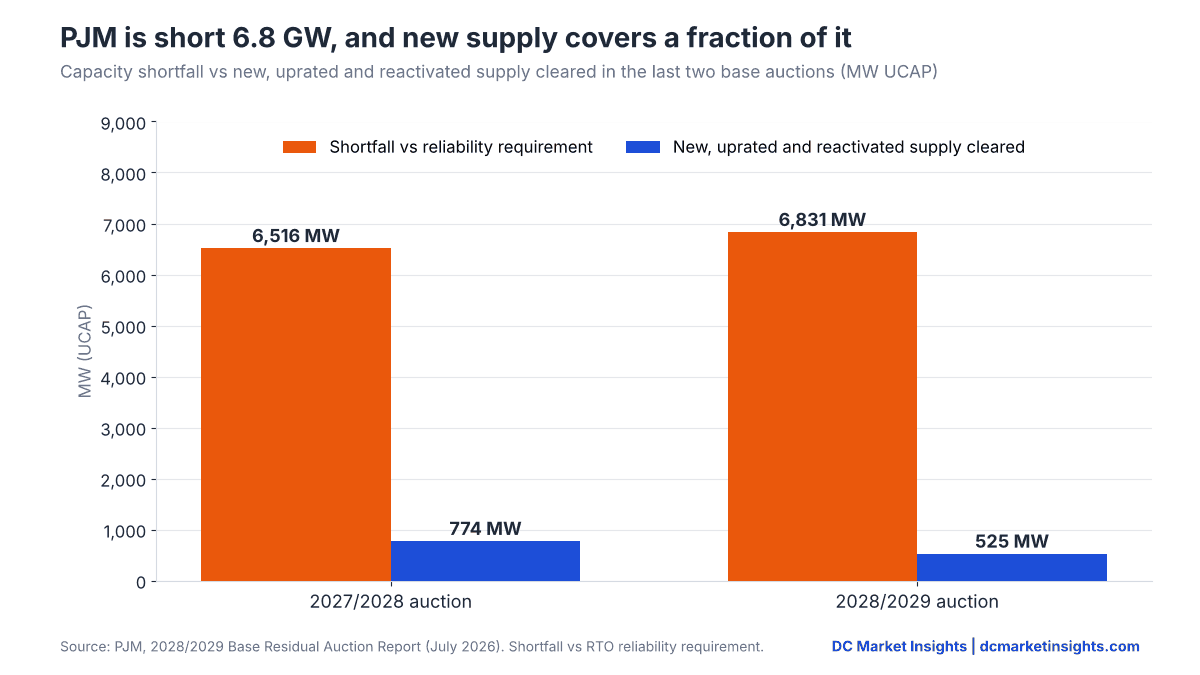
| PJM base auction | 2027/2028 | 2028/2029 |
|---|---|---|
| Clearing price (RTO) | $333.44/MW-day (cap) | $325.00/MW-day (cap) |
| Reliability requirement (UCAP) | 152,400 MW | 156,013 MW |
| Shortfall against the requirement | 6,516 MW | 6,831.3 MW |
| Total reserve margin (target 20%) | 14.9% | 14.7% |
| New, uprated and reactivated supply cleared | 774.3 MW | 524.7 MW |
| Total auction cost | $16.4 billion | $16.4 billion |
Source: PJM, 2028/2029 Base Residual Auction Report, July 2026. FERC’s 29 September order gives the 2027/2028 shortfall as 6,623 MW; we use PJM’s report figure and do not mix the two.
What changed: the backstop stalled at FERC
PJM’s Board chose its response in a 27 July decisional letter. It had three parts: a one-time reliability backstop procurement, an “Interim Resource Adequacy Service” for new large loads that do not bring their own capacity, and a Large Load Registry.
Existing consumers should not bear higher capacity costs caused by new Large Loads
The backstop, filed at FERC on 31 July, set an initial target of 6,831 MW, reduced for signed bilateral contracts and other new supply. Only new generation, plus documented new demand response and distributed resources, could take part. Resources must be in commercial operation by 1 June 2032. Contracts could run up to 15 years, at a maximum MW-weighted average price of $555/MW-day, according to PJM’s fact sheet. The offer window was to run from 30 September to 21 October.
| Reliability backstop procurement | As filed by PJM |
|---|---|
| Initial target | 6,831 MW, reduced for bilateral contracts and other new supply |
| Eligible resources | New generation; new demand response and distributed resources with documentation |
| Commercial operation deadline | 1 June 2032 |
| Contract length | Up to 15 years |
| Price ceiling | MW-weighted average of $555/MW-day |
| Cost allocation (as filed) | Zones by pro rata share of the target, then load-serving entities in each zone |
| Maximum annual cost at the ceiling | About $1.38 billion (our calculation: 6,831 MW × $555 × 365 days) |
| Maximum cost over 15 years | About $20.8 billion, undiscounted (our calculation) |
Sources: PJM, Reliability Backstop Procurement fact sheet, July 2026; FERC order, Docket ER26-3380-000, 29 Sep 2026. Our ceiling figures assume the full target is bought at the maximum price. Bilateral contracts and lower bids would reduce them.
FERC did not approve it as filed. In its 29 September order (Dockets ER26-3380-000 and EL26-108-000), the Commission accepted the filing, suspended it for five months and made it effective 28 February 2027, subject to refund. It found that three parts may be unjust and unreasonable: cost allocation, transmission owner exit rules, and load-serving entity collateral. It set those for a paper hearing and strongly encouraged PJM to file a new proposal instead. PJM put the procurement on hold.
The Department of Energy then filed a statement of position on 7 October. “PJM should implement the cost allocation and other reforms identified by the Commission,” DOE wrote, so that costs are not “unfairly shifted” to existing ratepayers, Utility Dive reported. DOE also pointed to the White House Ratepayer Protection Pledge, which PJM utilities including AEP, Dominion Energy, Exelon, FirstEnergy and PPL have signed. PJM spokesman Jeffrey Shields told Utility Dive that PJM intends to file by 29 October rather than wait for a hearing that runs into February 2027.
Who is hurting, and how much
Existing customers. PJM’s independent market monitor, Monitoring Analytics, says existing and forecast data center load raised capacity market revenues by about $29.4 billion across the 2025/2026 to 2028/2029 auctions. That is 46% of the $63.6 billion in total capacity charges, Utility Dive reported. In its first-half 2026 State of the Market report, the monitor put the total wholesale cost of power at $114.50/MWh, up 50.3% from $76.16/MWh a year earlier. Data center load in the capacity market added $11.11/MWh, or 9.7%, to that cost.
Utility Dive’s 27 August report on the first seven months of 2026 gives a 9% data center share ($10.48/MWh of $116.53/MWh). The monitor’s first-half report gives 9.7% ($11.11 of $114.50). The periods differ, so the figures should not be combined.
PJM is continuing to act like it’s business as usual.
Data center developers. The cost allocation fight decides whether new data centers pay a larger share of the backstop. At the $325/MW-day cap, capacity costs about $118,625 per MW-year. For a 100 MW load, that is about $11.9 million a year in capacity charges alone (our calculation, before PJM’s load scaling factors). A cost allocation that charges new large loads first would add backstop costs on top. Timelines are at risk too. Under the Board’s plan, new large loads that do not bring enough capacity by 1 June 2027 would take Interim Resource Adequacy Service, which can be curtailed before PJM’s pre-emergency demand response is called.
Northern Virginia and other PJM hubs. DC Market Insights data tracks 25 Virginia facilities with stated capacity: 495 MW operational, 351.5 MW under construction and 768 MW planned, including CloudHQ’s 300 MW Manassas campus and Digital Realty’s two 96 MW buildings in Manassas. Across the United States, our tracker lists 12,517 MW under construction and 20,699 MW planned at the 326 of 1,173 facilities with stated MW. These are IT or facility MW, not PJM’s UCAP, so they show exposure, not a share of the shortfall.
Generators and new supply. They stand to gain from 15-year contracts at up to $555/MW-day, but only once the rules are settled. Julia Hoos, head of USA East at Aurora Energy Research, warned in July of “an intervention doom loop” in PJM’s market, Utility Dive reported. The delay also hits developers lining up offers for a window that has not opened.
Bring your own power is the industry’s answer
The fastest relief so far has come from bilateral deals, which the backstop counts against its target. On 6 October, Google and Constellation Energy announced an agreement to add 890 MW of nuclear capacity to PJM through uprates at 11 units in Illinois, Pennsylvania and New Jersey, backed by more than $4.3 billion of investment, with the first uprate expected by 2028. A separate 15-year agreement covers 2,700 MW of existing Constellation generation, according to the companies’ release. By our calculation, 890 MW is about 13% of the 6,831 MW target, though nameplate uprates and PJM’s UCAP are measured differently.
We’re committed to meeting our growth responsibly by actively investing in clean, reliable power.
Bowring has argued for a stricter version: large loads should contract for their own generation, and those that cannot should face a separate auction with 15-year contracts. PJM’s Board went partway. From the 2029/2030 delivery year, new large loads above the 2028/2029 forecast are to be left out of auction demand until their new capacity is offered.
The December auction will not wait
The next base auction, for 2029/2030, runs in December. Maryland’s People’s Counsel asked PJM to adjust the posted load forecast for large loads that may not show up. PJM’s chief executive declined in a 1 September letter, saying that substantial load reduction would be needed to clear below the cap anyway.
we do not believe we should attempt to make any further adjustments to the load forecast for the 29/30 auction.
In our view, a third auction at or near the cap is the base case. The open question is whether the backstop is in place before it runs, so the 2028/2029 gap is not carried into 2029/2030.
Not just PJM
Other grids are also writing the bill for large loads into their rules. On 2 October, MISO filed at FERC for a 120-day Large Load Addition Resource Study for loads over 200 MW that come paired with new generation, and asked for a ruling by 2 December, Utility Dive reported. In Texas, ERCOT is auditing a 474 GW large-load queue, as we covered in our 7 October analysis. A Florida law passed in May requires data centers over 50 MW to cover the full cost of their grid connection. Grid Strategies found that utility data center load forecasts filed with FERC were about 40% higher than credible industry projections through 2030, Utility Dive reported. That gap is why regulators want new loads, not existing customers, to carry the risk.
What it means for operators, investors and vendors
Our view, based on the filings above:
- Model PJM capacity at the cap. Use $325-$333/MW-day, or about $118,625 per MW-year, as the base case for 2028-2030 budgets, not a fall back to earlier prices.
- Price in a backstop surcharge. The ceiling is about $1.38 billion a year across PJM (our calculation). If the 29 October filing charges new large loads first, a large share of that could land on data center tariffs.
- Bring capacity to cut the bill and the queue. Bilateral deals reduce the 6,831 MW target. The Google-Constellation uprates show the template: 890 MW, about 13% of the target.
- Plan for curtailment from June 2027. New loads without enough capacity would take interruptible interim service. Contracts for AI tenants need backup power and curtailment terms.
- Vendors: the backstop is an order book in waiting. Up to 6,831 MW of new generation, demand response and storage with a 2032 deadline. Turbine, storage and switchgear demand follows the rules, not the announcement.
For on-site and backup power options under these rules, see our Data Center Generator Market report. For demand response and storage, see the Data Center Energy Storage Market report. For the AI demand behind the load forecasts, see the AI Data Center Market report. Track the rules on our United States power and policy page, the sites on the United States data center map, and power and campus deals in the Deal Tracker.
What to watch next
- 22 October 2026: PJM special Members Committee meeting on the revised backstop.
- 29 October 2026: PJM’s planned new FPA section 205 filing at FERC, including cost allocation.
- About 13 November 2026: initial briefs in FERC’s paper hearing, if it is not held in abeyance.
- 2 December 2026: MISO’s requested FERC ruling on its large-load fast-track study.
- December 2026: PJM’s 2029/2030 Base Residual Auction.
- 28 February 2027: effective date FERC set for the suspended backstop, subject to refund.
- 1 June 2027: eligibility date for PJM’s Interim Resource Adequacy Service for new large loads.
Frequently asked questions
How big is PJM’s capacity shortfall?
6,831 MW. PJM’s 2028/2029 auction procured 149,181.6 MW against a reliability requirement of 156,013 MW, for a total reserve margin of 14.7% against a 20% target. The prior auction was 6,516 MW short.
What is PJM’s reliability backstop procurement?
A one-time purchase of up to 6,831 MW of new generation, demand response and distributed resources, on contracts of up to 15 years at a maximum average of $555/MW-day. FERC suspended it on 29 September 2026 over cost allocation, transmission owner exit rules and collateral.
How much have data centers added to PJM capacity costs?
About $29.4 billion across the last four base auctions, 46% of $63.6 billion, according to PJM’s market monitor. In the 2028/2029 auction, data center load drove $6.3 billion, or 38%, of $16.4 billion.
When will PJM refile the backstop?
By 29 October 2026, PJM told Utility Dive. A special Members Committee meeting is set for 22 October. DOE has asked FERC to make sure the costs of large loads are not shifted to existing customers.
Sources
- Utility Dive, “DOE presses PJM on ratepayer protections from large load costs”, 8 Oct 2026. Link
- US Department of Energy, statement of position at FERC (accession 20261007-5181), 7 Oct 2026. Link
- FERC, Order on PJM Reliability Backstop Procurement, 196 FERC ¶ 61,245, Dockets ER26-3380-000 and EL26-108-000, 29 Sep 2026. Link
- PJM, “Reliability Backstop Procurement” fact sheet, July 2026. Link
- PJM, “2028/2029 Base Residual Auction Report”, July 2026. Link
- PJM Board of Managers, decisional letter on CIFP, reliability backstop procurement and connect and manage, 27 Jul 2026. Link
- PJM, President and CEO response to the Maryland Office of People’s Counsel on the 2029/2030 Base Residual Auction, 1 Sep 2026. Link
- Monitoring Analytics, “2026 State of the Market Report for PJM: January through June”, 2026. Link
- Utility Dive, “PJM capacity prices hit price cap, reserve shortfall grows”, 15 Jul 2026. Link
- Utility Dive, “Data centers drove $6.3B in PJM capacity auction costs: market monitor”, 20 Jul 2026. Link
- Utility Dive, “Data center load made up 9% of PJM wholesale costs so far in 2026: market monitor”, 27 Aug 2026. Link
- Constellation Energy, “Google and Constellation announce landmark agreement to bring 890 MW of new nuclear capacity to PJM grid”, 6 Oct 2026. Link
- Utility Dive, “MISO proposes fast-track large load, generation study process”, 5 Oct 2026. Link
- Utility Dive, “Efforts to curb data center speculation gain ground across the US”, 23 Sep 2026. Link
- The White House, “Ratepayer Protection Pledge”. Link
- DC Market Insights, United States data center tracker and power and policy data, checked 12 Oct 2026. Link