
Nigeria Data Center Infrastructure Market Size, Share & Forecast to 2035
Market at a glance
The Nigeria Data Center Infrastructure market was worth USD 306.9 million in 2025 and is forecast to reach USD 1,090.0 million by 2035, growing at a 13.54% CAGR.
 By Amit Jain, Senior Consultant, ICT & Emerging Technologies
 Reviewed by Deepti Agrawal
Last updated 18 Oct 2026
Base year 2025 PDF + Excel
What is inside the report
- 01Introduction
- 02Executive Summary
- 03Market Scope and Estimate Comparison
- 04Market Drivers
- 05Market Trends
- 06Market Restraints
- 07Market Opportunities
- 08Pricing Analysis
- 09Standards and Regulation
- 10Market Segmentation by Infrastructure Type
- 20chapters
- 2020-2024Historical period
- 2026-2035Forecast period
- —Companies profiled
Segmentation
Full analysis
The Nigeria Data Center Infrastructure Market is valued at USD 448.35 million in 2026 and is projected to reach USD 1.09 billion by 2035, up from USD 306.88 million in 2025, a CAGR of 13.54% from 2025 to 2035 (DC Market Insights estimate). In Nigeria the money follows the power problem: the national grid delivers only part of its installed generation, so every Lagos hall is built to run on its own diesel or gas generators, and electrical plant takes 46.4% of 2025 spend, against roughly 38% in grid-reliable markets. The build wave is now in Lekki and Eko Atlantic, where Kasi Cloud flagged off a campus designed for about 100 MW of critical IT load on 19 May 2026 (Source: Nigeria Sovereign Investment Authority) and Airtel Africa’s 38 MW Nxtra facility is under construction. Nigeria Data Center Infrastructure covers the physical facility layers inside Nigerian data centers: electrical, mechanical and cooling, civil, structural and architectural works, and racks, cabling and physical network. The 2025 receipt is 33.5 MW of new IT load booked × USD 7.88 million of facility content per MW = USD 264.08 million, plus USD 16.75 million of racks and cabling and USD 26.05 million of upgrades across a 74.4 MW average installed base. Mechanical and cooling infrastructure grows fastest at 15.70% a year because AI-ready halls need chilled-water plant, and the Rest of South-West (Ogun and Oyo) is the fastest region at 23.58% a year as operators look for land and gas supply outside Lagos.
How Big Is Nigeria’s Data Center Infrastructure Spend in 2026?
DC Market Insights values Nigeria’s data center infrastructure spend at USD 448.35 million in 2026, 46.10% above the USD 306.88 million of 2025, because new IT completions double from 22 MW to 45 MW as Lekki and Eko Atlantic campuses come online.
- 2025 size: USD 306.88 million (USD 306.9 million rounded; DC Market Insights estimate).
- 2026 size: USD 448.35 million.
- 2030 size: USD 716.41 million.
- 2035 size: USD 1.09 billion.
- CAGR 2025-2035: 13.54% in the base case; 2035 low case USD 780.17 million, high case USD 1.35 billion.
- Largest infrastructure type: electrical infrastructure, USD 142.39 million in 2025 (46.4%).
- Fastest infrastructure type: mechanical and cooling infrastructure, 15.70% a year.
- Leading region: Lagos, 78.0% of 2025 spend (USD 239.37 million).
- Fastest region: Rest of South-West (Ogun and Oyo), 23.58% a year; fastest hub: Ogun (Sagamu, Abeokuta), 24.66% a year.
- Largest hub: Ikeja and Mainland, USD 86.17 million in 2025.
- Market leader: Schneider Electric, with an estimated 10% of 2025 equipment value (DC Market Insights estimate).
Key Takeaways: What Do the Numbers Say About Building Data Center Infrastructure in Nigeria?
Four findings carry the Nigeria Data Center Infrastructure Market forecast, each with its figure and the reason behind it.
- New-build spend on Nigeria data center infrastructure rises 45.96% in 2026 (DC Market Insights estimate), from USD 280.83 million to USD 409.91 million, because Equinix LG3, the first Kasi Cloud phase and Airtel’s Nxtra hall all reach completion in the same year.
- Backup power makes the Nigerian hall about USD 1.00 million per MW dearer than a hall in a grid-reliable market, because operators size generators at 2N and store fuel for 72 hours or more.
- Hyperscale and cloud data centers rise from 12.0% to 32.0% of spend by 2035, because local hosting rules for government and banking data pull cloud regions onshore.
- Upgrades of the installed base reach USD 275.53 million by 2035, 25.2% of the market, because generator, uninterruptible power supply (UPS) battery and chiller fleets in 644 MW of halls wear out faster under daily grid outages.
How Fast Will Nigeria’s Data Center Infrastructure Spend Grow to 2035?
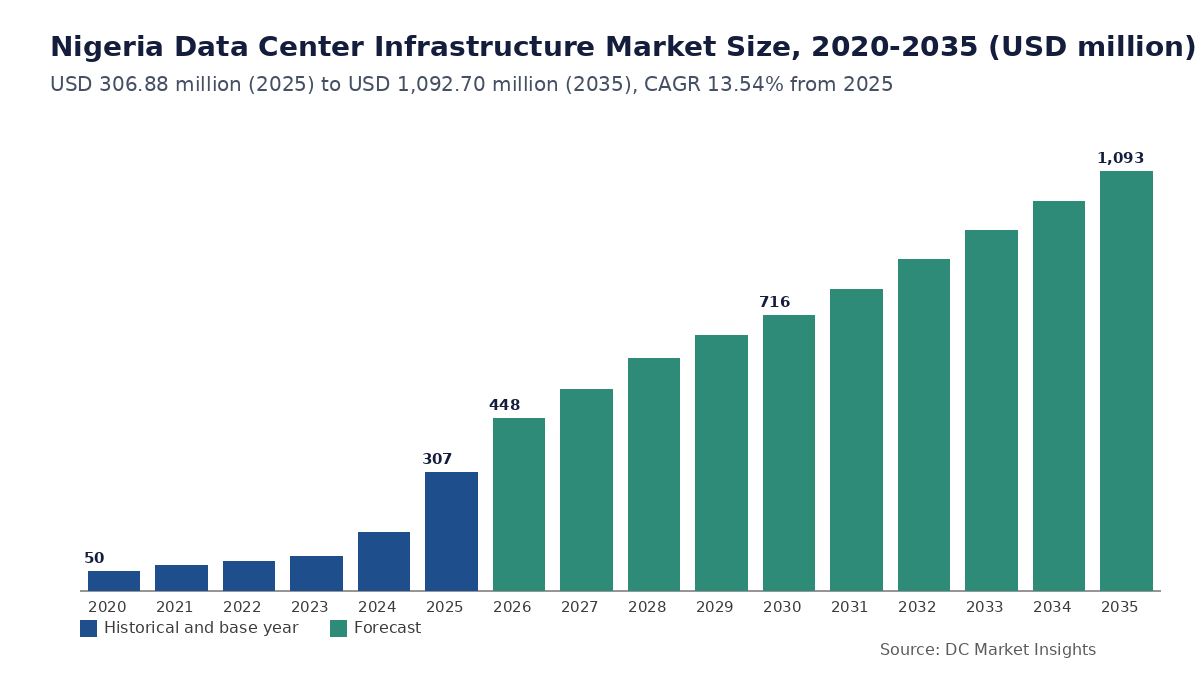
The Nigeria Data Center Infrastructure Market size was valued at USD 49.56 million in 2020, reached USD 306.88 million in 2025, and is anticipated to reach USD 1.09 billion by 2035, at a CAGR of 13.54% during the forecast period.
| Attribute | Value |
|---|---|
| Historical period | 2020-2024 |
| Base year | 2025 |
| Forecast period | 2026-2035 |
| Market size 2025 | USD 306.88 million |
| Market size 2026 | USD 448.35 million |
| CAGR 2025-2035 | 13.54% |
| Market size 2035 | USD 1.09 billion |
Growth from 2020 to 2025 ran at 44.00% a year from a small base, as Nigeria’s installed IT load rose from about 35 MW to 85 MW and Rack Centre’s 12 MW LGS2 hall was commissioned in April 2025. DC Market Insights expects 270 MW of new IT load from 2026 to 2030, which lifts annual spend to USD 716.41 million in 2030, before growth slows to 8.81% a year after 2030 as completions settle at 60 to 72 MW a year. The model counts only the facility layer: servers, storage and switches sit in the IT line of the Nigeria Data Center Market report.
What Does Nigeria Data Center Infrastructure Cover, and Where Does It Stop?
Nigeria data center infrastructure covers USD 306.88 million of 2025 spend on the physical plant that houses, powers and cools IT equipment in Nigerian data centers.
Included
Electrical infrastructure (utility connection inside the fence, medium-voltage switchgear and transformers, diesel and gas generators, fuel storage, UPS systems and batteries, busways and power distribution units, onsite solar and gas hybrids); mechanical and cooling infrastructure (chillers, computer room air handlers, in-row units, containment, pumps and piping, liquid-ready loops); civil, structural and architectural works (foundations, drainage, frames, envelopes, raised floors, fire detection and suppression, physical security); and racks, cabling and physical network. Both new halls and upgrades of operating halls are counted.
Excluded
Servers, storage and switches, land, grid electricity and diesel fuel, transmission works by the Transmission Company of Nigeria (TCN), colocation and cloud revenue, and facility management. Outsourced infrastructure and utility services, such as managed power plants, outsourced facility operations and energy-as-a-service contracts, count here only for the equipment and works they install; their service fees sit outside this market. Software that monitors the plant is sized in the Nigeria Data Center Infrastructure Management (DCIM) Market: that report covers the monitoring software layer, this one the equipment and works the software monitors.
How the segments fit together
Every year, infrastructure type, project type, data center type, tier and region each sum to the same total: USD 306.88 million in 2025 and USD 1.09 billion in 2035.
Why Are Other Nigeria Data Center Infrastructure Estimates Higher?
DC Market Insights puts the Nigeria Data Center Infrastructure Market at USD 448.35 million in 2026, and broader figures for the same name usually add IT hardware, land and fuel.
The earlier DC Market Insights edition counted servers, storage and networking equipment as infrastructure, which roughly doubled its total; taking the IT line out leaves only the facility layer. Other broad definitions also add land purchase in Lekki or Eko Atlantic, diesel fuel bills and colocation rent, which are real-estate or operating costs rather than infrastructure equipment. DC Market Insights keeps them out so that the figure can be checked against a buyer’s capital budget.
| Element | In this report | Why | 2025 value |
|---|---|---|---|
| Electrical, cooling, civil works | Yes | Facility capital spend | USD 290.13 million |
| Racks, cabling, physical network | Yes | Installed with the hall | USD 16.75 million |
| Servers, storage, switches | No | IT equipment, in the parent IT line | Parent report |
| DCIM software | No | Separate software market | Separate report |
| Land, diesel fuel, grid electricity, colocation rent | No | Real estate and operating costs | Not modelled |
The out-of-scope terms are IT hardware, servers, storage, land, diesel fuel, grid electricity and colocation rent. In-scope buyers include colocation operators, telecom carriers such as MTN and Airtel, banks and fintechs, federal and state agencies, cloud providers, and small and medium-sized enterprises (SMEs) that build or upgrade their own server rooms.
What Is Driving Data Center Infrastructure Investment in Nigeria?
Three Nigeria-specific forces lift Nigeria data center infrastructure spend from USD 306.88 million in 2025 to USD 716.41 million in 2030: local hosting rules, Lekki’s subsea-cable campuses and a 90,000 km national fibre build.
Local Hosting Rules for Government, Banking and Identity Data
According to the National Information Technology Development Agency (NITDA), its 2019 Guidelines for Nigerian Content Development in Information and Communications Technology require sovereign data to be hosted in Nigeria unless NITDA approves otherwise. The Central Bank of Nigeria (CBN) framework for Bank Verification Number (BVN) operations of 2021 keeps all BVN data inside the country, and the 2024 order designating Critical National Information Infrastructure added the BVN, the National Identification Number (NIN) and Nigeria Inter-Bank Settlement System (NIBSS) platforms. These rules keep 25.0% of 2025 spend, USD 76.72 million, in enterprise halls run by banks, telecoms and agencies, and they push foreign cloud providers towards Nigerian colocation.
Lekki and Eko Atlantic Campuses Next to the Subsea Cables
Kasi Cloud’s Lekki campus sits on about four hectares next to six subsea cable landing stations and is designed for about 100 MW of critical IT load, according to the Nigeria Sovereign Investment Authority release (May 2026). Airtel Africa began building its 38 MW Nxtra data center at Eko Atlantic in March 2024 with more than USD 120 million committed (Source: Airtel Africa). DC Market Insights expects the Lekki and Eko Atlantic hub to lift its share of national spend from 26.5% in 2025 to 30.8% in 2035, when it becomes the largest hub in the country.
Project BRIDGE and the 90,000 km Fibre Backbone
Project BRIDGE is designed to deploy 90,000 km of fibre across Nigeria, backed by USD 500 million from the World Bank Group and USD 100 million from the European Bank for Reconstruction and Development (EBRD), according to the Federal Ministry of Communications, Innovation and Digital Economy (February 2026). Fibre to Abuja, Port Harcourt, Kano and Ibadan makes regional halls viable, which is why spend outside Lagos rises from 22.0% to 30.0% of the total by 2035.
How Are Nigerian Data Centers Being Built Differently Now?
Two trends reshape the Nigeria data center infrastructure bill of materials: gas and solar hybrids that cut diesel hours, and AI-ready halls that lift cooling content per MW from USD 1.73 million in 2025 to about USD 2.86 million in 2035.
From Diesel Generators to Gas and Solar Hybrids
DC Market Insights estimates that diesel self-generation costs Lagos operators USD 0.28 to 0.33 per kWh, and the Nigerian Electricity Regulatory Commission (NERC) set the Band A grid tariff at N206.80 per kWh from 6 May 2024 for customers promised at least 20 hours of supply a day. Operators now add gas engines, solar arrays and battery storage alongside diesel sets; DC Market Insights puts onsite hybrid power at USD 0.30 million per MW of new IT load in 2025, part of the USD 142.39 million electrical line.
AI-Ready Halls and Chilled-Water Plant
The Kasi Cloud campus is engineered for high-density AI and accelerated computing, according to the Nigeria Sovereign Investment Authority, and MTN’s 9 MW Sifiso Dabengwa data center in Ikeja was built in two phases of 4.5 MW (Source: MTN Nigeria, July 2025). DC Market Insights models mechanical and cooling infrastructure, 21.1% of 2025 Nigeria data center infrastructure spend, growing the fastest of any infrastructure type at 15.70% a year.
Prefabricated Modules for Faster Phasing
Operators phase campuses in 1 to 12 MW blocks, such as the first phase of Equinix LG3 in Lagos, a USD 22 million investment set to open in the first quarter of 2026, according to the Equinix LG3 announcement (November 2025). Edge data centers take USD 24.55 million, or 8.0%, of 2025 Nigeria data center infrastructure spend (DC Market Insights estimate).
Why Do Nigerian Data Center Infrastructure Projects Stall? Restraints from Power and Currency
Unreliable grid supply and naira-denominated revenue against dollar-priced equipment are the two restraints on Nigeria data center infrastructure that could cut 2035 spend by up to USD 312.53 million, the gap between the base case and the low case.
Grid Availability and Diesel Dependence
DC Market Insights estimates that Nigeria’s grid delivers an average of 5,000 to 6,000 MW against more than 13,000 MW of installed generation, so data centers run on their own generators for many hours a day. The low case assumes 30% fewer completions from 2027 as power costs delay projects, which leaves 2035 spend at USD 780.17 million and the installed base at about 484 MW instead of 644 MW.
Currency Risk on Imported Equipment
Almost all switchgear, UPS systems, generators and chillers are imported and priced in US dollars or euros, while colocation contracts are partly paid in naira. DC Market Insights estimates that about 85% of 2025 equipment value is imported, and public build-cost disclosures in Lagos put full Tier III halls at USD 10 to 15 million per MW once land, shell and IT fit-out are added.
Which Nigeria Data Center Infrastructure Opportunities Are Worth the Most by 2035?
The two largest opportunities in Nigeria data center infrastructure are Lekki and Eko Atlantic campus fit-outs, worth USD 336.55 million a year by 2035, and upgrades of operating halls, worth USD 275.53 million a year by 2035.
Fit-Out of Lekki and Eko Atlantic Campuses
The Lekki and Eko Atlantic hub raises its share of spend from 26.5% to 30.8% by 2035 as the Kasi Cloud, Nxtra and other campuses move from shell to fit-out. Medium-voltage substations, generator farms and chilled-water plant are the first packages to tender.
Generator, Battery and Chiller Replacement in Operating Halls
Upgrade and retrofit spend grows 26.60% a year, faster than new builds at 11.27%, because generator sets that run many hours a day reach overhaul sooner and UPS batteries cycle daily. Suppliers with local service teams and spare-parts stock in Lagos and Abuja are best placed for these contracts.
What Does a Megawatt of Data Center Infrastructure Cost in Lagos and Abuja?
For Nigeria data center infrastructure, DC Market Insights puts facility content at USD 7.88 million per MW of IT load in 2025, rising to USD 10.59 million per MW in 2035, plus USD 0.50 million per MW for racks and cabling.
| Cost item | 2020 | 2025 | 2030 | 2035 |
|---|---|---|---|---|
| Facility content per new MW (USD million) | 6.80 | 7.88 | 9.14 | 10.59 |
| Racks and cabling per new MW (USD million) | 0.45 | 0.50 | 0.55 | 0.60 |
| Upgrade spend per installed MW-year (USD million) | 0.30 | 0.35 | 0.40 | 0.45 |
Public anchors back these values. MTN Nigeria put about USD 100 million of infrastructure into the 4.5 MW first phase of its Ikeja data center, a figure that includes the building shell for the full 9 MW and cloud networking (Source: MTN Nigeria, July 2025). Equinix’s first LG3 phase cost USD 22 million (Source: Equinix). DC Market Insights’ USD 8.38 million per MW of facility, rack and cabling content sits below the USD 10 to 15 million per MW full-build range because land, shell finishes and IT fit-out are excluded.
Which Hosting Rules, Data Laws and Standards Apply to Nigerian Data Center Infrastructure?
Five rules shape the USD 306.88 million of 2025 Nigeria data center infrastructure spend, from local hosting to data protection and power tariffs.
- NITDA Guidelines for Nigerian Content Development in ICT (2019): sovereign data hosted in Nigeria unless NITDA approves otherwise.
- Nigeria Cloud Computing Policy (2019): cloud services for public bodies, read together with the NITDA guidelines.
- CBN Regulatory Framework for BVN Operations (2021): all BVN data stored in Nigeria.
- Nigeria Data Protection Act 2023: cross-border transfers only with adequate protection or statutory conditions, with a transfer impact assessment.
- Designation of Critical National Information Infrastructure Order (2024): BVN, NIN and NIBSS platforms named as critical infrastructure.
Tier III certification is the norm for colocation contracts; Rack Centre describes LGS2 as a Tier III carrier- and cloud-neutral facility (Source: Rack Centre). DC Market Insights estimates that Tier III facilities take 65.0% of 2025 spend, USD 199.47 million.
Which Segment Makes the Money in Nigeria Data Center Infrastructure: Power, Cooling or Civil Works?
Electrical infrastructure leads the Nigeria Data Center Infrastructure Market with USD 142.39 million in 2025 (46.4%), while mechanical and cooling infrastructure grows fastest at 15.70% a year.
By Infrastructure Type
| Infrastructure Type | 2025 (USD million) | Share 2025 | 2035 (USD million) | CAGR 2025-2035 |
|---|---|---|---|---|
| Electrical Infrastructure | 142.39 | 46.4% | 513.34 | 13.68% |
| Mechanical and Cooling Infrastructure | 64.61 | 21.1% | 277.69 | 15.70% |
| Civil, Structural and Architectural | 83.13 | 27.1% | 257.87 | 11.99% |
| Racks, Cabling and Physical Network | 16.75 | 5.5% | 43.80 | 10.09% |
| Total | 306.88 | 100.0% | 1,092.70 | 13.54% |
Electrical infrastructure stays the largest line because every Nigerian hall carries generator capacity sized to run without the grid, fuel storage and large UPS battery banks. Civil works grow more slowly at 11.99% a year as larger campuses spread shell cost over more megawatts.
By Project Type
| Project Type | 2025 (USD million) | Share 2025 | 2035 (USD million) | CAGR 2025-2035 |
|---|---|---|---|---|
| New Build | 280.83 | 91.5% | 817.18 | 11.27% |
| Upgrade and Retrofit | 26.05 | 8.5% | 275.53 | 26.60% |
| Total | 306.88 | 100.0% | 1,092.70 | 13.54% |
New builds take 91.5% of 2025 spend, and upgrades are the fastest-growing project type at 26.60% a year as the installed base grows more than sevenfold to 644 MW by 2035.
By Data Center Type
| Data Center Type | 2025 (USD million) | Share 2025 | 2035 (USD million) | CAGR 2025-2035 |
|---|---|---|---|---|
| Colocation Data Centers | 168.78 | 55.0% | 502.64 | 11.53% |
| Hyperscale and Cloud Data Centers | 36.83 | 12.0% | 349.66 | 25.24% |
| Enterprise Data Centers (Banks, Telecoms, Government) | 76.72 | 25.0% | 163.91 | 7.89% |
| Edge Data Centers | 24.55 | 8.0% | 76.49 | 12.04% |
| Total | 306.88 | 100.0% | 1,092.70 | 13.54% |
Hyperscale and cloud data centers grow fastest at 25.24% a year, while colocation stays the largest type with USD 502.64 million in 2035, as most cloud providers enter Nigeria through colocation halls in the Nigeria Data Center Colocation Market.
By Tier Rating
| Rating | 2025 (USD million) | Share 2025 | 2035 (USD million) | CAGR 2025-2035 |
|---|---|---|---|---|
| Tier III | 199.47 | 65.0% | 721.18 | 13.71% |
| Tier IV | 46.03 | 15.0% | 240.39 | 17.97% |
| Tier I and II | 61.38 | 20.0% | 131.12 | 7.89% |
| Total | 306.88 | 100.0% | 1,092.70 | 13.54% |
Tier IV spend grows 17.97% a year as banks and payment switches demand fault-tolerant power paths on a grid that fails daily.
DC Exclusive: The Nigeria Backup-Power Cost Teardown, USD 8.38 Million per MW
DC Market Insights built this Nigeria data center infrastructure teardown from 10 inputs and modelled estimates: a 2025 Nigerian hall carries USD 8.38 million of facility, rack and cabling content per MW of IT load, about USD 1.00 million more than a comparable hall in a grid-reliable market.
| Cost element (USD million per MW of IT load, 2025) | Nigerian hall | Grid-reliable reference hall | Why Nigeria differs |
|---|---|---|---|
| Diesel and gas generators | 1.10 | 0.55 | 2N sets sized to run without the grid |
| Fuel storage and day tanks | 0.22 | 0.08 | 72 hours or more on site |
| Onsite solar, gas hybrid and controls | 0.30 | 0.00 | Cuts diesel hours at USD 0.28-0.33 per kWh |
| Medium-voltage switchgear and transformers | 0.78 | 0.78 | Same |
| UPS and batteries | 0.92 | 0.92 | Same |
| Low-voltage distribution, busway and PDUs | 0.46 | 0.46 | Same |
| Mechanical and cooling plant | 1.73 | 1.73 | Same |
| Civil, structural, fire and security | 2.36 | 2.36 | Same |
| Racks and cabling | 0.50 | 0.50 | Same |
| Total | 8.38 | 7.38 | Backup power premium plus hybrids |
Generators, fuel storage and hybrids add USD 1.00 million per MW, while every other element matches the reference hall. Applied to the 270 MW of new IT load modelled for 2026-2030, the backup-power premium alone is worth about USD 270 million of Nigeria data center infrastructure spend.
Region × Infrastructure Type Matrix, 2025 (USD million)
| Region | Electrical Infrastructure | Mechanical and Cooling Infrastructure | Civil, Structural and Architectural | Racks, Cabling and Physical Network | Total |
|---|---|---|---|---|---|
| Lagos | 111.06 | 50.40 | 64.84 | 13.07 | 239.37 |
| Abuja (FCT) and North Central | 17.09 | 7.75 | 9.98 | 2.01 | 36.83 |
| South-South and South-East | 7.12 | 3.23 | 4.15 | 0.84 | 15.34 |
| Rest of South-West (Ogun, Oyo) | 4.27 | 1.94 | 2.49 | 0.51 | 9.21 |
| North-West and North-East | 2.85 | 1.29 | 1.66 | 0.34 | 6.14 |
Is Lagos Still the Centre of Nigeria Data Center Infrastructure, and Which Region Grows Fastest?
Lagos leads Nigeria data center infrastructure with 78.0% of 2025 spend (USD 239.37 million), while the Rest of South-West (Ogun and Oyo) grows fastest at 23.58% a year to USD 76.49 million in 2035.
| Region | 2025 (USD million) | Share 2025 | 2035 (USD million) | CAGR 2025-2035 |
|---|---|---|---|---|
| Lagos | 239.37 | 78.0% | 764.89 | 12.32% |
| Abuja (FCT) and North Central | 36.83 | 12.0% | 152.98 | 15.30% |
| South-South and South-East | 15.34 | 5.0% | 65.56 | 15.63% |
| Rest of South-West (Ogun, Oyo) | 9.21 | 3.0% | 76.49 | 23.58% |
| North-West and North-East | 6.14 | 2.0% | 32.78 | 18.24% |
| Total | 306.88 | 100.0% | 1,092.70 | 13.54% |
Lagos: Ikeja, Lekki and Victoria Island
Lagos holds the subsea cable landings and most of the country’s 21 or so operating data centers; Ikeja and Mainland, home of Rack Centre and MTN’s Dabengwa site, is the largest hub with USD 86.17 million in 2025, while Lekki and Eko Atlantic grows fastest inside Lagos at 15.25% a year.
Abuja (FCT) and North Central
Abuja’s share rises from 12.0% to 14.0% by 2035, growing 15.30% a year, as federal agencies host sovereign data under the NITDA guidelines and Project BRIDGE fibre reaches the capital.
Rest of South-West (Ogun, Oyo)
Ogun and Oyo grow 23.58% a year, the fastest of any Nigerian region, because Ogun’s Sagamu and Abeokuta corridor offers larger plots, gas pipeline access and road links to Lagos at lower land prices.
South-South, South-East and the North
Port Harcourt leads the South-South with USD 9.21 million in 2025 on oil and gas demand, and Kano and Kaduna grow 18.24% a year from a small base as fibre and state government projects arrive.
Where in Nigeria Are Data Center Infrastructure Projects Built? 11 Hubs Ranked
Ikeja and Mainland leads the 11 Nigeria data center infrastructure hubs with USD 86.17 million in 2025, and Ogun (Sagamu, Abeokuta) grows fastest at 24.66% a year to USD 45.89 million in 2035.
| Rank | Hub | Region | 2025 (USD million) | 2035 (USD million) | CAGR 2025-2035 |
|---|---|---|---|---|---|
| 1 | Ikeja and Mainland | Lagos | 86.17 | 244.76 | 11.00% |
| 2 | Lekki and Eko Atlantic | Lagos | 81.38 | 336.55 | 15.25% |
| 3 | Victoria Island and Ikoyi | Lagos | 71.81 | 183.57 | 9.84% |
| 4 | Abuja Central and Wuse | Abuja (FCT) and North Central | 25.78 | 94.85 | 13.91% |
| 5 | Abuja Idu and Kuje | Abuja (FCT) and North Central | 11.05 | 58.13 | 18.06% |
| 6 | Port Harcourt | South-South and South-East | 9.21 | 38.03 | 15.24% |
| 7 | Kano and Kaduna | North-West and North-East | 6.14 | 32.78 | 18.24% |
| 8 | Ogun (Sagamu, Abeokuta) | Rest of South-West (Ogun, Oyo) | 5.06 | 45.89 | 24.66% |
| 9 | Ibadan | Rest of South-West (Ogun, Oyo) | 4.14 | 30.60 | 22.13% |
| 10 | Enugu and Onitsha | South-South and South-East | 3.38 | 14.42 | 15.63% |
| 11 | Benin City and Warri | South-South and South-East | 2.76 | 13.11 | 16.85% |
By 2035, Lekki and Eko Atlantic becomes the largest hub at USD 336.55 million, ahead of Ikeja and Mainland at USD 244.76 million.
What If Power Costs or Campus Build-Outs Change the 2035 Nigeria Data Center Infrastructure Forecast?
The 2035 Nigeria Data Center Infrastructure Market ranges from USD 780.17 million to USD 1.35 billion, around a base case of USD 1.09 billion.
| Scenario | Assumption | 2035 size | CAGR 2025-2035 |
|---|---|---|---|
| Low | New IT completions 30% below base from 2027 (power costs, currency) | USD 780.17 million | 9.78% |
| Base | 270 MW new IT 2026-2030; 644 MW installed by 2035 | USD 1.09 billion | 13.54% |
| High | Completions 25% above base from 2027 (Kasi and Nxtra full build-out) | USD 1.35 billion | 15.99% |
Which Suppliers and Operators Lead Nigeria Data Center Infrastructure?
In Nigeria data center infrastructure, the top five equipment suppliers hold an estimated 40% of 2025 equipment value, led by Schneider Electric with about 10% (DC Market Insights estimate, based on installed UPS and switchgear references in Lagos colocation sites).
- Schneider Electric
- Vertiv
- Huawei Digital Power
- Eaton
- ABB
- Caterpillar
- Cummins
- Mikano International
- Daikin
- Carrier
- Rittal
- Legrand
- Rack Centre
- Kasi Cloud
- Airtel Africa (Nxtra)
- MTN Nigeria
- Equinix (MainOne)
Equipment suppliers compete for packages, while operators such as Rack Centre, Equinix, Kasi Cloud, Airtel Africa and MTN Nigeria are the main buyers. Generator makers such as Caterpillar and Cummins, with local assemblers such as Mikano International, take an estimated 9% of equipment value together because of the backup-power load. Local engineering, procurement and construction (EPC) contractors take most civil packages, which keeps that USD 83.13 million line less concentrated than electrical equipment.
Which 2025 and 2026 Events Moved Nigeria Data Center Infrastructure?
Six dated Nigeria data center infrastructure events from April 2025 to May 2026 added about 159 MW of named capacity or plans to Nigeria’s pipeline.
- In April 2025, Rack Centre commissioned its 12 MW LGS2 data center in Lagos (Source: Rack Centre).
- In July 2025, MTN Nigeria unveiled its 9 MW Sifiso Dabengwa data center in Ikeja, built in two 4.5 MW phases (Source: MTN Nigeria).
- In November 2025, Equinix announced its USD 22 million LG3 data center in Lagos, set to open in the first quarter of 2026 (Source: Equinix).
- In February 2026, Project BRIDGE secured USD 100 million from the EBRD for 90,000 km of fibre (Source: Federal Ministry of Communications, Innovation and Digital Economy).
- In May 2026, Kasi Cloud flagged off its Lekki campus, designed for about 100 MW of critical IT load (Source: Nigeria Sovereign Investment Authority).
- In 2026, Airtel Africa’s 38 MW Nxtra data center at Eko Atlantic, started in March 2024, was scheduled to go live (Source: Airtel Africa).
Methodology: The Numbers Behind the Nigeria Data Center Infrastructure Model
DC Market Insights built the model from 15 inputs: 33.5 MW of new IT load booked in 2025 × USD 7.88 million per MW, plus USD 16.75 million of racks and cabling, plus 74.4 MW of average installed load × USD 0.35 million of upgrades, gives USD 306.88 million.
New IT completions rise from 5 MW in 2020 and 22 MW in 2025 to 45 MW in 2026, 60 MW in 2030 and 72 MW in 2035, booked half in the completion year and half in the year before; 1.5% of installed load retires each year, so the installed base reaches 85 MW in 2025, 341 MW in 2030 and 644 MW in 2035. Facility content per MW rises 3% a year from USD 6.80 million in 2020; upgrade spend rises from USD 0.30 million to USD 0.45 million per installed MW-year. Splits by infrastructure type, project type, data center type, tier, 5 regions and 11 hubs are DC Market Insights estimates and sum to the total every year.
Three bound checks hold. Ceiling 1: 341 MW installed in 2030 sits at the low end of industry projections of 300 to 400 MW of IT load within five years. Ceiling 2: USD 8.38 million per MW of facility, rack and cabling content is below the USD 10 to 15 million per MW full Tier III build cost disclosed in Lagos. Floor: named budgets for Nxtra (USD 120 million), Equinix LG3 (USD 22 million) and MTN’s first phase (USD 120 million) are below the USD 1.71 billion of modelled new-build facility spend in 2024-2028. Full details are in our research methodology.
Table of contents
- 01Introduction
- 1.1Market Definition and Scope
- 1.2Included and Excluded Elements
- 1.3Research Methodology Overview
- 02Executive Summary
- 2.1Market Snapshot, 2025, 2026 and 2035
- 2.2Key Market Statistics
- 2.3Key Takeaways
- 03Market Scope and Estimate Comparison
- 3.1Why Other Estimates Are Higher
- 3.2Scope Table: In and Out of Scope
- 04Market Drivers
- 4.1Local Hosting Rules for Government, Banking and Identity Data
- 4.2Lekki and Eko Atlantic Campuses Next to the Subsea Cables
- 4.3Project BRIDGE and the 90,000 km Fibre Backbone
- 05Market Trends
- 5.1From Diesel Generators to Gas and Solar Hybrids
- 5.2AI-Ready Halls and Chilled-Water Plant
- 5.3Prefabricated Modules for Faster Phasing
- 06Market Restraints
- 6.1Grid Availability and Diesel Dependence
- 6.2Currency Risk on Imported Equipment
- 07Market Opportunities
- 7.1Fit-Out of Lekki and Eko Atlantic Campuses
- 7.2Generator, Battery and Chiller Replacement in Operating Halls
- 08Pricing Analysis
- 8.1Facility Content per MW, 2020-2035
- 8.2Racks and Cabling per MW
- 8.3Upgrade Spend per Installed MW-Year
- 09Standards and Regulation
- 9.1NITDA Guidelines for Nigerian Content Development in ICT (2019)
- 9.2Nigeria Cloud Computing Policy (2019)
- 9.3CBN Regulatory Framework for BVN Operations (2021)
- 9.4Nigeria Data Protection Act 2023
- 9.5Critical National Information Infrastructure Order (2024)
- 10Market Segmentation by Infrastructure Type
- 10.1Electrical Infrastructure
- 10.2Mechanical and Cooling Infrastructure
- 10.3Civil, Structural and Architectural
- 10.4Racks, Cabling and Physical Network
- 11Market Segmentation by Project Type
- 11.1New Build
- 11.2Upgrade and Retrofit
- 12Market Segmentation by Data Center Type
- 12.1Colocation Data Centers
- 12.2Hyperscale and Cloud Data Centers
- 12.3Enterprise Data Centers (Banks, Telecoms, Government)
- 12.4Edge Data Centers
- 13Market Segmentation by Tier
- 13.1Tier III
- 13.2Tier IV
- 13.3Tier I and II
- 14DC Exclusive: The Nigeria Backup-Power Cost Teardown
- 14.1Nigerian Hall vs Grid-Reliable Reference Hall
- 14.2Region × Infrastructure Type Matrix, 2025
- 15Regional Analysis
- 15.1Lagos
- 15.2Abuja (FCT) and North Central
- 15.3Rest of South-West (Ogun, Oyo)
- 15.4South-South and South-East
- 15.5North-West and North-East
- 16Hub Analysis
- 16.1Ikeja and Mainland
- 16.2Lekki and Eko Atlantic
- 16.3Victoria Island and Ikoyi
- 16.4Abuja Central and Wuse
- 16.5Abuja Idu and Kuje
- 16.6Port Harcourt
- 16.7Kano and Kaduna
- 16.8Ogun (Sagamu, Abeokuta)
- 16.9Ibadan
- 16.10Enugu and Onitsha
- 16.11Benin City and Warri
- 17Forecast Scenarios
- 17.1Low Scenario
- 17.2Base Scenario
- 17.3High Scenario
- 18Competitive Insights
- 18.1Schneider Electric
- 18.2Vertiv
- 18.3Huawei Digital Power
- 18.4Eaton
- 18.5ABB
- 18.6Caterpillar
- 18.7Cummins
- 18.8Mikano International
- 18.9Daikin
- 18.10Carrier
- 18.11Rittal
- 18.12Legrand
- 18.13Rack Centre
- 18.14Kasi Cloud
- 18.15Airtel Africa (Nxtra)
- 18.16MTN Nigeria
- 18.17Equinix (MainOne)
- 19Recent Developments
- 19.1Dated Events, April 2025 to May 2026
- 20Methodology
- 20.1Model Inputs and Receipt
- 20.2Bound Checks
- Fig. 1Nigeria Data Center Infrastructure Market Size, 2020-2035 (USD million)
- Table 1Executive Summary Attributes
- Table 2Scope Table: Elements In and Out of Scope
- Table 3Cost per MW, 2020-2035
- Table 4Nigeria Data Center Infrastructure Market by Infrastructure Type
- Table 5Nigeria Data Center Infrastructure Market by Project Type
- Table 6Nigeria Data Center Infrastructure Market by Data Center Type
- Table 7Nigeria Data Center Infrastructure Market by Tier
- Table 8Backup-Power Cost Teardown per MW, 2025
- Table 9Region × Infrastructure Type Matrix, 2025
- Table 10Nigeria Data Center Infrastructure Market by Region
- Table 11Top 11 Hubs, 2025 and 2035
- Table 12Forecast Scenarios, 2035
About this report
Written by Amit Jain and reviewed by Deepti Agrawal, Senior Editor, Research. Figures are built top-down and bottom-up and reconciled before publication, with 2025 as the base year.
Read our methodologyHow we built this
- Historical period2020-2024
- Base year2025
- Forecast period2026-2035
- Sizing approachTop-down + bottom-up
Need more than the report?
Advisory on this market
Due diligence, site selection and market entry work, by the analysts who wrote this report.
See consulting servicesFrequently asked questions
USD 448.35 million in 2026, up 46.10% from USD 306.88 million in 2025, according to DC Market Insights estimates. The market is projected to reach USD 1.09 billion by 2035, a CAGR of 13.54% from 2025, as 270 MW of new IT load is completed by 2030.
USD 306.88 million of 2025 spend on the physical plant of Nigerian data centers: electrical systems including generators and UPS, cooling, civil and structural works, and racks and cabling. Servers, storage, land, diesel fuel and DCIM software are excluded.
USD 7.88 million of facility content per MW of IT load in 2025, plus USD 0.50 million for racks and cabling (DC Market Insights estimate). Backup generators, fuel storage and hybrids add about USD 1.00 million per MW versus a grid-reliable market.
Upgrade and retrofit spend grows fastest at 26.60% a year to 2035, and mechanical and cooling infrastructure is the fastest infrastructure type at 15.70% a year, because generators and batteries wear out under daily outages and AI-ready halls need chilled-water plant.
The Rest of South-West (Ogun and Oyo) grows fastest at 23.58% a year to USD 76.49 million in 2035, as operators seek larger plots and gas supply outside Lagos. Lagos still holds 78.0% of 2025 spend.
Electrical infrastructure takes USD 142.39 million, or 46.4%, of 2025 spend because the grid delivers only part of Nigeria’s installed generation, so halls carry 2N generators, 72 hours or more of fuel and large UPS battery banks.
About 85 MW of installed IT load at the end of 2025, rising to 341 MW in 2030 and 644 MW in 2035 in the DC Market Insights base case, led by Lagos campuses such as Rack Centre LGS2 (12 MW), Nxtra (38 MW) and Kasi Cloud (about 100 MW planned).
Schneider Electric leads with about 10% of 2025 equipment value and the top five hold about 40% (DC Market Insights estimate). Vertiv, Huawei Digital Power, Eaton, ABB, Caterpillar and Cummins supply equipment; Rack Centre, Equinix, Kasi Cloud, Airtel and MTN are major buyers.
USD 306.88 million in 2025 counts only facility equipment and works. Broader estimates, including the earlier USD 595.42 million edition, add servers, storage and networking, and some add land, diesel fuel and colocation rent.
Five rules shape the USD 306.88 million of 2025 spend: NITDA’s 2019 local hosting guidelines, the 2019 Cloud Computing Policy, the CBN’s 2021 BVN framework, the Nigeria Data Protection Act 2023 and the 2024 Critical National Information Infrastructure order.
Only the equipment and works they install. Data center outsourcing and infrastructure utility services, such as managed power plants, outsourced facility operations and energy-as-a-service, add service fees on top of the USD 306.88 million of 2025 infrastructure spend, and those fees are excluded.
Get this report
How do I get the full report?
Request a quote; we reply by email within one business day.
How and when will I receive the report?
By email, within 24–48 business hours of payment.
How can I pay?
Once you accept the quote, we email you a secure payment link.
Can I see a sample first?
Yes. Request a free sample and we will email it to you.
Can the report be tailored to my needs?
Yes. We can add countries, segments or data cuts. Talk to an analyst about the scope you need.
Can I get an invoice or pay against a purchase order?
Write to sales@dcmarketinsights.com and our team will help.