
Aerospace Data Center Market Size, Share & Forecast to 2035
Market at a glance
The Aerospace Data Center market was worth USD 4,020.0 million in 2025 and is forecast to reach USD 8,870.0 million by 2035, growing at a 8.24% CAGR.
 By Amit Jain, Senior Consultant, ICT & Emerging Technologies
 Reviewed by Deepti Agrawal
Last updated 25 Nov 2026
Base year 2025 PDF + Excel
Key findings
Boeing's 600 Deliveries and Airbus's EUR 73.4 Billion Revenue Load the Production Systems
Air-Gapped AI Factories: Lockheed Martin's DGX Cluster and Google Distributed Cloud
European Sovereign Clouds for Design Data: An Opening Worth USD 2.57 billion by 2035
What is inside the report
- 01Introduction
- 02Executive Summary
- 03Market Scope and Estimate Comparison
- 04Market Dynamics
- 05Pricing Analysis
- 06Standards and Regulation
- 07Market Segmentation by Component
- 08Market Segmentation by Deployment Model
- 09Market Segmentation by Workload
- 10Market Segmentation by End User
- 16chapters
- 2020-2024Historical period
- 2026-2035Forecast period
- —Companies profiled
Segmentation
Recent developments
Safran chose Singapore for a Safran.AI centre of excellence with about 50 staff over five years (Source: Safran).
Airbus said it was running a call for bids for 'Trusted Cloud' infrastructure (Source: Airbus).
Airbus inaugurated two new-generation supercomputers with Bull (Source: Airbus).
the FCC accepted for filing a SpaceX application for an orbital data center system of up to one million satellites (Source: FCC).
the DFARS CMMC clause rule took effect on 10 November (Source: Federal Register).
Lockheed Martin and Google Public Sector agreed to bring Gemini to Lockheed Martin's on-premises AI Factory (Source: Lockheed Martin).
Full analysis
The Aerospace Data Center Market is valued at USD 4.46 billion in 2026 and is projected to reach USD 8.87 billion by 2035, up from USD 4.02 billion in 2025, a CAGR of 8.24% from 2025 to 2035 (DC Market Insights estimate). The money in this market follows export-controlled engineering data rather than passenger traffic: a jet engine or satellite design is technical data under the U.S. International Traffic in Arms Regulations (ITAR), and since 25 March 2020 it may sit in a commercial cloud only if it is encrypted end to end and never stored in a country proscribed under 22 CFR 126.1 (Electronic Code of Federal Regulations, 22 CFR 120.54), so Airbus inaugurated two new Bull supercomputers in April 2026 with three times the throughput of the previous generation and opened a call for bids for ‘Trusted Cloud’ capacity immune to extra-territorial law (Airbus, June 2026). The 2025 receipt is 820 megawatts (MW) of information technology (IT) load used by aircraft and engine makers, defense aerospace primes, tier suppliers, space companies and maintenance, repair and overhaul (MRO) providers x USD 4.90 million of yearly spending per MW = USD 4.02 billion. Artificial intelligence (AI) training and inference is the fastest workload at 22.24% a year as primes such as Lockheed Martin run models inside air-gapped on-premises clusters, and Asia Pacific is the fastest region at 10.68%.
Key Market Statistics: How Big Is the Aerospace Data Center Market in 2026?
DC Market Insights values aerospace data center spending at USD 4.46 billion in 2026, 10.86% above 2025, as manufacturers add sovereign high-performance computing (HPC) and AI clusters and move non-controlled systems to cloud regions.
- Aerospace data center market size 2025: USD 4.02 billion
- Market size 2026: USD 4.46 billion
- Market size 2030: USD 6.31 billion
- Market size 2035: USD 8.87 billion
- CAGR 2025-2035: 8.24% (low case 6.52%, high case 9.83%)
- Largest component: IT hardware, USD 1.72 billion or 42.7% of 2025 value
- Fastest workload: AI training and inference, 22.24% a year to USD 2.39 billion by 2035
- Largest end user: commercial aircraft and engine OEMs, USD 1.37 billion in 2025; fastest end user: space launch and satellite companies at 11.65%
- Leading region: North America, USD 1.85 billion or 46.0% of 2025 value; fastest region: Asia Pacific at 10.68%
- Largest country: United States, USD 1.67 billion in 2025; fastest large country: China at 11.11%
- Market leaders: Hewlett Packard Enterprise, Dell Technologies, Eviden (Bull) and NVIDIA in owned HPC and AI clusters; Amazon Web Services, Microsoft Azure and Google Cloud in rented capacity (DC Market Insights assessment)
Key Takeaways: What Matters Most in Aerospace Data Center Spending?
- Owned capacity still carries 52% of the 820 MW in 2025 because export-controlled design data and simulation codes stay on premises, against 30% in public cloud.
- AI training and inference rises from 8% to 27% of value by 2035 because primes now run engineering assistants on their own GPU clusters.
- Space launch and satellite companies grow fastest among buyers at 11.65% because constellations add ground-segment and mission-data workloads.
- Compliance deadlines (CMMC from November 2025, EASA Part-IS from October 2025) add hosting cost because covered data needs accredited clouds or segregated halls.
Executive Summary: Aerospace Data Center Market Size, 2020-2035
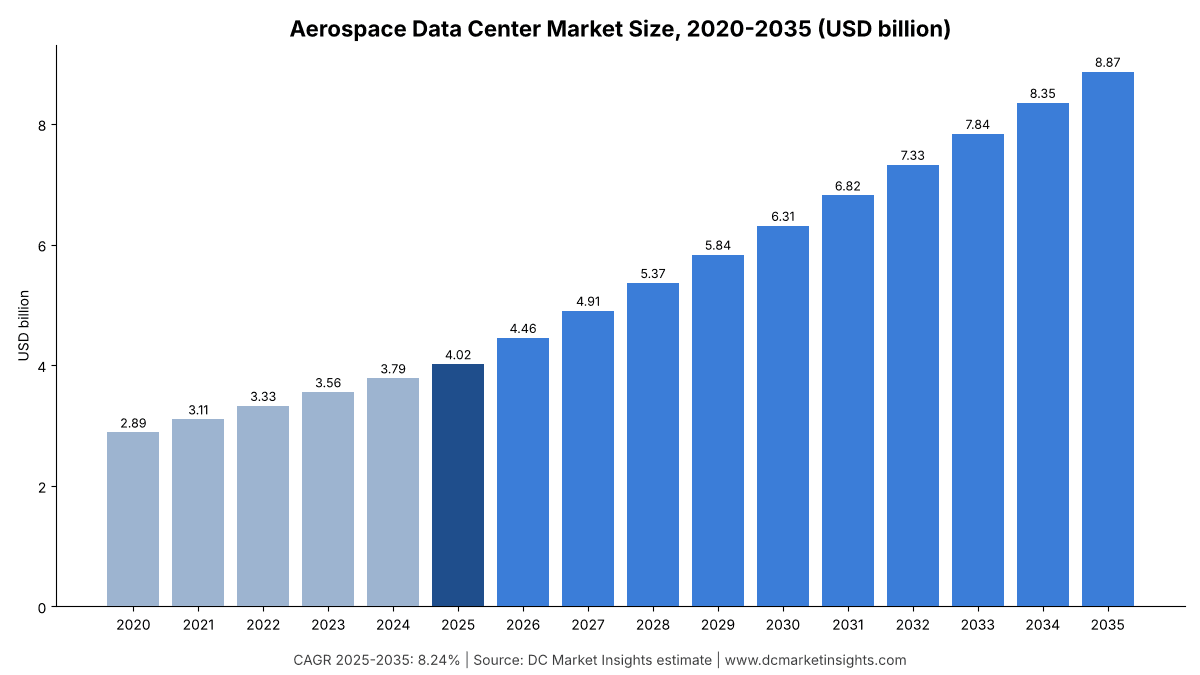
The Global Aerospace Data Center Market size was valued at USD 2.89 billion in 2020, reached USD 4.02 billion in 2025, and is anticipated to reach USD 8.87 billion by 2035, at a CAGR of 8.24% during the forecast period. Growth was 6.84% a year from 2020 to 2025 while production rates recovered; from 2025 aerospace IT load in use rises from 820 MW to 1,450 MW and its graphics processing unit (GPU) share from 7% to 26%.
| Attribute | Value |
|---|---|
| Historical period | 2020-2024 |
| Base year | 2025 |
| Forecast period | 2026-2035 |
| Market size 2025 | USD 4.02 billion |
| Market size 2026 | USD 4.46 billion |
| CAGR 2025-2035 | 8.24% |
| Market size 2035 | USD 8.87 billion |
| Segments covered | Component, deployment model, workload, end user, region, 12 countries |
Public cloud spending rises from USD 1.61 billion to USD 4.06 billion, while owned corporate data centers grow only 1.35% a year as their work moves into HPC and AI clusters or the cloud.
Which Data Centers Count in the Aerospace Data Center Market?
The Aerospace Data Center Market counts USD 4.02 billion of 2025 spending on data center capacity that aerospace companies own, colocate or rent to design, build, certify, support and operate aircraft, engines, spacecraft and launch vehicles.
Included: data centers, HPC clusters and computer rooms of commercial aircraft and engine makers, defense aerospace primes (their own engineering and production IT), tier-one and tier-two suppliers, launch and satellite companies (ground segment, mission data and engineering), and MRO providers; colocation they lease; public cloud infrastructure they rent; and the IT hardware, electrical and mechanical infrastructure and fit-out inside owned and colocated sites.
Excluded: airlines and airports (counted in the Transportation and Logistics Data Center Market); armed forces and defense agencies (counted in the Military Data Center Market); AI compute that space groups build to sell AI services, such as the roughly 1.0 gigawatt (GW) Colossus clusters described in the SpaceX registration statement of May 2026 (counted in AI data center reports); onboard avionics and satellite payload computers; software licences; and electricity bills.
How the segments fit together: every segment table splits the same USD 4.02 billion for 2025 and USD 8.87 billion for 2035 by component, deployment model, workload and end user, then by five regions and 12 countries.
Why Do Aerospace Data Center Market Estimates Differ?
The DC Market Insights estimate of USD 4.46 billion for 2026 counts only data center capacity that aerospace companies use for their own engineering, production and support work. Broader definitions add aerospace software and IT services, onboard computing, airline systems or the AI clusters that space groups sell as a service, and they come out several times larger; the SpaceX filing alone reports USD 12.73 billion of 2025 capital spending for its AI segment, more than three times this whole market. Narrower definitions count only supercomputers and miss the cloud bills behind enterprise resource planning (ERP), supply chain and aftermarket platforms.
| Element | In this report | Why |
|---|---|---|
| Owned HPC and AI clusters of OEMs and primes | Yes, USD 598.22 million in 2025 | Engineering simulation and model training for own programmes |
| Public cloud rented by aerospace companies | Yes, USD 1.61 billion in 2025 | Non-controlled ERP, aftermarket and collaboration workloads |
| Colocation leased by aerospace buyers | Yes, USD 336.53 million of fees in 2025 | Disaster-recovery and sovereign halls |
| AI clusters sold as AI services (Colossus) | No | Counted in AI data center reports |
| Airline and airport systems | No | Counted in the transportation and logistics data center market |
| Onboard avionics and payload computers | No | Not data center capacity |
Buyer groups inside the estimate run from six majors with combined 2025 revenue above USD 340 billion to thousands of small machine shops: the Aerospace Industries Association counted 9,300 U.S. aerospace and defense establishments in 2025, and the Federal Register CMMC rule describes a defense industrial base of more than 220,000 companies. The same method is used in the Manufacturing Data Center Market, whose automotive and transportation equipment segment contains part of this spending.
Market Drivers: Why Are Aerospace Companies Buying More Data Center Capacity?
Three forces carry most of the growth from USD 4.02 billion in 2025 to USD 8.87 billion in 2035: record production backlogs, sovereign-data rules for design data and cybersecurity certification of the supply chain.
Boeing’s 600 Deliveries and Airbus’s EUR 73.4 Billion Revenue Load the Production Systems
Boeing reported 2025 revenue of USD 89.5 billion and 600 commercial deliveries, its highest annual totals since 2018 (Boeing, January 2026), and Airbus reported 2025 revenue of EUR 73.4 billion, up 6%, with EUR 3,153 million of self-financed research and development (R&D) (Airbus, February 2026). Higher rates multiply manufacturing execution, quality and supply chain transactions, so manufacturing and supply chain systems spend USD 683.33 million in 2025.
Sovereign Engineering Data: Airbus’s Bull Supercomputers and Its ‘Trusted Cloud’ Tender
Airbus inaugurated two new-generation supercomputers with Bull in April 2026 and is evaluating ‘Trusted Cloud’ infrastructure for its most sensitive data, according to Airbus (June 2026), while Dassault Aviation develops all new programmes on a sovereign 3DEXPERIENCE cloud operated by Dassault Systèmes’ OUTSCALE brand (Dassault Systèmes, June 2023). These moves keep owned HPC and AI clusters growing 8.60% a year to USD 1.36 billion in 2035.
CMMC Certification Reaches 337,968 Contractors From November 2025
The Cybersecurity Maturity Model Certification (CMMC) program rule took effect on 16 December 2024 and DoD estimates 8,350 medium and large entities will need Level 2 third-party assessments (Federal Register, October 2024); the contract-clause rule took effect on 10 November 2025 with a three-year phase-in and covers an estimated 337,968 unique entities, 68% of them small (Federal Register, September 2025). Controlled data must sit in FedRAMP Moderate or equivalent clouds or in segregated owned rooms, which lifts colocation at 10.78% a year.
Market Trends: Where Are Aerospace Workloads Moving?
Aerospace buyers are splitting their estates: AI training and inference grows 22.24% a year and public cloud 9.70%, while owned corporate data centers grow 1.35%.
Air-Gapped AI Factories: Lockheed Martin’s DGX Cluster and Google Distributed Cloud
Lockheed Martin’s on-premises AI Factory, built on NVIDIA DGX SuperPOD, serves about 7,000 engineers and developers and processes more than one billion tokens a week, according to NVIDIA, and in October 2025 Lockheed Martin said it would run Google Gemini models inside its secure, on-premises and air-gapped environments (Lockheed Martin, October 2025). Northrop Grumman said in August 2025 it would deploy NVIDIA RTX PRO Servers for AI, design and simulation across nearly 100,000 employees. Defense aerospace primes spend USD 1.09 billion in 2025.
Engine Makers Mix National Exascale Time With Cloud: GE Aerospace on Frontier and AWS
GE Aerospace ran open-fan engine simulations on the Frontier exascale supercomputer at Oak Ridge, a machine of about 37,000 GPUs (GE Aerospace, June 2023), and moved reporting systems off physical infrastructure to Amazon Web Services in 2023, saving more than USD 500,000 a year, according to an AWS case study. Rolls-Royce said in November 2025 that a quantum-classical project with Xanadu and Riverlane cut air-flow simulation run times from weeks to under an hour. Engineering simulation and HPC remains the largest workload at USD 964.69 million in 2025.
Constellations Turn Space Companies Into Data Center Buyers
The Federal Communications Commission (FCC) accepted for filing a SpaceX application for up to one million satellites operating as the ‘SpaceX Orbital Data Center system’ (FCC DA 26-113, February 2026), and Rocket Lab reported record 2025 revenue of USD 602 million with a USD 1.85 billion backlog (Rocket Lab, February 2026). Ground segment, telemetry and mission data push space launch and satellite companies from USD 442.15 million to USD 1.33 billion.
Market Challenges and Restraints: What Slows Aerospace Data Center Spending?
Accreditation cost and legacy engineering estates hold the market back: corporate IT and back office, USD 803.91 million in 2025, grows only 4.44% a year.
ITAR and CMMC Accreditation Narrow the Supplier List
Under 22 CFR 120.54, encrypted technical data is not an export only if it is never stored in a proscribed country, and the U.S. Department of Defense (DoD) Chief Information Officer requires cloud providers holding controlled unclassified information to meet FedRAMP Moderate or its December 2023 equivalency standard, according to the DoD CIO. Fewer eligible regions mean higher prices: DC Market Insights uses USD 190 per kilowatt (kW)-month for aerospace colocation in 2025, about 5% above the transport rate.
Decades-Old Programmes Keep Old Halls Running
Aircraft stay in service for 25 years or more, so type-design and continued-airworthiness data must stay readable on validated systems; Airbus’s Skywise platform alone connects almost 12,000 aircraft since 2017 (Airbus, April 2026). Owned electrical and mechanical infrastructure therefore grows only 2.04% a year to USD 287.10 million in 2035 as old halls are kept running rather than rebuilt.
Market Opportunities: Where Is New Aerospace Computing Demand?
AI capacity and sovereign cloud are the two openings, worth USD 2.39 billion and USD 839.93 million of colocation fees by 2035.
European Sovereign Clouds for Design Data: An Opening Worth USD 2.57 billion by 2035
EASA Part-IS required Part 21 design and production organisations to comply with its information security rules by 16 October 2025 (European Union Aviation Safety Agency, Part-IS FAQ), and the EU Data Act removes cloud switching charges from 12 January 2027, according to the European Commission. Europe grows from USD 1.25 billion to USD 2.57 billion, and France is the second-largest country at USD 361.76 million in 2025.
Engineering Assistants and Physics AI: USD 2.39 Billion by 2035
Northrop Grumman said in April 2026 that a physics-AI model built with Flexcompute and NVIDIA cut a key part of spacecraft product development by a factor of 100, and Dassault Systèmes and NVIDIA announced OUTSCALE AI factories on three continents in February 2026. DC Market Insights prices GPU capacity at USD 8.20 million per MW-year of servers against USD 2.60 million for conventional capacity, so AI training and inference rises from USD 321.56 million in 2025 to USD 2.39 billion.
How Much Does an Aerospace Company Spend per MW of Data Center Capacity?
Aerospace buyers spent USD 4.90 million per MW of IT load in use in 2025, DC Market Insights estimates, rising to USD 6.12 million in 2035 as GPU capacity takes a larger share.
| Year | IT load in use (MW) | Market size | Spending per MW in use |
|---|---|---|---|
| 2020 | 680 | USD 2.89 billion | USD 4.25 million |
| 2025 | 820 | USD 4.02 billion | USD 4.90 million |
| 2030 | 1,100 | USD 6.31 billion | USD 5.74 million |
| 2035 | 1,450 | USD 8.87 billion | USD 6.12 million |
Public price anchors: GE Aerospace’s AWS move saves more than USD 500,000 a year on reporting systems; the DFARS CMMC rule estimates USD 266.3 million in present-value cost over 10 years at a 7% discount rate (Federal Register, September 2025); and Airbus’s self-financed R&D of EUR 3,153 million in 2025 sets the budget that engineering HPC draws on. DC Market Insights uses USD 190 per kW-month for aerospace colocation in 2025, a DC Market Insights estimate.
Which Rules and Standards Shape Aerospace Data Centers?
Eight rule sets decide where the USD 4.02 billion of 2025 spending can sit: export control, defense supply chain security, aviation information security and EU data and cyber law.
- ITAR 22 CFR 120.54 end-to-end encryption carve-out: effective 25 March 2020; no storage in §126.1 proscribed countries (Source: Federal Register, eCFR).
- CMMC Program rule, 32 CFR Part 170: effective 16 December 2024; about 1% of contractors need Level 3 (Source: Federal Register).
- DFARS CMMC clause rule, 48 CFR: effective 10 November 2025, three-year phase-in (Source: Federal Register).
- DoD FedRAMP Moderate equivalency memo of December 2023 for cloud providers holding controlled data (Source: DoD CIO).
- EASA Part-IS, Delegated Regulation (EU) 2022/1645: Part 21 organisations comply by 16 October 2025; Implementing Regulation (EU) 2023/203 authority requirements from 22 February 2026 (Source: EASA).
- EU NIS2 Directive (EU) 2022/2555: space is a sector of high criticality, applying from 18 October 2024 (Source: EUR-Lex).
- Proposed EU Space Act of 25 June 2025: cybersecurity rules for EU and non-EU operators serving Europe (Source: European Commission).
- EU Data Act (Regulation (EU) 2023/2854): applies since 12 September 2025; switching charges end 12 January 2027 (Source: European Commission).
Aerospace Data Center Market Segmentation: Which Segment Spends Most?
The largest component is IT hardware at USD 1.72 billion in 2025, commercial aircraft and engine OEMs the largest end user at USD 1.37 billion, and engineering simulation and HPC the largest workload at USD 964.69 million.
By Component
IT Hardware holds 42.7% of 2025 value; cloud infrastructure services grows fastest at 9.70% a year.
| Component | 2025 (USD million) | Share 2025 | 2035 (USD million) | CAGR 2025-2035 |
|---|---|---|---|---|
| IT Hardware | USD 1,717.41 million | 42.7% | USD 3,467.71 million | 7.28% |
| Cloud Infrastructure Services | USD 1,608.10 million | 40.0% | USD 4,057.16 million | 9.70% |
| Colocation Services | USD 336.53 million | 8.4% | USD 839.93 million | 9.58% |
| Electrical and Mechanical Infrastructure | USD 234.52 million | 5.8% | USD 287.10 million | 2.04% |
| Construction and Fit-Out | USD 123.00 million | 3.1% | USD 217.50 million | 5.87% |
By Deployment Model
Public Cloud holds 40.0% of 2025 value; colocation grows fastest at 10.78% a year.
| Deployment Model | 2025 (USD million) | Share 2025 | 2035 (USD million) | CAGR 2025-2035 |
|---|---|---|---|---|
| Public Cloud | USD 1,608.10 million | 40.0% | USD 4,057.16 million | 9.70% |
| Owned Corporate Data Centers | USD 976.05 million | 24.3% | USD 1,116.58 million | 1.35% |
| Colocation | USD 837.19 million | 20.8% | USD 2,330.95 million | 10.78% |
| Owned HPC and AI Clusters | USD 598.22 million | 14.9% | USD 1,364.71 million | 8.60% |
By Workload
Engineering Simulation and HPC holds 24.0% of 2025 value; AI training and inference grows fastest at 22.24% a year.
| Workload | 2025 (USD million) | Share 2025 | 2035 (USD million) | CAGR 2025-2035 |
|---|---|---|---|---|
| Engineering Simulation and HPC | USD 964.69 million | 24.0% | USD 1,773.88 million | 6.28% |
| Corporate IT and Back Office | USD 803.91 million | 20.0% | USD 1,241.72 million | 4.44% |
| PLM and Design Data | USD 723.52 million | 18.0% | USD 1,153.02 million | 4.77% |
| Manufacturing and Supply Chain Systems | USD 683.33 million | 17.0% | USD 1,153.02 million | 5.37% |
| Aftermarket and Fleet Data | USD 522.54 million | 13.0% | USD 1,153.02 million | 8.24% |
| AI Training and Inference | USD 321.56 million | 8.0% | USD 2,394.74 million | 22.24% |
By End User
Commercial Aircraft and Engine OEMs holds 34.0% of 2025 value; space launch and satellite companies grows fastest at 11.65% a year.
| End User | 2025 (USD million) | Share 2025 | 2035 (USD million) | CAGR 2025-2035 |
|---|---|---|---|---|
| Commercial Aircraft and Engine OEMs | USD 1,366.65 million | 34.0% | USD 2,838.21 million | 7.58% |
| Defense Aerospace Primes | USD 1,085.28 million | 27.0% | USD 2,306.04 million | 7.83% |
| Tier Suppliers and Component Makers | USD 723.52 million | 18.0% | USD 1,507.80 million | 7.62% |
| Space Launch and Satellite Companies | USD 442.15 million | 11.0% | USD 1,330.41 million | 11.65% |
| MRO Providers | USD 401.96 million | 10.0% | USD 886.94 million | 8.24% |
DC Exclusive: Aerospace Compute Sovereignty Tracker, 11 Programmes, 2023-2026
The Aerospace Compute Sovereignty Tracker is a DC Market Insights model built on 11 inputs from company and regulator sources; it shows where each named aerospace compute programme places its most sensitive workloads: owned HPC or AI clusters (4), sovereign clouds (3), national exascale time (1), public cloud (1), an AI centre of excellence (1) and one orbital filing that this estimate does not count.
| Company | Programme | Date | Scale disclosed | Where the workload sits |
|---|---|---|---|---|
| Airbus | Two Bull supercomputers (Toulouse and Hamburg) | Apr 2026 | 3x previous-generation throughput | Owned HPC |
| Airbus | ‘Trusted Cloud’ call for bids | Jun 2026 | Sensitive data immune to extra-territorial law | Sovereign cloud |
| Lockheed Martin | AI Factory on NVIDIA DGX SuperPOD | Oct 2024 | About 7,000 users, over 1 billion tokens a week | Owned AI cluster |
| Lockheed Martin | Google Gemini on Google Distributed Cloud | Oct 2025 | Inside air-gapped on-premises sites | Owned AI cluster |
| Northrop Grumman | NVIDIA RTX PRO Servers and AI Enterprise | Aug 2025 | Nearly 100,000 employees | Owned AI cluster |
| GE Aerospace | Open-fan simulation on Frontier | Jun 2023 | About 37,000 GPUs in the host machine | National exascale time |
| GE Aerospace | Reporting systems moved to AWS | 2023 | More than USD 500,000 a year saved | Public cloud |
| Dassault Aviation | Sovereign 3DEXPERIENCE cloud (OUTSCALE) | Jun 2023 | All new programmes | Sovereign cloud |
| Dassault Systèmes and NVIDIA | OUTSCALE AI factories | Feb 2026 | Three continents | Sovereign cloud |
| Safran | Safran.AI centre of excellence, Singapore | Oct 2026 | About 50 staff over five years | AI team |
| SpaceX | Orbital Data Center system filing (FCC DA 26-113) | Feb 2026 | Up to one million satellites | Orbital (not counted) |
The tracker explains the shape of the model: of the USD 4.85 billion added between 2025 and 2035, public cloud adds USD 2.45 billion for non-controlled systems, while owned HPC and AI clusters add USD 766.49 million for controlled design data. DC Market Insights estimates that a segregated, accredited hosting environment costs 20% to 40% more per MW than standard enterprise hosting.
Which Region Leads the Aerospace Data Center Market?
North America leads with USD 1.85 billion or 46.0% of 2025 value, and Asia Pacific grows fastest at 10.68% a year.
| Region | 2025 (USD million) | Share 2025 | 2035 (USD million) | CAGR 2025-2035 |
|---|---|---|---|---|
| North America | USD 1,849.00 million | 46.0% | USD 3,813.84 million | 7.51% |
| Europe | USD 1,246.06 million | 31.0% | USD 2,572.13 million | 7.52% |
| Asia Pacific | USD 643.13 million | 16.0% | USD 1,773.88 million | 10.68% |
| Middle East and Africa | USD 160.78 million | 4.0% | USD 443.47 million | 10.68% |
| Latin America | USD 120.59 million | 3.0% | USD 266.08 million | 8.24% |
North America
North America reaches USD 3.81 billion by 2035 at 7.51% a year; the Aerospace Industries Association reports USD 988.6 billion of U.S. aerospace and defense sales in 2025, and CMMC deadlines shape where that industry’s controlled data is hosted.
Europe
Europe grows 7.52% a year to USD 2.57 billion; the AeroSpace and Defence Industries Association of Europe (ASD) reports EUR 325.7 billion of 2024 turnover and 1,103,000 employees, with Toulouse and Hamburg hosting Airbus’s new supercomputers.
Asia Pacific
Asia Pacific grows fastest, from USD 643.13 million to USD 1.77 billion at 10.68% a year, as China’s civil programmes and India’s supplier base add engineering capacity and Safran opens its Safran.AI centre in Singapore.
Latin America
Latin America holds USD 120.59 million in 2025 and grows 8.24% a year, with Brazil at USD 68.33 million (DC Market Insights estimate).
Middle East and Africa
Middle East and Africa grows from USD 160.78 million to USD 443.47 million, a 10.68% CAGR, as Gulf MRO and satellite operators build in-country capacity (DC Market Insights estimate).
Top 12 Countries in the Aerospace Data Center Market
The United States leads with USD 1.67 billion in 2025, and China is the fastest large country at 11.11% a year.
| Rank | Country | Region | 2025 (USD million) | 2035 (USD million) | CAGR 2025-2035 |
|---|---|---|---|---|---|
| 1 | United States | North America | USD 1,668.12 million | USD 3,414.72 million | 7.43% |
| 2 | France | Europe | USD 361.76 million | USD 709.55 million | 6.97% |
| 3 | United Kingdom | Europe | USD 289.41 million | USD 567.64 million | 6.97% |
| 4 | Germany | Europe | USD 273.33 million | USD 549.90 million | 7.24% |
| 5 | China | Asia Pacific | USD 241.17 million | USD 691.81 million | 11.11% |
| 6 | Canada | North America | USD 180.88 million | USD 399.12 million | 8.24% |
| 7 | Japan | Asia Pacific | USD 128.63 million | USD 274.95 million | 7.89% |
| 8 | India | Asia Pacific | USD 88.43 million | USD 354.78 million | 14.90% |
| 9 | Italy | Europe | USD 88.43 million | USD 186.26 million | 7.73% |
| 10 | Spain | Europe | USD 72.35 million | USD 159.65 million | 8.24% |
| 11 | Brazil | Latin America | USD 68.33 million | USD 150.78 million | 8.24% |
| 12 | South Korea | Asia Pacific | USD 64.31 million | USD 177.39 million | 10.68% |
The 12 countries hold 87.7% of 2025 value. France ranks second at USD 361.76 million because Airbus, Safran and Dassault Aviation keep design and simulation capacity in the country.
Forecast Scenarios: How Large Could the Aerospace Data Center Market Be in 2035?
The 2035 Aerospace Data Center Market ranges from USD 7.56 billion in the low case to USD 10.27 billion in the high case, around the USD 8.87 billion base case.
| Scenario | 2035 market size | CAGR 2025-2035 | Assumption |
|---|---|---|---|
| Low | USD 7.56 billion | 6.52% | IT load 1,300 MW and GPU share 20% by 2035 |
| Base | USD 8.87 billion | 8.24% | IT load 1,450 MW and GPU share 26% |
| High | USD 10.27 billion | 9.83% | IT load 1,600 MW and GPU share 32% |
Low Scenario
USD 7.56 billion by 2035 (6.52% a year) if production rates stall and AI stays at pilot scale.
Base Scenario
USD 8.87 billion by 2035 (8.24% a year), with aerospace IT load rising from 820 MW to 1,450 MW.
High Scenario
USD 10.27 billion by 2035 (9.83% a year) if engineering assistants spread across the supply chain and constellations multiply ground-segment load.
Key Players and Market Share: Who Supplies Aerospace Data Centers?
Amazon Web Services, Microsoft Azure and Google Cloud hold about 60% of the USD 1.61 billion cloud segment in 2025, and Hewlett Packard Enterprise, Dell Technologies, Eviden and NVIDIA supply most owned HPC and AI clusters, a DC Market Insights estimate based on the programmes in the tracker.
- Hewlett Packard Enterprise
- Dell Technologies
- Eviden (Bull)
- NVIDIA
- Lenovo
- Amazon Web Services
- Microsoft Azure
- Google Cloud
- Oracle Cloud Infrastructure
- Dassault Systèmes (OUTSCALE)
- Siemens
- IBM
- Equinix
- Digital Realty
- Iron Mountain Data Centers
- Vertiv
- Schneider Electric
Supplier Facts, 2023-2026
Eviden’s Bull built Airbus’s two April 2026 supercomputers (Airbus, June 2026); NVIDIA DGX SuperPOD underpins Lockheed Martin’s AI Factory and RTX PRO Servers Northrop Grumman’s rollout; Google Distributed Cloud brings Gemini into Lockheed Martin’s air-gapped sites (Lockheed Martin, October 2025); Amazon Web Services hosts GE Aerospace reporting systems; and Dassault Systèmes runs Dassault Aviation’s sovereign design cloud through OUTSCALE.
Recent Developments in the Aerospace Data Center Market
Six dated events from 2025 and 2026 moved the Aerospace Data Center Market, which reaches USD 4.46 billion in 2026.
- In October 2026, Safran chose Singapore for a Safran.AI centre of excellence with about 50 staff over five years (Source: Safran).
- In June 2026, Airbus said it was running a call for bids for ‘Trusted Cloud’ infrastructure (Source: Airbus).
- In April 2026, Airbus inaugurated two new-generation supercomputers with Bull (Source: Airbus).
- In February 2026, the FCC accepted for filing a SpaceX application for an orbital data center system of up to one million satellites (Source: FCC).
- In November 2025, the DFARS CMMC clause rule took effect on 10 November (Source: Federal Register).
- In October 2025, Lockheed Martin and Google Public Sector agreed to bring Gemini to Lockheed Martin’s on-premises AI Factory (Source: Lockheed Martin).
Research Methodology: How DC Market Insights Sized the Aerospace Data Center Market
The USD 4.02 billion 2025 value is a bottom-up DC Market Insights model of 820 MW of aerospace IT load in use, including the cloud capacity these buyers rent, priced component by component; see the DC Market Insights research methodology.
Model Inputs
Aerospace IT load in use of 680, 820, 1,100 and 1,450 MW in 2020, 2025, 2030 and 2035; owned share 64%, 52%, 42% and 36%; colocated share 14%, 18%, 21% and 23%; public cloud the remainder; GPU share 2%, 7%, 18% and 26%. Servers cost USD 2.60 million per conventional MW-year (+1% a year) and USD 8.20 million per GPU MW-year (-1% a year) on owned and colocated MW; cloud USD 5.90 million (-1% a year) and USD 15.00 million (-3% a year) per MW-year; colocation USD 190 per kW-month (+1% a year); owned electrical and mechanical upkeep USD 0.55 million per owned MW-year; construction and fit-out USD 0.15 million per MW in use. For 2025: hardware USD 1.72 billion + cloud USD 1.61 billion + colocation USD 336.53 million + electrical and mechanical USD 234.52 million + construction USD 123.00 million = USD 4.02 billion.
Bound Checks
- Ceiling: USD 4.02 billion is 0.7% of the DC Market Insights global data center market of USD 570.04 billion in 2025, below the transport share of 2.0%.
- Revenue ceiling: USD 4.02 billion is about 1.2% of the 2025 revenue of Airbus, Boeing, GE Aerospace, RTX, Safran and Rolls-Royce (about USD 340 billion), within the range of IT infrastructure spending for engineering-heavy manufacturers.
- Floor: 9,300 U.S. aerospace and defense establishments (AIA, 2025) x USD 150,000 of hosting each = USD 1.40 billion, below the U.S. estimate of USD 1.67 billion.
Table of contents
- 01Introduction
- 1.1Report Description
- 1.2Market Definition and Scope
- 1.3Research Methodology
- 02Executive Summary
- 2.1Market Snapshot, 2025, 2026 and 2035
- 2.2Key Market Statistics
- 2.3Key Takeaways
- 03Market Scope and Estimate Comparison
- 3.1Included and Excluded
- 3.2Why Estimates Differ
- 04Market Dynamics
- 4.1Boeing and Airbus Production Load
- 4.2Sovereign Engineering Data and Trusted Cloud
- 4.3CMMC Certification of 337,968 Contractors
- 4.4Air-Gapped AI Factories at Defense Aerospace Primes
- 4.5Engine Simulation on Exascale Time and Cloud
- 4.6Space Companies as Data Center Buyers
- 4.7ITAR and CMMC Accreditation
- 4.8Decades-Old Programmes and Legacy Halls
- 4.9European Sovereign Clouds for Design Data
- 4.10Engineering Assistants and Physics AI
- 05Pricing Analysis
- 5.1Spend per MW, 2020-2035
- 5.2Public Price Anchors
- 06Standards and Regulation
- 6.1ITAR 22 CFR 120.54
- 6.2CMMC 32 CFR Part 170
- 6.3DFARS CMMC Clause Rule
- 6.4DoD FedRAMP Moderate Equivalency
- 6.5EASA Part-IS
- 6.6EU NIS2 Directive
- 6.7Proposed EU Space Act
- 6.8EU Data Act
- 07Market Segmentation by Component
- 7.1Cloud Infrastructure Services
- 7.2IT Hardware
- 7.3Colocation Services
- 7.4Electrical and Mechanical Infrastructure
- 7.5Construction and Fit-Out
- 08Market Segmentation by Deployment Model
- 8.1Public Cloud
- 8.2Owned Corporate Data Centers
- 8.3Owned HPC and AI Clusters
- 8.4Colocation
- 09Market Segmentation by Workload
- 9.1Engineering Simulation and HPC
- 9.2PLM and Design Data
- 9.3Manufacturing and Supply Chain Systems
- 9.4Aftermarket and Fleet Data
- 9.5AI Training and Inference
- 9.6Corporate IT and Back Office
- 10Market Segmentation by End User
- 10.1Commercial Aircraft and Engine OEMs
- 10.2Defense Aerospace Primes
- 10.3Tier Suppliers and Component Makers
- 10.4Space Launch and Satellite Companies
- 10.5MRO Providers
- 11DC Exclusive: Aerospace Compute Sovereignty Tracker
- 11.1Airbus: Two Bull supercomputers (Toulouse and Hamburg)
- 11.2Airbus: 'Trusted Cloud' call for bids
- 11.3Lockheed Martin: AI Factory on NVIDIA DGX SuperPOD
- 11.4Lockheed Martin: Google Gemini on Google Distributed Cloud
- 11.5Northrop Grumman: NVIDIA RTX PRO Servers and AI Enterprise
- 11.6GE Aerospace: Open-fan simulation on Frontier
- 11.7GE Aerospace: Reporting systems moved to AWS
- 11.8Dassault Aviation: Sovereign 3DEXPERIENCE cloud (OUTSCALE)
- 11.9Dassault Systèmes and NVIDIA: OUTSCALE AI factories
- 11.10Safran: Safran.AI centre of excellence, Singapore
- 11.11SpaceX: Orbital Data Center system filing (FCC DA 26-113)
- 12Regional Insights
- 12.1North America
- 12.2Europe
- 12.3Asia Pacific
- 12.4Latin America
- 12.5Middle East and Africa
- 13Country Analysis
- 13.1United States
- 13.2France
- 13.3United Kingdom
- 13.4Germany
- 13.5China
- 13.6Canada
- 13.7Japan
- 13.8India
- 13.9Italy
- 13.10Spain
- 13.11Brazil
- 13.12South Korea
- 14Forecast Scenarios
- 14.1Low Scenario
- 14.2Base Scenario
- 14.3High Scenario
- 15Key Players and Market Share
- 15.1Hewlett Packard Enterprise
- 15.2Dell Technologies
- 15.3Eviden (Bull)
- 15.4NVIDIA
- 15.5Lenovo
- 15.6Amazon Web Services
- 15.7Microsoft Azure
- 15.8Google Cloud
- 15.9Oracle Cloud Infrastructure
- 15.10Dassault Systèmes (OUTSCALE)
- 15.11Siemens
- 15.12IBM
- 15.13Equinix
- 15.14Digital Realty
- 15.15Iron Mountain Data Centers
- 15.16Vertiv
- 15.17Schneider Electric
- 16Recent Developments
- 16.1Safran.AI Singapore (October 2026)
- 16.2Airbus Trusted Cloud Tender (June 2026)
- 16.3Airbus Bull Supercomputers (April 2026)
- 16.4SpaceX Orbital Data Center Filing (February 2026)
- 16.5DFARS CMMC Rule in Force (November 2025)
- 16.6Lockheed Martin and Google Public Sector (October 2025)
- Fig. 1Aerospace Data Center Market Size, 2020-2035 (USD billion)
- Table 1Report Attributes
- Table 2Scope Comparison
- Table 3Pricing per MW, 2020-2035
- Table 4Market by Component, 2025 and 2035
- Table 5Market by Deployment Model, 2025 and 2035
- Table 6Market by Workload, 2025 and 2035
- Table 7Market by End User, 2025 and 2035
- Table 8Aerospace Compute Sovereignty Tracker
- Table 9Market by Region, 2025 and 2035
- Table 10Top 12 Countries, 2025 and 2035
- Table 11Forecast Scenarios, 2035
About this report
Written by Amit Jain and reviewed by Deepti Agrawal, Senior Editor, Research. Figures are built top-down and bottom-up and reconciled before publication, with 2025 as the base year.
Read our methodologyHow we built this
- Historical period2020-2024
- Base year2025
- Forecast period2026-2035
- Sizing approachTop-down + bottom-up
Need more than the report?
Advisory on this market
Due diligence, site selection and market entry work, by the analysts who wrote this report.
See consulting servicesFrequently asked questions
USD 4.46 billion in 2026, up 10.86% from USD 4.02 billion in 2025, according to DC Market Insights estimates. The market is projected to reach USD 8.87 billion by 2035, a CAGR of 8.24% from 2025.
8.24% a year from 2025 to 2035, after 6.84% a year from 2020 to 2025, as aerospace IT load in use rises from 820 MW to 1,450 MW and its GPU share from 7% to 26%.
USD 4.02 billion was spent in 2025 on data center capacity used by aircraft and engine makers, defense aerospace primes, suppliers, space companies and MRO providers: owned HPC and AI clusters, corporate data centers, colocation and rented cloud. Airlines, armed forces and onboard computers are excluded.
Yes, since 25 March 2020, if the technical data is encrypted end to end and never stored in a country proscribed under 22 CFR 126.1. Controlled unclassified defense data also needs FedRAMP Moderate or equivalent cloud providers, according to the DoD CIO.
337,968 unique entities are covered by the DFARS CMMC rule that took effect on 10 November 2025 with a three-year phase-in. DoD estimates 8,350 medium and large entities need Level 2 third-party assessments, which moves controlled data into accredited hosting.
AI training and inference grows fastest at 22.24% a year to USD 2.39 billion by 2035. Among buyers, space launch and satellite companies lead at 11.65% a year.
North America, with USD 1.85 billion or 46.0% of 2025 value. Asia Pacific grows fastest at 10.68% a year, and China is the fastest large country at 11.11%.
Four programmes in the DC Market Insights tracker are owned clusters: Airbus’s two Bull supercomputers of April 2026, Lockheed Martin’s DGX SuperPOD AI Factory and its Gemini deployment, and Northrop Grumman’s NVIDIA RTX PRO Server rollout.
USD 4.90 million per MW in use in 2025, rising to USD 6.12 million in 2035, DC Market Insights estimates. Aerospace colocation costs about USD 190 per kW-month in 2025.
USD 4.46 billion in 2026 counts only data center capacity aerospace companies use for their own work. Estimates that add aerospace software, airline systems or AI clusters sold as services, such as SpaceX’s Colossus, come out several times larger.
Get this report
How do I get the full report?
Request a quote; we reply by email within one business day.
How and when will I receive the report?
By email, within 24-48 business hours of payment.
How can I pay?
Once you accept the quote, we email you a secure payment link.
Can I see a sample first?
Yes. Request a free sample and we will email it to you.
Can the report be tailored to my needs?
Yes. We can add countries, segments or data cuts. Talk to an analyst about the scope you need.
Can I get an invoice or pay against a purchase order?
Write to sales@dcmarketinsights.com and our team will help.