
InfiniBand Market Size, Share & Forecast to 2035
Market at a glance
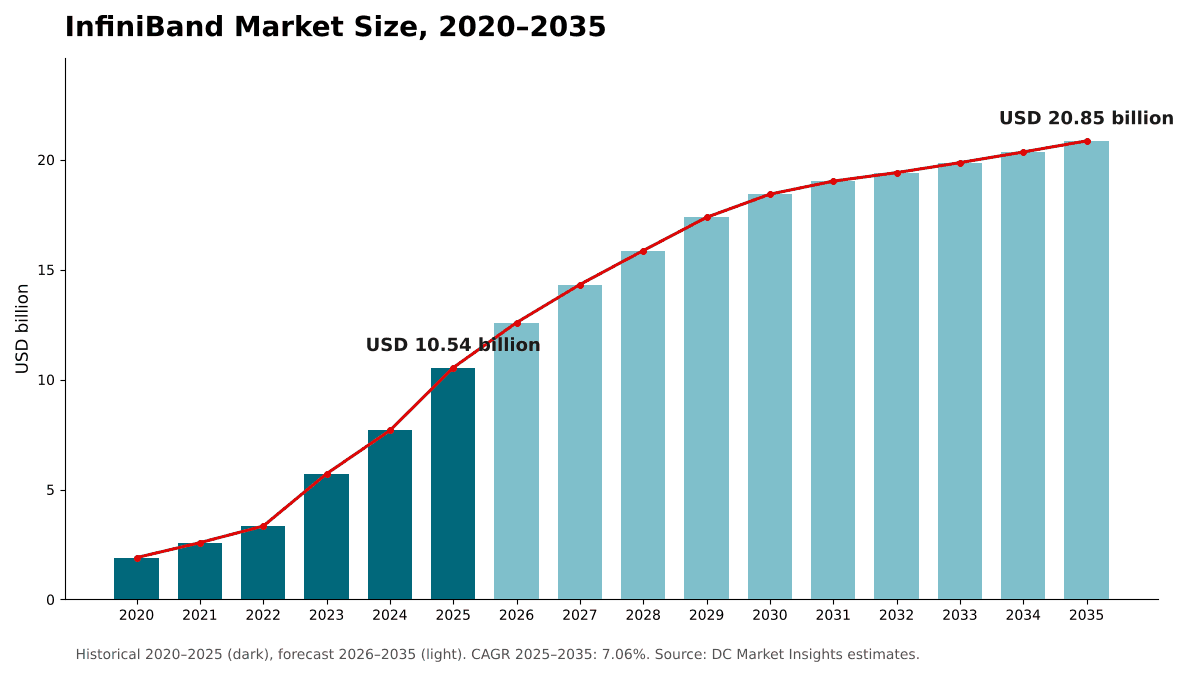
The InfiniBand market was worth USD 10.54 billion in 2025 and is forecast to reach USD 20.85 billion by 2035, growing at a 7.06% CAGR. North America accounts for 53.8% of the market.
 By Amit Jain, Senior Consultant, ICT & Emerging Technologies
 Reviewed by Deepti Agrawal
Last updated 10 Oct 2026
Base year 2025 PDF + Excel
Source: DC Market Insights analysis
Key findings
AI Back-End Fabrics Carry USD 4.72 Million of InfiniBand per MW
Co-Packaged Optics Cut Optical Power to as Low as 9 W
Ethernet for AI Takes a Growing Share of New Fabrics
GPU and Neocloud Providers More Than Double Their Spend by 2035
What is inside the report
- 01Introduction
- 02Research Methodology
- 03Executive Summary
- 04Market Dynamics
- 05Pricing
- 06Standards and Specifications
- 07Supply Chain
- 08Market Size and Forecast
- 09Market by Component
- 10Market by Data Rate
- 23chapters
- 2020-2024Historical period
- 2026-2035Forecast period
- 15Companies profiled
Regional insights
- North America53.8%
- Asia Pacific23.6%
- Europe15.2%
- Middle East and Africa4.6%
- Latin America2.8%
Segmentation
Companies profiled
- NVIDIA
- Hewlett Packard Enterprise
- IBM
- Intel
- Amphenol
- TE Connectivity
- Coherent
- Broadcom
- BizLink Technology
- Foxconn Interconnect Technology
- Applied Optoelectronics
- Volex
- Fujitsu
- The Siemon Company
- Cornelis Networks
Recent developments
Cornelis Networks launched the CN5000 400G scale-out network, supporting up to 500,000 endpoints, with broad availability from OEMs from the third quarter of 2025 (Source: Cornelis Networks press release).
the Ultra Ethernet Consortium released the UEC 1.0 specification, an Ethernet-based stack for AI and HPC networking (Source: Linux Foundation press release).
the IBTA published Release 2.0 of the InfiniBand Architecture Specifications, adding XDR at up to 200 Gb/s per lane and management of switches with up to 64K ports (Source: IBTA press release).
NVIDIA said its Quantum-X Photonics InfiniBand switch, with 144 ports at 800 Gb/s and co-packaged optics, would be available in early 2026 (Source: NVIDIA technical blog).
Microsoft Azure unveiled a cluster of 4,608 Blackwell Ultra GPUs for OpenAI connected by Quantum-X800 InfiniBand (Source: NVIDIA blog).
NVIDIA reported fiscal 2026 networking revenue of USD 31.38 billion, up 142%, and fourth-quarter networking revenue of USD 11.0 billion, which it attributed in part to the growth of its Ethernet and InfiniBand platforms (Source: NVIDIA SEC filing).
Full analysis
The InfiniBand Market covers the switches, host adapters and SuperNICs, cables and optical transceivers, and fabric management software and services used to build InfiniBand networks inside data centers, AI clusters and supercomputers. DC Market Insights values the global InfiniBand Market at USD 10.54 billion in 2025 and forecasts USD 20.85 billion by 2035, a CAGR of 7.06%. The 2025 value is built from the build itself: about 12.0 GW of new data center IT capacity, of which about 35% went into AI halls, with roughly 46% of that AI capacity wired with an InfiniBand back-end fabric at about USD 4.72 million of InfiniBand content per MW, gives USD 9.12 billion of AI spending, and supercomputing, storage and other enterprise fabrics add USD 1.42 billion. AI inference clusters are the fastest-growing segment at 12.09% a year because more inference runs on rack-scale systems that need the same scale-out fabric as training, and the Middle East and Africa is the fastest-growing region at 11.81% a year as DC Market Insights expects sovereign AI campuses in the Gulf states to scale from a small base.
Executive Summary
The Global InfiniBand Market size was valued at USD 1.90 billion in 2020, reached USD 10.54 billion in 2025, and is anticipated to reach USD 20.85 billion by 2035, at a CAGR of 7.06% during the forecast period.
| Report attribute | Details |
|---|---|
| Historical Period | 2020-2024 |
| Base Year | 2025 |
| Forecast Period | 2026-2035 |
| InfiniBand Market Size 2025 | USD 10.54 Billion |
| InfiniBand Market, CAGR | 7.06% |
| InfiniBand Market Size 2035 | USD 20.85 Billion |
The InfiniBand Market grew at 40.81% a year between 2020 and 2025, and 2025 alone added 37.2% over 2024 as graphics processing unit (GPU) training clusters moved from thousands to tens of thousands of accelerators. In the DC Market Insights view, InfiniBand became the default back-end fabric for the first wave of large AI clusters because it offered lossless transport, adaptive routing and in-network computing out of the box. Growth slows to 7.06% a year from 2025 to 2035 for one reason: Ethernet built for AI takes a growing share of new back-end fabrics. DC Market Insights models the InfiniBand share of new AI capacity falling from 46% in 2025 to 30% in 2030 and 27% in 2035, while AI capacity itself keeps rising, so the market still roughly doubles over the decade.
Market Scope: What Does the InfiniBand Market Cover?
The InfiniBand Market covers every product sold to build an InfiniBand fabric, valued at first sale in current US dollars, with 2025 as the base year and forecasts to 2035. DC Market Insights sizes it at USD 10.54 billion in 2025.
Included. InfiniBand switches (edge, leaf, spine and director systems, including co-packaged optics models), host channel adapters and SuperNICs sold or configured for InfiniBand, data processing units when shipped as InfiniBand endpoints, direct-attach copper cables, active copper and active optical cables, optical transceivers rated for InfiniBand links, InfiniBand gateways and routers, and fabric management software, support contracts and professional services.
Excluded. Ethernet switches and adapters, including Ethernet platforms built for AI and RDMA over Converged Ethernet (RoCE) fabrics, scale-up GPU interconnects such as NVLink, proprietary supercomputer interconnects, servers and GPUs, structured building cabling outside the cluster and installation labor.
How the segments fit together. The component, data-rate, application and end-user splits each re-cut the same USD 10.54 billion. The data-rate split assigns each switch, adapter and cable to the InfiniBand generation it runs: HDR at 200 Gb/s per port and below, NDR at 400 Gb/s, XDR at 800 Gb/s and next-generation links at 1.6 Tb/s and above.
Market Drivers: What Drives the InfiniBand Market?
Three drivers explain most of the growth in the InfiniBand Market: AI clusters that carry about USD 4.72 million of InfiniBand content per MW, the XDR upgrade cycle to 800 Gb/s per port, and the shift of inference onto rack-scale systems that need a scale-out fabric.
AI Back-End Fabrics Carry USD 4.72 Million of InfiniBand per MW
A GPU training cluster links every accelerator to a dedicated back-end network, so each MW of AI capacity carries far more switching, adapter and optical value than a cloud hall. DC Market Insights estimates the InfiniBand content of an AI hall at USD 4.72 million per MW in 2025, covering switches, SuperNICs, cables, transceivers and software. NVIDIA, the main InfiniBand supplier, reported networking revenue of USD 31.38 billion for its fiscal year 2026, which ended in January 2026, up 142% (Source: NVIDIA CFO commentary filed with the US Securities and Exchange Commission). Its fourth-quarter networking revenue was a record USD 11.0 billion, up 263% from a year earlier, which NVIDIA attributed to its NVLink compute fabric and the growth of its Ethernet and InfiniBand platforms. DC Market Insights estimates that InfiniBand accounted for about a third of that networking revenue in calendar 2025.
XDR Moves Each Port to 800 Gb/s
The InfiniBand Trade Association (IBTA) introduced XDR in October 2023, with 800 Gb/s per port, 1.6 Tb/s switch-to-switch links and 200 Gb/s per lane signaling. NVIDIA’s Quantum-X800 switch provides 144 ports of 800 Gb/s each, and its ConnectX SuperNIC delivers 800 Gb/s to each endpoint. In its second fiscal quarter of 2026, NVIDIA reported networking revenue of USD 7.3 billion, up 98%, driven in part by the ramp of XDR InfiniBand products. DC Market Insights estimates XDR products at USD 3.60 billion, or 34.1% of the InfiniBand Market, in 2025, and expects every installed NDR cluster to be expanded or replaced with XDR or faster links by 2030.
Inference Moves onto Rack-Scale Systems with Scale-Out Fabrics
DC Market Insights expects a growing share of inference to run on the same rack-scale systems used for training, linked across racks by a scale-out fabric. In October 2025, Microsoft Azure unveiled a cluster of 4,608 NVIDIA Blackwell Ultra GPUs in GB300 NVL72 systems, connected by Quantum-X800 InfiniBand at 800 Gb/s per GPU and built for OpenAI’s inference workloads. DC Market Insights estimates AI inference clusters at USD 2.70 billion of InfiniBand spending in 2025, rising to USD 8.45 billion by 2035.
Market Trends: How Is InfiniBand Changing?
The InfiniBand Market is moving to co-packaged optics, larger switch radix and a mix of InfiniBand and Ethernet inside the same operator’s estate.
Co-Packaged Optics Cut Optical Power to as Low as 9 W
NVIDIA’s Quantum-X Photonics InfiniBand switch places the optical engines next to the switch chip, providing 115 Tb/s of switching capacity across 144 ports at 800 Gb/s each. NVIDIA said the InfiniBand model would be available in early 2026. According to NVIDIA, pluggable transceivers often draw 30 W per interface, while co-packaged optics cut power to as low as 9 W. DC Market Insights expects co-packaged designs to move part of the value from cables and transceivers into the switch, which is why cables and transceivers grow at 7.79% a year rather than faster.
Specifications Expand to 64K-Port Fabrics
The IBTA published Release 2.0 of the InfiniBand Architecture Specifications, Volumes 1 and 2, on July 31, 2025. The release supports XDR at up to 200 Gb/s per lane, 800 Gb/s links on QSFP and 1.6 Tb/s links on QSFP-DD and OSFP, and management of large-radix switches supporting up to 64K ports. Larger radix means fewer switch tiers per cluster, which lowers the number of optical links per GPU and is built into the falling spend per MW in the DC Market Insights model.
Operators Run InfiniBand and Ethernet Side by Side
Large buyers increasingly run both fabrics. Meta described two 24,576-GPU clusters in March 2024, one with a RoCE fabric and one with an NVIDIA Quantum2 InfiniBand fabric, both connecting 400 Gbps endpoints. NVIDIA itself sells both: its finance chief said its Spectrum-X Ethernet technology was roughly on par with InfiniBand. DC Market Insights models the InfiniBand share of new AI capacity at 41% in 2026, down from 46% in 2025.
Market Challenges: What Holds the InfiniBand Market Back?
Ethernet built for AI and a concentrated supply base are the two constraints that DC Market Insights expects to cap InfiniBand growth at 7.06% a year to 2035.
Ethernet for AI Takes a Growing Share of New Fabrics
The Ultra Ethernet Consortium released its UEC 1.0 specification in June 2025, a full Ethernet-based communication stack for AI and high-performance computing (HPC) that spans network interface cards, switches, optics and cables and, according to the consortium, scales to millions of endpoints. In the DC Market Insights view, hyperscalers favor Ethernet because it runs on multi-vendor hardware and the same operations tools as their front-end networks. DC Market Insights models the InfiniBand share of new AI capacity falling from 46% in 2025 to 30% in 2030, which removes about USD 8.91 billion of potential 2030 spending compared with holding the 2025 share.
Single-Vendor Supply Limits Buyer Leverage
DC Market Insights estimates that NVIDIA supplies almost all InfiniBand switch and adapter silicon, so buyers have little price leverage and little second-source protection. Alternative scale-out fabrics are emerging: Cornelis Networks launched its CN5000 400G Omni-Path family in June 2025, supporting up to 500,000 endpoints, and claims 2 times higher message rates and 35% lower latency than InfiniBand NDR. The No. 2 to No. 4 systems on the June 2026 TOP500 list, El Capitan, Frontier and Aurora, all use the Slingshot-11 interconnect rather than InfiniBand.
Market Opportunities: Where Are the New Revenue Pools?
The two largest new revenue pools in the InfiniBand Market are GPU and neocloud providers, growing at 9.15% a year, and 1.6T-class links, which DC Market Insights forecasts at USD 13.66 billion by 2035.
GPU and Neocloud Providers More Than Double Their Spend by 2035
Specialist GPU cloud operators spent USD 2.76 billion on InfiniBand in 2025, and DC Market Insights expects their spend to reach USD 6.63 billion in 2035. DC Market Insights expects these operators to keep buying complete reference designs rather than mixing vendors. CoreWeave is a member of the IBTA alongside the main suppliers. The fabric design choices behind these clusters are covered in the Data Center Fabric Market report.
1.6T Links Become the Largest Data-Rate Class by 2035
Every speed generation forces a new round of switches, adapters and optics. DC Market Insights forecasts links at 1.6 Tb/s and above to grow from USD 73.80 million in 2025 to USD 13.66 billion in 2035, or 65.5% of the InfiniBand Market, as the 200 Gb/s per lane signaling defined in XDR is used for 1.6 Tb/s ports.
Pricing: How Much InfiniBand Does an AI Cluster Buy per MW?
An AI hall built on an InfiniBand back-end spends about USD 4.72 million per MW of IT load on InfiniBand products in 2025, according to DC Market Insights estimates covering switches, adapters, cables, transceivers and software, excluding labor.
| InfiniBand model input | 2020 | 2025 | 2030 | 2035 |
|---|---|---|---|---|
| InfiniBand spend per MW of AI capacity (USD million) | 5.60 | 4.72 | 4.22 | 3.86 |
| AI share of new data center capacity | 3% | 35% | 60% | 66% |
| InfiniBand share of new AI capacity | 86% | 46% | 30% | 27% |
Spend per MW falls about 2% a year because rack power density rises faster than port count: rack-scale systems put more GPUs behind each scale-out link, and higher-radix switches remove tiers from the fabric. Port prices per Gb/s also fall with each generation, while the price per port rises.
Standards and Regulation: Which Rules Shape InfiniBand?
InfiniBand is defined by one body, the IBTA, founded in 1999, whose steering committee members are Hewlett Packard Enterprise, IBM, Intel and NVIDIA.
InfiniBand Architecture Specification, Release 2.0 (July 2025). The IBTA Release 2.0 specifications add XDR at up to 200 Gb/s per lane, a new XDR forward error correction, direct support for CMIS 5.3 transceiver and cable management, and link auto-negotiation using IEEE 802.3 Clause 73. More than 400 devices were registered for the IBTA’s Plugfest 42 interoperability event.
Volume 1 Release 1.7 (October 2023). The earlier release introduced XDR, improved support for large-radix switches and added congestion control with network probes for InfiniBand and RoCE fabrics.
Ultra Ethernet Specification 1.0 (June 2025). Although it is not an InfiniBand standard, UEC 1.0 is the main competing specification for AI scale-out networks and shapes buyer choices.
Market Segmentation: Which Segment Leads the InfiniBand Market?
Switches lead the InfiniBand Market with 39.2% of 2025 value, NDR 400G leads data rates with 53.4%, AI training clusters lead applications with 60.9% and hyperscale cloud providers lead buyers with 44.7%. AI inference clusters are the fastest-growing segment at 12.09% a year because rack-scale inference systems are now linked by the same scale-out fabric as training clusters.
By Component: Switches Lead with 39.2%
| Component | 2025 (USD billion) | Share 2025 | 2035 (USD billion) | CAGR 2025-2035 |
|---|---|---|---|---|
| Switches | 4.13 | 39.2% | 7.74 | 6.47% |
| Adapters and SuperNICs | 2.61 | 24.8% | 4.71 | 6.07% |
| Cables and Transceivers | 3.13 | 29.7% | 6.63 | 7.79% |
| Software and Services | 0.66 | 6.3% | 1.77 | 10.31% |
Cables and transceivers gain 2.1 points of share by 2035 because each XDR and 1.6T port needs a higher-value optical link. Software and services grow fastest at 10.31% a year as fabric telemetry and management become part of every large cluster contract.
By Data Rate: NDR 400G Leads with 53.4%
| Data rate | 2025 (USD billion) | Share 2025 | 2035 (USD billion) | CAGR 2025-2035 |
|---|---|---|---|---|
| HDR 200G and Below | 1.24 | 11.8% | 0.25 | -14.82% |
| NDR 400G | 5.63 | 53.4% | 0.98 | -16.04% |
| XDR 800G | 3.60 | 34.1% | 5.96 | 5.19% |
| 1.6T and Above | 0.07 | 0.7% | 13.66 | 68.55% |
NDR still led in 2025 because Hopper-generation clusters, such as the 24,576-GPU InfiniBand cluster Meta described in 2024 with 400 Gbps endpoints, run on 400 Gb/s links. XDR took 34.1% as Blackwell systems ramped, and DC Market Insights expects XDR to peak before 2030, when 1.6T-class ports take over new builds.
By Application: AI Training Clusters Lead with 60.9%
| Application | 2025 (USD billion) | Share 2025 | 2035 (USD billion) | CAGR 2025-2035 |
|---|---|---|---|---|
| AI Training Clusters | 6.42 | 60.9% | 10.33 | 4.87% |
| AI Inference Clusters | 2.70 | 25.6% | 8.45 | 12.09% |
| HPC and Scientific Computing | 0.95 | 9.0% | 1.43 | 4.20% |
| Storage and Other Enterprise | 0.48 | 4.5% | 0.65 | 3.10% |
AI inference clusters reach 40.5% of the market by 2035. HPC and scientific computing keeps a steady base: the top three systems on the June 2026 Green500 ranking all use quad-rail NVIDIA InfiniBand NDR200, and the JUPITER Booster in Germany, ranked fifth on the June 2026 TOP500 list at 1.000 exaflop/s, was announced in 2023 with 24,000 NVIDIA GH200 superchips on Quantum-2 InfiniBand.
By End-user: Hyperscale Cloud Providers Lead with 44.7%
| End-user | 2025 (USD billion) | Share 2025 | 2035 (USD billion) | CAGR 2025-2035 |
|---|---|---|---|---|
| Hyperscale Cloud Providers | 4.71 | 44.7% | 8.38 | 5.93% |
| GPU and Neocloud Providers | 2.76 | 26.2% | 6.63 | 9.15% |
| Government and Research Labs | 1.77 | 16.8% | 3.04 | 5.57% |
| Enterprise and Financial Services | 1.30 | 12.3% | 2.79 | 7.98% |
Hyperscale cloud providers lose 4.5 points of share by 2035 as they move more of their own clusters to Ethernet, while GPU and neocloud providers gain 5.6 points. Government and research labs include national supercomputing centers and sovereign AI programs.
DC Exclusive: The InfiniBand Attach Model and Component × Buyer Matrix
At USD 1.90 billion in 2025, hyperscale switching is the single largest cell of the matrix and 18.0% of all InfiniBand spending. The matrix below cross-tabulates what is bought and who buys it.
| 2025, USD billion | Switches | Adapters and SuperNICs | Cables and Transceivers | Software and Services | Total |
|---|---|---|---|---|---|
| Hyperscale Cloud Providers | 1.90 | 1.11 | 1.50 | 0.21 | 4.71 |
| GPU and Neocloud Providers | 1.10 | 0.69 | 0.85 | 0.12 | 2.76 |
| Government and Research Labs | 0.65 | 0.46 | 0.46 | 0.19 | 1.77 |
| Enterprise and Financial Services | 0.48 | 0.35 | 0.32 | 0.14 | 1.30 |
| Total | 4.13 | 2.61 | 3.13 | 0.66 | 10.54 |
Hyperscale buyers spend 31.7% of their InfiniBand budget on cables and transceivers, the highest of any buyer, because their clusters span several halls and use optical links between tiers. Government and research labs spend 11.0% on software and services, more than twice the hyperscale share, because they buy integrated systems with long support contracts. A supplier with only switch silicon reaches about two-fifths or less of the money in every buyer row.
The InfiniBand attach model behind these figures has three inputs that any reader can check: new data center capacity delivered each year (12.0 GW in 2025), the AI share of that capacity (35%) and the share of AI capacity wired with InfiniBand (46%). Multiplying the result by InfiniBand content per MW gives AI spending; adding supercomputing, storage and enterprise fabrics gives the market. It is a DC Market Insights model, not a shipment count, built from 77 inputs: 64 annual values for capacity, AI share, InfiniBand attach and spend per MW (16 years each), 2 non-AI base series, 4 component splits, 4 buyer splits and 3 company disclosures used as a cross-check (NVIDIA networking revenue for fiscal 2026, its fourth quarter and its first quarter of fiscal 2027). The model and its assumptions are explained on our research methodology page.
Regional Insights: Which Region Leads the InfiniBand Market?
North America leads the InfiniBand Market with 53.8% of 2025 value, and the Middle East and Africa is the fastest-growing region at 11.81% a year, because sovereign AI programs are adding GPU campuses from a small base.
North America Leads with 53.8% Share
North American buyers spent USD 5.67 billion on InfiniBand in 2025, and the region is forecast to reach USD 10.14 billion in 2035, a CAGR of 5.98%. BloombergNEF counted 15.9 GW of the 23.1 GW of data center capacity under construction worldwide at the end of September 2025 in the United States. North America loses 5.2 points of share by 2035 as US hyperscalers shift new fabrics to Ethernet faster than buyers elsewhere.
Asia Pacific Holds 23.6% Share
Asia Pacific is worth USD 2.49 billion in 2025 and USD 5.46 billion by 2035, a CAGR of 8.18%. BloombergNEF counted 3.2 GW under construction across 283 sites in the region. DC Market Insights expects Japan, South Korea and India to add the most new InfiniBand capacity in the region.
Europe Holds 15.2% Share
Europe is worth USD 1.60 billion in 2025 and USD 3.11 billion by 2035, a CAGR of 6.85%. Research systems such as JUPITER, installed at EuroHPC/FZJ in Jülich, anchor demand from research centers.
Middle East and Africa Holds 4.6% Share
The Middle East and Africa is worth USD 484.98 million in 2025 and USD 1.48 billion by 2035, the fastest growth of any region at 11.81% a year. DC Market Insights allocates about 37% of the region’s 2025 value to Saudi Arabia.
Latin America Holds 2.8% Share
Latin America is worth USD 295.21 million in 2025 and USD 667.35 million by 2035, a CAGR of 8.50%, the smallest regional market in 2025.
Country Analysis: Which Countries Buy the Most InfiniBand?
The United States is the largest country market for InfiniBand at USD 5.13 billion in 2025, 48.7% of global value, followed by China at USD 875.83 million (8.3%) and Canada at USD 459.44 million (4.4%). The 12 largest countries account for 84.4% of 2025 spending.
| Rank | Country | Region | 2025 (USD billion) | Share 2025 | 2035 (USD billion) | CAGR 2025-2035 |
|---|---|---|---|---|---|---|
| 1 | United States | North America | 5.13 | 48.7% | 9.05 | 5.84% |
| 2 | China | Asia Pacific | 0.88 | 8.3% | 1.57 | 6.00% |
| 3 | Canada | North America | 0.46 | 4.4% | 0.91 | 7.10% |
| 4 | Japan | Asia Pacific | 0.45 | 4.3% | 0.89 | 7.06% |
| 5 | Germany | Europe | 0.38 | 3.6% | 0.71 | 6.48% |
| 6 | United Kingdom | Europe | 0.35 | 3.4% | 0.65 | 6.25% |
| 7 | South Korea | Asia Pacific | 0.26 | 2.5% | 0.54 | 7.54% |
| 8 | France | Europe | 0.25 | 2.4% | 0.51 | 7.18% |
| 9 | India | Asia Pacific | 0.24 | 2.3% | 0.86 | 13.71% |
| 10 | Saudi Arabia | Middle East and Africa | 0.18 | 1.7% | 0.62 | 13.12% |
| 11 | Australia | Asia Pacific | 0.18 | 1.7% | 0.40 | 8.63% |
| 12 | Singapore | Asia Pacific | 0.14 | 1.4% | 0.28 | 7.01% |
India is the fastest-growing large country market at 13.71% a year, ahead of Saudi Arabia at 13.12%, as national AI programs and new GPU clouds start from a small installed base. The country figures are a DC Market Insights allocation of the regional totals, weighted by each country’s estimated share of AI and supercomputing capacity.
Forecast Scenarios: How Could the 2035 Forecast Change?
The InfiniBand Market reaches USD 20.85 billion by 2035 in the base case, with a range of USD 17.56 billion to USD 24.05 billion across the low and high scenarios.
| Scenario | Assumption from 2026 | 2035 (USD billion) | CAGR 2025-2035 |
|---|---|---|---|
| Low | InfiniBand share of new AI capacity falls to about 23% by 2035 as Ultra Ethernet fabrics mature faster | 17.56 | 5.23% |
| Base | InfiniBand share of new AI capacity falls to 27% by 2035; AI share of new capacity reaches 66% | 20.85 | 7.06% |
| High | InfiniBand holds about 32% of new AI capacity in 2035 on training and sovereign AI demand | 24.05 | 8.59% |
The InfiniBand attach rate is the main swing factor: each point of share of new AI capacity is worth about USD 0.69 billion of 2035 market value. A second swing factor is the pace of capacity additions, which follows the AI capital spending of the largest cloud providers.
Competitive Insights: Who Leads the InfiniBand Market?
- NVIDIA
- Hewlett Packard Enterprise
- IBM
- Intel
- Amphenol
- TE Connectivity
- Coherent
- Broadcom
- BizLink Technology
- Foxconn Interconnect Technology
- Applied Optoelectronics
- Volex
- Fujitsu
- The Siemon Company
- Cornelis Networks
NVIDIA is the market leader with about 84% of the InfiniBand Market in 2025 (DC Market Insights estimate: NVIDIA supplies nearly all InfiniBand switch and adapter silicon, worth 64.0% of the market, plus most branded cables, transceivers and fabric software). NVIDIA reported record data center networking revenue of USD 14.8 billion in its first quarter of fiscal 2027, up 199% from a year earlier, and tied its data center growth in part to demand for its InfiniBand, Spectrum-X Ethernet and NVLink solutions. Hewlett Packard Enterprise, IBM, Intel and NVIDIA sit on the IBTA steering committee, and Amphenol, TE Connectivity, Coherent, Broadcom, BizLink, Foxconn Interconnect Technology, Applied Optoelectronics, Volex, Fujitsu and Siemon are among the 59 IBTA member companies, supplying cables, optics, components and systems. Cornelis Networks, listed among IBTA members, competes with its CN5000 Omni-Path fabric.
Recent Developments
- In June 2025, Cornelis Networks launched the CN5000 400G scale-out network, supporting up to 500,000 endpoints, with broad availability from OEMs from the third quarter of 2025 (Source: Cornelis Networks press release).
- In June 2025, the Ultra Ethernet Consortium released the UEC 1.0 specification, an Ethernet-based stack for AI and HPC networking (Source: Linux Foundation press release).
- In July 2025, the IBTA published Release 2.0 of the InfiniBand Architecture Specifications, adding XDR at up to 200 Gb/s per lane and management of switches with up to 64K ports (Source: IBTA press release).
- In August 2025, NVIDIA said its Quantum-X Photonics InfiniBand switch, with 144 ports at 800 Gb/s and co-packaged optics, would be available in early 2026 (Source: NVIDIA technical blog).
- In October 2025, Microsoft Azure unveiled a cluster of 4,608 Blackwell Ultra GPUs for OpenAI connected by Quantum-X800 InfiniBand (Source: NVIDIA blog).
- In February 2026, NVIDIA reported fiscal 2026 networking revenue of USD 31.38 billion, up 142%, and fourth-quarter networking revenue of USD 11.0 billion, which it attributed in part to the growth of its Ethernet and InfiniBand platforms (Source: NVIDIA SEC filing).
We follow these launches, cluster deployments and standards updates as they happen in our data center industry updates. Switch platforms that compete with InfiniBand in the same halls are covered in the Data Center Switch Market report.
Methodology: How We Built the InfiniBand Market Model
DC Market Insights built this market bottom-up from 16 annual capacity cohorts (2020 to 2035). Each cohort’s new data center capacity was multiplied by the AI share of that capacity, the share of AI capacity wired with an InfiniBand back-end and an InfiniBand spend per MW that falls from USD 5.60 million in 2020 to USD 3.86 million in 2035. Two non-AI series were added: supercomputing and scientific computing at USD 948.00 million in 2025, growing 4.2% a year, and storage and other enterprise fabrics at USD 476.00 million in 2025, growing 3.1% a year. The total was split by 4 components, 4 data rates, 4 applications, 4 end-users and 5 regions, and every split sums to the market total. The result was checked top-down against NVIDIA’s disclosed networking revenue: the USD 10.54 billion 2025 market equals 33.6% of NVIDIA’s fiscal 2026 networking revenue of USD 31.38 billion, which also includes NVLink and Ethernet, so InfiniBand sits well inside that ceiling. Country values allocate each regional total by country weights for AI and supercomputing capacity. The analyst named on this page built the model, and the reviewer checked the arithmetic, the sources and the dates before publication.
Table of contents
- 01Introduction
- 1.1Market Definition and Scope
- 1.2Report Coverage and Currency
- 1.3Abbreviations and Data Rate Generations
- 02Research Methodology
- 2.1Bottom-Up InfiniBand Attach Model
- 2.2Top-Down Check Against Supplier Disclosures
- 2.3Assumptions and Limitations
- 03Executive Summary
- 3.1Market Size, 2020-2035
- 3.2Key Findings
- 3.3Analyst Viewpoint
- 04Market Dynamics
- 4.1Drivers
- 4.2Trends
- 4.3Challenges
- 4.4Opportunities
- 05Pricing
- 5.1InfiniBand Spend per MW of AI Capacity, 2020-2035
- 06Standards and Specifications
- 6.1InfiniBand Architecture Specification Release 2.0
- 6.2XDR and Volume 1 Release 1.7
- 6.3Ultra Ethernet Specification 1.0 and Competing Fabrics
- 07Supply Chain
- 7.1Switch and Adapter Silicon
- 7.2Cables, Optics and Transceivers
- 7.3System Integrators and OEMs
- 08Market Size and Forecast
- 8.1Global Market Value, 2020-2035
- 8.2Year-on-Year Growth
- 8.3AI and Non-AI Spending
- 09Market by Component
- 9.1Switches
- 9.2Adapters and SuperNICs
- 9.3Cables and Transceivers
- 9.4Software and Services
- 10Market by Data Rate
- 10.1HDR 200G and Below
- 10.2NDR 400G
- 10.3XDR 800G
- 10.41.6T and Above
- 11Market by Application
- 11.1AI Training Clusters
- 11.2AI Inference Clusters
- 11.3HPC and Scientific Computing
- 11.4Storage and Other Enterprise
- 12Market by End-user
- 12.1Hyperscale Cloud Providers
- 12.2GPU and Neocloud Providers
- 12.3Government and Research Labs
- 12.4Enterprise and Financial Services
- 13DC Exclusive: InfiniBand Attach Model and Component × Buyer Matrix
- 13.1Attach Model Inputs
- 13.2Component × Buyer Matrix, 2025
- 14North America
- 14.1United States
- 14.2Canada
- 15Europe
- 15.1Germany
- 15.2United Kingdom
- 15.3France
- 15.4Rest of Europe
- 16Asia Pacific
- 16.1China
- 16.2Japan
- 16.3South Korea
- 16.4India
- 16.5Australia
- 16.6Singapore
- 16.7Rest of Asia Pacific
- 17Latin America
- 17.1Latin America Market, 2025 and 2035
- 18Middle East and Africa
- 18.1Saudi Arabia
- 18.2Rest of Middle East and Africa
- 19Regional Cross-Sections
- 19.1Region Shares, 2025 and 2035
- 19.2Country Ranking, 2025 and 2035
- 20Forecast Scenarios
- 20.1Low Scenario
- 20.2Base Scenario
- 20.3High Scenario
- 21Competitive Landscape
- 21.1Market Share Estimate, 2025
- 21.2IBTA Membership and Ecosystem
- 21.3Recent Developments
- 22Company Profiles
- 22.1NVIDIA
- 22.2Hewlett Packard Enterprise
- 22.3IBM
- 22.4Intel
- 22.5Amphenol
- 22.6TE Connectivity
- 22.7Coherent
- 22.8Broadcom
- 22.9BizLink Technology
- 22.10Foxconn Interconnect Technology
- 22.11Applied Optoelectronics
- 22.12Volex
- 22.13Fujitsu
- 22.14The Siemon Company
- 22.15Cornelis Networks
- 23Analyst Recommendations
- 23.1For Suppliers
- 23.2For Buyers
- 23.3For Investors
- Fig. 1InfiniBand Market Size, 2020–2035
- Fig. 2InfiniBand Market by Component, 2025 and 2035
- Fig. 3InfiniBand Market by Data Rate, 2025 and 2035
- Fig. 4InfiniBand Market by Application, 2025 and 2035
- Fig. 5InfiniBand Market by End-user, 2025 and 2035
- Fig. 6InfiniBand Market Component × Buyer Matrix, 2025
- Fig. 7InfiniBand Market by Region, 2025 and 2035
- Fig. 8InfiniBand Market Forecast Scenarios, 2035
- Table 1InfiniBand Market Report Attributes
- Table 2InfiniBand Model Inputs, 2020, 2025, 2030 and 2035
- Table 3InfiniBand Market by Component, 2025 and 2035
- Table 4InfiniBand Market by Data Rate, 2025 and 2035
- Table 5InfiniBand Market by Application, 2025 and 2035
- Table 6InfiniBand Market by End-user, 2025 and 2035
- Table 7Component × Buyer Matrix, 2025
- Table 8InfiniBand Market by Region, 2025 and 2035
- Table 9Top 12 Countries, 2025 and 2035
- Table 10Forecast Scenarios, 2035
About this report
Written by Amit Jain and reviewed by Deepti Agrawal, Senior Editor, Research. Figures are built top-down and bottom-up and reconciled before publication, with 2025 as the base year.
Read our methodologyHow we built this
- Historical period2020-2024
- Base year2025
- Forecast period2026-2035
- Sizing approachTop-down + bottom-up
Need more than the report?
Advisory on this market
Due diligence, site selection and market entry work, by the analysts who wrote this report.
See consulting servicesFrequently asked questions
USD 10.54 billion in 2025, rising to USD 20.85 billion by 2035. DC Market Insights estimates the market at USD 1.90 billion in 2020.
7.06% a year from 2025 to 2035. Growth was much faster, at 40.81% a year, between 2020 and 2025 as AI training clusters scaled up.
USD 4.13 billion, or 39.2% of the market in 2025, for switches, the leading component. Software and services grow fastest among components at 10.31% a year.
About USD 4.72 million per MW of AI capacity in 2025, falling to USD 3.86 million by 2035, according to DC Market Insights estimates covering switches, adapters, cables, transceivers and software.
USD 5.67 billion, or 53.8% of 2025 value, in North America, the leading region. The Middle East and Africa grows fastest at 11.81% a year.
About 84% for NVIDIA, the market leader (DC Market Insights estimate). Hewlett Packard Enterprise, IBM, Intel, Amphenol, TE Connectivity, Coherent, Broadcom and other IBTA members supply systems, cables, optics and components.
46% of new AI capacity used InfiniBand in 2025, falling to 30% by 2030 in the DC Market Insights model, but the market still roughly doubles to USD 20.85 billion by 2035.
USD 5.13 billion in the United States, or 48.7% of 2025 spending, followed by China at USD 875.83 million. India grows fastest among large country markets at 13.71% a year (DC Market Insights estimate).
Get this report
How do I get the full report?
Request a quote; we reply by email within one business day.
How and when will I receive the report?
By email, within 24–48 business hours of payment.
How can I pay?
Once you accept the quote, we email you a secure payment link.
Can I see a sample first?
Yes. Request a free sample and we will email it to you.
Can the report be tailored to my needs?
Yes. We can add countries, segments or data cuts. Talk to an analyst about the scope you need.
Can I get an invoice or pay against a purchase order?
Write to sales@dcmarketinsights.com and our team will help.