

Key takeaways
- The Cloud and AI Development Act, proposed on 3 June 2026, “aims to triple EU capacity in the next five-to-seven years” (European Commission, COM(2026) 502). From 12.4 GW of supply in 2025 (Technopolis study for the Commission), that means about 37.2 GW (our calculation).
- That is about 24.8 GW of new capacity, or 3.5 to 5.0 GW a year (our calculation). Germany alone covered only 56% of its own 2025 demand: 2,309 MW of supply against 4,124 MW (Think Tank EUROPA).
- Across Germany, France, Ireland, Denmark and the Netherlands, DC Market Insights tracks 2,110 MW under construction and 7,607 MW planned. The 9.7 GW pipeline equals 39% of the EU’s tripling gap; the part being built equals 8.5%.
- A Council progress report dated 26 November shows no general approach yet. The European Parliament plans its position for 27 April 2027 and the roadmap target for adoption is Q4 2027 (Council ST 15300/26).
- Spain approved a royal decree on 20 November: data centres above 10 MW must match 80% of their power with new renewables hour by hour, with PUE of 1.25 or less and WUE of 0.1 or less in the transition (MITECO).
Europe’s data centre rulebook moved on three fronts this week, and none of them adds a megawatt yet. Spain set the toughest grid-access terms in the EU. A leaked Commission model for local “tripartite” deals with grid operators and towns turned out to be voluntary. And on 1 December, telecom ministers meet in Brussels as the Council’s progress report on the Cloud and AI Development Act (CADA) records that talks have not yet reached a common position.
The stake is a number. The Commission wants to triple EU data centre capacity in five to seven years. Our own tracker shows how much of that is real today: in the five EU markets below, less than a tenth of the gap is under construction.
How we got here: a capacity target without a grid chapter
The Commission tabled the Cloud and AI Development Act on 3 June 2026 as part of its tech sovereignty package (procedure 2026/0138(COD)). The explanatory memorandum sets the aim in one line and points to the Energy Efficiency Directive rating scheme to decide which data centres count as sustainable.
aims to triple EU capacity in the next five-to-seven years and reach the needed capacity by 2035
The baseline comes from a Technopolis study for the Commission, summarised by Think Tank EUROPA on 10 November: 12.4 GW of supply against 15.3 GW of demand in 2025, so EU data centres covered 81% of EU demand. Without new policy, the study expects supply of 42.5 GW against demand of 61.5 GW in 2036, a coverage of about 69%.
The tools are permits and procurement. Each member state must designate at least one data centre acceleration zone, where permits should come within 12 months; the Commission wants all necessary permits within 18 months in every member state by 2030. European cloud firms should double their share from 15% to 30% by 2036. What the proposal does not do, Think Tank EUROPA notes, is address grid capacity, which the Council itself has identified as the main obstacle.
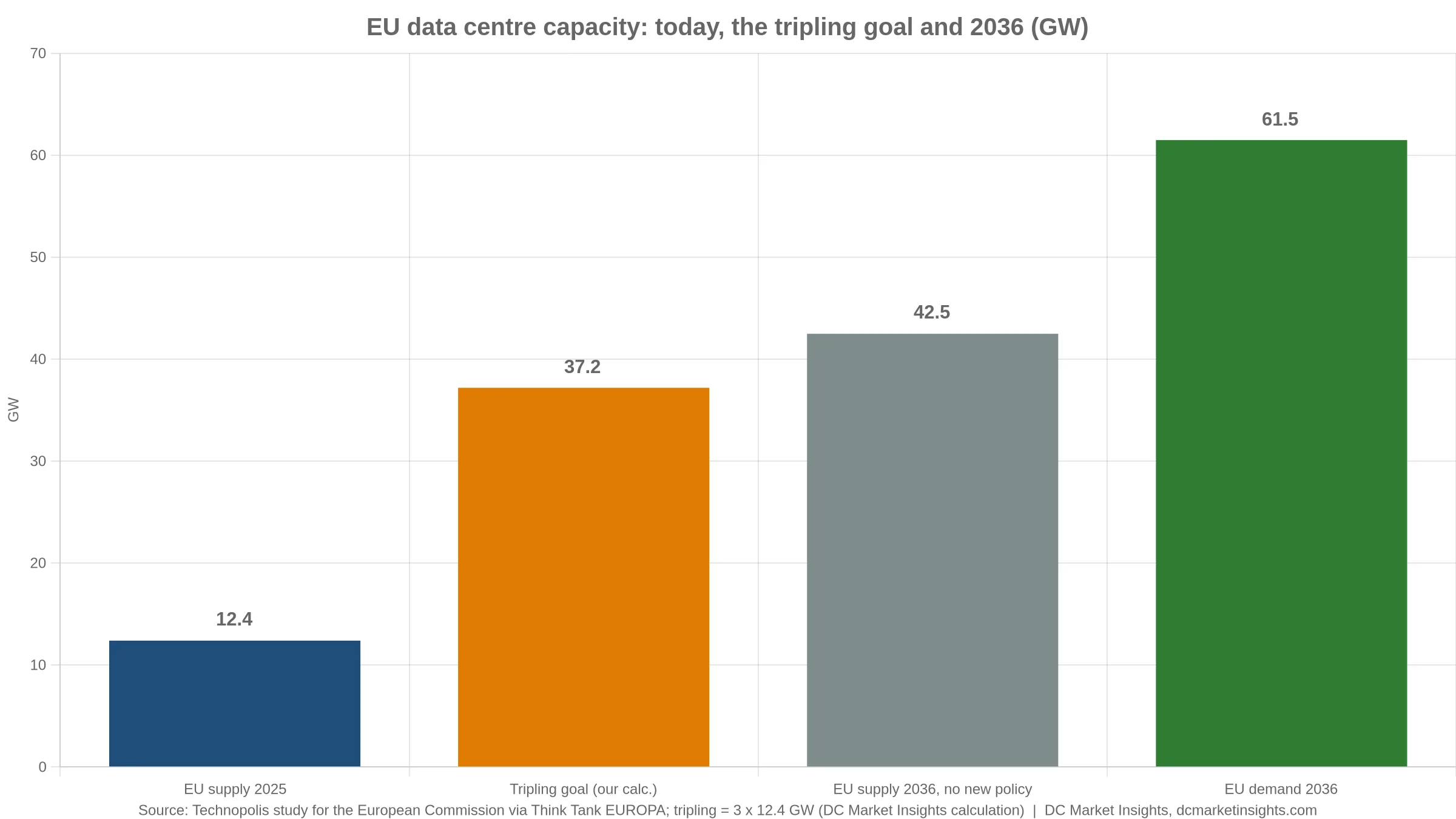
In our view the chart shows the odd shape of the target. The Commission’s own no-policy case already passes 37 GW by 2036. The tripling goal is therefore about speed: reaching that level by 2031-2033 instead of the mid-2030s, while demand keeps running ahead.
What changed this week: a progress report, a leak and a decree
The Council file. The Irish Presidency’s progress report of 13 November was prepared “with a view to submitting it to the TTE (Telecommunications) Council at its meeting on 1 December 2026.” The updated version of 26 November invites ministers only “to take note of the progress made”. Compromise texts so far extend the deadline to designate an acceleration zone from 6 to 12 months and push the date of application from 12 to 18 months after entry into force. The 26 November report lists nine open issues, among them a possible national security and defence exemption and “the trigger for the obligation to set up a data centre acceleration zone”.
What the compromise drops. According to The European Post, the Presidency text of 16 November drops the duty to assess impacts on water bodies, deletes the greenhouse gas reference from the energy needs analysis, and turns the Commission’s power to overrule national cloud risk assessments into recommendations that governments must answer within three months.
The leaked energy model. On 26 November Euronews published a Commission draft titled “EU model for tripartite agreements on the sustainable integration of data centres into the energy system”. It was built with 18 member states and 14 industry associations. Participation “is voluntary”, and the commitments “do not create any legal obligations for the signatory parties”. It asks operators to share demand forecasts and consider flexible connections, encourages heat reuse, and lets member states designate areas by grid capacity. The first local agreements could begin in 2027.
We cannot sell out our natural resources to American Big Tech because that would be of no benefit to us.
Spain goes further than Brussels. On 20 November Spain’s Council of Ministers approved a royal decree on the energy, environmental and digital-sovereignty terms for data centres, MITECO said. Data centres above 10 MW must cover 80% of consumption with renewables matched hour by hour, from plants that entered the system no more than 36 months before the centre starts, until renewables pass 90% of Spain’s mix. Until EU labels apply, PUE must be 1.25 or less and WUE 0.1 or less. Projects already in process get six months to comply, or three if waiting for a grid-access tender.
In the absence of this Royal Decree, we would have an impact of 5,000 million euros on our invoices
| Rule | Date | Binding? | Key numbers |
|---|---|---|---|
| Cloud and AI Development Act (Commission proposal) | 3 Jun 2026 | Proposal; Council progress report only | Triple capacity in 5-7 years; permits in zones within 12 months; 18 months everywhere by 2030 |
| Council compromise (Irish Presidency) | 16 Nov 2026 | Working text | Zone deadline 6 to 12 months; application 12 to 18 months; water-body check dropped |
| EU tripartite model (leaked draft) | Reported 26 Nov 2026 | Voluntary | First local agreements from 2027; monitoring to at least 2035 |
| Spain royal decree | 20 Nov 2026 | Yes, from publication in the BOE | >10 MW; 80% hourly renewables; PUE ≤1.25; WUE ≤0.1 |
Sources: EUR-Lex; Council ST 16007/26; The European Post; Euronews; MITECO. The 18-month EU-wide permit goal is from Think Tank EUROPA’s summary of the proposal.
On Spain’s grid figures: DCD reports 15 GW of data centre access permits granted (6 GW transmission, 9 GW distribution) and more than 20 GW pending; the MITECO release does not give these figures. DCD and W.Media also describe the 60%/70% alternative for flexible (APRS) sites differently; we follow MITECO: 60% in peak hours to 31 December 2028, then 70% in peak and flat hours, for five years.
What our data shows this week
Market signal is where we read our own tracker. As of 27 November, DC Market Insights tracks 4,456 data centres in 105 countries worldwide, with 27.6 GW live, 39.0 GW under construction and 98.9 GW planned among sites with a published capacity. For the EU’s tripling goal, the five markets in the Technopolis country table are the test.
| Market | Supply 2025 (MW, Technopolis) | Demand 2025 (MW, Technopolis) | DCMI live (MW) | DCMI under construction (MW) | DCMI planned (MW) |
|---|---|---|---|---|---|
| Germany | 2,309 | 4,124 | 933 | 1,449 | 2,937 |
| France | 1,893 | 2,207 | 338 | 216 | 2,206 |
| Netherlands | 1,873 | 1,044 | 217 | 186 | 263 |
| Ireland | 1,638 | 548 | 53 | 248 | 1,210 |
| Denmark | 463 | 310 | 55 | 12 | 992 |
| Total | 8,176 | 8,233 | 1,596 | 2,110 | 7,607 |
Sources: Technopolis study for the European Commission, via Think Tank EUROPA; DC Market Insights facilities tracker, 27 Nov 2026. DCMI figures count only sites with a published MW (93 of 203 German sites, 33 of 109 French, 33 of 110 Dutch, 18 of 46 Irish, 13 of 36 Danish), so DCMI live MW is far below national supply estimates and the two columns must not be compared as market size.
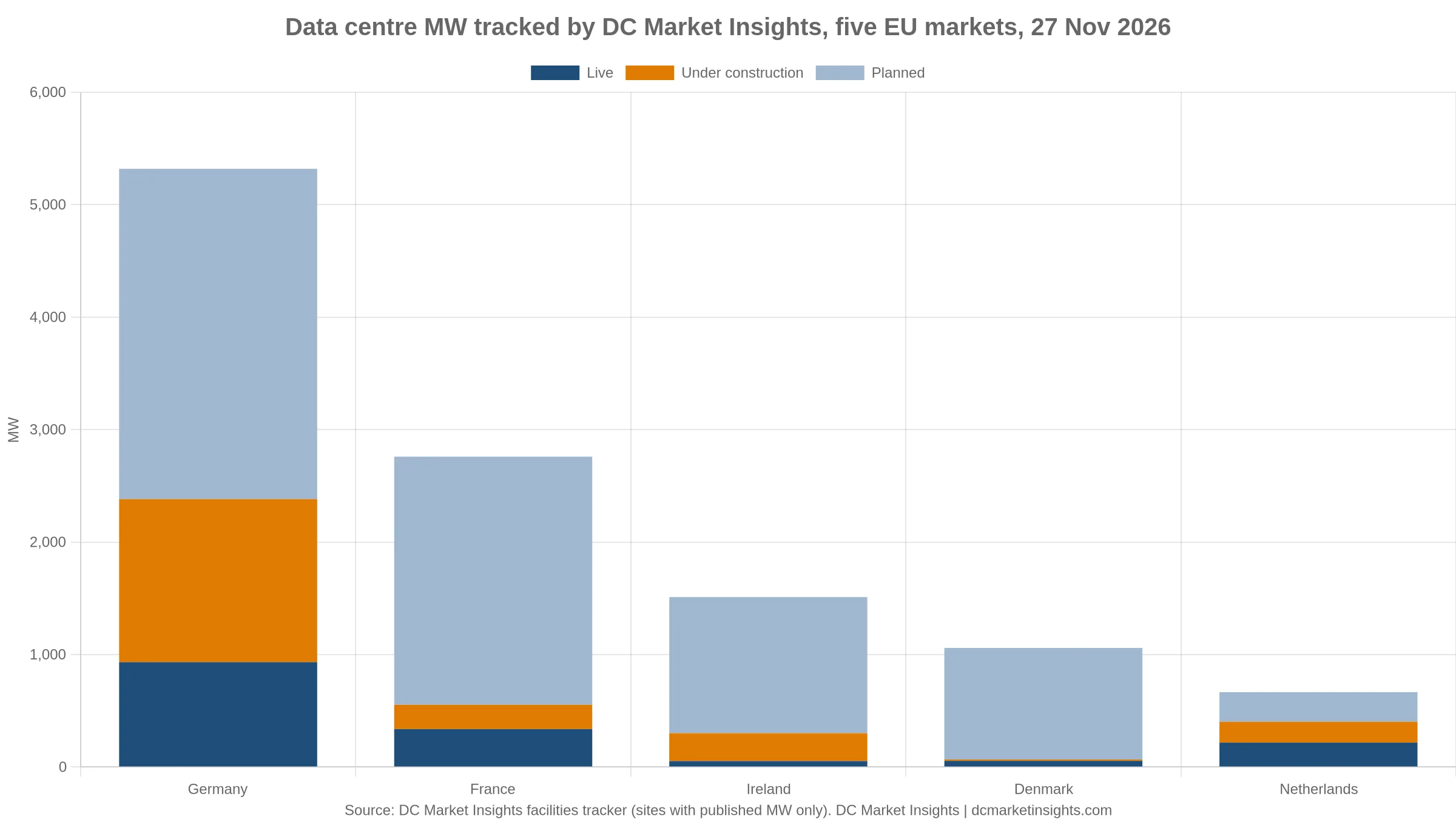
Three signals stand out. First, the pipeline is mostly paper. Of 9,717 MW of named projects in the five markets, 2,110 MW (22%) is under construction. Against the 24.8 GW the EU needs to add, the building share is 8.5% and the whole pipeline 39% (our calculation).
Second, Germany is where the shortfall sits and where the builds are. Germany covered 56% of its own demand in 2025, and it holds 69% of the MW under construction in our five-market set (1,449 of 2,110 MW). Since 22 October our German count rose from 177 to 203 sites; live MW rose by 89 MW, planned MW by 522 MW, and under-construction MW fell by 565 MW as projects were reclassified or went live.
Third, Ireland and Denmark have plans but no grid path. In Ireland, 1,210 MW is planned against 248 MW being built, under the CRU large energy user policy. Denmark’s 992 MW of plans sit behind a grid priority model that puts most data centres in the last of four categories, as we reported on 2 November.
Outside the EU, our UK count rose from 184 to 207 sites since 21 October, with live MW up 304 MW to 1,064 MW and planned MW up 474 MW to 7,409 MW. Most of that is better data on existing sites, not new capacity; under-construction MW rose only 46 MW, to 332 MW.
Who gains and who is exposed
Developers in acceleration zones. A 12-month permit clock is the main prize. Our view: the zones matter most in Germany and France, where planned MW is two to ten times the MW being built in our data, and least in grid-capped markets such as Ireland, where the binding constraint is a connection offer, not a permit.
Operators in Spain. The decree’s 80% hourly match is a large energy bill to source. A 100 MW site at 90% load uses about 788 GWh a year; 80% is about 631 GWh that must come from renewables less than three years old, matched hour by hour (our calculation). That favours flexible sites that can use the APRS route and sites paired with storage.
European cloud providers. The share goal of 30% by 2036 and the sovereignty levels help them on public contracts. But Think Tank EUROPA estimates only about 1.4% of the cloud market will face European-ownership requirements, and the Commission does not expect them to take effect before 2031.
Residents and grid operators. The leaked model gives towns and grid companies a seat at the table but no binding commitment from operators on renewables, water or heat. That is the gap protest groups pointed to in early November, as we reported on 6 November.
The wider pattern: the Gulf builds while Europe drafts
The contrast this week came from the Gulf. Sharjah’s deputy ruler approved a master plan for a communications technology free zone in Kalba with a 400 MW data centre complex, six data centre plots and sites for two power stations, The Tech Capital reported on 27 November. One approval in one emirate covers land and power together, which is the step that EU rules still split between permits and grid operators.
Inside Europe, capital keeps arriving at the asset level. Wren House agreed to take GIC’s 80% of Equinix’s first xScale joint venture for about EUR700m, and bids for a stake in Pure DC were due this month, as we reported on 25 November and 18 November. Public money is narrower: the EU covers at most about 11% of a large AI gigafactory site, we calculated on 26 November.
Capacity baselines differ by source: Euronews cites about 12 GW installed in 2025 from the leaked draft; the Technopolis study gives 12.4 GW of supply; Think Tank EUROPA says the Impact Assessment uses 12.1 GW. We use 12.4 GW for the tripling calculation and do not mix the figures.
What it means for operators, investors and vendors
Our view, based on the figures above:
- Plan for 2027-2028 zones, not 2026 permits. With a 12-month designation window and an 18-month application date, CADA zones are unlikely to issue permits before 2028 if the act is adopted in Q4 2027.
- Price the Spanish rule now. About 631 GWh a year of new, hourly-matched renewables per 100 MW at 90% load sets the PPA and storage budget for any Spanish project above 10 MW.
- Treat Germany as the swing market. It holds 1,449 MW of the 2,110 MW under construction in our five-market set and the largest supply gap (1,815 MW in 2025).
- Discount paper pipelines. Only 22% of tracked MW in the five markets is under construction; underwrite on connection offers, not plans.
- Vendors: the EU target means 3.5-5.0 GW a year. That is the order book Europe’s power and cooling suppliers would need to serve if the tripling goal holds.
- Cloud sellers: sovereignty pays slowly. Ownership rules may touch about 1.4% of the market and start around 2031.
For sizing, see our Data Center Market report (US$697.78 billion in 2026), the Sovereign AI Infrastructure Market report and the Data Center Renewable Energy Market report. Country rules are tracked on our Germany, Spain and Denmark power and policy pages.
What to watch next
- 1 December 2026: Telecommunications Council in Brussels; ministers take note of the CADA progress report (ST 16007/26).
- 3 December 2026: bids close for Lot 2 of the EU AI gigafactory call (large sites).
- Late November to December 2026: Energinet’s answers to about 16 GW of Danish data centre connection requests under the new priority model.
- 14 December 2026: the EU consultation on data centre minimum performance standards closes.
- Publication in Spain’s BOE (date not set): the royal decree takes effect, starting the six-month and three-month compliance windows.
- 27 April 2027: planned European Parliament position on CADA; adoption targeted for Q4 2027.
Frequently asked questions
How much data centre capacity does the EU have?
About 12.4 GW of supply in 2025 against 15.3 GW of demand, according to a Technopolis study for the European Commission. Other Commission documents use 12.1 GW, and the leaked draft reported by Euronews says about 12 GW.
What does tripling EU data centre capacity mean in GW?
From 12.4 GW, tripling means about 37.2 GW, or roughly 24.8 GW of new capacity in five to seven years: 3.5 to 5.0 GW a year (our calculation). The Commission’s no-policy outlook reaches 42.5 GW only in 2036.
When will the Cloud and AI Development Act be adopted?
Not before late 2027 on current plans. Ministers take note of a progress report on 1 December 2026, the European Parliament plans its position for 27 April 2027, and the roadmap target for adoption is Q4 2027.
What does Spain’s new data centre decree require?
Data centres above 10 MW must match 80% of their use with new renewables hour by hour, keep PUE at 1.25 or less and WUE at 0.1 or less during the transition, and report efficiency data. Spain approved it on 20 November 2026.
Sources
- European Commission, “Proposal for a Regulation … (Cloud and AI Development Act)”, COM(2026) 502 final, 3 Jun 2026. Link
- Council of the EU, Presidency, “Cloud and AI Development Act – Progress report”, ST 15300/26, 13 Nov 2026. Link
- Council of the EU, General Secretariat, “Cloud and AI Development Act – Progress report”, ST 16007/26, 26 Nov 2026. Link
- Council of the EU, “Transport, Telecommunications and Energy Council (Telecommunications), 1 December 2026”. Link
- Think Tank EUROPA, “Data centres, AI and digital sovereignty: New EU proposal may close critical gaps but leaves Europe’s wider dependencies intact”, 10 Nov 2026. Link
- Euronews, “EU wants more data centres but won’t force new green commitments, leaked draft reveals”, 26 Nov 2026. Link
- The European Post, “Cloud and AI Development Act Draft Drops Water Checks for Data Centres”, 19 Nov 2026. Link
- MITECO, “El Gobierno aprueba el Real Decreto para la sostenibilidad energética, medioambiental y de resiliencia y soberanía digital de los centros de datos”, 20 Nov 2026. Link
- W.Media, “Spain approves new energy and digital sovereignty rules for data centers”, 24 Nov 2026. Link
- DCD, “Spain approves decree on data centers to curb electricity costs”, Nov 2026. Link
- The Tech Capital, “UAE’s Sharjah approves plans for 400MW data centre complex”, 27 Nov 2026. Link
- DC Market Insights, facilities tracker and Data Center Power & Policy pages (Germany, France, Netherlands, Ireland, Denmark, United Kingdom), data as of 27 Nov 2026. Link