Executive summary:
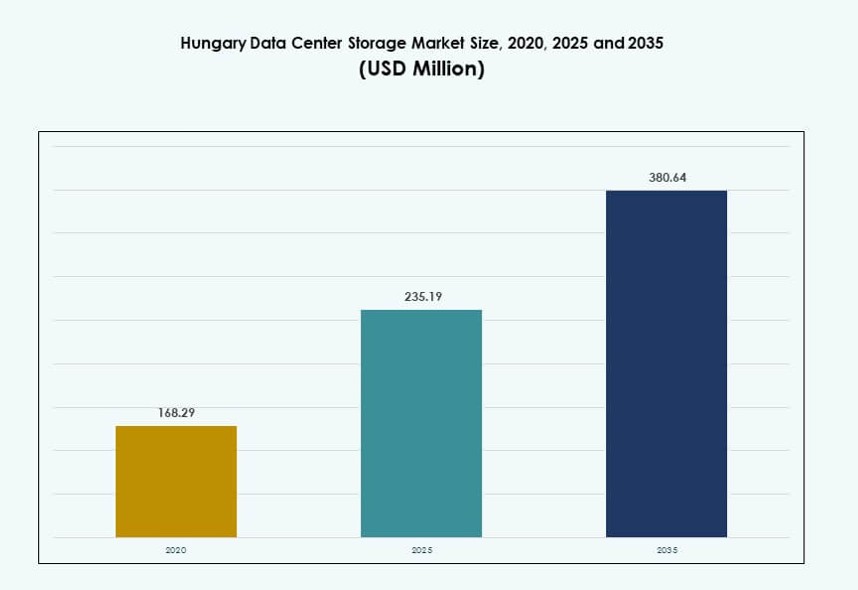
The Hungary Data Center Storage Market size was valued at USD 168.29 million in 2020 to USD 235.19 million in 2025 and is anticipated to reach USD 380.64 million by 2035, at a CAGR of 4.87% during the forecast period.
| REPORT ATTRIBUTE |
DETAILS |
| Historical Period |
2020-2023 |
| Base Year |
2024 |
| Forecast Period |
2025-2035 |
| Hungary Data Center Storage Market Size 2025 |
USD 235.19 Million |
| Hungary Data Center Storage Market, CAGR |
4.87% |
| Hungary Data Center Storage Market Size 2035 |
USD 380.64 Million |
Enterprises in Hungary are shifting toward hybrid and cloud-native storage to support digital transformation. The rising adoption of AI, IoT, and big data is increasing demand for low-latency, high-performance infrastructure. Government digitalization efforts and local compliance needs drive storage investments across sectors. Businesses prioritize software-defined, modular systems to optimize cost and flexibility. The market’s strategic relevance grows as organizations modernize legacy systems and move toward scalable platforms.
Central Hungary leads the market, with Budapest accounting for the majority of storage deployments due to its strong fiber infrastructure and enterprise density. Western Hungary shows momentum driven by manufacturing and cross-border IT activity. Eastern and Southern regions are gradually expanding through public-sector digital initiatives and educational institution upgrades. The market displays balanced development shaped by both commercial demand and state-led infrastructure growth.
Market Dynamics:
Market Drivers
Growing Shift Toward Digital Transformation Across Enterprise Workloads
The Hungary Data Center Storage Market benefits from the fast-paced digital shift across sectors. Local enterprises increasingly migrate workloads to data centers for reliability and scalability. Strong demand for backup, disaster recovery, and real-time analytics boosts enterprise storage investments. Companies seek low-latency storage that supports both legacy systems and modern cloud-native applications. Integration of AI and IoT across industrial and service verticals adds complexity to storage needs. These technologies require high-throughput infrastructure for real-time processing. Software-defined storage and virtualization gain traction to manage this complexity effectively. The market plays a critical role in enabling enterprise agility. It serves as a digital foundation for strategic IT decision-making.
Adoption of Hybrid Cloud Architecture Enhancing Storage Flexibility and Performance
Hybrid cloud storage architecture is rapidly expanding across Hungary’s IT ecosystem. Enterprises seek seamless integration between on-prem and cloud environments. Flexibility, compliance, and cost-efficiency drive this trend, especially for mid-sized businesses. Organizations prefer hybrid setups to optimize workload distribution and minimize latency. Secure storage provisioning in both private and public clouds improves accessibility and resilience. Hungary’s storage vendors develop hybrid-ready offerings to align with global cloud standards. Adoption of cloud-native platforms enables dynamic storage allocation. The Hungary Data Center Storage Market supports critical workflows across distributed environments. It ensures business continuity through enhanced flexibility and scalability.
Technology Modernization Initiatives Supporting Strategic Infrastructure Investments
Government and private sector investments aim to modernize IT infrastructure across the country. Public digital initiatives accelerate demand for secure, energy-efficient data storage. Enterprises adopt next-gen storage solutions that align with evolving compliance standards. Modern data centers implement high-density flash systems to meet growing data volumes. Organizations prioritize storage performance metrics such as IOPS and throughput. Demand for data encryption, backup automation, and seamless failover boosts software storage uptake. Partnerships with global OEMs help local firms scale capabilities faster. The Hungary Data Center Storage Market plays a vital role in supporting national digitalization strategies. It bridges the gap between infrastructure needs and enterprise goals.
- For instance, in 2024, Magyar Telekom reported HUF 113.3 billion in capex, with a focus on upgrading its national gigabit fixed network, forming a critical layer for digital infrastructure supporting enterprise storage modernization.
Increased Need for Data Localization and Sovereign Infrastructure Solutions
Data sovereignty policies and GDPR compliance fuel interest in locally hosted storage. Enterprises avoid cross-border data transfer risks by opting for domestic data centers. Industries such as BFSI, government, and healthcare require high-compliance, localized data handling. This trend promotes investments in enterprise-grade storage infrastructure within Hungary’s borders. Secure and compliant solutions drive uptake of modular and scalable systems. Encryption-at-rest and geo-fencing features are prioritized in new deployments. Service providers expand local footprint to address rising demand. The Hungary Data Center Storage Market evolves to support trusted infrastructure. It delivers resilient, policy-aligned storage for regulated sectors.
- For instance, Vantage Data Centers announced a €1.4 billion investment in its EMEA data center platform in 2024 to expand capacity across Europe, supported by GIC and MEAG. The investment aims to scale its regional footprint with over 2.5 GW of IT capacity in development.
Market Trends
Surge in AI and Machine Learning Workloads Driving Need for Intelligent Storage
Demand for AI-ready storage is increasing as enterprises expand machine learning use cases. Organizations process unstructured data from sensors, images, and logs to train models. This drives uptake of scalable, high-speed storage that supports parallel processing. NVMe systems gain preference for their low latency and high throughput performance. Storage vendors integrate AI capabilities to improve data tiering and workload optimization. Real-time analytics applications require infrastructure that adapts dynamically. Hungary’s enterprises build intelligent workflows powered by storage-driven insights. The Hungary Data Center Storage Market aligns with these evolving compute trends. It supports data-intensive workloads across research, healthcare, and manufacturing.
Rise of Edge Storage Infrastructure in Support of Latency-Sensitive Applications
Enterprises increasingly adopt edge storage solutions to process data closer to source. Applications such as IoT, smart city systems, and autonomous vehicles require real-time data access. Localized edge data centers host high-performance storage to minimize latency. Hungary sees rising deployments of micro data centers across industrial zones. Edge storage improves response time and enables uninterrupted analytics flow. Use of SSDs and ruggedized flash systems supports operation in remote environments. Telecom operators deploy edge storage nodes to support 5G services. Hungary Data Center Storage Market enables distributed data architectures. It plays a vital role in decentralizing storage workloads.
Transition Toward Green Storage Systems Emphasizing Energy and Resource Efficiency
Sustainability goals drive adoption of energy-efficient data storage technologies. Enterprises demand storage hardware with low power consumption and high density. Green storage solutions reduce both operational cost and carbon footprint. Flash-based systems replace legacy spinning drives to lower energy use. Hungary’s providers invest in storage cooling innovations and power optimization. Liquid cooling and AI-controlled thermal management gain interest. Public sector organizations enforce green IT standards across infrastructure projects. The Hungary Data Center Storage Market incorporates ESG principles into technology roadmaps. It supports enterprises in building responsible and compliant IT environments.
Evolution of Storage-as-a-Service (STaaS) Business Models Across Enterprise Segments
Flexible, subscription-based storage models gain traction among SMEs and startups. STaaS enables businesses to scale capacity without upfront infrastructure costs. Vendors offer bundled services combining storage hardware, software, and management tools. Pay-as-you-grow models support predictable OPEX budgeting. Hungary-based MSPs expand offerings in this area to serve regional markets. STaaS solutions integrate with hybrid cloud platforms and offer multi-tenancy. Enterprises access advanced features like snapshots, backup, and tiering on demand. The Hungary Data Center Storage Market adapts to recurring revenue models. It creates new opportunities for service differentiation and market expansion.
Market Challenges
High Cost of Advanced Storage Infrastructure Deployment and Integration
Modern storage systems such as all-flash arrays and NVMe solutions demand high capital investment. Small and mid-sized firms struggle to afford such technologies at scale. Integration with existing infrastructure requires skilled labor and specialized tools. Many Hungarian enterprises face IT budget constraints limiting upgrades. Cost of storage migration from legacy to modern systems remains a barrier. Training staff to manage complex hybrid setups adds operational expense. Local vendors face pricing pressure from global competitors with broader portfolios. The Hungary Data Center Storage Market must balance innovation with affordability. Sustained demand hinges on cost-effective and modular offerings.
Cybersecurity Threats and Data Protection Compliance Creating Operational Pressure
Rising ransomware attacks and cyber risks heighten focus on secure storage systems. Enterprises must ensure data is encrypted, backed up, and quickly restorable. Regulatory mandates such as GDPR introduce strict compliance expectations. Storage vendors must integrate advanced threat detection, access control, and recovery features. Downtime from breaches can result in financial losses and reputational damage. Businesses demand zero-trust architecture and immutable backups. Meeting these security needs increases infrastructure complexity and cost. The Hungary Data Center Storage Market navigates this environment with robust security-first solutions. It must address evolving threat vectors while supporting business continuity.
Market Opportunities
Growing Cloud-Native Startup Ecosystem Driving Agile Storage Demand
Hungary’s tech startup ecosystem fuels demand for agile and scalable storage solutions. Cloud-native businesses need dynamic provisioning, API-based access, and multi-cloud support. Vendors offering flexible deployment and STaaS platforms stand to benefit. Public-private partnerships promote innovation hubs, strengthening demand for smart storage. The Hungary Data Center Storage Market responds to these digital-first workflows. It offers flexible, usage-based models for fast-growing business environments.
Enterprise AI and HPC Projects Unlocking High-Capacity Storage Investments
AI, scientific computing, and large dataset analysis require high-throughput storage platforms. Universities, research labs, and enterprises invest in robust systems supporting parallel processing. Flash arrays, NVMe, and object storage meet these needs with speed and scale. Infrastructure readiness for AI boosts market relevance across sectors. The Hungary Data Center Storage Market supports this trend with intelligent storage platforms. It helps power high-compute environments across verticals.
Market Segmentation
By Storage Type
Traditional storage continues to dominate the Hungary Data Center Storage Market due to its affordability and simplicity. However, all-flash storage is quickly gaining share in high-performance environments such as financial services and AI workloads. Hybrid storage, offering both flash and spinning disks, attracts enterprises balancing cost with speed. Market momentum is shifting toward hybrid systems due to rising AI and analytics workloads. Others, such as object-based storage, remain niche but are growing in archiving use cases.
By Storage Deployment
Storage Area Network (SAN) systems hold the largest market share due to high availability and performance in enterprise environments. Network-attached Storage (NAS) systems gain traction among mid-sized firms for file sharing and collaboration. Direct-attached Storage (DAS) remains relevant in small-scale setups but is losing share to networked solutions. Others, such as hyperconverged platforms, emerge as alternatives for agile deployments. The Hungary Data Center Storage Market reflects this mix of traditional and next-gen deployments.
By Component
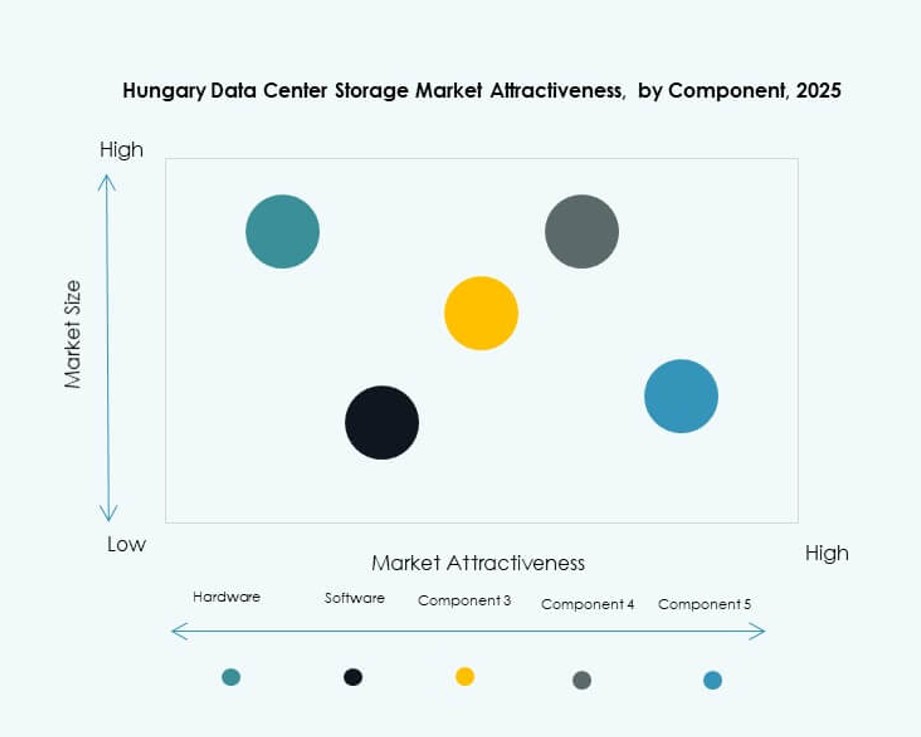
Hardware leads the Hungary Data Center Storage Market, driven by investments in servers, flash arrays, and high-density racks. However, software solutions are gaining attention as storage management becomes more complex. Features like deduplication, tiering, and backup automation boost demand. Vendors bundle both components in turnkey solutions. Enterprises seek performance from hardware and intelligence from software. The market evolves toward integrated systems offering seamless control.
By Medium
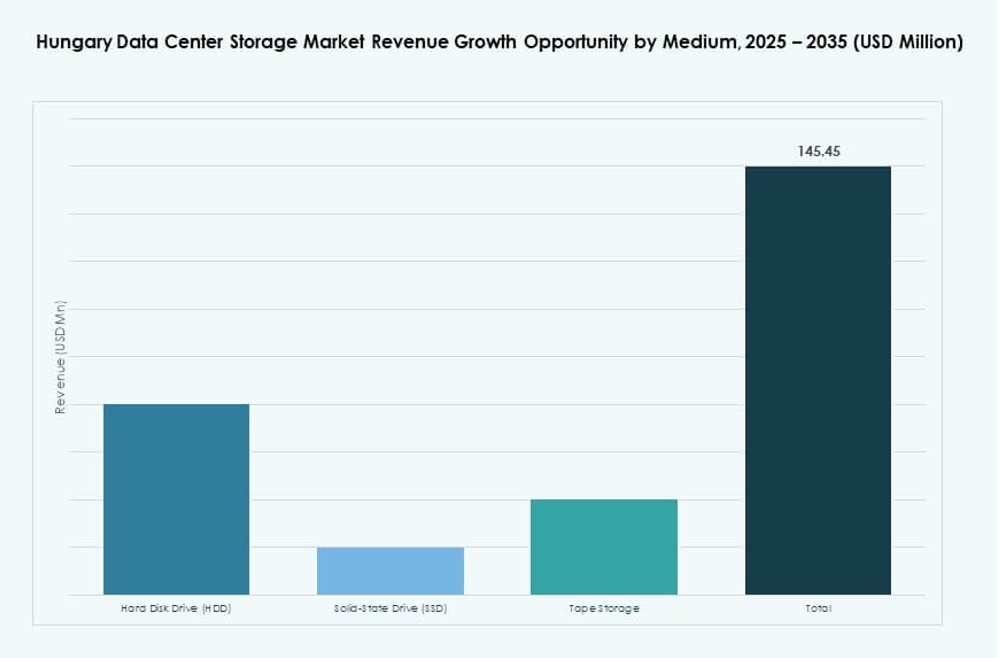
Hard Disk Drives (HDD) dominate in bulk storage and backup use cases due to cost-efficiency. Solid-State Drives (SSD) are rising in primary storage and edge deployments for performance-critical workloads. Tape storage retains a role in long-term archival and regulatory compliance. Enterprises diversify media use based on cost, performance, and durability. The Hungary Data Center Storage Market continues to shift toward SSD for latency-sensitive tasks.
By Deployment Model
On-premises deployments hold a strong share due to data control, compliance, and low latency. However, cloud-based models are expanding fast, especially among startups and mid-tier firms. Hybrid models combine both, offering agility and control. Enterprises select deployment types based on application, cost, and security needs. The Hungary Data Center Storage Market sees hybrid gaining ground with increasing cloud adoption.
By Application
IT and Telecommunications remain dominant users, requiring high-throughput, low-latency storage. BFSI follows closely, driven by regulatory needs and sensitive data storage. Government and healthcare sectors prioritize secure and compliant infrastructure. Others, including education and manufacturing, show steady adoption driven by digitalization. The Hungary Data Center Storage Market sees consistent growth across all verticals, with IT and BFSI leading demand.
Regional Insights
Central Hungary Dominates the National Storage Market Share with Budapest as a Core Hub
Central Hungary holds the largest share of the Hungary Data Center Storage Market, accounting for nearly 60%. Budapest serves as the primary data center hub due to its connectivity and commercial presence. Hyperscale and colocation providers concentrate capacity around the capital. Strong fiber infrastructure and cloud availability zones support enterprise workloads. The region attracts both domestic and international investments in digital infrastructure. It continues to lead due to scale, workforce, and policy support.
- For example, Magyar Telekom expanded its gigabit fixed network to over 3.8 million access points nationwide by end-2024, with capex after leases at HUF 113.3 billion primarily for Hungarian fixed gigabit rollout.
Western Hungary Emerges with Industrial-Driven Growth in Localized Storage Infrastructure
Western Hungary captures about 25% of the market, driven by manufacturing zones and cross-border data needs. Cities such as Győr and Székesfehérvár experience rising demand from industrial automation and logistics. Edge storage deployments gain traction in these zones due to real-time processing needs. Connectivity to Austria and Slovakia supports cross-regional storage activity. The Hungary Data Center Storage Market reflects this industrial demand with site-specific investments. It expands capacity to serve regional enterprises.
- For instance, 4iG acquired a majority stake in Mobil Adat Ltd, strengthening its IoT-focused data transmission capabilities that support enterprise data traffic and storage-intensive workloads across Hungary.
Eastern and Southern Hungary Show Moderate Uptake Supported by Government IT Programs
Eastern and Southern Hungary together hold around 15% of the market. These areas lag in private data center development but benefit from public-sector digitization programs. Educational, municipal, and healthcare institutions drive localized storage demand. Infrastructure expansion projects aim to improve connectivity in these regions. Government-backed cloud adoption programs further stimulate interest in secure storage systems. The Hungary Data Center Storage Market broadens access through shared infrastructure and colocation. It supports digital inclusion in underserved areas.
Competitive Insights:
- 4iG
- T-Systems Hungary
- Dell Technologies
- Hewlett Packard Enterprise (HPE)
- IBM Corporation
- NetApp
- Cisco Systems, Inc.
- Huawei Technologies Co., Ltd.
- Lenovo Group
- Hitachi Vantara
The Hungary Data Center Storage Market features a competitive landscape shaped by local integrators and global technology providers. Domestic firms like 4iG and T-Systems Hungary focus on enterprise and public-sector clients with tailored infrastructure solutions. Multinational companies including HPE, Dell Technologies, and IBM deliver high-performance storage systems integrated with hybrid and cloud-native platforms. NetApp and Cisco lead in software-defined and network-attached storage solutions. Huawei and Lenovo expand their presence with modular systems and cost-effective models. Players compete on performance, energy efficiency, and security features. Market consolidation through strategic partnerships and government IT initiatives further influences vendor positioning. It remains dynamic, with strong competition across verticals and deployment models.
Recent Developments:
- In December 2025, 4iG Information Technology Ltd acquired a 90 percent stake in Mobil Adat Ltd, a leading Hungarian provider of managed data transmission services, enhancing its data communications and IoT capabilities in the region.
- In January 2025, EPAM expanded its global partnership with Google Cloud, leveraging Vertex AI for scalable AI solutions relevant to data management, with operations including its Hungarian entity contributing to digital transformation efforts.