Executive summary:
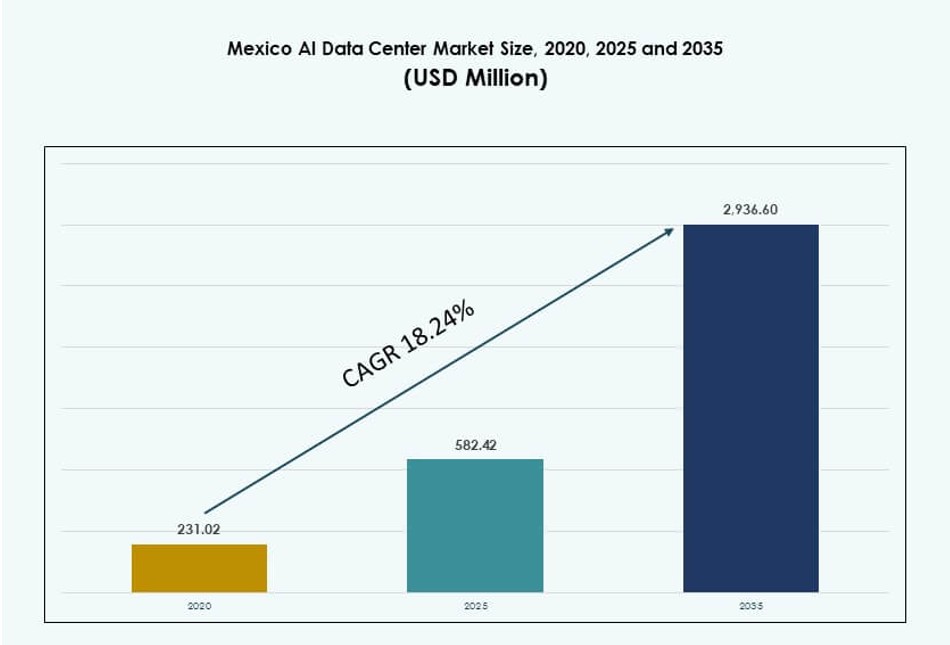
The Mexico AI Data Center Market size was valued at USD 231.02 million in 2020 to USD 582.42 million in 2025 and is anticipated to reach USD 2,936.60 million by 2035, at a CAGR of 17.50% during the forecast period.
| REPORT ATTRIBUTE |
DETAILS |
| Historical Period |
2020-2023 |
| Base Year |
2024 |
| Forecast Period |
2025-2035 |
| Mexico AI Data Center Market Size 2025 |
USD 582.42 Million |
| Mexico AI Data Center Market, CAGR |
17.50% |
| Mexico AI Data Center Market Size 2035 |
USD 2,936.60 Million |
Rising AI adoption across finance, manufacturing, and telecom sectors is accelerating demand for high-density computing infrastructure. Enterprises deploy GPU-powered systems for machine learning, vision analytics, and real-time processing. Cloud providers expand regional zones to meet sovereign data and low-latency requirements. Liquid cooling and modular rack designs are gaining traction. Investors view AI infrastructure as a long-term strategic asset. Growing interest in AI-native applications supports data center scalability. Mexico attracts hyperscale projects due to workforce, energy access, and cross-border connectivity. The market gains relevance for regional AI workload deployment.
Central Mexico leads the market with dense development in Querétaro and Mexico City driven by connectivity, land availability, and enterprise demand. Northern regions such as Monterrey are emerging hubs due to strong industrial activity and proximity to U.S. infrastructure corridors. Southern areas remain underpenetrated but show gradual growth potential through edge deployments. Strategic zoning and permitting frameworks influence location decisions. Central and northern corridors attract the majority of AI infrastructure investment.
Market Dynamics:
Market Drivers
Rapid Growth of GPU-Based Infrastructure for AI Model Training and Inference Workloads
AI workloads in Mexico are accelerating demand for dense GPU-based computing. Enterprises and research institutions adopt high-performance infrastructure for training foundation models. These systems require advanced racks supporting liquid or hybrid cooling. The Mexico AI Data Center Market benefits from higher rack power densities and next-gen power distribution. It supports inference tasks for real-time use cases like fraud detection and recommendation engines. Cloud providers invest in scalable GPU clusters to serve local and regional demand. Technology vendors partner with hyperscalers to accelerate deployment. High-throughput networks and low-latency fabrics become mandatory. Edge AI inference requirements drive rack design and site selection.
- For instance, ODATA’s QR04 hyperscale data center near San Miguel de Allende was designed for a total IT capacity of 24 MW with the first phase operational, and it uses Aligned Data Centers’ patented Delta³ air‑cooling technology that supports up to 50 kW per rack.
Strategic Shift Toward Digital Sovereignty and Regional AI Compute Infrastructure
Government policies favor domestic data processing for AI and sensitive applications. Mexico’s regulatory stance encourages local deployment of training infrastructure. This reduces reliance on foreign cloud zones for compute-heavy tasks. The Mexico AI Data Center Market plays a central role in enabling sovereign digital operations. National investments target energy-efficient designs, resilient infrastructure, and zonal diversity. AI compute zones are expanding in metro and energy-rich regions. Public-private collaborations support AI research at scale. Data compliance rules accelerate deployment of regulated AI workflows. The market supports institutional AI growth with locally managed infrastructure.
- For instance, CloudHQ announced a USD 4.8 billion investment to build six new data centers in Querétaro designed to support next‑generation cloud computing and AI services, with an initial 200 MW of capacity planned by 2027 and infrastructure to scale further.
Surging Enterprise Adoption of AI-Driven Applications Across Industry Verticals
AI adoption in financial services, manufacturing, and logistics boosts infrastructure demand. Companies use AI for risk scoring, predictive maintenance, and supply chain optimization. These models require stable, low-latency environments for deployment. The Mexico AI Data Center Market enables enterprises to process workloads locally. It reduces latency and improves data privacy. Tier III and Tier IV facilities meet uptime and compliance expectations. Businesses shift from pilot AI use cases to full-scale implementation. Demand grows for modular, scalable, and secure AI hosting. Operators see strong growth from mid-sized firms expanding AI adoption.
Increased Investment in Hyperscale and Edge Facilities for Scalable AI Hosting
Operators focus on hybrid architecture supporting both centralized training and edge inference. Hyperscale campuses offer core processing for large language models and generative AI. Edge locations serve latency-sensitive services in industrial and urban zones. The Mexico AI Data Center Market supports both needs with tailored capacity and interconnects. Infrastructure includes liquid-cooled GPU racks, high-speed switches, and DCIM tools. Local governments offer incentives for capacity expansion in strategic regions. Multinational cloud players invest in new availability zones with AI capabilities. Enterprise demand and cloud-native AI tools fuel long-term infrastructure scaling. Edge AI brings compute closer to users and devices.
Market Trends
Integration of Liquid Cooling and High-Density Rack Designs to Support AI Cluster Demands
The market is moving toward thermal-efficient solutions for racks exceeding 30 kW. Operators deploy direct-to-chip and rear-door liquid cooling for dense GPUs. Liquid cooling enables compact designs without performance compromise. The Mexico AI Data Center Market supports rack modernization for AI loads. Liquid-cooled systems reduce energy waste and improve thermal balance. Facility operators retrofit older halls to meet high-density requirements. Liquid cooling adoption is driven by hyperscale needs and thermal limits. High-density designs allow vertical scalability in constrained footprints. Operators view thermal innovation as a competitive differentiator.
Adoption of AI-Native Monitoring and DCIM Platforms for Real-Time Infrastructure Optimization
Data centers implement AI-based tools to track power, temperature, and workload distribution. Smart dashboards enhance visibility across rack and facility levels. The Mexico AI Data Center Market supports AI-driven management tools to optimize operations. Operators use predictive alerts to prevent hardware stress or failure. Integrated monitoring helps balance loads and manage cooling. AI platforms improve sustainability through automated energy use adjustments. Tools adapt dynamically to AI workload intensity. Asset management becomes more proactive and data-informed. Operators gain efficiency without compromising availability.
Expansion of Edge Micro Data Centers to Enable Distributed AI Processing Across Industrial Zones
Edge deployments grow to support smart factories, IoT, and connected infrastructure. Modular racks and prefabricated micro facilities enable rapid deployment. The Mexico AI Data Center Market supports edge AI with low-latency infrastructure. Compact designs suit constrained environments in industrial clusters. Operators target manufacturing and transport hubs for rollout. Micro data centers use remote management and AI-based orchestration. Edge sites handle video analytics, predictive modeling, and automation. Cloud-native applications extend into physical environments. Demand grows for ruggedized, scalable edge form factors.
Deployment of AI-Focused Availability Zones and Colocation Sites by Global Cloud Providers
Leading cloud firms add AI-specific infrastructure to new and existing zones. These zones host GPUs, AI accelerators, and high-bandwidth fabric. The Mexico AI Data Center Market benefits from direct hyperscale investments. Operators offer colocation services with AI-ready configurations. Interconnects link AI zones to edge and metro fiber networks. Tenants prefer proximity to end-users for inference workloads. Dedicated zones for AI enable better service-level control. Cloud providers meet demand with regional build-outs. Investors back hyperscale projects focused on AI readiness.
Market Challenges
High Power Demand, Grid Limitations, and Cooling Infrastructure Gaps in Supporting AI Density
AI infrastructure requires consistent high power delivery across large deployments. Dense GPU racks exceed traditional power draw per square foot. The Mexico AI Data Center Market faces strain from grid capacity issues and utility delays. Some zones lack substations or fast-track permitting for expansion. Thermal management remains a limiting factor in older facilities. Operators struggle to integrate advanced cooling due to legacy layouts. Power usage effectiveness (PUE) varies widely across locations. Peak load management and green sourcing remain unresolved. Investors remain cautious in regions with unreliable grid access.
Talent Shortages, Regulatory Complexity, and Supply Chain Delays Impacting Buildout Cycles
AI data centers demand skilled technical staff for design, operations, and security. The local workforce still faces shortages in advanced data center engineering. The Mexico AI Data Center Market is affected by delays in permits, inspections, and compliance. Regulatory clarity around AI data processing remains limited. Import dependencies slow down hardware supply for AI deployments. Lead times for racks, PDUs, and cooling units increase project timelines. Cross-border sourcing of GPUs and switches faces logistical issues. Developers require predictable timelines to justify long-term investment. These gaps delay project commissioning and AI go-live schedules.

Market Opportunities
Cross-Border AI Collaboration and Integration with U.S. Infrastructure Supporting Growth at Scale
Mexico can serve as a nearshore alternative for U.S. hyperscalers seeking proximity and cost savings. New data corridors link northern Mexico to southwestern U.S. fiber routes. The Mexico AI Data Center Market benefits from this regional synergy. Shared investment frameworks support dual-country AI training networks. Operators tap into demand for bilingual AI models and regional language datasets. Border regions provide land, labor, and logistics advantages. Cross-border edge zones enable AI inference closer to users.
Industrial AI Adoption and Smart Manufacturing Expansion Driving Local Compute Demand
AI transforms operational decision-making in manufacturing zones across Mexico. Companies invest in real-time vision systems, robotic analytics, and production automation. The Mexico AI Data Center Market supports infrastructure for on-site or near-site compute. Local zones reduce latency for time-sensitive industrial AI. Demand grows for energy-efficient, AI-tuned colocation sites. Industrial parks emerge as anchor zones for AI edge deployment. Operators form partnerships with manufacturing clusters.
Market Segmentation
By Type
The hyperscale segment dominates the Mexico AI Data Center Market due to large-scale investments by cloud providers and international tech companies. These facilities support high-density racks and offer scalable capacity for AI training and inference. Colocation and enterprise data centers also see demand from financial, telecom, and retail sectors. Edge and micro data centers are emerging fast to serve industrial zones, logistics hubs, and urban areas. Their growth is driven by proximity needs and latency-sensitive AI workloads.
By Component
Hardware remains the leading segment in the Mexico AI Data Center Market, driven by demand for GPUs, AI accelerators, high-density racks, and liquid cooling systems. Software and orchestration tools gain traction due to AI-native platforms managing data flow, performance, and power use. The services segment supports deployments, maintenance, and consulting, helping enterprises scale AI adoption. Hardware dominates in spend and criticality, while software ensures operational efficiency across AI clusters and facilities.
By Deployment
Cloud deployment leads in the Mexico AI Data Center Market as hyperscalers expand AI infrastructure across the region. Cloud-based AI services gain popularity due to ease of scalability, cost efficiency, and support for remote workloads. Hybrid models are also growing, especially for industries needing localized inference with cloud backup. On-premise remains relevant in BFSI and healthcare for regulatory and latency reasons. The market increasingly leans toward hybrid-cloud flexibility for AI tasks.
By Application
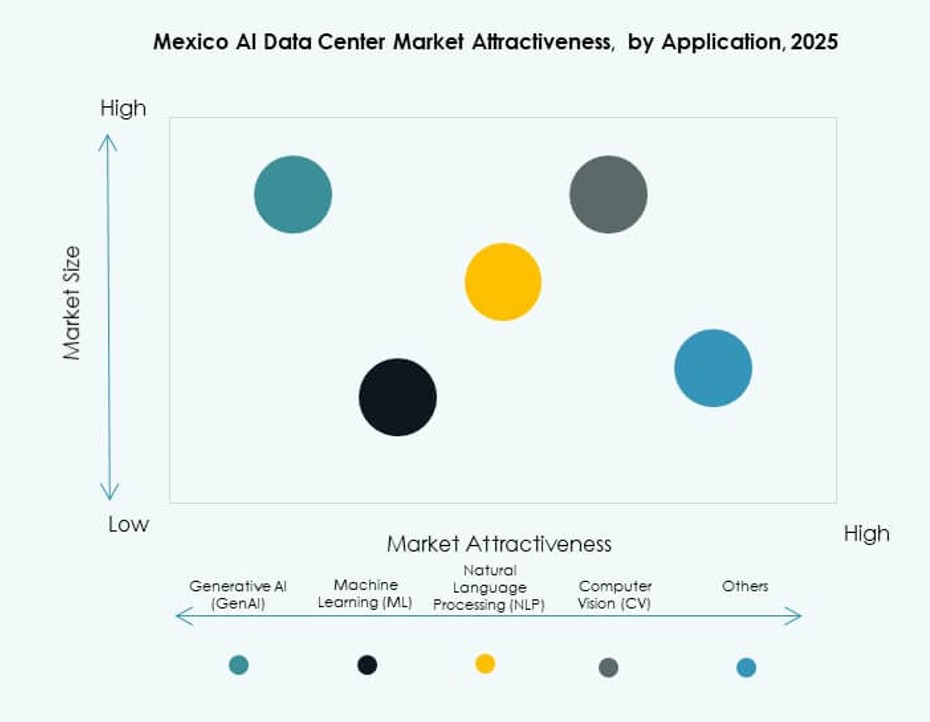
Machine learning (ML) holds the largest share of the Mexico AI Data Center Market due to its broad adoption across business processes. Generative AI (GenAI) sees rapid growth, especially in content, language, and automation use cases. Natural language processing (NLP) supports bilingual AI services in customer support and digital assistants. Computer vision (CV) is expanding in manufacturing and security sectors. Other applications like robotics and simulation models see steady growth in AI-focused environments.
By Vertical
IT and telecom dominate vertical demand in the Mexico AI Data Center Market due to early AI integration and infrastructure capabilities. BFSI follows closely, driven by AI in fraud detection and risk modeling. Healthcare shows growth in diagnostics and patient insights through AI platforms. Retail uses AI for inventory optimization and personalized marketing. Automotive and manufacturing gain from AI-driven automation and quality control. Media and entertainment deploy GenAI models for localized content. Other verticals continue to explore AI for operational efficiency.
Regional Insights
Central Region Leads with Over 50% Market Share Backed by Robust Infrastructure and Hyperscale Activity
The Central region, particularly Querétaro and Mexico City, leads the Mexico AI Data Center Market with over 50% share. Querétaro hosts many hyperscale campuses with access to reliable power and interconnects. Mexico City supports enterprise-grade and edge deployments due to dense urban workloads. Proximity to universities and research centers supports AI innovation. Operators in this zone benefit from regulatory clarity and skilled labor. Regional investment focuses on expanding high-density capacity.
Northern Region Emerges as Strategic Cross-Border Hub with 30% Market Share in AI Infrastructure
The Northern region, including Monterrey and border states, holds around 30% market share. Its location near U.S. tech hubs supports cross-border fiber connectivity. Energy access and industrial demand fuel data center expansion. Mexico’s northern states offer cost-effective land and logistics for hyperscalers. AI workloads related to logistics, manufacturing, and supply chains boost demand. Operators position sites to serve both domestic and U.S. users efficiently.
- For instance, Ascenty operates multiple Tier III‑certified data centers in Mexico (including Querétaro facilities) interconnected by its proprietary fiber‑optic network spanning Latin America, providing high‑availability power and robust connectivity that supports enterprise and cloud workloads.
Southern and Other Regions Capture Remaining 20% Share with Edge and Enterprise Deployment Potential
Southern states and secondary metro areas account for the remaining 20% of the Mexico AI Data Center Market. Growth is driven by localized edge deployments in retail and manufacturing zones. Infrastructure expansion is slower due to grid and permit challenges. Emerging cities focus on micro data centers and smart city applications. Operators see potential in Tier II zones as AI adoption spreads. Enterprise clients explore regional sites to meet redundancy and latency needs.
- For instance, KIO Networks operates two data centers in Mérida, Yucatán (MER1 and MER2), featuring carrier‑neutral connectivity and modular infrastructure that support enterprise colocation, connectivity, and mission‑critical IT workloads for local organizations.
Competitive Insights:
- KIO Networks
- ODATA
- Ascenty
- Triara
- Microsoft (Azure)
- Amazon Web Services (AWS)
- Google Cloud / Alphabet
- NVIDIA
- Equinix
- Digital Realty Trust
The Mexico AI Data Center Market features a strong mix of domestic players and global hyperscalers. KIO Networks, ODATA, and Triara lead local infrastructure deployment with focus on colocation and enterprise clients. Ascenty, backed by Digital Realty, expands hyperscale capacity across northern and central zones. Microsoft, AWS, and Google Cloud anchor the cloud-native AI segment with large GPU clusters and regional availability zones. NVIDIA drives ecosystem growth through partnerships and AI-ready infrastructure enablement. Equinix and Digital Realty serve global firms seeking cross-border connectivity. It remains a highly contested market with rising specialization in AI workloads, edge zones, and sovereign cloud configurations.
Recent Developments:
- In August 2025, ODATA, a major Latin American data center operator, launched its QR04 hyperscale data center near San Miguel de Allende in the Querétaro region. This facility adds 24 MW of capacity and enhances the company’s interconnected network of four hyperscale sites in Mexico, supporting cloud and AI workloads across highly available infrastructure.
- In August 2025, Tata Consultancy Services (TCS) launched a new AI-powered operations center in Mexico City, marking its eighth facility in the country. The office employs AI specialists and engineers to deliver solutions in cloud, cybersecurity, and cognitive operations, aiming to create jobs and drive digital transformation