
Data Center Fabric Market Size, Share & Forecast to 2035
Market at a glance
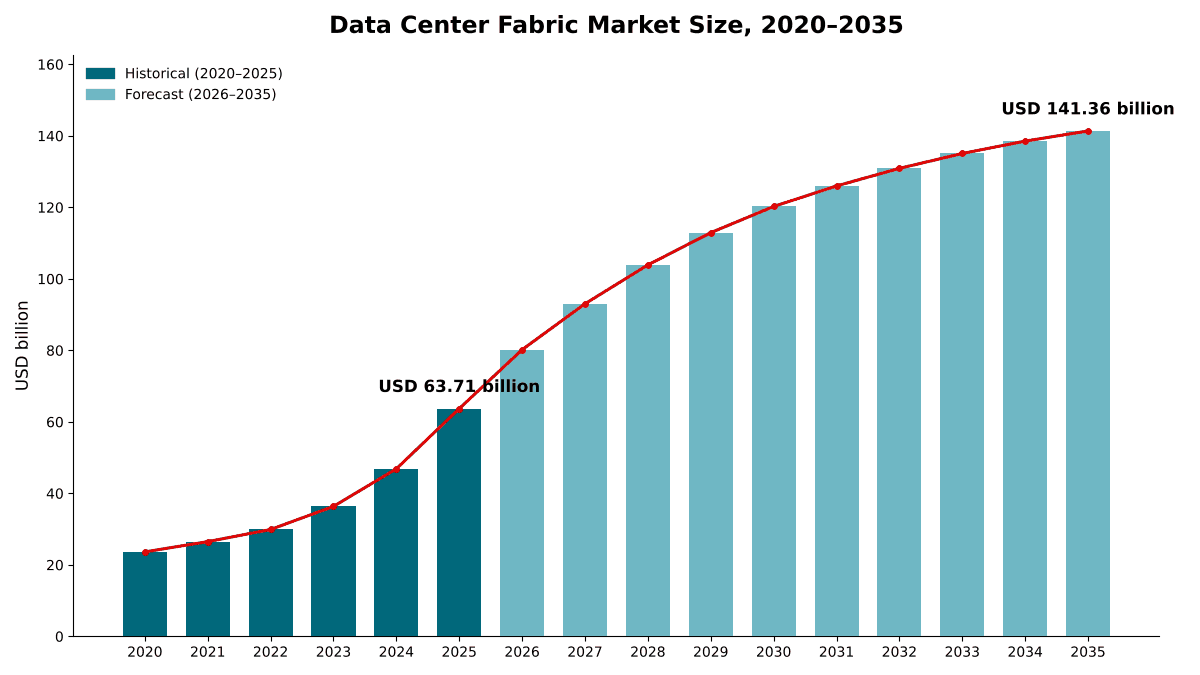
The Data Center Fabric market was worth USD 63.71 billion in 2025 and is forecast to reach USD 141.36 billion by 2035, growing at a 8.3% CAGR. North America accounts for 47.6% of the market.
 By Amit Jain, Senior Consultant, ICT & Emerging Technologies
 Reviewed by Deepti Agrawal
Last updated 10 Oct 2026
Base year 2025 PDF + Excel
Reviewed by Deepti Agrawal
Last updated 10 Oct 2026
Base year 2025 PDF + Excel
Source: DC Market Insights analysis
Key findings
AI Halls Need USD 7.62 Million of Fabric per MW
Ethernet Takes Over the AI Back-End Fabric
One Supplier Holds About 41% of Fabric Spend
GPU and Neocloud Providers Reach USD 24.60 Billion by 2035
What is inside the report
- 01Introduction
- 02Research Methodology
- 03Executive Summary
- 04Market Dynamics
- 05Pricing Analysis
- 06Standards and Regulation
- 07Supply Chain Analysis
- 08Market Size and Forecast
- 09Market by Component
- 10Market by Fabric Type
- 21chapters
- 2020-2024Historical period
- 2026-2035Forecast period
- 16Companies profiled
Regional insights
- North America47.6%
- Asia Pacific27.1%
- Europe15.2%
- Middle East and Africa5.6%
- Latin America4.5%
Segmentation
Companies profiled
- NVIDIA
- Arista Networks
- Cisco
- Hewlett Packard Enterprise (Juniper Networks)
- Huawei
- Broadcom
- Dell Technologies
- Celestica
- Accton Technology
- H3C
- Marvell Technology
- AMD
- Nokia
- Extreme Networks
- Ruijie Networks
- ZTE
Recent developments
Cisco expanded its partnership with NVIDIA, announcing that Cisco Silicon One would be the only partner silicon included in NVIDIA Spectrum-X (Source: Cisco newsroom release).
the UALink Consortium ratified the UALink 200G 1.0 Specification for scale-up connection of up to 1,024 accelerators in a pod (Source: UALink Consortium announcement).
the Ultra Ethernet Consortium released UEC Specification 1.0, an Ethernet-based communication stack for AI and HPC (Source: Linux Foundation press release).
Hewlett Packard Enterprise completed its acquisition of Juniper Networks, doubling the size of its networking business (Source: HPE press release).
NVIDIA announced that Meta and Oracle are standardizing on Spectrum-X Ethernet switches to boost their AI data center networks (Source: NVIDIA press release).
Broadcom announced that its 102.4 Tbps Tomahawk 6 switch series is shipping in production volume (Source: Broadcom announcement).
Full analysis
The Data Center Fabric Market covers the switched network fabric that ties servers, accelerators and storage together inside a data center: leaf, spine and scale-up fabric switches, fabric adapters and SuperNICs, fabric management and automation software, and the services that design and deploy them. DC Market Insights values the global Data Center Fabric Market at USD 63.71 billion in 2025 and forecasts USD 141.36 billion by 2035, a CAGR of 8.30%. The 2025 value is built from two cohorts: about 5.4 GW of accelerated IT load commissioned in 2025 at roughly USD 7.62 million of fabric per MW gives USD 41.15 billion, and an installed base of about 86.1 GW of general-purpose capacity spending about USD 0.262 million per MW a year on fabric adds USD 22.56 billion. GPU and neocloud providers are the fastest-growing segment at 11.84% a year because their halls are built almost entirely around AI back-end and scale-up fabrics, and the Middle East and Africa is the fastest-growing region at 10.74% a year because DC Market Insights expects sovereign AI campuses in the Gulf to add capacity quickly from a small base.
Executive Summary
The Global Data Center Fabric Market size was valued at USD 23.64 billion in 2020, reached USD 63.71 billion in 2025, and is anticipated to reach USD 141.36 billion by 2035, at a CAGR of 8.30% during the forecast period.
| Report attribute | Details |
|---|---|
| Historical Period | 2020-2024 |
| Base Year | 2025 |
| Forecast Period | 2026-2035 |
| Data Center Fabric Market Size 2025 | USD 63.71 Billion |
| Data Center Fabric Market, CAGR | 8.30% |
| Data Center Fabric Market Size 2035 | USD 141.36 Billion |
The market grew at 21.93% a year between 2020 and 2025, and DC Market Insights estimates that 2025 alone added 35.9% over 2024 as graphics processing unit (GPU) clusters reached 100,000 or more accelerators, each needing its own back-end fabric. DC Market Insights estimates that AI halls generated 64.6% of fabric spending in 2025, up from 16.6% in 2020, and forecasts 72.9% by 2035.
Growth slows to 8.30% a year from 2025 to 2035 for two reasons. Fabric spend per AI MW falls about 2.6% a year as each switch generation carries more bandwidth per watt, and the annual volume of accelerated capacity commissioned rises more slowly after 2030, from 13.6 GW in 2030 to 17.6 GW in 2035.
Market Scope: What Does the Data Center Fabric Market Cover?
The Data Center Fabric Market covers every product and service that builds the switched fabric inside a data center, valued at first sale in current US dollars, with 2025 as the base year and forecasts to 2035. DC Market Insights sizes it at USD 63.71 billion in 2025.
Included. Leaf, spine and super-spine switches built into two-tier and three-tier Clos fabrics; AI back-end scale-out switches running Ethernet or InfiniBand; scale-up fabric switches such as NVLink switch trays; fabric adapters, including network interface cards (NIC), SuperNICs and InfiniBand host channel adapters; fabric operating systems, controllers, telemetry and intent-based automation software; and fabric design, deployment and support services.
Excluded. Routers used for data center interconnect and edge routing, firewalls and load balancers, out-of-band management networks, cables, pluggable optical transceivers and co-packaged optical engines sold separately, campus and branch networks, and the servers and accelerators themselves.
How the segments fit together. The component, fabric type, protocol, deployment model and end-user splits each re-cut the same USD 63.71 billion. The AI scale-up fabric type and the NVLink and other non-Ethernet scale-up protocol are equal in 2025 at USD 7.33 billion, and diverge after 2026 as Ethernet-based scale-up enters the market. Wider network spending, including routers and interconnect, is covered in the Data Center Networking Market report.
Market Drivers: What Drives the Data Center Fabric Market?
Three drivers explain most of the growth in the Data Center Fabric Market: AI halls that, by DC Market Insights estimates, need about 29 times more fabric spend per MW than the annual fabric spend of a general-purpose hall, a capacity pipeline of more than 23 GW under construction, and hyperscalers standardizing on Ethernet AI fabrics.
AI Halls Need USD 7.62 Million of Fabric per MW
An AI training or inference cluster connects every accelerator through a back-end scale-out fabric and, inside each rack, a scale-up fabric, on top of the front-end and storage fabric that every hall needs. DC Market Insights estimates fabric content at USD 7.62 million per MW of accelerated IT load commissioned in 2025, against annual fabric spend of USD 0.262 million per MW across the general-purpose installed base. Vendor results show the scale of that shift. NVIDIA Corporation (NVIDIA) reported networking revenue of USD 31.38 billion in fiscal 2026, up 142% from USD 12.99 billion a year earlier, and a record USD 11.0 billion in the fourth quarter alone, up 263% from a year earlier (Source: NVIDIA CFO commentary filed with the US Securities and Exchange Commission).
More Than 23 GW of Capacity Is Under Construction
BloombergNEF counted more than 23 GW of data center capacity under construction worldwide at the end of September 2025, spread across 831 sites (Source: BloombergNEF analysis). DC Market Insights models accelerated IT load commissioned each year rising from 5.4 GW in 2025 to 13.6 GW in 2030 and 17.6 GW in 2035, while the general-purpose installed base grows from 86.1 GW to 119.9 GW. The AI cohort grows from USD 41.15 billion of fabric spend in 2025 to USD 103.05 billion in 2035.
Hyperscalers Standardize on Ethernet AI Fabrics
Buyers are standardizing fabric architectures before they build. In October 2025, NVIDIA announced that Meta and Oracle are standardizing on Spectrum-X Ethernet switches. Cisco took USD 4 billion of AI infrastructure orders from hyperscalers in the fourth quarter of fiscal 2026, bringing its fiscal 2026 total to USD 9.3 billion. Arista Networks reported 2025 revenue of USD 9.01 billion, up 28.6% (Source: Arista earnings release filed with the SEC).
Market Trends: How Is the Data Center Fabric Changing?
The Data Center Fabric Market is moving toward Ethernet in AI back-end fabrics, toward separate scale-up fabrics with their own open standards, and toward open network operating systems on disaggregated hardware.
Ethernet Takes Over the AI Back-End Fabric
Ethernet fabrics are worth USD 42.87 billion in 2025, or 67.3% of the Data Center Fabric Market, and DC Market Insights forecasts them to grow at 10.13% a year to USD 112.52 billion by 2035. InfiniBand fabrics, worth USD 13.51 billion in 2025, decline 0.94% a year to USD 12.30 billion as new AI clusters move to Ethernet with congestion control built for AI traffic. NVIDIA reported that xAI’s Colossus cluster of 100,000 Hopper GPUs maintained 95% data throughput enabled by Spectrum-X congestion control. Switch silicon keeps pace: Broadcom announced in March 2026 that its 102.4 Tbps Tomahawk 6 family is shipping in production volume (Source: Broadcom announcement).
Scale-Up Becomes a Fabric of Its Own
AI scale-up fabrics, which link accelerators inside a rack or pod at memory-like latency, are worth USD 7.33 billion in 2025 and grow at 10.84% a year, the fastest of the three fabric types. Open alternatives to proprietary links are arriving. The UALink Consortium ratified the UALink 200G 1.0 Specification in April 2025, enabling 200G per lane scale-up connection for up to 1,024 accelerators within an AI computing pod. Broadcom’s Tomahawk Ultra, shipping since July 2025, reaches 250ns switch latency at full 51.2 Tbps throughput for scale-up and supercomputing use.
Open Network Operating Systems Gain Ground
Disaggregated and open network operating system (NOS) fabrics are worth USD 18.16 billion in 2025 and grow at 11.51% a year, reaching 38.2% of the market by 2035. SONiC, the open NOS that moved to the Linux Foundation in 2022, already ran on millions of ports and over 100 different switches from multiple vendors and application-specific integrated circuits (ASIC) at that time. In May 2026, OpenAI described MRC (Multipath Reliable Connection), a network protocol extending RDMA over Converged Ethernet (RoCE) that it developed with Advanced Micro Devices (AMD), Broadcom, Intel, Microsoft and NVIDIA and already deploys across all of its largest NVIDIA GB200 supercomputers.
Market Challenges: What Holds the Data Center Fabric Market Back?
Supplier concentration and the pace of architecture change are the two constraints that DC Market Insights expects to weigh on the Data Center Fabric Market, with about 41% of 2025 value sitting with one supplier.
One Supplier Holds About 41% of Fabric Spend
DC Market Insights estimates that NVIDIA holds about 41% of the Data Center Fabric Market in 2025, based on its fiscal 2026 networking revenue of USD 31.38 billion less an assumed 17% for cables, optics and other items outside fabric scope. Open specifications such as those of the Ultra Ethernet Consortium (UEC) and UALink give buyers second-source options.
Each Speed Generation Forces a Fabric Redesign
Fabric generations now turn over faster than buildings. The Institute of Electrical and Electronics Engineers (IEEE) P802.3dj project for 200 Gb/s, 400 Gb/s, 800 Gb/s and 1.6 Tb/s Ethernet received conditional approval in February 2026 to go to IEEE Standards Association ballot, after its fourth recirculation ballot reached 99% approval. Optics are moving into the switch: NVIDIA announced Spectrum-X Photonics co-packaged optics switches with 512 ports of 800Gb/s or 2,048 ports of 200Gb/s, for a total throughput of 400Tb/s, and in August 2026 revealed that Spectrum-6 switch systems support both pluggable and co-packaged optics. Each step raises bandwidth per watt but shortens the useful life of fabrics installed two or three years earlier.
Market Opportunities: Where Are the New Revenue Pools?
The three largest new revenue pools in the Data Center Fabric Market are GPU and neocloud providers growing at 11.84% a year, fabric management and automation software growing at 11.73%, and sovereign AI campuses in the Middle East and Africa growing at 10.74%.
GPU and Neocloud Providers Reach USD 24.60 Billion by 2035
Specialist GPU cloud operators spent USD 8.03 billion on fabric in 2025, and DC Market Insights forecasts USD 24.60 billion by 2035, more than three times the 2025 level. DC Market Insights estimates that 84.2% of their 2025 spend went into AI back-end and scale-up fabrics, the highest share of any buyer group.
Fabric Software Grows Faster Than Fabric Hardware
Fabric management and automation software is worth USD 4.52 billion in 2025 and reaches USD 13.71 billion by 2035, lifting its share from 7.1% to 9.7%. Larger fabrics need telemetry, congestion tuning and automated provisioning that a team cannot run by hand. Cisco, for example, positioned Nexus HyperFabric AI clusters with NVIDIA around automated, cloud-managed operations across a unified compute and networking fabric.
Sovereign AI Campuses Lift the Middle East and Africa
Saudi Arabia’s fabric spend grows at 12.04% a year in the DC Market Insights model, from USD 981.08 million in 2025 to USD 3.06 billion by 2035, the second-fastest country rate in the top 12.
Pricing: How Much Do Data Centers Spend on Fabric per MW?
An AI hall commissioned in 2025 carries about USD 7.62 million of fabric per MW of accelerated IT load, while the general-purpose installed base spends about USD 0.262 million per MW a year on fabric additions and refresh. These are DC Market Insights estimates covering switches, adapters, fabric software and services, excluding cables and optics.
| Fabric spend (USD million per MW) | 2020 | 2025 | 2030 | 2035 |
|---|---|---|---|---|
| AI hall, per MW commissioned | 9.80 | 7.62 | 6.68 | 5.86 |
| General-purpose base, per MW per year | 0.318 | 0.262 | 0.289 | 0.319 |
| Accelerated IT load commissioned (GW) | 0.40 | 5.40 | 13.60 | 17.60 |
The two lines move in opposite directions. AI fabric spend per MW falls about 2.6% a year from 2025 because each switch generation, from 51.2 Tbps to 102.4 Tbps silicon and from pluggable to co-packaged optics, delivers more bandwidth per watt and per dollar. DC Market Insights models general-purpose spend per MW dipping in 2023 and 2024 as buyers paused refresh to fund AI, then rising about 2% a year to 2035 as 400G and 800G front-end fabrics replace 100G.
Standards and Regulation: Which Rules Shape Data Center Fabrics?
Five sets of standards decide how data center fabrics are built: IEEE 802.3 Ethernet physical layers, the Ultra Ethernet specification, the UALink specification, the Open Compute Project (OCP) scale-up Ethernet work and InfiniBand.
IEEE 802.3dj. The project covers 200 Gb/s, 400 Gb/s, 800 Gb/s and 1.6 Tb/s Ethernet and received conditional approval in February 2026 to go to Standards Association ballot.
Ultra Ethernet Specification 1.0 (June 2025). The Ultra Ethernet Consortium released UEC Specification 1.0, a comprehensive, Ethernet-based communication stack for AI and high-performance computing (HPC) that covers all layers of the networking stack, including NICs, switches, optics and cables. AMD’s Pensando Pollara 400 AI NIC, designed with developing UEC standards and features, was available for purchase by April 2025.
UALink 200G 1.0 (April 2025). The specification enables 200G-per-lane scale-up connection for up to 1,024 accelerators within an AI computing pod, giving buyers an open alternative to proprietary scale-up links.
OCP Ethernet for Scale-Up Networking (ESUN). OCP announced the ESUN workstream in October 2025, with initial participants including AMD, Arista, ARM, Broadcom, Cisco, HPE Networking, Marvell, Meta, Microsoft, NVIDIA, OpenAI and Oracle, and published its first specification in March 2026.
InfiniBand. NVIDIA’s Quantum-X800 InfiniBand and Spectrum-X800 Ethernet were announced in March 2024, described by NVIDIA as the world’s first networking platforms capable of end-to-end 800Gb/s throughput.
Market Segmentation: Which Segment Leads the Data Center Fabric Market?
Fabric switching hardware leads the Data Center Fabric Market with 71.9% of 2025 value, front-end and storage fabric is the largest fabric type with 49.5%, Ethernet leads protocols with 67.3%, and hyperscale cloud providers lead buyers with 50.2%. GPU and neocloud providers are the fastest-growing segment at 11.84% a year, ahead of fabric management and automation software at 11.73%, because neocloud halls are built almost entirely around AI back-end and scale-up fabrics.
By Component: Fabric Switching Hardware Leads with 71.9%
| Component | 2025 (USD billion) | Share 2025 | 2035 (USD billion) | CAGR 2025-2035 |
|---|---|---|---|---|
| Fabric Switching Hardware | 45.81 | 71.9% | 97.68 | 7.87% |
| Fabric Adapters and SuperNICs | 8.41 | 13.2% | 18.38 | 8.14% |
| Fabric Services | 4.97 | 7.8% | 11.59 | 8.83% |
| Fabric Management and Automation Software | 4.52 | 7.1% | 13.71 | 11.73% |
Switching hardware loses 2.8 points of share by 2035 as software and services grow faster.
By Fabric Type: Front-End and Storage Fabric Leads with 49.5%
| Fabric type | 2025 (USD billion) | Share 2025 | 2035 (USD billion) | CAGR 2025-2035 |
|---|---|---|---|---|
| Front-End and Storage Fabric | 31.53 | 49.5% | 58.80 | 6.43% |
| AI Back-End Scale-Out Fabric | 24.85 | 39.0% | 62.06 | 9.58% |
| AI Scale-Up Fabric | 7.33 | 11.5% | 20.50 | 10.84% |
AI back-end scale-out fabric overtakes front-end and storage fabric before 2035 and reaches 43.9% of the market.
By Protocol: Ethernet Leads with 67.3%
| Protocol | 2025 (USD billion) | Share 2025 | 2035 (USD billion) | CAGR 2025-2035 |
|---|---|---|---|---|
| Ethernet | 42.87 | 67.3% | 112.52 | 10.13% |
| InfiniBand | 13.51 | 21.2% | 12.30 | -0.94% |
| NVLink and Other Non-Ethernet Scale-Up | 7.33 | 11.5% | 16.54 | 8.49% |
Ethernet gains 12.3 points of share by 2035, partly in back-end fabrics and partly in scale-up, where Ethernet-based designs from the ESUN work take about USD 3.95 billion of the USD 20.50 billion scale-up fabric type by 2035.
By Deployment Model: Vendor-Integrated Fabric Leads with 71.5%
Vendor-integrated fabrics, where switch hardware and the network operating system come from one supplier, are worth USD 45.55 billion in 2025 and grow at 6.73% a year to USD 87.36 billion. Disaggregated and open-NOS fabrics, which pair white-box or merchant-silicon switches with SONiC or an in-house operating system, are worth USD 18.16 billion and grow at 11.51% a year to USD 54.00 billion, as hyperscalers extend open software from front-end fabrics into AI back-end fabrics.
By End-user: Hyperscale Cloud Providers Lead with 50.2%
| End-user | 2025 (USD billion) | Share 2025 | 2035 (USD billion) | CAGR 2025-2035 |
|---|---|---|---|---|
| Hyperscale Cloud Providers | 31.98 | 50.2% | 73.93 | 8.74% |
| Enterprises | 12.61 | 19.8% | 19.93 | 4.68% |
| GPU and Neocloud Providers | 8.03 | 12.6% | 24.60 | 11.84% |
| Government and Research | 6.63 | 10.4% | 14.98 | 8.50% |
| Telecom Service Providers | 4.46 | 7.0% | 7.92 | 5.91% |
Enterprises, including banking and financial services firms, grow slowest at 4.68% a year as workloads move to cloud service providers and colocation.
DC Exclusive: The Fabric Spend per MW Model and Fabric Type × Buyer Matrix
At USD 15.07 billion in 2025, hyperscale AI back-end fabric is the single largest cell of the matrix and 23.7% of all data center fabric spending. The matrix below cross-tabulates what is built and who builds it.
| 2025, USD billion | Front-End and Storage | AI Back-End Scale-Out | AI Scale-Up | Total |
|---|---|---|---|---|
| Hyperscale Cloud Providers | 12.28 | 15.07 | 4.63 | 31.98 |
| Enterprises | 10.63 | 1.56 | 0.42 | 12.61 |
| GPU and Neocloud Providers | 1.27 | 5.25 | 1.51 | 8.03 |
| Government and Research | 3.38 | 2.55 | 0.70 | 6.63 |
| Telecom Service Providers | 3.97 | 0.42 | 0.07 | 4.46 |
| Total | 31.53 | 24.85 | 7.33 | 63.71 |
Hyperscale cloud providers spend 61.6% of their fabric budget on AI back-end and scale-up fabrics, while enterprises still spend 84.3% on front-end and storage fabric and telecom service providers 89.0%; a vendor strong only in front-end fabric is selling into the slowest-growing buyers. GPU and neocloud providers mirror enterprises, with 84.2% of spend on AI fabrics.
The matrix is a DC Market Insights model, not a shipment count. It is built from 72 inputs: 32 capacity data points (16 years of accelerated IT load commissioned and 16 years of general-purpose installed base), 2 fabric spend curves per MW, 17 segment splits, 5 regional splits, 12 country weights and 4 supplier disclosures used as a cross-check. The model and its assumptions are explained on our research methodology page.
Regional Insights: Which Region Leads the Data Center Fabric Market?
North America leads the Data Center Fabric Market with 47.6% of 2025 value, and the Middle East and Africa is the fastest-growing region at 10.74% a year, because DC Market Insights expects sovereign AI programs to add campus-scale capacity from a small base.
North America Leads with 47.6% Share
North American operators spent USD 30.32 billion on data center fabric in 2025, and the region is forecast to reach USD 63.05 billion in 2035, a CAGR of 7.60%. The United States alone accounts for USD 26.87 billion, and DC Market Insights allocates the largest share of hyperscale AI back-end fabric spend to the region. The region loses 3.0 points of share by 2035 as others catch up, not because its volume slows.
Asia Pacific Holds 27.1% Share and Grows at 9.18%
Asia Pacific is worth USD 17.27 billion in 2025 and USD 41.56 billion by 2035. China is the largest country market in the region at USD 6.54 billion, and DC Market Insights models India, South Korea and Australia growing faster than the regional average. Asia Pacific gains 2.3 points of share, the largest gain of any region.
Europe Holds 15.2% Share
Europe is worth USD 9.68 billion in 2025 and USD 19.65 billion by 2035, a CAGR of 7.33%, the slowest of the five regions. DC Market Insights models a larger share of European spend in enterprise front-end fabric refresh, which grows more slowly than AI back-end fabric.
Middle East and Africa Holds 5.6% Share and Grows Fastest at 10.74%
The Middle East and Africa is worth USD 3.57 billion in 2025 and USD 9.89 billion by 2035. Saudi Arabia accounts for USD 981.08 million of 2025 spend, 27.5% of the region, in the DC Market Insights country allocation, and the United Arab Emirates accounts for USD 849.08 million, growing 11.46% a year to USD 2.51 billion by 2035.
Latin America Holds 4.5% Share
Latin America is worth USD 2.87 billion in 2025 and USD 7.21 billion by 2035, a CAGR of 9.66%, with Brazil at USD 1.23 billion, or 43.0% of the region, and Mexico at USD 702.36 million, growing 10.23% a year to USD 1.86 billion by 2035 in the DC Market Insights country allocation.
Country Analysis: Which Countries Spend the Most on Data Center Fabric?
The United States is the largest country market for data center fabric at USD 26.87 billion in 2025, 42.2% of global value, followed by China at USD 6.54 billion (10.3%) and Canada at USD 3.09 billion (4.9%). The 12 largest countries account for 79.4% of 2025 spending.
| Rank | Country | Region | 2025 (USD billion) | Share 2025 | 2035 (USD billion) | CAGR 2025-2035 |
|---|---|---|---|---|---|---|
| 1 | United States | North America | 26.87 | 42.2% | 55.48 | 7.52% |
| 2 | China | Asia Pacific | 6.54 | 10.3% | 14.38 | 8.19% |
| 3 | Canada | North America | 3.09 | 4.9% | 6.87 | 8.31% |
| 4 | United Kingdom | Europe | 2.19 | 3.4% | 4.20 | 6.75% |
| 5 | Japan | Asia Pacific | 2.14 | 3.4% | 4.70 | 8.17% |
| 6 | Germany | Europe | 2.01 | 3.2% | 4.03 | 7.18% |
| 7 | India | Asia Pacific | 1.78 | 2.8% | 6.32 | 13.51% |
| 8 | France | Europe | 1.28 | 2.0% | 2.67 | 7.65% |
| 9 | South Korea | Asia Pacific | 1.28 | 2.0% | 2.95 | 8.73% |
| 10 | Brazil | Latin America | 1.23 | 1.9% | 3.04 | 9.43% |
| 11 | Australia | Asia Pacific | 1.21 | 1.9% | 2.99 | 9.49% |
| 12 | Saudi Arabia | Middle East and Africa | 0.98 | 1.5% | 3.06 | 12.04% |
India is the fastest-growing large country market at 13.51% a year, ahead of Saudi Arabia at 12.04%, as hyperscale and sovereign AI capacity spreads beyond the established hubs. The country figures are a DC Market Insights allocation of the regional totals, weighted by each country’s estimated share of installed and new data center capacity.
Forecast Scenarios: How Could the 2035 Forecast Change?
The Data Center Fabric Market reaches USD 141.36 billion by 2035 in the base case, with a range of USD 113.44 billion to USD 164.32 billion across the low and high scenarios.
| Scenario | Assumption from 2026 | 2035 (USD billion) | CAGR 2025-2035 |
|---|---|---|---|
| Low | Accelerated capacity commissioned 20% below base; AI fabric spend per MW falls 3.5% a year | 113.44 | 5.94% |
| Base | Accelerated capacity rises to 17.6 GW a year; AI fabric spend per MW falls 2.6% a year | 141.36 | 8.30% |
| High | Accelerated capacity 15% above base; AI fabric spend per MW falls 2.0% a year as scale-up fabrics extend across racks and pods | 164.32 | 9.94% |
The low case reflects a two-year pause in AI capital spending and faster price declines from co-packaged optics. The high case assumes grid connections keep pace with announced campus plans and that multi-rack scale-up domains, enabled by UALink and ESUN, add a new fabric layer.
Competitive Insights: Who Leads the Data Center Fabric Market?
- NVIDIA
- Arista Networks
- Cisco
- Hewlett Packard Enterprise (Juniper Networks)
- Huawei
- Broadcom
- Dell Technologies
- Celestica
- Accton Technology
- H3C
- Marvell Technology
- AMD
- Nokia
- Extreme Networks
- Ruijie Networks
- ZTE
NVIDIA is the market leader with about 41% of the Data Center Fabric Market in 2025, and the three largest suppliers, NVIDIA, Arista and Cisco, together hold close to three-fifths (DC Market Insights estimate, based on NVIDIA’s fiscal 2026 networking revenue of USD 31.38 billion and Arista’s 2025 total revenue of USD 9.01 billion set against the USD 63.71 billion market, less an allowance for sales outside fabric scope, plus an assumed Cisco data center fabric share of about 6%). NVIDIA sells both Quantum InfiniBand and Spectrum-X Ethernet fabrics, Arista grew 2025 revenue by 28.6%, and Cisco took AI infrastructure orders from hyperscalers of USD 9.3 billion in fiscal 2026 on total revenue of USD 63.3 billion. Hewlett Packard Enterprise (HPE) completed its acquisition of Juniper Networks in July 2025, a deal that doubles the size of HPE’s networking business; HPE reported networking revenue of USD 2.9 billion in the third quarter of fiscal 2026, up 74.9%. Broadcom supplies merchant switch silicon, including Tomahawk 6 and Jericho4, which is designed to interconnect over one million XPUs across multiple data centers, and AMD sells the Pensando Pollara 400 AI NIC.
Recent Developments
- In February 2025, Cisco expanded its partnership with NVIDIA, announcing that Cisco Silicon One would be the only partner silicon included in NVIDIA Spectrum-X (Source: Cisco newsroom release).
- In April 2025, the UALink Consortium ratified the UALink 200G 1.0 Specification for scale-up connection of up to 1,024 accelerators in a pod (Source: UALink Consortium announcement).
- In June 2025, the Ultra Ethernet Consortium released UEC Specification 1.0, an Ethernet-based communication stack for AI and HPC (Source: Linux Foundation press release).
- In July 2025, Hewlett Packard Enterprise completed its acquisition of Juniper Networks, doubling the size of its networking business (Source: HPE press release).
- In October 2025, NVIDIA announced that Meta and Oracle are standardizing on Spectrum-X Ethernet switches to boost their AI data center networks (Source: NVIDIA press release).
- In March 2026, Broadcom announced that its 102.4 Tbps Tomahawk 6 switch series is shipping in production volume (Source: Broadcom announcement).
We follow these deals, launches and standards as they happen in our data center industry updates, and switch-level detail is covered in the Data Center Switch Market report.
Methodology: How We Built the Data Center Fabric Market Model
DC Market Insights built this market bottom-up from two cohorts over 16 years (2020 to 2035). The AI cohort multiplies accelerated IT load commissioned each year, from 0.40 GW in 2020 to 5.4 GW in 2025 and 17.6 GW in 2035, by fabric spend per AI MW, which falls from USD 9.80 million in 2020 to USD 7.62 million in 2025 and 2.6% a year after that. The general-purpose cohort multiplies the installed base, from 62.0 GW in 2020 to 86.1 GW in 2025 and 119.9 GW in 2035, by annual fabric spend per MW of USD 0.262 million in 2025, rising 2% a year. The total was split by 4 components, 3 fabric types, 3 protocols, 2 deployment models, 5 end-users and 5 regions, and every split sums to the market total. The result was checked top-down against the disclosures of 4 listed suppliers, NVIDIA, Arista, Cisco and HPE, and against published capacity counts: NVIDIA’s fiscal 2026 networking revenue and Arista’s 2025 total revenue together came to USD 40.38 billion, equal to 63.4% of the 2025 market before allowing for sales outside fabric scope and for NVIDIA’s fiscal year ending in January 2026. Country values allocate each regional total by country weights for installed and new capacity. The analyst named on this page built the model, and the reviewer checked the arithmetic, the sources and the dates before publication.
Table of contents
- 01Introduction
- 1.1Market Definition and Scope
- 1.2Research Objectives
- 1.3Currency, Units and Years Considered
- 1.4Stakeholders
- 02Research Methodology
- 2.1Bottom-Up Capacity Cohort Model
- 2.2Fabric Spend per MW Assumptions
- 2.3Top-Down Supplier Disclosure Checks
- 2.4Data Sources and Validation
- 03Executive Summary
- 3.1Market Snapshot, 2025 and 2035
- 3.2Key Findings
- 3.3Analyst Viewpoint
- 04Market Dynamics
- 4.1Drivers
- 4.2Trends
- 4.3Challenges
- 4.4Opportunities
- 05Pricing Analysis
- 5.1Fabric Spend per AI MW, 2020-2035
- 5.2Fabric Spend per General-Purpose MW, 2020-2035
- 5.3Price Effect of Switch Generations and Co-Packaged Optics
- 06Standards and Regulation
- 6.1IEEE 802.3dj
- 6.2Ultra Ethernet Specification 1.0
- 6.3UALink 200G 1.0
- 6.4OCP Ethernet for Scale-Up Networking
- 6.5InfiniBand
- 07Supply Chain Analysis
- 7.1Switch Silicon Suppliers
- 7.2Switch and Adapter Manufacturers
- 7.3Network Operating System and Software Vendors
- 7.4Integrators and Service Providers
- 08Market Size and Forecast
- 8.1Market Size, 2020-2035
- 8.2AI Cohort and General-Purpose Cohort, 2020-2035
- 09Market by Component
- 9.1Fabric Switching Hardware
- 9.2Fabric Adapters and SuperNICs
- 9.3Fabric Management and Automation Software
- 9.4Fabric Services
- 10Market by Fabric Type
- 10.1Front-End and Storage Fabric
- 10.2AI Back-End Scale-Out Fabric
- 10.3AI Scale-Up Fabric
- 11Market by Protocol
- 11.1Ethernet
- 11.2InfiniBand
- 11.3NVLink and Other Non-Ethernet Scale-Up
- 12Market by Deployment Model
- 12.1Vendor-Integrated Fabric
- 12.2Disaggregated and Open-NOS Fabric
- 13Market by End-user
- 13.1Hyperscale Cloud Providers
- 13.2Enterprises
- 13.3GPU and Neocloud Providers
- 13.4Government and Research
- 13.5Telecom Service Providers
- 14DC Exclusive: Fabric Spend per MW Model and Fabric Type × Buyer Matrix
- 14.1Model Structure and Inputs
- 14.2Fabric Type × End-user Matrix, 2025
- 15Market by Region
- 15.1North America (United States, Canada)
- 15.2Asia Pacific (China, Japan, India, South Korea, Australia)
- 15.3Europe (United Kingdom, Germany, France)
- 15.4Middle East and Africa (Saudi Arabia)
- 15.5Latin America (Brazil)
- 16Country Analysis
- 16.1Top 12 Countries, 2025 and 2035
- 16.2Country Growth Rates, 2025-2035
- 17Regional Cross-Sections
- 17.1Region by Fabric Type, 2025 and 2035
- 17.2Region by End-user, 2025 and 2035
- 18Forecast Scenarios
- 18.1Low Scenario
- 18.2Base Scenario
- 18.3High Scenario
- 19Competitive Landscape
- 19.1Market Share Analysis, 2025
- 19.2Top-3 Concentration
- 19.3Recent Developments
- 20Company Profiles
- 20.1NVIDIA
- 20.2Arista Networks
- 20.3Cisco
- 20.4Hewlett Packard Enterprise (Juniper Networks)
- 20.5Huawei
- 20.6Broadcom
- 20.7Dell Technologies
- 20.8Celestica
- 20.9Accton Technology
- 20.10H3C
- 20.11Marvell Technology
- 20.12AMD
- 20.13Nokia
- 20.14Extreme Networks
- 20.15Ruijie Networks
- 20.16ZTE
- 21Analyst Recommendations
- 21.1For Fabric Suppliers
- 21.2For Data Center Operators
- 21.3For Investors
- Fig. 1Data Center Fabric Market Size, 2020-2035
- Fig. 2Data Center Fabric Market by Component, 2025 and 2035
- Fig. 3Data Center Fabric Market by Fabric Type, 2025 and 2035
- Fig. 4Data Center Fabric Market by Protocol, 2025 and 2035
- Fig. 5Data Center Fabric Market by End-user, 2025 and 2035
- Fig. 6Fabric Type × End-user Matrix, 2025
- Fig. 7Data Center Fabric Market by Region, 2025 and 2035
- Fig. 8Forecast Scenarios, 2035
- Table 1Report Attributes
- Table 2Fabric Spend per MW, 2020-2035
- Table 3Market by Component, 2025 and 2035
- Table 4Market by Fabric Type, 2025 and 2035
- Table 5Market by Protocol, 2025 and 2035
- Table 6Market by Deployment Model, 2025 and 2035
- Table 7Market by End-user, 2025 and 2035
- Table 8Fabric Type × End-user Matrix, 2025
- Table 9Market by Region, 2025 and 2035
- Table 10Top 12 Countries, 2025 and 2035
- Table 11Forecast Scenarios, 2035
- Table 12Recent Developments
About this report
Written by Amit Jain and reviewed by Deepti Agrawal, Senior Editor, Research. Figures are built top-down and bottom-up and reconciled before publication, with 2025 as the base year.
Read our methodologyHow we built this
- Historical period2020-2024
- Base year2025
- Forecast period2026-2035
- Sizing approachTop-down + bottom-up
Need more than the report?
Advisory on this market
Due diligence, site selection and market entry work, by the analysts who wrote this report.
See consulting servicesFrequently asked questions
USD 63.71 billion in 2025, rising to USD 141.36 billion by 2035. DC Market Insights estimates the market at USD 23.64 billion in 2020.
8.30% a year from 2025 to 2035. Growth was faster, at 21.93% a year, between 2020 and 2025 as GPU clusters added AI back-end and scale-up fabrics.
Front-end and storage fabric, with USD 31.53 billion or 49.5% of the market in 2025. AI scale-up fabric grows fastest among fabric types at 10.84% a year.
About USD 7.62 million per MW of accelerated IT load commissioned in 2025, against USD 0.262 million per MW a year for the general-purpose installed base, according to DC Market Insights estimates.
North America, with USD 30.32 billion or 47.6% of 2025 value. The Middle East and Africa grows fastest at 10.74% a year.
NVIDIA leads with about 41% of the market, and NVIDIA, Arista and Cisco together hold close to three-fifths (DC Market Insights estimate). Hewlett Packard Enterprise (Juniper Networks), Huawei, Broadcom, Dell Technologies, Celestica, Accton Technology, H3C, AMD and others also compete.
Ethernet fabrics hold 67.3% of 2025 value and grow 10.13% a year to USD 112.52 billion by 2035, while InfiniBand fabrics decline 0.94% a year to USD 12.30 billion (DC Market Insights estimates).
Hyperscale cloud providers, with USD 31.98 billion or 50.2% of 2025 demand. GPU and neocloud providers grow fastest at 11.84% a year.
Licences, delivery and payment
Which licence should I choose?
Single User is a view-only PDF for one person. Multi User adds a printable PDF and the Excel data for unlimited users at one location. Enterprise covers your whole company and includes 100 free analyst hours.
How and when will I receive the report?
By email, within 24–48 business hours of payment, in the formats of your licence.
How can I pay?
Securely through PayPal: with a PayPal account, a debit or credit card, or PayPal Pay Later where available. Prices are in US dollars.
Can I see a sample first?
Yes. Request a free sample and we will email it to you.
Can the report be tailored to my needs?
Yes. We can add countries, segments or data cuts. Talk to an analyst about the scope you need.
Can I get an invoice or pay against a purchase order?
Write to sales@dcmarketinsights.com and our team will help.