
Egypt Data Center Infrastructure Market Size, Share & Forecast to 2035
Market at a glance
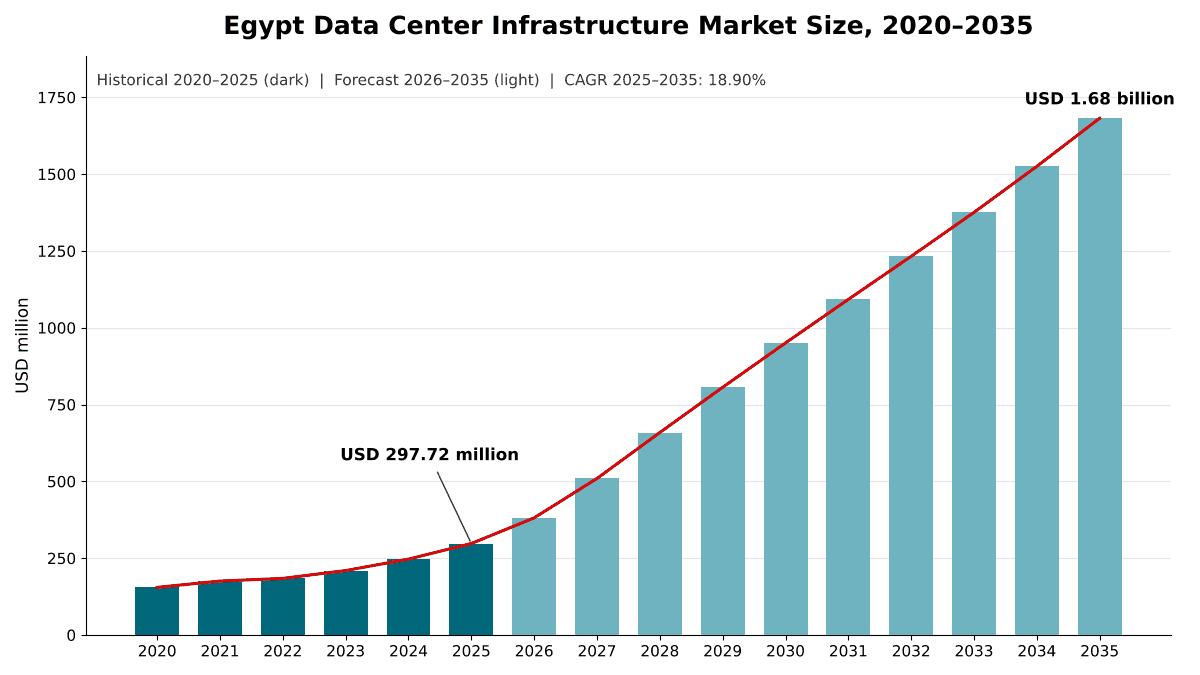
The Egypt Data Center Infrastructure market was worth USD 297.7 million in 2025 and is forecast to reach USD 1,680.0 million by 2035, growing at a 18.9% CAGR. Greater Cairo accounts for 74.2% of the market.
 By Priyanka Mor, Senior Consultant
 Reviewed by Deepti Agrawal
Last updated 7 Oct 2026
Base year 2025 PDF + Excel
Reviewed by Deepti Agrawal
Last updated 7 Oct 2026
Base year 2025 PDF + Excel
Source: DC Market Insights analysis
Key findings
Ten NTRA Licences Move 137 MW of Campuses into Construction by 2030
AI Halls Push Server Spending to USD 675.94 Million by 2035
Commercial Electricity Prices Rise About 20% on Average
Hyperscale Data Centers Grow 27.28% a Year
What is inside the report
- 01Introduction
- 02Research Methodology
- 03Executive Summary
- 04Market Dynamics
- 05Pricing
- 06Standards and Regulation
- 07Supply Chain
- 08Market Size and Forecast
- 09Market by Infrastructure Type
- 10Market by Electrical Infrastructure
- 21chapters
- 2020-2024Historical period
- 2026-2035Forecast period
- 14Companies profiled
Regional insights
- Greater Cairo74.2%
- Suez Canal Economic Zone and Red Sea10.5%
- Alexandria and North Coast10.1%
- Rest of Egypt5.1%
Segmentation
Companies profiled
- Elsewedy Electric
- Gulf Data Hub
- Telecom Egypt
- Vodafone Business
- Cassava Technologies
- Intro Group
- Khazna Data Centers
- Benya Group
- Hassan Allam Digital Infrastructure
- Raya Data Center
- Huawei
- Vertiv
- MultiNet Communications
- Administrative Capital for Urban Development
Recent developments
Vertiv and MultiNet Communications announced a distribution partnership in Egypt covering power management, cooling systems, IT management and professional services (Source: African Wireless Communications report).
Telecom Egypt announced that SEA-ME-WE 6 had completed its two Egyptian landings, at Port Said and Ras Ghareb (Source: Telecom Egypt press release).
Egypt raised commercial electricity prices by an average of about 20% (Source: BusinessDay report).
Telecom Egypt resolved not to proceed with a proposed data center transaction with Helios Investments and will carve its data center services into a wholly owned subsidiary (Source: Telecom Egypt press release).
Vodafone Business, Elsewedy Electric and Cassava Technologies announced ADC Egypt, starting with 20 MW and planned to scale to 200 MW (Source: Ahram Online report).
the communications minister reviewed Intro Group's plans for the 80 MW Kemet Data Centre in the SCZONE, with USD 270 million in the first phase (Source: Daily News Egypt report).
Full analysis
The Egypt Data Center Infrastructure Market covers the physical infrastructure installed in Egyptian data centers: electrical systems, mechanical and cooling systems, civil, structural and architectural works, fire protection and monitoring, and IT and network hardware (servers, storage, networking equipment, cabling, racks and enclosures). DC Market Insights values the Egypt Data Center Infrastructure Market at USD 297.72 million in 2025 and forecasts USD 1.68 billion by 2035, a CAGR of 18.90%. The 2025 value is built from capacity: about 11 MW of IT load completed in 2025 and 15 MW completing in 2026, at USD 6.84 million of facility infrastructure per MW in conventional halls and USD 9.43 million per MW in AI halls, gives USD 91.95 million of electrical, mechanical, civil and other facility infrastructure, and IT and network hardware for new halls and for refresh on an installed base of about 103 MW adds USD 205.77 million. The market is the hardware and construction layer of the wider Egypt Data Center Market, which adds USD 27.82 million of design fees, permits, software licences and integration services in 2025. Hyperscale data centers are the fastest-growing segment at 27.28% a year as AI and GPU-as-a-Service campuses arrive, and the Suez Canal Economic Zone and Red Sea is the fastest-growing region at 30.69% a year because new campuses sit next to the cable landings at Port Said and Ras Ghareb.
Executive Summary
The Egypt Data Center Infrastructure Market size was valued at USD 154.96 million in 2020, reached USD 297.72 million in 2025, and is anticipated to reach USD 1.68 billion by 2035, at a CAGR of 18.90% during the forecast period.
| Report attribute | Details |
|---|---|
| Historical Period | 2020-2024 |
| Base Year | 2025 |
| Forecast Period | 2026-2035 |
| Egypt Data Center Infrastructure Market Size 2025 | USD 297.72 Million |
| Egypt Data Center Infrastructure Market, CAGR | 18.90% |
| Egypt Data Center Infrastructure Market Size 2035 | USD 1.68 Billion |
The Egypt Data Center Infrastructure Market grew at 13.95% a year between 2020 and 2025, and 2025 added 20.5% over 2024 as Telecom Egypt’s second Regional Data Hub (RDH 2) phase, with an estimated IT load of 4.6 MW and expected completion by the end of 2025, was built. Growth peaks in 2026 and 2027, at 28.0% and 33.6%, when licensed campuses move from groundwork to switchgear, chiller and server installation, and then settles at 10.3% in 2035 as the installed base grows larger.
IT and network infrastructure is 69.1% of 2025 value because refresh of servers, storage and network equipment in the existing halls is the largest single spend. The facility layer, electrical, mechanical and civil works, is 30.9% in 2025 and is where the new campuses show up first: every MW of new capacity needs a substation connection, uninterruptible power supply (UPS) systems and chillers before any server is installed.
Market Scope: What Does the Egypt Data Center Infrastructure Market Cover?
The Egypt Data Center Infrastructure Market is the annual spend on physical infrastructure built into and installed in data centers located in Egypt, valued in current US dollars, with 2025 as the base year and forecasts to 2035. DC Market Insights sizes it at USD 297.72 million in 2025.
Included. Electrical infrastructure (utility service and grid connection inside the site boundary, medium-voltage substations and transformers, UPS systems, battery energy storage systems (BESS), power distribution units (PDUs), transfer switches, switchgear, generators and busway); mechanical infrastructure (computer room air conditioners and air handlers (CRAC and CRAH), chillers, hot and cold aisle containment, pumps and piping, and liquid cooling such as coolant distribution units); civil, structural and architectural works (site preparation, foundations, superstructure, building envelope, raised floors and modular building systems); other facility systems (fire detection and suppression, physical security and building monitoring hardware); and IT and network infrastructure (servers, storage, networking equipment, structured cabling and optical fiber, racks and enclosures). New builds, expansions, retrofits and IT refresh are all counted, in enterprise, colocation, hyperscale, edge and other facilities, including modular units.
Excluded. Land, design and engineering fees, permits, software licences, systems integration and managed services, utility-side grid and renewable generation assets, subsea cables and landing stations, colocation and cloud service revenues, electricity and operating costs.
How the segments fit together. The infrastructure type, data center type and tier splits each re-cut the same USD 297.72 million total. The electrical, mechanical and IT and network splits break down their own infrastructure type, and the regional split allocates the total across four Egyptian sub-markets. The Egypt Data Center Infrastructure Market is 91.5% of the Egypt Data Center Market in 2025: USD 7.47 million of design fees and permits and USD 20.35 million of software and integration services sit in the wider market only.
Market Drivers: What Drives the Egypt Data Center Infrastructure Market?
A pipeline of announced campuses with budgets of USD 250 million to USD 2.1 billion drives the Egypt Data Center Infrastructure Market, supported by Egypt’s subsea cable position and a state plan of up to USD 860 million a year for data centres, cloud and AI.
Ten NTRA Licences Move 137 MW of Campuses into Construction by 2030
Egypt’s National Telecommunications Regulatory Authority (NTRA) has issued ten data centre licences over the past two years. The largest announced projects are Gulf Data Hub and Elsewedy’s three complexes of 192 MW, expanding to 300 MW in 5-7 years, for USD 2.1 billion; ADC Egypt, a joint venture of Vodafone Business, Elsewedy Electric and Cassava Technologies, with 20 MW in its first three years and plans to scale to 200 MW; Intro Group’s 80 MW Kemet Data Centre in the Suez Canal Economic Zone (SCZONE); and Khazna Data Centers and Benya Group’s 25 MW campus at Maadi Technology Park, expandable to 50 MW, for USD 250 million. Data Center Dynamics reports that the NTRA has also licensed Hassan Allam Digital Infrastructure, which plans an initial investment of USD 400 million. DC Market Insights does not assume the whole pipeline is built: the model completes 137 MW between 2026 and 2030, and each MW needs USD 6.84 million to USD 9.43 million of facility infrastructure in 2025 prices.
Fourteen Subsea Cables Make Egypt a Transit Hub for Interconnection
The Center for Strategic and International Studies (CSIS) counts 14 active cable systems in Egypt, with plans for more than 21 within the next three years, and says Egypt is responsible for approximately 17% of global internet traffic. SEA-ME-WE 6, a 21,700 km system, completed two Egyptian landings in 2025, at Port Said on the Mediterranean and Ras Ghareb on the Red Sea. Cable density raises demand for networking equipment, structured cabling and optical fiber inside data halls: networking equipment is worth USD 37.04 million in 2025 and cabling and optical fiber USD 12.76 million in the DC Market Insights model, and colocation data centers, which host most interconnection, hold 36.9% of the market.
State Digital Spending of up to USD 860 Million a Year Funds New Halls
A Ministry of Communications and Information Technology (MCIT) plan sets out annual investment of USD 500 million to USD 860 million in data centres, cloud computing and artificial intelligence (AI) infrastructure from the 2026/27 fiscal year through 2030. Part of that budget becomes the electrical, mechanical and IT hardware this report counts: DC Market Insights forecasts the Egypt Data Center Infrastructure Market at USD 509.48 million in 2027 and USD 950.53 million in 2030.
Market Trends: How Is Data Center Infrastructure in Egypt Changing?
AI halls, liquid cooling and greenfield coastal campuses are reshaping the Egypt Data Center Infrastructure Market: DC Market Insights estimates servers rise from 49.0% of IT and network spend in 2025 to 55.3% in 2035.
AI Halls Push Server Spending to USD 675.94 Million by 2035
Vodafone Business and Cassava Technologies plan to give businesses and government entities local access to NVIDIA technologies and GPU-as-a-Service. An AI hall carries about USD 12.74 million of IT and network hardware per MW in the DC Market Insights model, against USD 3.28 million in a conventional hall, so servers grow 20.96% a year, from USD 100.82 million in 2025 to USD 675.94 million in 2035. Storage grows more slowly, at 16.67% a year, because AI training clusters spend more per MW on accelerators than on storage arrays.
Liquid Cooling and Piping Gain Share from Room Air Units
Higher rack densities shift mechanical spending away from room air units. Others, mainly liquid cooling such as coolant distribution units and rear-door heat exchangers, is the fastest-growing mechanical item at 25.34% a year, rising from 15.0% of mechanical spend in 2025 to 26.1% in 2035, and pumps and piping systems grow 21.33% a year. CRAC and CRAH units fall from 33.0% to 23.8% of mechanical spend, by DC Market Insights estimates.
Greenfield Campuses Move to the Suez Canal and Add Solar Power
Kemet Data Centre will be built in the Integrated Sokhna Industrial Zone, will span 80,000 sqm in two phases, and is expected to be partially powered by solar energy. Greenfield sites need full electrical, mechanical and civil packages, so 42.5% of 2025 infrastructure spending in the Suez Canal Economic Zone and Red Sea goes to the facility layer, against 29.8% in Greater Cairo, in the DC Market Insights matrix.
Market Challenges: What Holds the Egypt Data Center Infrastructure Market Back?
A 20% average rise in commercial electricity prices from April 2026, foreign-currency funding for imported equipment and slow conversion of announcements into builds are the main constraints DC Market Insights sees on the Egypt Data Center Infrastructure Market.
Commercial Electricity Prices Rise About 20% on Average
Egypt raised electricity prices for commercial users from April 2026, with prices across all brackets increasing by an average of about 20%, according to a Reuters report published by BusinessDay. Higher power prices raise the value of efficient UPS systems, chillers with free cooling and containment, and support DC Market Insights’ forecast of 17.24% a year for electrical infrastructure, which reaches USD 213.61 million in 2035. Egypt also targets 42% of electricity from renewable sources by 2030 and over 60% by 2040, according to the US International Trade Administration (ITA) Egypt Country Commercial Guide, which gives the latest price for buying solar-produced electricity as 1.8 US cents per kWh.
Imported Equipment Depends on Foreign Capital
The largest campus budgets depend on foreign direct investment. ADC Egypt’s first phase is expected to attract up to USD 200 million in foreign direct investment, with total investment that could reach USD 1 billion as the project expands. In July 2026 Telecom Egypt resolved not to proceed with a proposed transaction with Helios Investments, which had valued the Regional Data Hub (RDH) at USD 230 million, potentially up to USD 260 million, and will instead carve its data center services into a wholly owned subsidiary. DC Market Insights treats funding and deal delays as the main downside risk in its low scenario.
Announced Capacity Far Exceeds What Is Being Built
The four largest named projects, Gulf Data Hub and Elsewedy, ADC Egypt, Kemet and Khazna, announce 630 MW at full build-out, while DC Market Insights completes 382 MW in total between 2026 and 2035. Power connections, tenant commitments and equipment lead times, not announcements, set the pace of infrastructure spending.
Market Opportunities: Where Are the New Revenue Pools in the Egypt Data Center Infrastructure Market?
Hyperscale data centers, growing 27.28% a year, battery energy storage, growing 23.27% a year, and IT and network refresh in Greater Cairo, worth USD 155.17 million in 2025, are the largest new revenue pools in the Egypt Data Center Infrastructure Market.
Hyperscale Data Centers Grow 27.28% a Year
Hyperscale data centers account for USD 47.04 million of infrastructure spending in 2025 and USD 524.74 million in 2035, rising from 15.8% to 31.2% of the market, by DC Market Insights estimates. Gulf Data Hub and Elsewedy’s three complexes, with 192 MW expanding to 300 MW, aim for Uptime Tier III and LEED certifications.
Battery Energy Storage Doubles Its Share of Electrical Spend
Battery energy storage systems grow from USD 3.48 million in 2025 to USD 28.20 million in 2035, from 8.0% to 13.2% of electrical infrastructure, as operators pair lithium-ion storage with solar supply and use batteries to manage peak tariffs. UPS systems remain the largest electrical item at USD 11.76 million in 2025.
Tier III Upgrades in Cairo Keep IT Refresh Steady
Greater Cairo accounts for USD 221.01 million of 2025 infrastructure spending, of which IT and network infrastructure makes up USD 155.17 million in the DC Market Insights matrix. Raya Data Center received a USD 15 million investment from Africa50 and an additional USD 10 million from Raya Information Technology for a facility set to become one of the top certified Tier III facilities in Egypt, and Telecom Egypt’s RDH 2 holds a Tier III design certification.
Pricing: How Much Does Data Center Infrastructure Cost per MW in Egypt?
A conventional data center hall in Egypt needs about USD 6.84 million of electrical, mechanical, civil and other facility infrastructure per MW of IT load in 2025, and an AI hall about USD 9.43 million per MW. These are DC Market Insights estimates, excluding land, design fees and IT hardware.
| Infrastructure spend per MW (USD million) | 2025 | 2030 | 2035 |
|---|---|---|---|
| Facility infrastructure, conventional hall | 6.84 | 7.26 | 7.71 |
| Facility infrastructure, AI hall | 9.43 | 9.06 | 8.70 |
| IT and network hardware, conventional hall | 3.28 | 3.36 | 3.44 |
| IT and network hardware, AI hall | 12.74 | 12.11 | 11.52 |
Announced project budgets give a cross-check, all DC Market Insights calculations from the announced figures, which can include land, design and IT: Khazna’s Cairo campus implies about USD 10.0 million per MW (USD 250 million for 25 MW) and Gulf Data Hub and Elsewedy about USD 10.9 million per MW (USD 2.1 billion for 192 MW). Facility infrastructure costs per MW in AI halls fall over time as liquid cooling and high-density power designs become standard, while conventional halls rise with construction and equipment inflation.
Standards and Regulation: Which Rules Shape Data Center Infrastructure in Egypt?
Four sets of rules shape data center infrastructure in Egypt: NTRA licensing, Uptime Institute tier certification, the Personal Data Protection Law and the national renewable energy targets.
NTRA licensing. The NTRA approved a regulatory framework to establish data centers and provide cloud computing services in August 2021. The US ITA describes a licensing framework for Public Data Center Providers (PDCP) that offers 15-year licences.
Uptime Institute tiers. The Administrative Capital for Urban Development (ACUD) data center in the New Administrative Capital holds Uptime Institute Tier III certifications for design documents and constructed facility, Telecom Egypt’s RDH 2 received Tier III design certification, Kemet aims to be the first project of its kind in the SCZONE to achieve Tier III, and Gulf Data Hub targets Tier III and LEED certifications. Tier 3 facilities hold 64.9% of 2025 infrastructure spending in the DC Market Insights model.
Personal Data Protection Law. Law No. 151 of 2020 is implemented through executive regulations issued as Ministerial Decree No. 816 of 2025. Controllers and processors must notify the Personal Data Protection Center within 72 hours of becoming aware of a personal data breach, and transferring, storing or processing personal data outside Egypt requires a licence and is permitted only to jurisdictions with an adequate level of protection.
Renewable energy targets. The 42% renewable electricity target for 2030 shapes site selection, and solar-assisted campuses such as Kemet need on-site switchgear and storage to integrate variable supply.
Market Segmentation: Which Segment Leads the Egypt Data Center Infrastructure Market?
IT and network infrastructure leads the Egypt Data Center Infrastructure Market with 69.1% of 2025 value, enterprise data centers lead data center types with 39.2%, and Tier 3 leads tiers with 64.9%. Hyperscale data centers are the fastest-growing segment at 27.28% a year, against 20.22% for colocation, because AI and GPU-as-a-Service campuses are planned at a scale no Egyptian enterprise builds.
By Infrastructure Type: IT and Network Infrastructure Leads with 69.1%
| Infrastructure type | 2025 (USD million) | Share 2025 | 2035 (USD billion) | CAGR 2025-2035 |
|---|---|---|---|---|
| IT and Network Infrastructure | 205.77 | 69.1% | 1.22 | 19.50% |
| Electrical Infrastructure | 43.55 | 14.6% | 0.21 | 17.24% |
| Mechanical Infrastructure | 24.73 | 8.3% | 0.14 | 18.59% |
| Civil, Structural and Architectural | 19.31 | 6.5% | 0.09 | 16.29% |
| Others | 4.36 | 1.5% | 0.02 | 17.87% |
IT and network infrastructure reaches USD 1.22 billion in 2035, 72.7% of the market. Others covers fire detection and suppression, physical security and monitoring hardware, and grows faster than civil works because security and monitoring requirements rise with each Tier III certification.
By Electrical Infrastructure: UPS Leads with 27.0%
| Electrical infrastructure | 2025 (USD million) | Share 2025 | 2035 (USD million) | CAGR 2025-2035 |
|---|---|---|---|---|
| Uninterruptible Power Supply (UPS) | 11.76 | 27.0% | 53.60 | 16.38% |
| Utility Service and Grid Connection | 9.15 | 21.0% | 40.16 | 15.94% |
| Transfer Switches and Switchgear | 8.36 | 19.2% | 37.60 | 16.22% |
| Power Distribution Units (PDUs) | 5.14 | 11.8% | 26.49 | 17.82% |
| Battery Energy Storage Systems (BESS) | 3.48 | 8.0% | 28.20 | 23.27% |
| Others | 5.66 | 13.0% | 27.56 | 17.15% |
Others, mainly diesel generators and busway, is worth USD 5.66 million in 2025.
By Mechanical Infrastructure: CRAC and CRAH Units Lead with 33.0%
| Mechanical infrastructure | 2025 (USD million) | Share 2025 | 2035 (USD million) | CAGR 2025-2035 |
|---|---|---|---|---|
| Cooling Units (CRAC and CRAH) | 8.15 | 33.0% | 32.38 | 14.79% |
| Chillers | 7.67 | 31.0% | 38.36 | 17.46% |
| Pumps and Piping Systems | 2.97 | 12.0% | 20.54 | 21.33% |
| Containment Systems | 2.23 | 9.0% | 9.25 | 15.29% |
| Others | 3.71 | 15.0% | 35.50 | 25.34% |
Chillers overtake CRAC and CRAH units before 2030 in the DC Market Insights model, because larger campuses use central chilled-water plants rather than room units.
By IT and Network Infrastructure: Servers Lead with 49.0%
| IT and network infrastructure | 2025 (USD million) | Share 2025 | 2035 (USD million) | CAGR 2025-2035 |
|---|---|---|---|---|
| Server | 100.82 | 49.0% | 675.94 | 20.96% |
| Networking Equipment | 37.04 | 18.0% | 205.35 | 18.68% |
| Storage | 30.87 | 15.0% | 144.23 | 16.67% |
| Cabling and Optical Fiber | 12.76 | 6.2% | 66.00 | 17.86% |
| Racks and Enclosures | 10.49 | 5.1% | 56.23 | 18.28% |
| Others | 13.79 | 6.7% | 74.56 | 18.38% |
By Data Center Type: Enterprise Data Centers Lead with 39.2%
| Data center type | 2025 (USD million) | Share 2025 | 2035 (USD million) | CAGR 2025-2035 |
|---|---|---|---|---|
| Enterprise Data Center | 116.70 | 39.2% | 333.01 | 11.06% |
| Colocation Data Center | 109.86 | 36.9% | 692.93 | 20.22% |
| Hyperscale Data Center | 47.04 | 15.8% | 524.74 | 27.28% |
| Edge Data Center | 13.70 | 4.6% | 87.46 | 20.37% |
| Other Data Centers | 10.42 | 3.5% | 43.73 | 15.42% |
Enterprise data centers, including bank, government and telecom halls, account for USD 116.70 million in 2025. Colocation overtakes them before 2030 and reaches 41.2% of the market in 2035, by DC Market Insights estimates.
By Tier Type: Tier 3 Leads with 64.9%
Tier 3 facilities are worth USD 193.22 million in 2025 and USD 1.17 billion by 2035, growing 19.72% a year. Tier 4, at USD 37.81 million (12.7%), grows fastest at 22.71% a year as hyperscale and financial users specify fault-tolerant power and cooling. Tier 2 rooms, at USD 45.55 million (15.3%), grow 13.37% a year, and Tier 1 rooms, at USD 21.14 million (7.1%), grow 11.10% a year as small server rooms move into colocation.
DC Exclusive: The Cairo vs Suez Canal Infrastructure Mix Matrix
At USD 155.17 million in 2025, IT and network infrastructure in Greater Cairo is the single largest cell of the matrix and 52.1% of all Egyptian data center infrastructure spending.
| 2025, USD million | IT and Network | Electrical | Mechanical | Civil and Structural | Others | Total |
|---|---|---|---|---|---|---|
| Greater Cairo | 155.17 | 31.67 | 17.68 | 13.46 | 3.03 | 221.01 |
| Suez Canal Economic Zone and Red Sea | 18.06 | 5.56 | 3.60 | 3.41 | 0.77 | 31.40 |
| Alexandria and North Coast | 21.42 | 4.31 | 2.41 | 1.62 | 0.37 | 30.13 |
| Rest of Egypt | 11.12 | 2.01 | 1.04 | 0.82 | 0.19 | 15.18 |
| Total | 205.77 | 43.55 | 24.73 | 19.31 | 4.36 | 297.72 |
Greater Cairo spends 70.2% of its infrastructure budget on IT and network hardware because its halls are full and refresh is the main spend. The Suez Canal Economic Zone and Red Sea spends 42.5% on electrical, mechanical, civil and other facility infrastructure because its campuses are greenfield builds on industrial land, and Rest of Egypt has the highest IT share, 73.3%, because its rooms are small enterprise and government sites.
The matrix is a DC Market Insights model, not a project count. It is built from 129 inputs: the 69 capacity, cost and allocation inputs of our Egypt data center model, 4 exclusion ratios for design fees and software, 34 sub-segment weights for 2025 and 2035, 18 data center type and tier weights, and 4 regional checks. The method is explained on our research methodology page.
Regional Insights: Which Region Leads the Egypt Data Center Infrastructure Market?
Greater Cairo leads with 74.2% of 2025 value. In the Egypt Data Center Infrastructure Market, the Suez Canal Economic Zone and Red Sea is the fastest-growing region at 30.69% a year because new campuses need land, power and direct access to the cable landings.
Greater Cairo Leads with 74.2% Share
Greater Cairo, including the New Administrative Capital, Smart Village and Maadi Technology Park, is worth USD 221.01 million in 2025 and USD 937.75 million by 2035, a CAGR of 15.55%. Data Center Map lists 10 of Egypt’s 14 data centers in Cairo, and Khazna’s 25 MW campus and the ACUD government data center sit in the capital region.
Suez Canal Economic Zone and Red Sea Holds 10.5% Share
The Suez Canal Economic Zone and Red Sea, covering Ain Sokhna, Port Said and Ras Ghareb, is worth USD 31.40 million in 2025 and USD 456.42 million by 2035, growing 30.69% a year and reaching 27.1% of the market as Kemet’s 80 MW campus is built.
Alexandria and North Coast Holds 10.1% Share
Alexandria and the North Coast are worth USD 30.13 million in 2025 and USD 175.12 million by 2035, a CAGR of 19.24%, supported by Mediterranean cable landings and enterprise refresh.
Rest of Egypt Holds 5.1% Share
The rest of Egypt, including the Nile Delta, Upper Egypt and Sinai, is worth USD 15.18 million in 2025 and USD 112.58 million by 2035, a CAGR of 22.19%, as edge sites and government regional centers add capacity.
Forecast Scenarios: How Could the 2035 Forecast Change?
The Egypt Data Center Infrastructure Market reaches USD 1.68 billion by 2035 in the base case, with a range of USD 1.20 billion to USD 2.02 billion across the low and high scenarios.
| Scenario | Assumption from 2026 | 2035 (USD billion) | CAGR 2025-2035 |
|---|---|---|---|
| Low | Completions 30% below base; AI share of new capacity 20% lower | 1.20 | 14.93% |
| Base | Completions rise to 55 MW a year by 2035; AI share of new capacity reaches 36% | 1.68 | 18.90% |
| High | Completions 20% above base; AI share 12% higher | 2.02 | 21.09% |
The low case reflects delayed foreign funding and slower power connections; the high case assumes ADC Egypt, Kemet and the licensed campuses keep their announced schedules.
Competitive Insights: Who Leads the Egypt Data Center Infrastructure Market?
- Elsewedy Electric
- Gulf Data Hub
- Telecom Egypt
- Vodafone Business
- Cassava Technologies
- Intro Group
- Khazna Data Centers
- Benya Group
- Hassan Allam Digital Infrastructure
- Raya Data Center
- Huawei
- Vertiv
- MultiNet Communications
- Administrative Capital for Urban Development
Infrastructure demand is concentrated in a few developers: Gulf Data Hub and Elsewedy (300 MW), ADC Egypt (200 MW) and Kemet (80 MW) account for 92.1% of the 630 MW announced at full build-out by the four largest named projects, which also include Khazna (50 MW) (DC Market Insights calculation from announced capacities). Elsewedy Electric appears in both of the two largest projects. On the equipment side, Huawei supplied its FusionDC1000A prefabricated all-in-one data center to Mountain View, which can be installed on site in just one day, and Vertiv distributes its power management, cooling systems and IT management portfolio in Egypt through MultiNet Communications.
Recent Developments
- In June 2025, Vertiv and MultiNet Communications announced a distribution partnership in Egypt covering power management, cooling systems, IT management and professional services (Source: African Wireless Communications report).
- In July 2025, Telecom Egypt announced that SEA-ME-WE 6 had completed its two Egyptian landings, at Port Said and Ras Ghareb (Source: Telecom Egypt press release).
- In April 2026, Egypt raised commercial electricity prices by an average of about 20% (Source: BusinessDay report).
- In July 2026, Telecom Egypt resolved not to proceed with a proposed data center transaction with Helios Investments and will carve its data center services into a wholly owned subsidiary (Source: Telecom Egypt press release).
- In September 2026, Vodafone Business, Elsewedy Electric and Cassava Technologies announced ADC Egypt, starting with 20 MW and planned to scale to 200 MW (Source: Ahram Online report).
- In September 2026, the communications minister reviewed Intro Group’s plans for the 80 MW Kemet Data Centre in the SCZONE, with USD 270 million in the first phase (Source: Daily News Egypt report).
We follow these licences, launches and equipment deals as they happen in our data center industry updates. Related reports: Egypt Data Center Market and Egypt Data Center Colocation Market.
Methodology: How We Built the Egypt Data Center Infrastructure Market Model
DC Market Insights built the Egypt Data Center Infrastructure Market from the same 18 annual capacity cohorts (2019 to 2036) as its Egypt Data Center Market model, each split into conventional and AI halls, starting from an installed base of 58 MW of IT load at the end of 2019 and reaching about 103 MW at the end of 2025 and about 485 MW at the end of 2035. Facility spend per MW was reduced by the 24% of general construction that is design fees, permits and site consultancy, giving USD 6.84 million of facility infrastructure per MW in conventional halls and USD 9.43 million in AI halls in 2025, and IT spend was reduced by the 9% that is software and integration services, giving USD 3.28 million and USD 12.74 million of IT and network hardware per MW for fit-out. The total was split by 5 infrastructure types, 6 electrical items, 5 mechanical items, 6 IT and network items, 5 data center types, 4 tiers and 4 regions, and every split sums to its parent. The result was checked top-down against announced project costs of USD 10.0 million to USD 10.9 million per MW and against the MCIT plan of USD 500 million to USD 860 million a year for data centres, cloud and AI from 2026/27, which is larger than the model’s 2027 value of USD 509.48 million because the plan also covers cloud and AI services.
Table of contents
- 01Introduction
- 1.1Market Definition and Scope
- 1.2Infrastructure Included and Excluded
- 1.3Relationship to the Egypt Data Center Market
- 1.4Currency, Base Year and Forecast Period
- 02Research Methodology
- 2.1Capacity Cohort Model
- 2.2Infrastructure Cost per MW
- 2.3Exclusion of Design Fees and Software
- 2.4Top-Down Checks
- 2.5Source Ledger and Fact-Checking
- 03Executive Summary
- 3.1Market Size, 2020-2035
- 3.2Key Findings
- 3.3Analyst View
- 04Market Dynamics
- 4.1Drivers
- 4.2Trends
- 4.3Challenges
- 4.4Opportunities
- 05Pricing
- 5.1Facility Infrastructure Cost per MW, Conventional and AI Halls
- 5.2IT and Network Hardware Cost per MW
- 5.3Announced Project Budget Cross-Checks
- 06Standards and Regulation
- 6.1NTRA Data Center Licensing
- 6.2Uptime Institute Tier Certification
- 6.3Personal Data Protection Law No. 151 of 2020
- 6.4Renewable Energy Targets and Electricity Tariffs
- 07Supply Chain
- 7.1Electrical and Mechanical Equipment Suppliers
- 7.2IT and Network Hardware Suppliers
- 7.3Distributors and Integrators
- 7.4Developers and Operators
- 08Market Size and Forecast
- 8.1Market Size, 2020-2035
- 8.2Year-on-Year Growth
- 8.3Infrastructure in New Builds vs Refresh
- 09Market by Infrastructure Type
- 9.1IT and Network Infrastructure
- 9.2Electrical Infrastructure
- 9.3Mechanical Infrastructure
- 9.4Civil, Structural and Architectural
- 9.5Others
- 10Market by Electrical Infrastructure
- 10.1Uninterruptible Power Supply (UPS)
- 10.2Utility Service and Grid Connection
- 10.3Transfer Switches and Switchgear
- 10.4Power Distribution Units (PDUs)
- 10.5Battery Energy Storage Systems (BESS)
- 10.6Others
- 11Market by Mechanical Infrastructure
- 11.1Cooling Units (CRAC and CRAH)
- 11.2Chillers
- 11.3Pumps and Piping Systems
- 11.4Containment Systems
- 11.5Others
- 12Market by IT and Network Infrastructure
- 12.1Server
- 12.2Networking Equipment
- 12.3Storage
- 12.4Cabling and Optical Fiber
- 12.5Racks and Enclosures
- 12.6Others
- 13Market by Data Center Type
- 13.1Enterprise Data Center
- 13.2Colocation Data Center
- 13.3Hyperscale Data Center
- 13.4Edge Data Center
- 13.5Other Data Centers
- 14Market by Tier Type
- 14.1Tier 1
- 14.2Tier 2
- 14.3Tier 3
- 14.4Tier 4
- 15DC Exclusive: Cairo vs Suez Canal Infrastructure Mix Matrix
- 15.1Matrix by Region and Infrastructure Type, 2025
- 15.2Facility vs IT Mix by Region
- 15.3Model Inputs
- 16Market by Region
- 16.1Greater Cairo
- 16.2Suez Canal Economic Zone and Red Sea
- 16.3Alexandria and North Coast
- 16.4Rest of Egypt
- 17Regional Cross-Sections
- 17.1Greater Cairo by Infrastructure Type
- 17.2Suez Canal Economic Zone and Red Sea by Infrastructure Type
- 17.3Alexandria and North Coast by Infrastructure Type
- 17.4Rest of Egypt by Infrastructure Type
- 18Forecast Scenarios
- 18.1Low Scenario
- 18.2Base Scenario
- 18.3High Scenario
- 19Competitive Landscape
- 19.1Announced Capacity Concentration
- 19.2Developer and Operator Positioning
- 19.3Equipment Vendor Positioning
- 19.4Recent Developments
- 20Company Profiles
- 20.1Elsewedy Electric
- 20.2Gulf Data Hub
- 20.3Telecom Egypt
- 20.4Vodafone Business
- 20.5Cassava Technologies
- 20.6Intro Group
- 20.7Khazna Data Centers
- 20.8Benya Group
- 20.9Hassan Allam Digital Infrastructure
- 20.10Raya Data Center
- 20.11Huawei
- 20.12Vertiv
- 20.13MultiNet Communications
- 20.14Administrative Capital for Urban Development
- 21Analyst Recommendations
- 21.1For Equipment Vendors
- 21.2For Developers and Operators
- 21.3For Investors
- Fig. 1Egypt Data Center Infrastructure Market Size, 2020-2035
- Fig. 2Egypt Data Center Infrastructure Market by Infrastructure Type, 2025 and 2035
- Fig. 3Electrical Infrastructure Mix, 2025 and 2035
- Fig. 4Mechanical Infrastructure Mix, 2025 and 2035
- Fig. 5IT and Network Infrastructure Mix, 2025 and 2035
- Fig. 6Market by Data Center Type, 2025 and 2035
- Fig. 7Market by Region, 2025 and 2035
- Fig. 8Forecast Scenarios, 2035
- Table 1Report Attributes
- Table 2Infrastructure Cost per MW, 2025, 2030 and 2035
- Table 3Market by Infrastructure Type, 2025 and 2035
- Table 4Market by Electrical Infrastructure, 2025 and 2035
- Table 5Market by Mechanical Infrastructure, 2025 and 2035
- Table 6Market by IT and Network Infrastructure, 2025 and 2035
- Table 7Market by Data Center Type, 2025 and 2035
- Table 8Market by Tier Type, 2025 and 2035
- Table 9Cairo vs Suez Canal Infrastructure Mix Matrix, 2025
- Table 10Market by Region, 2025 and 2035
- Table 11Forecast Scenarios, 2035
- Table 12Announced Data Center Projects in Egypt
About this report
Written by Priyanka Mor and reviewed by Deepti Agrawal, Senior Editor, Research. Figures are built top-down and bottom-up and reconciled before publication, with 2025 as the base year.
Read our methodologyHow we built this
- Historical period2020-2024
- Base year2025
- Forecast period2026-2035
- Sizing approachTop-down + bottom-up
Need more than the report?
Advisory on this market
Due diligence, site selection and market entry work, by the analysts who wrote this report.
See consulting servicesFrequently asked questions
USD 297.72 million in 2025, rising to USD 1.68 billion by 2035 at a CAGR of 18.90%, according to DC Market Insights. The figure excludes design fees, permits, software licences and integration services, which the wider Egypt Data Center Market includes.
18.90% a year from 2025 to 2035, after 13.95% a year from 2020 to 2025. Growth peaks in 2026 and 2027, at 28.0% and 33.6%, as licensed campuses move into construction.
14 data centers are listed in Egypt by Data Center Map, 10 of them in Cairo. DC Market Insights estimates about 103 MW of installed IT load at the end of 2025, rising to about 485 MW at the end of 2035.
69.1% of 2025 value is IT and network infrastructure, worth USD 205.77 million, led by servers. Electrical infrastructure follows with 14.6%, and hyperscale data centers are the fastest-growing segment at 27.28% a year.
USD 6.84 million of facility infrastructure per MW for a conventional hall and USD 9.43 million per MW for an AI hall in 2025, by DC Market Insights estimates, excluding land, design fees and IT hardware.
30.69% a year in the Suez Canal Economic Zone and Red Sea, which grows from USD 31.40 million in 2025 to USD 456.42 million by 2035. Greater Cairo leads in 2025 with 74.2% of value.
92.1% of the 630 MW announced by the four largest named projects comes from Gulf Data Hub and Elsewedy, ADC Egypt and Kemet. Huawei and Vertiv are among the equipment suppliers with Egyptian projects or partners.
14 active subsea cable systems, ten NTRA data centre licences in two years and an MCIT plan of USD 500 million to USD 860 million a year for data centres, cloud and AI from 2026/27 drive new capacity.
Licences, delivery and payment
Which licence should I choose?
Single User is a view-only PDF for one person. Multi User adds a printable PDF and the Excel data for unlimited users at one location. Enterprise covers your whole company and includes 100 free analyst hours.
How and when will I receive the report?
By email, within 24–48 business hours of payment, in the formats of your licence.
How can I pay?
Securely through PayPal: with a PayPal account, a debit or credit card, or PayPal Pay Later where available. Prices are in US dollars.
Can I see a sample first?
Yes. Request a free sample and we will email it to you.
Can the report be tailored to my needs?
Yes. We can add countries, segments or data cuts. Talk to an analyst about the scope you need.
Can I get an invoice or pay against a purchase order?
Write to sales@dcmarketinsights.com and our team will help.