
South Korea Data Center Thermal Management Market Size, Share & Forecast to 2035
Market at a glance
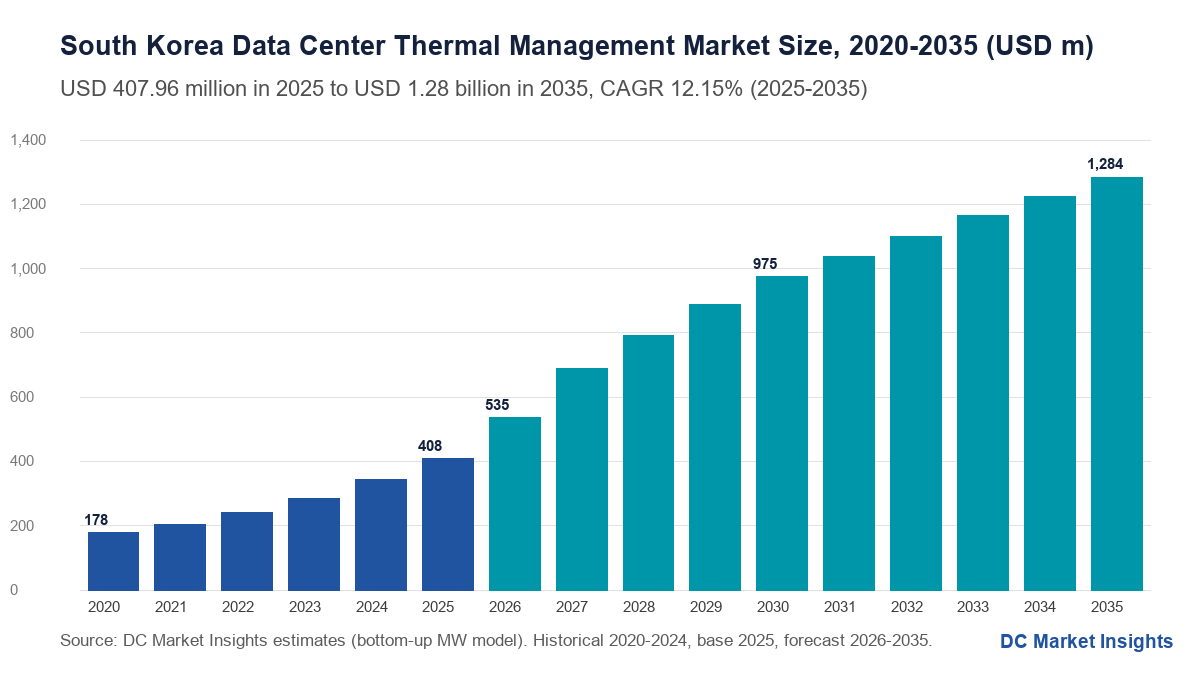
The South Korea Data Center Thermal Management market was worth USD 408.0 million in 2025 and is forecast to reach USD 1,280.0 million by 2035, growing at a 12.15% CAGR.
 By Amit Jain, Senior Consultant, ICT & Emerging Technologies
 Reviewed by Deepti Agrawal
Last updated 22 Oct 2026
Base year 2025 PDF + Excel
Key findings
Rack Density at Ulsan, Paju and Gumi: 40-100 kW per Rack
Korean CDUs Qualify for NVIDIA Platforms
Service Contracts on a 5.3 GW Installed Base
What is inside the report
- 01Introduction
- 02Research Methodology
- 03Executive Summary
- 04Market Dynamics
- 05Pricing Analysis
- 06Standards and Regulation
- 07Market Segmentation by Component
- 08Market Segmentation by Deployment
- 09Market Segmentation by Cooling Approach
- 10Market Segmentation by Data Center Type
- 16chapters
- 2020-2024Historical period
- 2026-2035Forecast period
- —Companies profiled
Segmentation
Recent developments
SK Telecom and AWS broke ground on the 100 MW Ulsan AI data center, designed for 40-100 kW per rack (Source: SK Telecom).
LG Electronics, SK Enmove and GRC signed an MOU on immersion cooling at LG's Pyeongtaek test bed (Source: LG Electronics).
KT Cloud opened its Gasan AI data center with 26 MW of IT load and direct-to-chip cooling (Source: KT Cloud).
Samsung SDS announced a KRW 427.3 billion, 60 MW AI data center in Gumi with chilled water to the server (Source: Samsung SDS).
FläktGroup announced a KRW 240 billion HVAC and CDU line at Samsung's Gwangju site (Source: FläktGroup).
LG Electronics' 2.6 MW CDU qualified as NVIDIA DSX Ready (Source: LG Electronics).
Full analysis
The South Korea Data Center Thermal Management Market is valued at USD 535.18 million in 2026 and is projected to reach USD 1.28 billion by 2035, up from USD 407.96 million in 2025, a CAGR of 12.15% from 2025 to 2035 (DC Market Insights estimate). The South Korea Data Center Thermal Management Market covers the equipment, controls and services that remove heat from Korean data halls: chillers, computer-room air handlers, coolant distribution units (CDUs), direct-to-chip and immersion systems, containment, thermal monitoring software and the service contracts that keep them running. What moves the money in Korea is rack density meeting a rationed grid: the SK Telecom and Amazon Web Services (AWS) campus in Ulsan is specified at 40-100 kW of cooling per rack, while the Distributed Energy Activation Act, in force since June 2024, puts every new load of 10 MW or more through a grid impact assessment, so operators squeeze more compute out of each approved megawatt. The receipt behind the 2025 figure is 230 MW of new IT capacity × USD 1.35 million of thermal content per MW = USD 310.50 million of new-build spend, plus 1,547 MW of installed IT load × USD 63 thousand a year of service, software and retrofit spend = USD 97.46 million. Direct-to-chip liquid cooling is the largest growth pool at 21.17% a year, and the Honam Region is the fastest region at 20.20% a year because the National AI Computing Center at Haenam and the OpenAI and SK Telecom site in South Jeolla sit outside the capital-area grid queue.
Key Market Statistics: How Big Is the South Korea Data Center Thermal Management Market in 2026?
DC Market Insights values the South Korea Data Center Thermal Management Market at USD 535.18 million in 2026, 31.18% above 2025, as new IT capacity completed in Korea rises from 230 MW to 300 MW.
- Market size 2025: USD 407.96 million (about USD 408.0 million)
- Market size 2026: USD 535.18 million
- Market size 2030: USD 974.65 million
- Market size 2035: USD 1.28 billion
- CAGR 2025-2035: 12.15% (low case 9.56%, high case 14.36%)
- Largest component: Cooling Equipment, 70.47% of 2025 spend (USD 287.50 million)
- Fastest cooling approach: Immersion Cooling at 22.91% a year, from USD 8.16 million to USD 64.21 million
- Leading region: Capital Region (Seoul, Gyeonggi Province and Incheon), 66.00% of 2025 spend
- Fastest region: Honam Region at 20.20% a year
- Largest province: Gyeonggi Province, USD 134.63 million in 2025
- Market leader: LG Electronics, about 18% of 2025 equipment spend (DC Market Insights estimate)
Key Takeaways: What Should a Korean Data Center Cooling Buyer Know in 2026?
DC Market Insights draws four takeaways from a Korean data center thermal management market that grows from USD 407.96 million in 2025 to USD 1.28 billion in 2035.
- Liquid cooling is no longer a pilot in Korea, because KT Cloud’s Gasan site (26 MW of IT load, opened November 2025) runs direct-to-chip cooling commercially and every large AI campus announced since then specifies hybrid or liquid designs (Source: KT Cloud via Aju Business Daily); DC Market Insights puts direct-to-chip at 18.00% of 2025 spend and 39.00% by 2035.
- Software and services grow faster than hardware, because the installed base climbs from 1,547 MW in 2025 to 5,269 MW in 2035 and each megawatt carries a yearly run-rate of USD 63-83 thousand; services and software reach 35.37% of spend by 2035.
- The grid decides where the cooling goes, because only 40 of 601 capital-area projects were expected to get power on time (Source: Ministry of Trade, Industry and Energy (MOTIE), July 2024); the Capital Region’s share falls from 66.00% to 50.00%.
- Cooling makers now build in Korea, because FläktGroup is spending KRW 240 billion (USD 158 million) on a CDU-led line at Samsung’s Gwangju site for operation by end-2028 (Source: FläktGroup, September 2026).
South Korea Data Center Thermal Management Market Summary: What Did Korea Spend on Data Center Heat Removal in 2025?
Korea spent USD 407.96 million on data center thermal management in 2025. The South Korea Data Center Thermal Management Market size was valued at USD 178.22 million in 2020, reached USD 407.96 million in 2025, and is anticipated to reach USD 1.28 billion by 2035, at a CAGR of 12.15% during the forecast period. From 2020 to 2025 the market grew 18.01% a year as new IT completions rose from 120 MW to 230 MW and the number of Korean data centers reached 182 (Source: Korea Data Center Council (KDCC), August 2026).
| Report attribute | Details |
|---|---|
| Historical period | 2020-2024 |
| Base year | 2025 |
| Forecast period | 2026-2035 |
| Market size 2025 | USD 407.96 million |
| Market size 2026 | USD 535.18 million |
| CAGR 2025-2035 | 12.15% |
| Market size 2035 | USD 1.28 billion |
Growth peaks at 31.18% in 2026 and 28.67% in 2027 as the Ulsan, Paju and Gasan halls are fitted out, then eases to 4.90% by 2035 when annual completions level off near 510 MW and the installed base, not new halls, carries 34.06% of spend. DC Market Insights estimates that Korea holds about 6.2% of Asia Pacific data center thermal management spend in 2025, against USD 6.60 billion for the region in the Asia Pacific Data Center Thermal Management Market.
What Does Data Center Thermal Management Cover in South Korea?
Data center thermal management in South Korea is the USD 407.96 million (2025) layer of hardware, software and services that keeps Korean IT equipment inside its temperature and humidity limits, counted where the data center is built.
Included
- Cooling equipment: chillers, cooling towers and dry coolers, computer-room air conditioners and air handlers, in-row units, rear-door heat exchangers, CDUs, cold plates and manifolds supplied as part of a facility loop, and immersion tanks and fluids (USD 287.50 million in 2025).
- Airflow management and containment: hot- and cold-aisle containment, blanking, raised-floor and ceiling airflow parts and facility fans (USD 16.10 million).
- Thermal monitoring software and controls: temperature and pressure sensors, controllers, the thermal modules of data center infrastructure management (DCIM) and building management systems (BMS), computational fluid dynamics (CFD) tools and AI-based cooling optimisation (USD 25.46 million).
- Thermal services: commissioning, preventive maintenance, refrigerant and fluid service, monitoring as a service and cooling retrofits (USD 78.90 million).
Excluded
- Heat sinks and fans built into servers by the server maker, power supplies and electrical distribution, office and comfort air conditioning in mixed-use buildings, and the electricity bill for running the cooling plant.
How the Segments Fit Together
The four components add to the total in every year. The deployment split divides the same total into new-build projects (USD 310.50 million) and installed-base operations and upgrades (USD 97.46 million); the cooling-approach and data-center-type splits allocate the same total by technology and by owner. This report is wider than the South Korea Data Center Cooling Market, which counts cooling equipment and cooling service only: about one eighth (12.5%) of 2025 thermal management spend is containment, thermal software and controls, and thermal engineering services that the cooling report leaves out.
Why Do South Korea Data Center Thermal Management Market Estimates Differ?
South Korea data center thermal management estimates differ because definitions differ; DC Market Insights puts the 2026 market at USD 535.18 million on a facility-thermal definition.
Broader definitions add server-internal heat sinks and fans, uninterruptible power and power distribution, telecom shelters, refrigeration equipment used outside data halls, and the electricity cost of running chillers, which can more than double the headline. Narrower definitions keep only computer-room air conditioning and leave out chillers and liquid loops, which understates a market where hybrid air and liquid designs are now the norm. Small and mid-size enterprises (SMEs), public agencies and edge operators are in scope as buyers.
| Element | In this report | Why |
|---|---|---|
| Chillers, air handlers, CDUs, immersion | Yes, USD 287.50 million | Core heat-removal plant |
| Containment and airflow | Yes, USD 16.10 million | Sets the cooling load per rack |
| Thermal software and sensors | Yes, USD 25.46 million | Controls set points and fan speeds |
| Server-internal heat sinks and fans | No | Sold inside the server price |
| Electricity for cooling | No | Operating cost, not a thermal product |
Market Drivers: What Is Driving Thermal Management Spending in Korean Data Centers?
Three Korea-specific forces lift South Korea data center thermal management spend from USD 407.96 million in 2025 to USD 974.65 million in 2030, a 19.03% annual rate.
Rack Density at Ulsan, Paju and Gumi: 40-100 kW per Rack
The SK Telecom and AWS campus in Ulsan, a 100 MW site that broke ground on 29 August 2025 for operation from 2027, is designed for 40-100 kW of cooling per rack with a hybrid air and water system (Source: SK Telecom). Samsung SDS’s 60 MW Gumi site, a KRW 427.3 billion project due in March 2029, will deliver chilled water directly to high-power servers (Source: Samsung SDS, January 2026). At these densities DC Market Insights estimates thermal content of USD 1.8-2.2 million per MW, against USD 1.35 million for the 2025 national average, which is why content per MW rises to USD 1.66 million by 2035.
Grid Rationing Turns Cooling Efficiency Into Capacity
Under the Distributed Energy Activation Act, in force from June 2024, users asking for 10 MW or more must pass a grid impact assessment, and MOTIE has had grounds since March 2023 to refuse supply to capital-area data centers that need 5 MW or more (Source: MOTIE). With the large-user industrial rate raised from KRW 165.8 to KRW 182.7 per kWh on 24 October 2024 (Source: Korea Electric Power Corporation (KEPCO)), every 0.1 point cut in power usage effectiveness (PUE) on a 20 MW hall saves about 17.5 GWh and KRW 3.2 billion a year (DC Market Insights estimate). That arithmetic funds free-cooling chillers, containment and AI-based control software, the fastest component at 16.99% a year.
Sovereign AI Compute: 15,000 Chips at Haenam
The National AI Computing Center at Haenam Solaseado, led by a Samsung SDS consortium with KRW 2.5 trillion of investment and about 15,000 AI chips, broke ground on 3 August 2026 for completion in 2028 (Source: Ministry of Science and ICT (MSIT)). Together with the October 2025 OpenAI agreements for sites in South Jeolla with SK Telecom and in Pohang with Samsung, it moves high-density cooling demand south, and DC Market Insights expects the Honam Region’s share of national spend to double from 6% in 2025 to 12% in 2035.
Market Trends: How Is Data Center Cooling Changing in Korea?
South Korea data center thermal management is moving from room air to the chip: direct-to-chip cooling rises from 18.00% of spend in 2025 to 39.00% in 2035.
Korean CDUs Qualify for NVIDIA Platforms
LG Electronics completed infrastructure qualification of its 600 kW, 1 MW and 2.6 MW CDU models, with the 2.6 MW unit qualified as NVIDIA DSX Ready in September 2026 (Source: LG Electronics, September 2026). LG Uplus’s Paju campus, with 200 MW of power secured and its first building due in June 2027, uses LG CDUs, direct-to-chip loops and free-cooling chillers (Source: LG Uplus via Kyunggi News). DC Market Insights counts CDUs and facility-side liquid loops inside the USD 73.43 million direct-to-chip segment for 2025.
Immersion Moves From Lab to Test Bed
LG Electronics, SK Enmove and Green Revolution Cooling (GRC) signed a memorandum of understanding (MOU) on immersion cooling in October 2025, combining LG CDUs and chillers, SK Enmove fluids and GRC tanks at LG’s Pyeongtaek test bed (Source: LG Electronics, October 2025). HD Hyundai Oilbank began validation with Seoul National University in 2026 (Source: HD Hyundai Oilbank). Immersion stays small at USD 8.16 million in 2025 but is the fastest approach, reaching USD 64.21 million by 2035.
Cooling Makers Build Factories in Korea
FläktGroup, bought by Samsung Electronics for EUR 1.5 billion in November 2025, will build a 21,500 m² line in Gwangju with CDUs as its lead product for operation by end-2028 (Source: FläktGroup, September 2026), and LG Electronics said in October 2026 that it is adding AI data center cooling capacity in Korea (Source: LG Electronics). Local production shortens lead times for the USD 417.30 million of new-build thermal spend DC Market Insights expects in 2026.
Market Challenges and Restraints: What Holds Back Thermal Management Projects in South Korea?
Two constraints could cut 2035 South Korea data center thermal management spend to the USD 1.02 billion low case, 20.84% below the base case.
Grid Assessments Delay Capital-Area Projects
Of 601 data centers requested in Seoul, Gyeonggi and Incheon to 2029, MOTIE expected only 40 (6.7%) to receive power on time (Source: MOTIE via Asia Economy, July 2024). Each delayed 20 MW hall defers about USD 28 million of thermal equipment at 2026 content (DC Market Insights estimate), which is why the Capital Region grows only 9.08% a year against 12.15% nationally.
Water Loops and Skills for Liquid Cooling
Hybrid sites such as Ulsan and Gumi bring chilled water to the rack, and Korea had no commercial direct-to-chip site before November 2025, so commissioning and fluid-quality skills are scarce. DC Market Insights applies a 5% lower liquid content in the low case for slower adoption, and IBK Securities noted in September 2026 that low entry barriers in immersion cooling are already pressing supplier margins.
Market Opportunities: Where Can Thermal Management Suppliers Win in Korea?
Two pools offer data center thermal management suppliers in South Korea about USD 454.23 million a year by 2035.
Service Contracts on a 5.3 GW Installed Base
The installed IT base reaches 5,269 MW by 2035, and at USD 83 thousand per MW per year of maintenance, fluid service, monitoring and engineering, thermal services grow from USD 78.90 million in 2025 to USD 331.95 million in 2035, a 15.45% CAGR.
Retrofits of Older Air-Cooled Halls
About 182 Korean data centers were operating in 2025 (Source: KDCC), and many enterprise and public halls were designed for air cooling at well under 10 kW per rack. DC Market Insights values enterprise and public data center thermal spend at USD 89.75 million in 2025; converting a share of those halls to rear-door or direct-to-chip cooling supports rear-door heat exchanger growth of 14.68% a year to USD 128.42 million by 2035.
Pricing: How Much Does Data Center Thermal Management Cost per MW in Korea?
DC Market Insights estimates South Korea data center thermal management content at USD 1.35 million per MW of new IT load in 2025, rising to USD 1.66 million in 2035 as liquid loops replace room air.
| Year | New-build thermal content (USD million per MW) | Installed-base run-rate (USD thousand per MW per year) |
|---|---|---|
| 2020 | 1.15 | 51 |
| 2025 | 1.35 | 63 |
| 2030 | 1.55 | 74 |
| 2035 | 1.66 | 83 |
Public anchors: KEPCO’s large-user industrial rate of KRW 182.7 per kWh from October 2024 sets the payback on efficient chillers; LG Electronics reported about KRW 600 billion (more than USD 428 million) of AI data center cooling orders in the first half of 2026, mostly chillers and air-side units (Source: LG Electronics via The Korea Times); and FläktGroup’s KRW 240 billion Gwangju line prices new local CDU capacity at about USD 158 million. At an exchange rate of KRW 1,400 per USD, cooling equipment alone averaged USD 1.25 million per MW in 2025.
Standards and Regulation: Which Rules Shape Data Center Cooling in South Korea?
Five Korean rules and one global guideline shape how USD 535.18 million of 2026 South Korea data center thermal management spend is designed.
- Distributed Energy Activation Act (in force June 2024): grid impact assessment for loads of 10 MW or more; news reports put the pass rate at 20 of 374 applications (Source: MOTIE data via Money Today).
- MOTIE supply-refusal rule (March 2023): grounds to refuse power to capital-area data centers needing 5 MW or more.
- Framework Act on the Development of Artificial Intelligence (AI Basic Act), in force 22 January 2026: the legal base for national AI computing infrastructure such as the 15,000-chip Haenam center.
- AI data center special act passed in May 2026: power purchase and grid-assessment relief for AI data centers outside the capital area (Source: National Assembly, as reported by Money Today).
- Green Data Center certification run by KDCC: four grades, 23 data centers certified by December 2022, with PUE as the core metric.
- ASHRAE Technical Committee 9.9 thermal guidelines: recommended server inlet range of 18-27 °C, the design basis for Korean chilled-water and free-cooling set points.
Market Segmentation: Which Thermal Management Segment Leads in South Korea?
Cooling Equipment leads South Korea data center thermal management with USD 287.50 million in 2025 (70.47%), while Thermal Monitoring Software and Controls grows fastest at 16.99% a year.
By Component
| Component | 2025 (USD million) | Share 2025 | 2035 (USD million) | CAGR 2025-2035 |
|---|---|---|---|---|
| Cooling Equipment | 287.50 | 70.47% | 790.50 | 10.64% |
| Airflow Management and Containment | 16.10 | 3.95% | 39.44 | 9.37% |
| Thermal Monitoring Software and Controls | 25.46 | 6.24% | 122.28 | 16.99% |
| Thermal Services | 78.90 | 19.34% | 331.95 | 15.45% |
By Deployment
| Deployment | 2025 (USD million) | Share 2025 | 2035 (USD million) | CAGR 2025-2035 |
|---|---|---|---|---|
| New-Build Projects | 310.50 | 76.11% | 846.84 | 10.55% |
| Installed Base Operations and Upgrades | 97.46 | 23.89% | 437.33 | 16.20% |
By Cooling Approach
| Cooling approach | 2025 (USD million) | Share 2025 | 2035 (USD million) | CAGR 2025-2035 |
|---|---|---|---|---|
| Air-Based Room and Row Cooling | 293.73 | 72.00% | 590.71 | 7.24% |
| Rear-Door Heat Exchangers | 32.64 | 8.00% | 128.42 | 14.68% |
| Direct-to-Chip Liquid Cooling | 73.43 | 18.00% | 500.82 | 21.17% |
| Immersion Cooling | 8.16 | 2.00% | 64.21 | 22.91% |
By Data Center Type
| Data center type | 2025 (USD million) | Share 2025 | 2035 (USD million) | CAGR 2025-2035 |
|---|---|---|---|---|
| Hyperscale and AI Data Centers | 155.03 | 38.00% | 680.61 | 15.94% |
| Colocation Data Centers | 146.87 | 36.00% | 385.25 | 10.12% |
| Enterprise and Public Data Centers | 89.75 | 22.00% | 154.10 | 5.55% |
| Edge Data Centers | 16.32 | 4.00% | 64.21 | 14.68% |
Hyperscale and AI data centers become the largest owner group by 2035 at USD 680.61 million, a 15.94% CAGR, because every AI campus in the tracker below specifies liquid or hybrid cooling.
DC Exclusive: The Korean AI Campus Cooling Tracker, 7 Projects and About 756 MW
DC Market Insights tracks seven named Korean AI campuses with about 756 MW of planned capacity; at the 2026 thermal content of USD 1.39 million per MW, they carry about USD 1.05 billion of data center thermal management value as they are built. This is a DC Market Insights estimate built on 7 inputs, one public announcement per project.
| Project | Location | MW | Thermal design | Timing |
|---|---|---|---|---|
| SK Telecom and AWS, Ulsan AI data center | Ulsan | 100 | Hybrid air and water cooling, 40-100 kW per rack | Operations from 2027 |
| LG Uplus Paju AI data center | Gyeonggi Province | 200 (power secured) | Hybrid air plus direct-to-chip, LG Electronics CDUs and free-cooling chillers | Building 1 due June 2027 |
| Naver Gak Sejong phases 2 and 3 | Sejong City | 270 (campus plan) | Direct liquid cooling as base design, immersion under test | 2028-2029 |
| Samsung SDS Gumi AI data center | Gyeongsangbuk-do | 60 | Hybrid, chilled water direct to high-power servers | March 2029 |
| KT Cloud and SGC Energy, Gunsan | Jeollabuk-do | 60 (phase 1) | Liquid cooling for next-generation GPUs | Early 2028 |
| KT Cloud Gasan AI data center | Seoul | 26 IT (40 grid) | Direct-to-chip liquid cooling | Opened November 2025 |
| OpenAI joint ventures with SK Telecom and Samsung SDS | Jeollanam-do and Pohang | 40 (2 x 20 initial) | Not disclosed | Announced October 2025 |
Reading the tracker: five of the seven projects sit outside the Capital Region, six name liquid or hybrid cooling, and the two largest (Paju and Sejong) together hold 470 MW. Sources: SK Telecom, LG Uplus, Naver Cloud, Samsung SDS, KT Cloud and OpenAI announcements; MW for Paju is secured power, not IT load.
Regional Insights: Which Korean Region Spends Most on Data Center Thermal Management?
The Capital Region leads South Korea data center thermal management spend with USD 269.25 million in 2025 (66.00%), and the Honam Region grows fastest at 20.20% a year to USD 154.10 million by 2035.
| Region | 2025 (USD million) | Share 2025 | 2035 (USD million) | CAGR 2025-2035 |
|---|---|---|---|---|
| Capital Region | 269.25 | 66.00% | 642.08 | 9.08% |
| Chungcheong Region | 48.96 | 12.00% | 192.62 | 14.68% |
| Yeongnam Region | 44.88 | 11.00% | 218.31 | 17.14% |
| Honam Region | 24.48 | 6.00% | 154.10 | 20.20% |
| Gangwon and Jeju | 20.40 | 5.00% | 77.05 | 14.21% |
Capital Region
Seoul, Gyeonggi Province and Incheon held 74.77% of private data centers in 2025 (Source: KDCC); KT Cloud’s 26 MW Gasan site and LG Uplus’s Paju campus keep the region at half of national spend in 2035 despite grid limits, growing 9.08% a year.
Chungcheong Region
Naver’s Gak Sejong campus, planned at 270 MW with direct liquid cooling in later phases, lifts Sejong City’s spend 16.79% a year to 2035, the fastest rate in the region.
Yeongnam Region
Ulsan (SK Telecom and AWS, 100 MW) and Gumi (Samsung SDS, 60 MW) lift the region’s share from 11% to 17% by 2035; Ulsan grows 23.06% a year.
Honam Region
The Haenam National AI Computing Center and the South Jeolla AI campus make Jeollanam-do the fastest province at 23.32% a year, an eightfold rise over the decade.
Gangwon and Jeju
Cooler climate and new power agreements in Gangwon support a 14.21% CAGR and a 6% national share by 2035, with free cooling usable for more of the year than in Seoul.
Province Analysis: Which Korean Provinces and Cities Carry the Most Thermal Spend?
Gyeonggi Province leads South Korea data center thermal management spend with USD 134.63 million in 2025, and Jeollanam-do is the fastest large province at 23.32% a year.
| Rank | Province or city | Region | 2025 (USD million) | 2035 (USD million) | CAGR 2025-2035 |
|---|---|---|---|---|---|
| 1 | Gyeonggi Province | Capital Region | 134.63 | 321.03 | 9.08% |
| 2 | Seoul | Capital Region | 96.93 | 205.47 | 7.80% |
| 3 | Incheon | Capital Region | 37.70 | 115.58 | 11.86% |
| 4 | Sejong City | Chungcheong Region | 19.58 | 92.46 | 16.79% |
| 5 | Busan | Yeongnam Region | 17.95 | 69.86 | 14.56% |
| 6 | Chungcheongnam-do | Chungcheong Region | 14.69 | 53.93 | 13.89% |
| 7 | Daejeon | Chungcheong Region | 14.69 | 46.23 | 12.15% |
| 8 | Gangwon-do | Gangwon and Jeju | 14.28 | 55.48 | 14.54% |
| 9 | Jeollanam-do | Honam Region | 11.74 | 95.54 | 23.32% |
| 10 | Ulsan | Yeongnam Region | 9.87 | 78.59 | 23.06% |
| 11 | Gyeongsangbuk-do | Yeongnam Region | 9.87 | 39.30 | 14.82% |
| 12 | Gwangju | Honam Region | 7.35 | 30.82 | 15.42% |
Scenario Analysis: How Could the South Korea Data Center Thermal Management Market Look in 2035?
DC Market Insights puts the 2035 South Korea data center thermal management market between USD 1.02 billion and USD 1.56 billion, with USD 1.28 billion in the base case.
| Scenario | 2035 (USD million) | CAGR 2025-2035 | Assumption from 2027 |
|---|---|---|---|
| Low | 1,016.57 | 9.56% | New MW 20% below base as grid assessments stall projects; liquid content 5% lower; software spend 10% lower |
| Base | 1,284.16 | 12.15% | Completions rise from 300 MW (2026) to 510 MW (2035) |
| High | 1,560.85 | 14.36% | New MW 20% above base as the AI data center special act speeds non-capital sites; liquid content 4% higher |
Key Players: Who Supplies Data Center Thermal Management in South Korea?
DC Market Insights estimates that the top five suppliers (LG Electronics, Vertiv, Schneider Electric, Samsung Electronics with FläktGroup, and Trane Technologies) held about 55% of 2025 South Korea data center thermal management equipment spend, with LG Electronics the leader at about 18%, based on installed chiller and air-handler references.
- LG Electronics: Eco Solution (ES) company revenue of KRW 9.32 trillion in 2025 (Source: LG Electronics, January 2026); CDUs qualified for NVIDIA platforms
- Samsung Electronics and FläktGroup: EUR 1.5 billion acquisition completed November 2025; FläktGroup sales above EUR 700 million (Source: Samsung Electronics)
- Vertiv: net sales of USD 10.23 billion in 2025, Asia Pacific USD 2.02 billion (Source: Vertiv, February 2026); Korean distribution through Leaders Systems and TS Core
- Schneider Electric: 75% of Motivair bought for USD 850 million in 2024 for liquid cooling (Source: Schneider Electric)
- SK Enmove: immersion cooling fluids, partner of GRC and LG
- Green Revolution Cooling (GRC): immersion tanks
- Trane Technologies: chillers for hyperscale halls
- Carrier: chillers and computer-room air handling
- Johnson Controls: chillers and controls
- Daikin: air conditioning and chillers
- Mitsubishi Electric: chillers and precision air conditioning
- Stulz: precision air conditioning
- Delta Electronics: in-row and rack cooling
- GST: Korean immersion cooling systems, pilot with S-Oil to May 2029
- Iceotope: precision liquid cooling tested with SK Telecom
Buyer concentration is high: DC Market Insights estimates that SK Telecom, KT Cloud, LG Uplus, Naver Cloud and Samsung SDS ordered about 45% of 2025 thermal equipment by value.
Recent Developments: What Changed in Korean Data Center Cooling Since 2025?
South Korea data center thermal management saw 6 dated project and supplier events between August 2025 and September 2026, covering 186 MW of liquid- or hybrid-cooled capacity at Ulsan, Gasan and Gumi.
- In August 2025, SK Telecom and AWS broke ground on the 100 MW Ulsan AI data center, designed for 40-100 kW per rack (Source: SK Telecom).
- In October 2025, LG Electronics, SK Enmove and GRC signed an MOU on immersion cooling at LG’s Pyeongtaek test bed (Source: LG Electronics).
- In November 2025, KT Cloud opened its Gasan AI data center with 26 MW of IT load and direct-to-chip cooling (Source: KT Cloud).
- In January 2026, Samsung SDS announced a KRW 427.3 billion, 60 MW AI data center in Gumi with chilled water to the server (Source: Samsung SDS).
- In September 2026, FläktGroup announced a KRW 240 billion HVAC and CDU line at Samsung’s Gwangju site (Source: FläktGroup).
- In September 2026, LG Electronics’ 2.6 MW CDU qualified as NVIDIA DSX Ready (Source: LG Electronics).
Methodology: How the Model Values the South Korea Data Center Thermal Management Market
DC Market Insights built the USD 407.96 million (2025) figure bottom-up from 16 yearly capacity cohorts, 4 component prices and 12 provinces, using the same capacity inputs as the South Korea Data Center Cooling Market so the two reports reconcile.
- Receipt: 230 MW new IT × USD 1.35 million per MW (cooling equipment 1.25, containment 0.07, sensors and controls 0.03) = USD 310.50 million; 1,547 MW installed × USD 63 thousand per MW (service 45, software 12, engineering 6) = USD 97.46 million.
- Ceiling 1: USD 407.96 million is about 20% of Vertiv’s USD 2.02 billion Asia Pacific sales in 2025, a region that includes China, India and Australia.
- Ceiling 2: USD 407.96 million is 6.2% of the USD 6.60 billion Asia Pacific thermal management market, in line with Korea’s share of regional data center capacity.
- Floor: 2024 thermal spend of USD 343.67 million is about 7.7% of KRW 6.22 trillion (USD 4.44 billion) of 2024 Korean commercial data center revenue (Source: KDCC), a normal share for plant spend plus service.
Every segment, region and province table sums to the national total in 2025 and 2035; CAGRs are recomputed from endpoints. Sources are company releases, filings and government data named in the text; the full method is on the research methodology page, and the national demand picture is in the South Korea Data Center Market and South Korea AI Data Center Market reports.
Table of contents
- 01Introduction
- 1.1Market Definition and Scope
- 1.2Included and Excluded Elements
- 1.3How the Segments Fit Together
- 1.4Why South Korea Data Center Thermal Management Estimates Differ
- 02Research Methodology
- 2.1Bottom-Up Model: MW × Thermal Content per MW
- 2.2Bound Checks
- 2.3Source Ledger
- 03Executive Summary
- 3.1Market Snapshot, 2025, 2026 and 2035
- 3.2Key Market Statistics
- 3.3Key Takeaways
- 04Market Dynamics
- 4.1Driver: Rack Density at Ulsan, Paju and Gumi
- 4.2Driver: Grid Rationing Turns Cooling Efficiency Into Capacity
- 4.3Driver: Sovereign AI Compute at Haenam
- 4.4Trend: Korean CDUs Qualify for NVIDIA Platforms
- 4.5Trend: Immersion Moves From Lab to Test Bed
- 4.6Trend: Cooling Makers Build Factories in Korea
- 4.7Challenge: Grid Assessments Delay Capital-Area Projects
- 4.8Challenge: Water Loops and Skills for Liquid Cooling
- 4.9Opportunity: Service Contracts on a 5.3 GW Installed Base
- 4.10Opportunity: Retrofits of Older Air-Cooled Halls
- 05Pricing Analysis
- 5.1Thermal Content per MW, 2020-2035
- 5.2Installed-Base Run-Rate per MW
- 5.3Public Price Anchors
- 06Standards and Regulation
- 6.1Distributed Energy Activation Act
- 6.2MOTIE Supply-Refusal Rule
- 6.3AI Basic Act
- 6.4AI Data Center Special Act
- 6.5Green Data Center Certification
- 6.6ASHRAE TC 9.9 Thermal Guidelines
- 07Market Segmentation by Component
- 7.1Cooling Equipment
- 7.2Airflow Management and Containment
- 7.3Thermal Monitoring Software and Controls
- 7.4Thermal Services
- 08Market Segmentation by Deployment
- 8.1New-Build Projects
- 8.2Installed Base Operations and Upgrades
- 09Market Segmentation by Cooling Approach
- 9.1Air-Based Room and Row Cooling
- 9.2Rear-Door Heat Exchangers
- 9.3Direct-to-Chip Liquid Cooling
- 9.4Immersion Cooling
- 10Market Segmentation by Data Center Type
- 10.1Hyperscale and AI Data Centers
- 10.2Colocation Data Centers
- 10.3Enterprise and Public Data Centers
- 10.4Edge Data Centers
- 11DC Exclusive: Korean AI Campus Cooling Tracker
- 11.1SK Telecom and AWS, Ulsan AI data center
- 11.2LG Uplus Paju AI data center
- 11.3Naver Gak Sejong phases 2 and 3
- 11.4Samsung SDS Gumi AI data center
- 11.5KT Cloud and SGC Energy, Gunsan
- 11.6KT Cloud Gasan AI data center
- 11.7OpenAI joint ventures with SK Telecom and Samsung SDS
- 12Regional Analysis
- 12.1Capital Region
- 12.2Chungcheong Region
- 12.3Yeongnam Region
- 12.4Honam Region
- 12.5Gangwon and Jeju
- 13Province Analysis
- 13.1Gyeonggi Province
- 13.2Seoul
- 13.3Incheon
- 13.4Sejong City
- 13.5Busan
- 13.6Chungcheongnam-do
- 13.7Daejeon
- 13.8Gangwon-do
- 13.9Jeollanam-do
- 13.10Ulsan
- 13.11Gyeongsangbuk-do
- 13.12Gwangju
- 14Forecast Scenarios
- 14.1Low Case
- 14.2Base Case
- 14.3High Case
- 15Key Players
- 15.1LG Electronics
- 15.2Samsung Electronics and FläktGroup
- 15.3Vertiv
- 15.4Schneider Electric
- 15.5SK Enmove
- 15.6Green Revolution Cooling
- 15.7Trane Technologies
- 15.8Carrier
- 15.9Johnson Controls
- 15.10Daikin
- 15.11Mitsubishi Electric
- 15.12Stulz
- 15.13Delta Electronics
- 15.14GST
- 15.15Iceotope
- 15.16Buyer Concentration
- 16Recent Developments
- 16.1August 2025 to September 2026
- Fig. 11. South Korea Data Center Thermal Management Market Size, 2020-2035 (USD million)
- Table 11. Report Attributes
- Table 22. Scope Comparison
- Table 33. Thermal Content per MW, 2020-2035
- Table 44. Market by Component, 2025 and 2035
- Table 55. Market by Deployment, 2025 and 2035
- Table 66. Market by Cooling Approach, 2025 and 2035
- Table 77. Market by Data Center Type, 2025 and 2035
- Table 88. Korean AI Campus Cooling Tracker
- Table 99. Market by Region, 2025 and 2035
- Table 1010. Top 12 Provinces and Cities
- Table 1111. Forecast Scenarios, 2035
About this report
Written by Amit Jain and reviewed by Deepti Agrawal, Senior Editor, Research. Figures are built top-down and bottom-up and reconciled before publication, with 2025 as the base year.
Read our methodologyHow we built this
- Historical period2020-2024
- Base year2025
- Forecast period2026-2035
- Sizing approachTop-down + bottom-up
Need more than the report?
Advisory on this market
Due diligence, site selection and market entry work, by the analysts who wrote this report.
See consulting servicesFrequently asked questions
USD 535.18 million in 2026, up 31.18% from USD 407.96 million in 2025, according to DC Market Insights estimates. The market is projected to reach USD 1.28 billion by 2035, a CAGR of 12.15% from 2025.
12.15% a year from 2025 to 2035, after 18.01% a year in 2020-2025. Growth peaks at 31.18% in 2026 as AI halls in Ulsan, Paju and Gasan are fitted out.
USD 535.18 million in 2026 is a facility-thermal figure: cooling plant, containment, thermal software and services. Wider definitions add server heat sinks, power equipment or cooling electricity, which can double the headline.
12.5% of 2025 spend: thermal management (USD 407.96 million) adds containment, thermal monitoring software and engineering services to cooling equipment and cooling service, which the cooling market counts alone.
Immersion cooling at 22.91% a year, from USD 8.16 million in 2025 to USD 64.21 million in 2035; direct-to-chip cooling is the largest growth pool, rising to USD 500.82 million.
USD 1.35 million per MW of new IT load in 2025, rising to USD 1.66 million by 2035, plus USD 63 thousand per installed MW a year for service and software (DC Market Insights estimates).
The Capital Region with USD 269.25 million in 2025 (66.00%); the Honam Region grows fastest at 20.20% a year as AI campuses move to South Jeolla.
10 MW and larger loads need a grid impact assessment since June 2024, so operators buy efficient chillers, containment and control software; thermal software grows 16.99% a year to USD 122.28 million by 2035.
About 55% of 2025 equipment spend sits with LG Electronics, Vertiv, Schneider Electric, Samsung with FläktGroup and Trane Technologies, with LG Electronics the leader at about 18% (DC Market Insights estimates).
About 756 MW across 7 tracked AI campuses, carrying about USD 1.05 billion of thermal value at 2026 content; six of the seven name liquid or hybrid cooling, according to DC Market Insights.
Get this report
How do I get the full report?
Request a quote; we reply by email within one business day.
How and when will I receive the report?
By email, within 24-48 business hours of payment.
How can I pay?
Once you accept the quote, we email you a secure payment link.
Can I see a sample first?
Yes. Request a free sample and we will email it to you.
Can the report be tailored to my needs?
Yes. We can add countries, segments or data cuts. Talk to an analyst about the scope you need.
Can I get an invoice or pay against a purchase order?
Write to sales@dcmarketinsights.com and our team will help.