
Turkey Data Center Market Size, Share & Forecast to 2035
Market at a glance
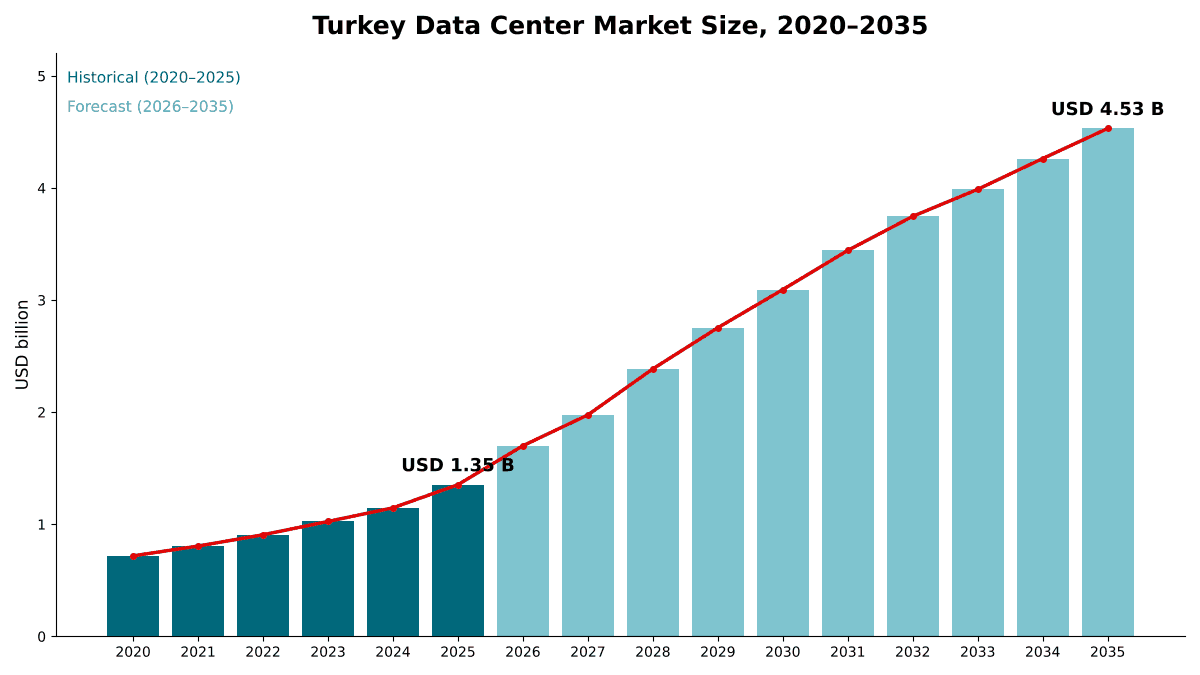
The Turkey Data Center market was worth USD 1,350.0 million in 2025 and is forecast to reach USD 4,530.0 million by 2035, growing at a 12.84% CAGR. Istanbul and Marmara account for 58.3% of the market.
 By Priyanka Mor, Senior Consultant
 Reviewed by Deepti Agrawal
Last updated 10 Oct 2026
Base year 2025 PDF + Excel
Source: DC Market Insights analysis
Key findings
A 1 Gigawatt Target and a USD 1.5 Billion Support Budget Pull Capacity Forward
Projects Move from Single Halls to Campuses of 20 MW to 48 MW
Electricity Tariffs Rose Again in April 2026
Cloud Regions from Google and Alibaba Open a Hyperscale Supply Chain
What is inside the report
- 01Introduction
- 02Research Methodology
- 03Executive Summary
- 04Market Dynamics
- 05Pricing Analysis
- 06Standards and Regulation
- 07Energy and Connectivity Landscape
- 08Supply Chain Analysis
- 09Market Size and Forecast
- 10Turkey Data Center Market, By Infrastructure
- 21chapters
- 2020-2024Historical period
- 2026-2035Forecast period
- 10Companies profiled
Regional insights
- Istanbul and Marmara58.3%
- Ankara and Central Anatolia24.3%
- Izmir and Aegean9.8%
- Rest of Turkey7.6%
Segmentation
Companies profiled
- Turkcell
- Türk Telekom
- Vodafone Türkiye
- Equinix
- Google Cloud
- Edgnex (DAMAC)
- Trendyol
- Castle Investments
- Alibaba Cloud
- Oracle
Recent developments
Equinix opened IL4, its second data center in Istanbul, with 1,125 cabinets, within an Istanbul campus that will provide over 7,500 m² of colocation space (Source: Equinix press release).
Turkcell secured EUR 100 million in murabaha financing from Emirates NBD Bank to expand its data center business (Source: Data Center Dynamics news report).
Trendyol announced a 48 MW data center in Ankara with Castle Investments, with around USD 500 million invested and a first phase of 9.6 MW (Source: Data Center Dynamics news report).
Google announced a new Google Cloud region in Türkiye as part of a 10-year, USD 2 billion investment in the country, with Turkcell planning to invest USD 1 billion (Source: Google Cloud blog).
DAMAC and Vodafone Türkiye announced the opening of the first phase of their Izmir data center with 4 MW, with total investment set to reach USD 300 million and 20 MW (Source: Data Center Dynamics news report).
Türk Telekom reported that it had laid the foundation of a third large data center at Başkent Organized Industrial Zone in Ankara (Source: Bloomberg HT news report).
Full analysis
The Turkey Data Center Market covers the IT infrastructure, power infrastructure, cooling infrastructure and general construction that operators, cloud providers and enterprises buy to build, equip and refresh data centers in Türkiye. DC Market Insights values the Turkey Data Center Market at USD 1.35 billion in 2025 and forecasts USD 4.53 billion by 2035, a CAGR of 12.84%. The 2025 value is built from capacity: an estimated 340 MW of installed IT load at about USD 2.95 million of IT equipment spend per MW, plus 30 MW of new capacity at about USD 8.60 million of facility cost per MW and facility refresh on the installed base. Hyperscale and cloud data centers are the fastest-growing segment at 18.09% a year because the Turkcell and Google Cloud program, described by the Investment Office of the Presidency as Türkiye’s first hyperscale regional data center, adds cloud capacity from a small base, and Ankara and Central Anatolia is the fastest-growing region at 15.92% a year as new campuses for cloud, e-commerce and telecom operators are planned around the capital.
Executive Summary
The Turkey Data Center Market size was valued at USD 718.38 million in 2020, reached USD 1.35 billion in 2025, and is anticipated to reach USD 4.53 billion by 2035, at a CAGR of 12.84% during the forecast period.
| Report attribute | Details |
|---|---|
| Historical Period | 2020-2024 |
| Base Year | 2025 |
| Forecast Period | 2026-2035 |
| Turkey Data Center Market Size 2025 | USD 1.35 Billion |
| Turkey Data Center Market, CAGR | 12.84% |
| Turkey Data Center Market Size 2035 | USD 4.53 Billion |
The market grew at 13.50% a year between 2020 and 2025, and 2025 added 18.0% over 2024 as new capacity rose from 21 MW to 30 MW. DC Market Insights estimates that installed IT capacity in Türkiye rose from 240 MW in 2020 to 340 MW in 2025 and forecasts 740 MW in 2030 and 1,250 MW in 2035. Growth speeds up from 2026 because three kinds of buyers are building at once: telecom operators expanding colocation, a planned hyperscale cloud region, and large domestic platforms such as Trendyol building their own campuses.
The forecast is deliberately below the official ambition. President Recep Tayyip Erdoğan set a target of at least 1 gigawatt of installed data center capacity by 2030, and DC Market Insights models 740 MW by 2030, or 74% of that target, because grid connections, financing costs and equipment lead times limit how fast projects move from announcement to operation. The high scenario below shows what the market looks like if the target is met.
Market Scope: What Does the Turkey Data Center Market Cover?
The Turkey Data Center Market is the annual spending on data center infrastructure installed in Türkiye, worth USD 1.35 billion in 2025 by DC Market Insights estimates. Spending is valued at first sale in current US dollars, with 2025 as the base year and forecasts to 2035.
Included. IT infrastructure installed in data centers (servers, storage systems and data center networking equipment), power infrastructure (medium- and low-voltage switchgear, uninterruptible power supplies, generators, power distribution and busways), cooling infrastructure (chillers, computer room air handlers, in-row and liquid cooling) and general construction (shell, fit-out, fire suppression, security and building management). It covers enterprise, colocation, hyperscale and cloud, and edge data centers of every tier.
Excluded. Colocation rents, cloud subscription fees and managed service revenues, electricity bills, land purchases, IT equipment in offices and telecom network equipment outside the data center, and software licenses that are not sold as part of a data center build.
How the segments fit together. The four infrastructure categories split the same USD 1.35 billion by what is bought, the four data center types split it by who builds the facility, the three tier classes split it by resilience design, and the six end-user groups split it by the industry whose workloads run in the facility. Every split sums to the market total in every year.
Market Drivers: What Drives the Turkey Data Center Market?
Three drivers explain most of the growth in the Turkey Data Center Market: a national push for at least 1 gigawatt of capacity backed by a USD 1.5 billion support budget, a planned hyperscale cloud region, and telecom operators that are scaling data centers into a standalone business.
A 1 Gigawatt Target and a USD 1.5 Billion Support Budget Pull Capacity Forward
Policy sets the pace of new builds. Türkiye has set a target of at least 1 gigawatt of installed data center capacity by 2030, and the HIT-30 program sets aside a USD 1.5 billion support budget for data centers. Industry and Technology Minister Mehmet Fatih Kacır said Türkiye will mobilize USD 10 billion in data center and artificial intelligence (AI) investments by 2030, according to the Investment Office of the Presidency. Cumulative data center infrastructure spending over 2026 to 2030 totals USD 11.91 billion in our model, including IT equipment refresh in existing halls, as annual new capacity rises from 30 MW to 100 MW.
A Hyperscale Cloud Region Brings a USD 3 Billion Program
Google announced plans for a new Google Cloud region in Türkiye as part of a 10-year, USD 2 billion investment in the country, built in collaboration with Turkcell, and Turkcell plans to invest USD 1 billion in data centers and cloud technologies as part of the partnership (Source: Google Cloud announcement). The Investment Office of the Presidency described the combined program as USD 3 billion for Türkiye’s first hyperscale regional data center (Source: Investment Office of the Presidency of the Republic of Türkiye). Turkcell’s annual report on Form 20-F states that the region is expected to become operational during the 2028-2029 timeframe. The hyperscale and cloud segment therefore grows more than fivefold over the forecast period, at 18.09% a year.
Telecom Operators Turn Data Centers into a Standalone Business
Turkcell’s data center and cloud revenue rose from Turkish lira (TRY) 3.5 billion in 2024 to TRY 5.1 billion at the end of 2025, a real growth rate of 45.0%, and its cumulative data center investments reached EUR 585 million as of 2025. Turkcell incorporated TDC Veri Hizmetleri in 2024 to consolidate its data center and cloud operations, according to its annual report on Form 20-F filed with the US Securities and Exchange Commission (Source: Turkcell Form 20-F). Türk Telekom has laid the foundation of a third large data center at Başkent Organized Industrial Zone in Ankara. Colocation data centers grow at 12.37% a year in our forecast as operators sell this capacity to banks, retailers and cloud providers.
Market Trends: How Is the Turkey Data Center Market Changing?
The Turkey Data Center Market is shifting from enterprise-owned server rooms toward multi-megawatt colocation and cloud campuses, from Istanbul toward Ankara and Izmir, and from foreign-only capital toward joint ventures with Gulf investors.
Projects Move from Single Halls to Campuses of 20 MW to 48 MW
Project size is rising quickly. Trendyol, with UAE-based Castle Investments, plans a 48 MW data center in Ankara with around USD 500 million invested, and the first phase of 9.6 MW is due to launch in the third quarter of 2026. The Izmir data center of DAMAC and Vodafone Türkiye announced the opening of its first phase with 4 MW, and total investment is set to reach USD 300 million for 20 MW. By comparison, Turkcell’s eight core data centers across four markets had 41.5 MW of capacity as disclosed in 2025. DC Market Insights forecasts the average annual capacity addition to rise from 30 MW in 2025 to 100 MW from 2030.
Gulf Capital Funds a Growing Share of New Builds
Investors and lenders from the United Arab Emirates now back several of the largest projects. Turkcell secured EUR 100 million (USD 112.5 million) in murabaha financing from Emirates NBD Bank to expand its data center business, Edgnex (now Damac Digital), the data center business set up by UAE-based Damac Group, is the partner in the Izmir facility, and Castle Investments is the partner in Trendyol’s Ankara project. The Izmir budget grew from an original plan of USD 100 million for 6 MW, expandable to 12 MW, to USD 300 million for 20 MW.
Cooling and Power Take a Larger Share of Spending
Cooling infrastructure grows fastest of the four infrastructure categories at 18.15% a year, and power infrastructure grows at 15.56% a year. Higher rack densities for AI and cloud workloads raise facility cost per MW from USD 8.60 million in 2025 to USD 9.87 million in 2035, while IT spend per MW of installed capacity falls as each server delivers more compute.
Market Challenges: What Holds the Turkey Data Center Market Back?
Energy costs, the gap between announced and delivered capacity, and a changing regulatory perimeter are the three constraints that DC Market Insights expects to slow the Turkey Data Center Market.
Electricity Tariffs Rose Again in April 2026
Electricity is the largest operating cost of a data center. Medium-voltage industrial tariffs in Türkiye rose 5.8% from April 2026, while residential tariffs rose 25%. Coal remained the largest source of Turkish electricity at 34% of generation in 2025, and wind and solar made up 22%, according to Ember. DC Market Insights estimates that power infrastructure spending grows at 15.56% a year, faster than IT equipment, partly because operators invest in more efficient electrical and cooling plant to offset higher tariffs.
Announced Capacity Arrives Later Than Planned
Timelines slip. The Vodafone and Edgnex facility in Izmir was planned in February 2024 to go live in the first quarter of 2025, and the opening of its first phase, with 4 MW, was announced in September 2026. The Turkcell and Google Cloud region is planned for 2028 in company statements and for the 2028-2029 timeframe in Turkcell’s Form 20-F. To reflect these delays, DC Market Insights estimates 740 MW of installed capacity in 2030 rather than the 1 GW target.
Regulators May Extend Oversight to Data Centers
Turkcell’s Form 20-F notes that the Information and Communication Technologies Authority (ICTA, known locally as BTK) may extend regulatory oversight to other areas of its business in the future, including data centers. New licensing or reporting duties would add compliance cost, especially for smaller colocation providers.
Market Opportunities: Where Are the New Revenue Pools?
The two largest new revenue pools in the Turkey Data Center Market are hyperscale and cloud data centers, which grow by USD 1.34 billion between 2025 and 2035, and Ankara, which grows by USD 1.11 billion over the same period.
Cloud Regions from Google and Alibaba Open a Hyperscale Supply Chain
Alibaba plans to establish its first cloud regions in Türkiye, Finland and the Netherlands, according to Daily Sabah, which adds a second hyperscale cloud provider to the Google Cloud region with Turkcell. Turkcell expects its data center capacity to more than double by the end of 2032 and plans to invest about USD 1 billion in data centers and the cloud region by 2032. Suppliers of high-density power and cooling systems, and contractors that can deliver Tier III and Tier IV halls quickly, are best placed to win this work. Tier IV designs grow fastest by tier at 16.30% a year in the DC Market Insights forecast.
Data Localization Keeps Regulated Workloads Inside Türkiye
Banking regulation requires Turkish banks to locate their primary systems and their secondary backup systems inside the country, and the amended personal data protection law sets a tiered regime for any transfer of personal data abroad. Regulated workloads therefore stay in Turkish data centers even when the bank or insurer uses cloud services. Banking, financial services and insurance (BFSI) is the second-largest end-user group, with 22.8% of 2025 spending and growth of 11.15% a year. Operators that combine local hosting with interconnection, such as the edge sites covered in the Turkey Edge Data Center Market report, can serve latency-sensitive and regulated workloads at the same time.
Pricing: How Much Does a Data Center Cost per MW in Turkey?
A new data center in Türkiye costs about USD 8.60 million per MW of IT load for power, cooling and construction in 2025, and operators spend about USD 2.95 million per MW of installed capacity each year on IT equipment. These are DC Market Insights estimates; they exclude land and electricity.
| Spend per MW (USD million) | 2020 | 2025 | 2030 | 2035 |
|---|---|---|---|---|
| New-build facility cost per MW added | 7.80 | 8.60 | 9.21 | 9.87 |
| IT equipment spend per MW installed, per year | 2.31 | 2.95 | 2.67 | 2.41 |
| Facility refresh per MW installed, per year | 0.36 | 0.42 | 0.48 | 0.54 |
Facility cost per MW rises about 1.4% a year because new halls are designed for higher rack densities, liquid cooling and Tier III or Tier IV resilience. IT spend per MW falls about 2.0% a year after 2025 because each new server generation fits more compute into the same power envelope. The published project budgets give a cross-check: the Trendyol project in Ankara plans around USD 500 million for 48 MW, and the Izmir project of DAMAC and Vodafone Türkiye plans USD 300 million for 20 MW. Those budgets work out to about USD 10.42 million and USD 15.00 million per MW; they can include land, IT equipment and later phases, so they sit above the DC Market Insights facility cost per MW.
Standards and Regulation: Which Rules Shape Data Centers in Turkey?
Three sets of rules decide where Turkish data is hosted and how data centers are run: the Personal Data Protection Law, banking information systems regulation and the telecom regulator’s licensing perimeter.
Personal Data Protection Law No. 6698 (KVKK), as amended by Law No. 7499. Article 9, as amended, builds the regime for data transfers outside Türkiye in three tiers: adequacy decisions, appropriate safeguards such as standard contracts, and limited exceptions. A standard contract must be notified to the Personal Data Protection Board within five business days of signature. The added paperwork makes local hosting the simpler option for many companies.
Banking information systems regulation. The Banking Regulation and Supervision Agency (BDDK) regulation on banks’ information systems requires banks to locate their primary systems and the secondary systems that hold data and system backups inside Türkiye. BFSI is the second-largest end-user group in the DC Market Insights model at 22.8% of 2025 spending.
Telecom regulation. The Information and Communication Technologies Authority regulates electronic communications operators, and Turkcell’s Form 20-F flags that its oversight may extend to data centers in the future.
Market Segmentation: Which Segment Leads the Turkey Data Center Market?
Spending on IT infrastructure leads the Turkey Data Center Market with 70.8% of 2025 spending, enterprise data centers lead by type with 39.2%, and IT and telecom companies lead end users with 33.4%. Hyperscale and cloud data centers are the fastest-growing segment at 18.09% a year, against 12.37% for colocation and 8.63% for enterprise data centers, because the planned Google Cloud region and new cloud entrants add capacity from a small base.
By Infrastructure: IT Leads with 70.8%
| Infrastructure | 2025 (USD billion) | Share 2025 | 2035 (USD billion) | CAGR 2025-2035 |
|---|---|---|---|---|
| IT Infrastructure | 0.96 | 70.8% | 2.90 | 11.69% |
| Power Infrastructure | 0.16 | 11.8% | 0.68 | 15.56% |
| Cooling Infrastructure | 0.08 | 6.3% | 0.45 | 18.15% |
| General Construction | 0.15 | 11.1% | 0.51 | 12.95% |
IT infrastructure, worth USD 958.75 million in 2025, loses 6.9 points of share by 2035 as facility spending grows faster. Power infrastructure is worth USD 159.77 million and general construction USD 149.91 million in 2025. Cooling more than quintuples to USD 449.63 million by 2035. Storage systems are one part of IT infrastructure; the Turkey Data Center Infrastructure Market report covers facility systems in more depth.
By Type: Enterprise Data Centers Lead with 39.2%
| Data center type | 2025 (USD billion) | Share 2025 | 2035 (USD billion) | CAGR 2025-2035 |
|---|---|---|---|---|
| Enterprise Data Centers | 0.53 | 39.2% | 1.21 | 8.63% |
| Colocation Data Centers | 0.43 | 31.8% | 1.38 | 12.37% |
| Hyperscale and Cloud Data Centers | 0.31 | 23.1% | 1.65 | 18.09% |
| Edge Data Centers | 0.08 | 5.9% | 0.29 | 13.59% |
Enterprise data centers, worth USD 530.48 million in 2025, still lead because banks, public institutions and large manufacturers run their own facilities. Hyperscale and cloud data centers overtake both enterprise and colocation before 2035 and reach 36.4% of the market. Edge data centers, worth USD 79.84 million in 2025, grow at 13.59% a year.
By Tier Standard: Tier III Leads with 65.1%
Tier III facilities account for USD 880.96 million (65.1%) of 2025 spending and reach USD 3.09 billion by 2035, a CAGR of 13.39%. Tier IV facilities are worth USD 219.23 million (16.2%) and grow fastest at 16.30% a year as hyperscale and financial tenants ask for fault-tolerant designs. Tier I and II facilities are worth USD 253.06 million (18.7%) and grow only 5.78% a year as small server rooms move into colocation and cloud.
By End-User: IT and Telecom Lead with 33.4%
| End-user | 2025 (USD billion) | Share 2025 | 2035 (USD billion) | CAGR 2025-2035 |
|---|---|---|---|---|
| IT and Telecom | 0.45 | 33.4% | 1.59 | 13.41% |
| BFSI | 0.31 | 22.8% | 0.89 | 11.15% |
| Government and Public Sector | 0.21 | 15.3% | 0.73 | 13.49% |
| E-commerce and Retail | 0.15 | 11.2% | 0.58 | 14.36% |
| Healthcare | 0.06 | 4.7% | 0.24 | 13.99% |
| Others | 0.17 | 12.6% | 0.50 | 11.42% |
IT and telecom companies spend USD 451.99 million in 2025. E-commerce and retail grows fastest at 14.36% a year, led by platforms such as Trendyol that build their own capacity and resell the surplus. Government and public sector spending of USD 207.05 million grows at 13.49% a year with e-government services and the national AI agenda.
DC Exclusive: The Turkey Capacity-to-Spend Model and Type × Infrastructure Matrix
At USD 411.44 million in 2025, IT infrastructure in enterprise data centers is the largest single cell of the matrix and 30.4% of the Turkey Data Center Market. The matrix below cross-tabulates what is bought against who builds the facility.
| 2025, USD million | IT Infrastructure | Power | Cooling | General Construction | Total |
|---|---|---|---|---|---|
| Enterprise Data Centers | 411.44 | 50.20 | 26.69 | 42.15 | 530.48 |
| Colocation Data Centers | 265.82 | 65.58 | 33.48 | 65.45 | 430.33 |
| Hyperscale and Cloud Data Centers | 228.66 | 32.67 | 18.89 | 32.38 | 312.60 |
| Edge Data Centers | 52.83 | 11.32 | 5.76 | 9.93 | 79.84 |
| Total | 958.75 | 159.77 | 84.82 | 149.91 | USD 1.35 billion |
Colocation providers spend 38.2% of their budget on facility systems, against 22.4% for enterprise data centers, because colocation operators build the shell and the power and cooling plant while tenants bring their own servers. Colocation is the largest buyer of power infrastructure at USD 65.58 million, so suppliers of switchgear, uninterruptible power supplies and generators sell first to colocation operators. Hyperscale and cloud data centers spend 73.1% on IT infrastructure in 2025, but their facility spend rises fastest once the cloud region campuses are under construction.
The matrix is a DC Market Insights model, not a shipment count. It is built from 47 inputs: 32 capacity points (16 years of new capacity and 16 years of installed base, 2020 to 2035), 3 spend-per-MW curves, 4 data center type splits, 4 infrastructure splits and 4 public disclosures used as cross-checks (Turkcell’s capacity, Turkcell’s data center and cloud revenue, the Equinix Istanbul campus and the 1 gigawatt national target). The model and its assumptions are explained on our research methodology page.
Regional Insights: Which Region Leads the Turkey Data Center Market?
Istanbul and Marmara lead the Turkey Data Center Market with 58.3% of 2025 spending, and Ankara and Central Anatolia is the fastest-growing region at 15.92% a year, because the largest new projects of e-commerce, telecom and cloud operators are planned around the capital.
Istanbul and Marmara Leads with 58.3% Share
Istanbul and Marmara account for USD 788.94 million in 2025 and reach USD 2.32 billion by 2035, a CAGR of 11.39%. The region hosts the Equinix interconnection campus: Equinix opened its second Istanbul data center, IL4, in October 2024 with 1,125 cabinets, and the Equinix Istanbul campus of IL2 and IL4 will provide over 7,500 m² of colocation space in total. Turkcell’s Gebze and Tekirdag data centers are also in the region. The region loses 7.1 points of share by 2035 as new capacity spreads to Ankara.
Ankara and Central Anatolia Holds 24.3% Share
Ankara and Central Anatolia is worth USD 328.84 million in 2025 and USD 1.44 billion by 2035, the fastest growth of any region at 15.92% a year. Turkcell operates core data centers in Ankara, Trendyol’s 48 MW project with Castle Investments is in Ankara, and Türk Telekom has laid the foundation of a large new data center at Başkent Organized Industrial Zone.
Izmir and Aegean Holds 9.8% Share
Izmir and Aegean is worth USD 132.62 million in 2025 and USD 466.65 million by 2035, a CAGR of 13.41%. The DAMAC and Vodafone Türkiye facility announced the opening of its first phase of 4 MW in September 2026 and is planned to reach 20 MW, and Turkcell also operates a core data center in Izmir.
Rest of Turkey Holds 7.6% Share
The rest of the country is worth USD 102.85 million in 2025 and USD 303.55 million by 2035, a CAGR of 11.43%. Demand comes from regional enterprise and public-sector server rooms, disaster-recovery sites and edge facilities for content delivery and mobile networks. Turkey’s 5G rollout supports this demand: 5G passed 43 million subscribers within about three months of launch, according to Transport and Infrastructure Minister Abdulkadir Uraloğlu.
Forecast Scenarios: How Could the 2035 Forecast Change?
The Turkey Data Center Market reaches USD 4.53 billion by 2035 in the base case, with a range of USD 3.83 billion to USD 5.79 billion across the low and high scenarios.
| Scenario | Assumption from 2026 | 2035 (USD billion) | CAGR 2025-2035 |
|---|---|---|---|
| Low | Annual capacity additions 20% below base; installed capacity of 1,068 MW in 2035 | 3.83 | 10.95% |
| Base | Installed capacity of 740 MW in 2030 and 1,250 MW in 2035 | 4.53 | 12.84% |
| High | The 1 gigawatt target is met in 2030; installed capacity of 1,620 MW in 2035 | 5.79 | 15.65% |
The low case is what further delays to grid connections and project finance look like: the cloud region slips toward 2029, and colocation operators phase campuses more slowly. The high case assumes that the 1 gigawatt target, the HIT-30 support budget and the Gulf-funded joint ventures all deliver on schedule. Exchange rates are the main swing factor for reported value, because most equipment is imported and priced in US dollars or euros while operators earn much of their revenue in Turkish lira.
Competitive Insights: Who Leads the Turkey Data Center Market?
- Turkcell
- Türk Telekom
- Vodafone Türkiye
- Equinix
- Google Cloud
- Edgnex (DAMAC)
- Trendyol
- Castle Investments
- Alibaba Cloud
- Oracle
Turkcell leads the domestic operators that disclose capacity, with 41.5 MW across eight core data centers as disclosed in 2025. DC Market Insights estimates Turkcell’s share of installed capacity in Türkiye at about 12.2% in 2025 (DC Market Insights estimate: Turkcell’s disclosed 41.5 MW set against the modeled installed base of 340 MW). Its footprint totals 122,000 sqm, including 32,000 sqm of white space, and its data center and cloud services serve more than 4,000 companies. Türk Telekom launched Türk Telekom Cloud in November 2022, when it operated three data centers offering 12,700 sqm of white space, and the company is in talks with Oracle on a data center services framework. Vodafone Türkiye entered the market at scale through its Izmir joint venture with Edgnex. Equinix runs a carrier-neutral interconnection campus in Istanbul; it entered Türkiye in 2017 by acquiring the Zenium Istanbul campus for USD 93 million. Google Cloud and Alibaba Cloud bring hyperscale cloud regions and Trendyol, with Castle Investments, is building its own 48 MW campus in Ankara.
Recent Developments
- In October 2024, Equinix opened IL4, its second data center in Istanbul, with 1,125 cabinets, within an Istanbul campus that will provide over 7,500 m² of colocation space (Source: Equinix press release).
- In May 2025, Turkcell secured EUR 100 million in murabaha financing from Emirates NBD Bank to expand its data center business (Source: Data Center Dynamics news report).
- In May 2025, Trendyol announced a 48 MW data center in Ankara with Castle Investments, with around USD 500 million invested and a first phase of 9.6 MW (Source: Data Center Dynamics news report).
- In November 2025, Google announced a new Google Cloud region in Türkiye as part of a 10-year, USD 2 billion investment in the country, with Turkcell planning to invest USD 1 billion (Source: Google Cloud blog).
- In September 2026, DAMAC and Vodafone Türkiye announced the opening of the first phase of their Izmir data center with 4 MW, with total investment set to reach USD 300 million and 20 MW (Source: Data Center Dynamics news report).
- In September 2026, Türk Telekom reported that it had laid the foundation of a third large data center at Başkent Organized Industrial Zone in Ankara (Source: Bloomberg HT news report).
We follow these deals, launches and capacity announcements as they happen in our data center industry updates.
Methodology: How We Built the Turkey Data Center Market Model
DC Market Insights built the Turkey Data Center Market bottom-up from 16 annual capacity cohorts (2020 to 2035). For each year, the model multiplies new capacity by a facility cost per MW (USD 7.80 million in 2020, USD 8.60 million in 2025 and USD 9.87 million in 2035), multiplies the average installed base by an IT equipment spend per MW (USD 2.95 million in 2025, falling to USD 2.41 million in 2035) and adds facility refresh on the installed base (USD 0.42 million per MW in 2025). Installed capacity rises from 240 MW in 2020 to 340 MW in 2025, 740 MW in 2030 and 1,250 MW in 2035. The total was split by 4 infrastructure categories, 4 data center types, 3 tier classes, 6 end-user groups and 4 regions, and every split sums to the market total. The result was checked top-down against Turkcell’s capacity of 41.5 MW as disclosed in 2025, Turkcell’s data center and cloud revenue of TRY 5.1 billion in 2025, the Equinix Istanbul campus and the 1 gigawatt national target, and the forecast stays below that target in the base case. The analyst named on this page built the model, and the reviewer checked the arithmetic, the sources and the dates before publication.
Table of contents
- 01Introduction
- 1.1Market Definition and Scope
- 1.2Research Objectives
- 1.3Currency, Base Year and Forecast Period
- 1.4Key Stakeholders
- 02Research Methodology
- 2.1Bottom-Up Capacity-to-Spend Model
- 2.2Top-Down Cross-Checks
- 2.3Data Sources
- 2.4Assumptions and Limitations
- 03Executive Summary
- 3.1Turkey Data Center Market Snapshot, 2025 and 2035
- 3.2Key Findings
- 3.3Analyst Viewpoint
- 04Market Dynamics
- 4.1Market Drivers
- 4.2Market Trends
- 4.3Market Challenges
- 4.4Market Opportunities
- 05Pricing Analysis
- 5.1New-Build Facility Cost per MW
- 5.2IT Equipment Spend per MW
- 5.3Facility Refresh Spend per MW
- 5.4Project Budget Benchmarks
- 06Standards and Regulation
- 6.1Personal Data Protection Law No. 6698 and Law No. 7499
- 6.2Banking Information Systems Regulation
- 6.3Telecom Regulation and Data Center Oversight
- 6.4Tier Classes
- 07Energy and Connectivity Landscape
- 7.1Electricity Tariffs
- 7.2Electricity Generation Mix
- 7.35G and Broadband Adoption
- 08Supply Chain Analysis
- 8.1Equipment Suppliers
- 8.2Contractors and Integrators
- 8.3Operators and Developers
- 8.4Financing Partners
- 09Market Size and Forecast
- 9.1Market Size, 2020-2035
- 9.2Installed Capacity, 2020-2035
- 9.3Annual Capacity Additions, 2020-2035
- 10Turkey Data Center Market, By Infrastructure
- 10.1IT Infrastructure
- 10.2Power Infrastructure
- 10.3Cooling Infrastructure
- 10.4General Construction
- 11Turkey Data Center Market, By Type
- 11.1Enterprise Data Centers
- 11.2Colocation Data Centers
- 11.3Hyperscale and Cloud Data Centers
- 11.4Edge Data Centers
- 12Turkey Data Center Market, By Tier Standard
- 12.1Tier I and II
- 12.2Tier III
- 12.3Tier IV
- 13Turkey Data Center Market, By End-User
- 13.1IT and Telecom
- 13.2BFSI
- 13.3Government and Public Sector
- 13.4E-commerce and Retail
- 13.5Healthcare
- 13.6Others
- 14DC Exclusive: Capacity-to-Spend Model
- 14.1Type × Infrastructure Matrix, 2025
- 14.2Model Inputs
- 15Turkey Data Center Market, By Region
- 15.1Istanbul and Marmara
- 15.2Ankara and Central Anatolia
- 15.3Izmir and Aegean
- 15.4Rest of Turkey
- 16Regional Cross-Sections
- 16.1Region by Type, 2025 and 2035
- 16.2Region by Infrastructure, 2025 and 2035
- 17Forecast Scenarios
- 17.1Low Scenario
- 17.2Base Scenario
- 17.3High Scenario
- 18Investment Pipeline
- 18.1Announced Projects
- 18.2Cloud Regions
- 18.3Joint Ventures
- 19Competitive Landscape
- 19.1Capacity Share of Disclosed Operators
- 19.2Competitive Positioning
- 19.3Recent Developments
- 20Company Profiles
- 20.1Turkcell
- 20.2Türk Telekom
- 20.3Vodafone Türkiye
- 20.4Equinix
- 20.5Google Cloud
- 20.6Edgnex (DAMAC)
- 20.7Trendyol
- 20.8Castle Investments
- 20.9Alibaba Cloud
- 20.10Oracle
- 21Analyst Recommendations
- 21.1For Operators
- 21.2For Equipment Suppliers
- 21.3For Investors
- Fig. 1Turkey Data Center Market Size, 2020–2035
- Fig. 2Turkey Data Center Market by Type, 2025 and 2035
- Fig. 3Turkey Data Center Market by Region, 2025 and 2035
- Fig. 4Installed Data Center Capacity in Turkey, 2020–2035
- Fig. 5Turkey Data Center Market by Infrastructure, 2025 and 2035
- Fig. 6Type × Infrastructure Matrix, 2025
- Table 1Report Attributes
- Table 2Spend per MW, 2020, 2025, 2030 and 2035
- Table 3Turkey Data Center Market by Infrastructure, 2025 and 2035
- Table 4Turkey Data Center Market by Type, 2025 and 2035
- Table 5Turkey Data Center Market by Tier Standard, 2025 and 2035
- Table 6Turkey Data Center Market by End-User, 2025 and 2035
- Table 7Type × Infrastructure Matrix, 2025
- Table 8Turkey Data Center Market by Region, 2025 and 2035
- Table 9Forecast Scenarios, 2035
- Table 10Recent Developments
About this report
Written by Priyanka Mor and reviewed by Deepti Agrawal, Senior Editor, Research. Figures are built top-down and bottom-up and reconciled before publication, with 2025 as the base year.
Read our methodologyHow we built this
- Historical period2020-2024
- Base year2025
- Forecast period2026-2035
- Sizing approachTop-down + bottom-up
Need more than the report?
Advisory on this market
Due diligence, site selection and market entry work, by the analysts who wrote this report.
See consulting servicesFrequently asked questions
USD 1.35 billion in 2025. DC Market Insights values the Turkey Data Center Market at USD 1.35 billion in 2025 and forecasts USD 4.53 billion by 2035, up from USD 718.38 million in 2020.
12.84% a year from 2025 to 2035, according to DC Market Insights, after 13.50% a year from 2020 to 2025. Growth is driven by colocation expansion, a planned hyperscale cloud region and the national 1 gigawatt capacity target.
Hyperscale and cloud data centers, at 18.09% a year, rising from USD 312.60 million in 2025 to USD 1.65 billion in 2035. By infrastructure, cooling grows fastest at 18.15% a year.
About 340 MW of installed IT capacity in 2025, by DC Market Insights estimates, rising to 740 MW in 2030 and 1,250 MW in 2035. The government target is at least 1 gigawatt by 2030.
About USD 8.60 million per MW of IT load for power, cooling and construction in 2025, by DC Market Insights estimates, plus about USD 2.95 million per MW a year of IT equipment spend. Land and electricity are excluded.
41.5 MW across eight core data centers as disclosed in 2025, about 12.2% of installed capacity in 2025 by DC Market Insights estimates. Turkcell’s data center and cloud revenue rose to TRY 5.1 billion in 2025, and it serves more than 4,000 companies.
Istanbul and Marmara, with 58.3% of 2025 spending, or USD 788.94 million. Ankara and Central Anatolia is the fastest-growing region at 15.92% a year.
Ten companies shape the market: Turkcell, Türk Telekom, Vodafone Türkiye, Equinix, Google Cloud, Edgnex (DAMAC), Trendyol, Castle Investments, Alibaba Cloud and Oracle, spanning telecom operators, colocation, cloud regions and self-build platforms.
2028-2029, according to Turkcell's annual report on Form 20-F. The Investment Office of the Presidency describes the combined program as USD 3 billion for Türkiye's first hyperscale regional data center, built by Google Cloud in collaboration with Turkcell.
48 MW, with around USD 500 million invested, planned with UAE-based Castle Investments. The first phase of 9.6 MW is due to launch in the third quarter of 2026. It is one of the campus-scale projects moving the market beyond single halls.
20 MW, with total investment set to reach USD 300 million. The first phase opened with 4 MW. The original plan was USD 100 million for 6 MW, expandable to 12 MW. Edgnex, now Damac Digital, is the partner in the Izmir facility.
Get this report
How do I get the full report?
Request a quote; we reply by email within one business day.
How and when will I receive the report?
By email, within 24–48 business hours of payment.
How can I pay?
Once you accept the quote, we email you a secure payment link.
Can I see a sample first?
Yes. Request a free sample and we will email it to you.
Can the report be tailored to my needs?
Yes. We can add countries, segments or data cuts. Talk to an analyst about the scope you need.
Can I get an invoice or pay against a purchase order?
Write to sales@dcmarketinsights.com and our team will help.