
Austria Data Center Market Size, Share & Forecast to 2035
Market at a glance
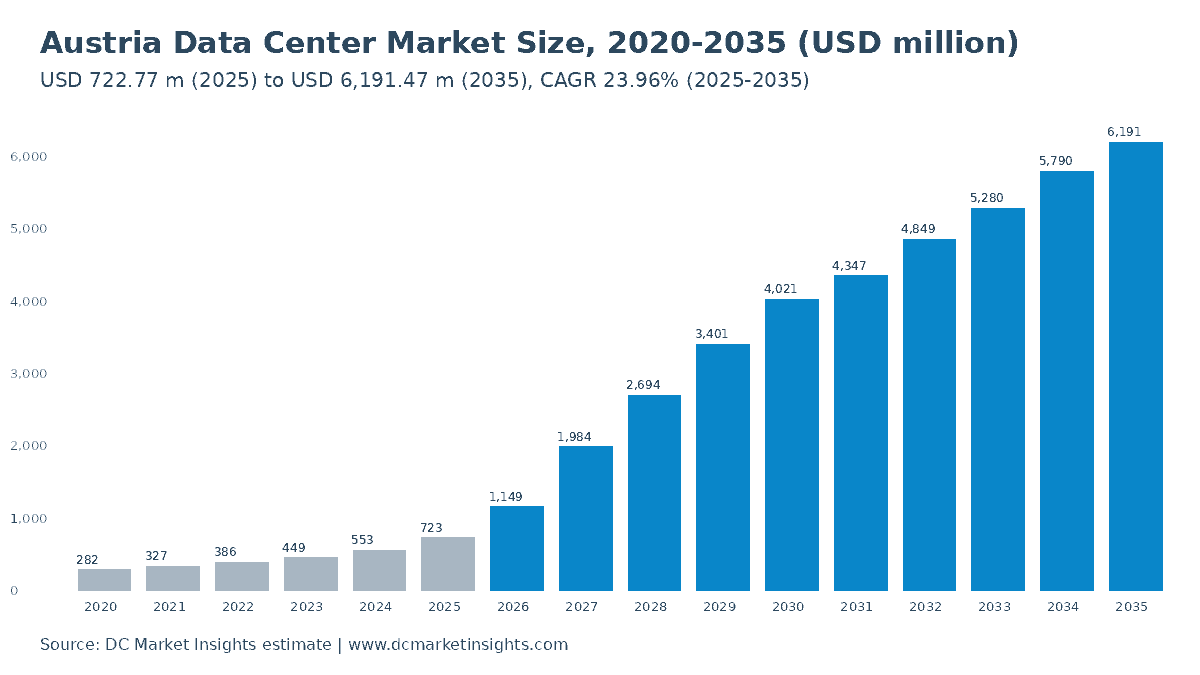
The Austria Data Center market was worth USD 722.8 million in 2025 and is forecast to reach USD 6,190.0 million by 2035, growing at a 23.96% CAGR.
 By Amit Jain, Senior Consultant, ICT & Emerging Technologies
 Reviewed by Deepti Agrawal
Last updated 18 Oct 2026
Base year 2025 PDF + Excel
What is inside the report
- 01Introduction
- 02Executive Summary
- 03Regulation
- 04Market Drivers
- 05Market Trends
- 06Market Challenges
- 07Market Opportunities
- 08Pricing
- 09Market Segmentation
- 10DC Exclusive: Austria Permit and Grid Timeline
- 17chapters
- 2020-2024Historical period
- 2026-2035Forecast period
- —Companies profiled
Segmentation
Full analysis
The Austria Data Center Market is valued at USD 1.15 billion in 2026 and is projected to reach USD 6.19 billion by 2035, up from USD 722.77 million in 2025, a CAGR of 23.96% from 2025 to 2035 (DC Market Insights estimate). Austria Data Center Market spend is set by grid access more than by demand: Austria’s roughly 50 data centers use just over 1.4 TWh of electricity a year, while about 1 GW of new connection requests sit in the queue, according to a 2026 study by the Austrian Datacenter Association (ADCA) with Digital Realty. Two 150 MW projects decide the next five years, Google’s campus at Kronstorf in Upper Austria (ground broken April 2026, commissioning planned for 2027) and CloudHQ’s campus at Leopoldsdorf in Lower Austria (presented October 2026), and they move the money away from Vienna’s colocation halls toward hyperscale sites with their own substations. The 2025 receipt is 166 MW of installed IT load: 15 MW of new halls at USD 10.50 million per MW of facility cost, plus AI fit-out at USD 35 million per AI MW, plus USD 2.50 million per installed MW a year of conventional IT refresh, which adds up to USD 722.77 million (USD 722.8 million rounded). AI workloads grow fastest at 40.34% a year because the share of new Austrian capacity built for graphics processing unit (GPU) clusters rises from 15% to 55%, and Upper Austria is the fastest region at 38.92% a year because Kronstorf alone adds 150 MW of peak demand.
Key Market Statistics: How Big Is the Austria Data Center Market in 2026?
DC Market Insights values the Austria Data Center Market at USD 1.15 billion in 2026, 58.93% above the USD 722.77 million of 2025, because Digital Realty’s VIE13 first stage and Google’s Kronstorf shell are both booked in 2026.
- Market size 2025: USD 722.77 million (DC Market Insights estimate).
- Market size 2026: USD 1.15 billion.
- Market size 2030: USD 4.02 billion.
- Market size 2035: USD 6.19 billion; CAGR 23.96% from 2025 to 2035 (low case USD 4.48 billion, high case USD 7.62 billion).
- Largest component: IT Infrastructure, USD 508.83 million in 2025 (70.4% of spend).
- Fastest segment: AI Workloads, 40.34% a year to 2035.
- Leading region: Vienna, 52.0% of 2025 spend (USD 375.84 million).
- Fastest region: Upper Austria, 38.92% a year, led by Kronstorf at 68.28% a year.
- Largest hub: Vienna Floridsdorf, USD 216.83 million in 2025.
- Market leader: Digital Realty (Interxion), the largest colocation operator, with an estimated 65% to 70% of 2026 facility spend shared with Microsoft and Google (DC Market Insights estimate).
How Fast Is Austrian Data Center Spending Growing After the Microsoft Cloud Region?
The Austria Data Center Market size was valued at USD 282.16 million in 2020, reached USD 722.77 million in 2025, and is anticipated to reach USD 6.19 billion by 2035, at a CAGR of 23.96% during the forecast period.
| Report attribute | Details |
|---|---|
| Historical period | 2020-2024 |
| Base year | 2025 |
| Forecast period | 2026-2035 |
| Market size 2025 | USD 722.77 million |
| Market size 2026 | USD 1.15 billion |
| CAGR 2025-2035 | 23.96% |
| Market size 2035 | USD 6.19 billion |
Spending grew 20.70% a year from 2020 to 2025, when Microsoft built the three data centers around Vienna that opened as its Austrian cloud region on 30 June 2025, with services from August 2025, according to Microsoft. The next leg is larger: DC Market Insights models 790 MW of IT completions from 2026 to 2035, against about 1 GW of requests in the grid queue, which lifts installed IT load from 166 MW in 2025 to 910 MW in 2035. AI fit-out and AI refresh together reach USD 3.47 billion in 2035, which is why the Austria Data Center Market grows faster than its facility layer.
What Does the Austria Data Center Market Include, and Where Is the Boundary?
The Austria Data Center Market covers capital spend inside Austrian data centers, USD 722.77 million in 2025, across four layers: IT infrastructure, power solutions, cooling systems and general construction.
Included
Servers, storage and network equipment installed in Austrian halls (USD 508.83 million in 2025), uninterruptible power supplies, switchgear and generators (USD 96.27 million), chillers, dry coolers and heat pumps (USD 42.79 million), and shell, fit-out and fire protection (USD 74.88 million). Colocation, cloud and hyperscale, and enterprise and government halls are all counted, from small edge rooms in Tyrol to the 150 MW campuses.
Excluded
Land, electricity bills, grid works by Austrian Power Grid (APG) and the distribution operators, colocation rent and cloud revenue are excluded, so the rent bands in the pricing section explain buyer costs but do not add to the market total. Waste-heat networks outside the fence, such as the Wien Energie pipes to Klinik Floridsdorf, are also outside the boundary.
How the Austrian layers fit together
The Austria Data Center Market is the Austrian cut of the global Data Center Market, built on the same unit values; the facility layer is analysed in depth in the Austria Data Center Infrastructure Market report, and the GPU-hall slice in the Austria AI Data Center Market report.
Why Do Austria Data Center Market Estimates Differ?
Estimates differ because DC Market Insights counts only capital spend inside the halls, USD 1.15 billion in 2026, while broader definitions add revenue streams that sit on top of that spend.
Wider estimates add colocation and cloud service revenue, managed services, telecom interconnection, electricity cost and land, and some count the whole value of enterprise IT that sits outside data centers. The earlier edition of this page used such a definition and showed USD 2.24 billion for 2025; the bottom-up 2025 value of USD 722.77 million follows from 166 MW of installed IT load, which matches the 1.4 TWh electricity use reported by the ADCA study at a power usage effectiveness (PUE) of about 1.45 and 65% utilisation. In-scope buyers include small and medium-sized enterprises (SMEs) that rent racks in Vienna, Linz or Graz, because their racks sit inside counted halls.
| Element | In scope | Why |
|---|---|---|
| IT, power, cooling, construction in Austrian halls | Yes, USD 722.77 million (2025) | Physical spend measured per MW |
| Colocation rent and cloud revenue | No | Revenue earned on the same assets |
| Electricity and grid connection works | No | Operating cost and utility capital |
| Land and off-site heat networks | No | Not data center equipment |
Which Austrian Rules Do Data Center Operators Have to Comply With in 2026?
Three rules shape Austria Data Center Market spend in 2026, starting with the 500 kW reporting threshold of the Federal Energy Efficiency Act (Energieeffizienzgesetz, EEffG).
EEffG reporting from 500 kW of IT load
Operators of data centers with at least 500 kW of IT power must report energy and water data every year by 15 May, starting in 2024, under the act published on 17 April 2024, according to the Austrian business service portal (USP). The Austrian data feeds the EU data center rating under Commission Delegated Regulation (EU) 2024/1364, which makes metering and PUE tracking a fixed line of about 1% of facility cost in new halls (DC Market Insights estimate).
NISG 2026 cybersecurity duties from 1 October 2026
The Network and Information Systems Security Act 2026 (NISG 2026), Federal Law Gazette I No. 94/2025, entered into force on 1 October 2026, according to the Austrian legal information system (RIS). Data center service providers fall under the NIS2 Directive, so access control, monitoring and incident reporting become audited costs for the 50 Austrian sites.
Environmental impact assessment for campus-scale projects
CloudHQ’s 150 MW Leopoldsdorf campus must pass an environmental impact assessment (Umweltverträglichkeitsprüfung, UVP), according to CloudHQ’s October 2026 presentation, which sets 2028 as the earliest realistic first-hall date in the DC Market Insights base case.
What Is Driving Data Center Investment in Austria?
Three Austria-specific drivers add USD 5.47 billion of annual spend between 2025 and 2035, led by hyperscale campuses that each need 150 MW of grid capacity.
Google Kronstorf: 150 MW in Upper Austria from 2027
Google broke ground on its first Austrian data center at Kronstorf on 23 April 2026, with a maximum power demand of 150 MW and commissioning planned for 2027, according to Google’s announcement. DC Market Insights books 60 MW of Austrian completions in 2027, up from 25 MW in 2026, and most of that step comes from Kronstorf. At USD 11.14 million per MW of facility cost in 2027, a 100 MW first phase alone carries more than USD 1.10 billion of shell, power and cooling spend, which is why Upper Austria’s share of the market rises from 8.0% in 2025 to 25.0% in 2035.
APG’s Wien Südost substation opens new Vienna capacity
Austrian Power Grid began building the Wien Südost substation in June 2026 with EUR 300 million, plus EUR 40 million from Wiener Netze, and named data centers as target customers, according to APG. APG plans about EUR 9 billion of grid investment to 2035, including EUR 680 million in 2026. The new substation is what lets Vienna keep 36.0% of 2035 spend, USD 2.23 billion, even as new campuses move outside the city.
Digital Realty VIE13: Austria’s largest single hall
Digital Realty’s VIE13 in Wien-Floridsdorf (18,050 m²) costs about EUR 250 million in its first stage and more than EUR 400 million at full build-out, and is due to go live at the end of 2026, according to Digital Realty during the Federal Chancellor’s site visit in June 2026. The first stage alone equals about USD 283 million, or 60% of the USD 469.38 million facility spend DC Market Insights books for 2026.
Which Trends Are Changing Austrian Data Center Design?
Heat reuse and sovereign AI computing are the two trends that change what Austrian operators buy, and together they shift about 68.2% of 2035 spend to AI-ready halls.
Hospital heating from data center waste heat in Floridsdorf
Since autumn 2023, waste heat from Digital Realty’s Vienna campus has heated Klinik Floridsdorf through three Wien Energie heat pumps with 3 MW of heating output, covering 50% to 70% of the hospital’s heat demand and saving up to 4,000 t of carbon dioxide a year, according to the City of Vienna. DC Market Insights expects new Vienna halls to carry heat-recovery coils and heat-pump connections worth about 3% of cooling spend, part of the USD 272.13 million cooling line in 2035.
AI:AT, the Austrian AI factory, creates local GPU demand
The AI:AT AI Factory Austria runs from 1 July 2025 to 30 June 2028 with a total cost of EUR 30.0 million, half of it from the European Union, coordinated by Advanced Computing Austria (ACA) in Vienna, according to the EU’s CORDIS database. It gives Austrian start-ups and industry a first GPU pool, and the commercial follow-on is what lifts the AI share of new Austrian capacity from 15% in 2025 to 50% in 2030.
What Holds Back Austrian Data Center Projects?
A 1 GW grid queue and a renewable share that fell to 78% in 2025 are the two constraints that cap the Austria Data Center Market base case at 790 MW of completions to 2035.
A 1 GW connection queue for about 166 MW of installed IT load
The ADCA study reported a queue of about 1 GW of connection requests in January 2026, six times the installed IT load DC Market Insights estimates for 2025. Only projects with confirmed substation slots, such as those on the Wien Südost node, reach construction, so DC Market Insights caps completions at 95 MW a year after 2033.
Renewable supply fell from 94% to 78% of consumption
Renewables covered 78% of Austrian electricity consumption in 2025, down from a record 94% in 2024, according to E-Control data published in September 2026. Operators that sell 100% renewable power, as Microsoft does with VERBUND hydropower for its Austrian region, must contract more power purchase agreements (PPAs), which raises the risk premium on new campuses and is reflected in the low case of USD 4.48 billion for 2035.
Where Are the Investment Openings in the Austria Data Center Market?
The two largest openings are mega data center campus sites in Lower Austria and AI refresh in existing halls, which DC Market Insights sizes at USD 1.49 billion and USD 1.90 billion of the 2035 market respectively.
Lower Austria campuses beside Vienna
Lower Austria reaches USD 1.49 billion by 2035, growing 27.58% a year, because mega data center sites such as Leopoldsdorf combine land with 150 MW connections that Vienna cannot offer. The province has published its own data center strategy paper, and CloudHQ has offered a EUR 9 million infrastructure contribution to its host municipality, which shows how Lower Austrian sites compete for campus projects.
GPU refresh cycles in existing Austrian halls
Installed AI capacity in Austria rises from 6.7 MW in 2025 to 366.4 MW in 2035 in the DC Market Insights model, and replacing one fifth of that GPU base every year accounts for USD 1.90 billion of 2035 spend, a larger slice than new AI fit-out of USD 1.57 billion in the same year. Integrators that hold service contracts on Vienna AI halls capture this recurring spend.
How Much Does a Data Center Cost per MW in Austria, and What Do Buyers Pay per kW?
A new Austrian data center costs about USD 10.50 million per MW of IT load in 2025 before IT equipment, rising to USD 14.11 million by 2035 at 3% a year (DC Market Insights estimate).
| Unit value (USD million) | 2020 | 2025 | 2030 | 2035 |
|---|---|---|---|---|
| Facility cost per MW of IT load | 9.06 | 10.50 | 12.17 | 14.11 |
| AI IT fit-out per AI MW | 35.00 | 35.00 | 32.50 | 30.00 |
| Conventional IT per installed MW a year | 1.65 | 2.50 | 2.50 | 2.50 |
The public anchor is VIE13: EUR 250 million for the first stage of an 18,050 m² building. For buyers who search for 2026 Austrian pricing bands, DC Market Insights estimates wholesale rent of EUR 120 to EUR 180 per kW a month for conventional racks used by industrial companies, media and visual effects (VFX) render farms and banks, and EUR 200 to EUR 350 per kW a month for liquid-cooled AI and high-performance computing (HPC) space used by AI startups, tech companies and industrial HPC teams. Small edge rooms that serve tourism regions in Tyrol and Salzburg price at the top of the conventional band because their fixed costs spread over fewer kW. At EUR 150 per kW a month, a hall costing USD 10.50 million per MW pays back its facility cost in about 5.2 years, which explains why operators keep building despite the grid queue. These rents are outside the market total, which counts capital spend only.
Which Segment of the Austria Data Center Market Makes the Most Money?
Information technology (IT) infrastructure makes the most money in the Austria Data Center Market, USD 508.83 million or 70.4% of 2025 spend, and AI Workloads grow fastest at 40.34% a year.
By component
| Component | 2025 (USD million) | Share 2025 | 2035 (USD million) | CAGR 2025-2035 |
|---|---|---|---|---|
| IT Infrastructure | 508.83 | 70.4% | 4,830.81 | 25.24% |
| Power Solutions | 96.27 | 13.3% | 612.30 | 20.32% |
| General Construction | 74.88 | 10.4% | 476.23 | 20.32% |
| Cooling Systems | 42.79 | 5.9% | 272.13 | 20.32% |
By workload
AI Workloads reach USD 4.22 billion by 2035, growing 40.34% a year, because each AI MW carries USD 35 million of GPU servers and networking against USD 2.50 million a year for a conventional MW.
| Workload | 2025 (USD million) | Share 2025 | 2035 (USD million) | CAGR 2025-2035 |
|---|---|---|---|---|
| Conventional Workloads | 580.41 | 80.3% | 1,971.93 | 13.01% |
| AI Workloads | 142.36 | 19.7% | 4,219.54 | 40.34% |
By data center type
Colocation leads with 52.0% of 2025 spend, but Cloud and Hyperscale grows fastest at 30.55% a year as Google and CloudHQ campuses come online.
| Data center type | 2025 (USD million) | Share 2025 | 2035 (USD million) | CAGR 2025-2035 |
|---|---|---|---|---|
| Colocation | 375.84 | 52.0% | 2,352.76 | 20.13% |
| Cloud and Hyperscale | 202.38 | 28.0% | 2,909.99 | 30.55% |
| Enterprise and Government | 144.55 | 20.0% | 928.72 | 20.44% |
By end user
IT and Telecom buyers hold 34.0% of 2025 spend, and Manufacturing and Energy grows 25.27% a year as Upper Austrian and Styrian industry moves simulation and quality-inspection AI into local halls.
| End user | 2025 (USD million) | Share 2025 | 2035 (USD million) | CAGR 2025-2035 |
|---|---|---|---|---|
| IT and Telecom | 245.74 | 34.0% | 2,476.59 | 25.99% |
| BFSI (banking, financial services and insurance) | 144.55 | 20.0% | 990.64 | 21.22% |
| Manufacturing and Energy | 130.10 | 18.0% | 1,238.29 | 25.27% |
| Government and Public Sector | 115.64 | 16.0% | 804.89 | 21.41% |
| Media Tourism and Other | 86.74 | 12.0% | 681.06 | 22.88% |
DC Exclusive: The Austria Permit and Grid Timeline, 10 Milestones to 2027
DC Market Insights built the Austria Permit and Grid Timeline from 10 inputs, and the modelled estimate shows that milestones between June 2026 and 2027 carry about 300 MW of announced capacity, the base for the USD 1.98 billion of spend estimated for 2027.
| Date | Milestone | Size | Effect on spend (DC Market Insights estimate) |
|---|---|---|---|
| Autumn 2023 | Floridsdorf hospital heat reuse starts | 3 MW heat | Heat recovery becomes a design default in Vienna |
| 17 Apr 2024 | EEffG amendment published | 500 kW threshold | Metering and reporting in every new hall |
| 30 Jun 2025 | Microsoft Austrian cloud region opens | 3 data centers | Lifted 2025 spend to USD 722.77 million |
| 1 Jul 2025 | AI:AT AI factory starts | EUR 30.0 million | First Austrian GPU demand pool |
| Jan 2026 | ADCA study counts the grid queue | About 1 GW | Ceiling for 2026-2035 completions |
| 23 Apr 2026 | Google breaks ground at Kronstorf | 150 MW peak | Main driver of 60 MW completions in 2027 |
| Jun 2026 | APG starts Wien Südost substation | EUR 340 million | Keeps Vienna at 36.0% of 2035 spend |
| 1 Oct 2026 | NISG 2026 in force | About 50 sites | Security and reporting become audited costs |
| Oct 2026 | CloudHQ presents Leopoldsdorf, UVP needed | 150 MW | First halls from 2028 in the base case |
| End 2026 | Digital Realty VIE13 first stage live | EUR 250 million | About 60% of 2026 facility spend |
Read together, the timeline shows that permits and substations, not tenant demand, set the order in which Austrian capacity arrives: every milestone after April 2026 is a grid or permit event.
Which Austrian Region Leads Data Center Spending, and Which Grows Fastest?
Vienna leads with USD 375.84 million or 52.0% of 2025 spend, and Upper Austria grows fastest at 38.92% a year because of Google’s 150 MW Kronstorf campus.
| Region | 2025 (USD million) | Share 2025 | 2035 (USD million) | CAGR 2025-2035 |
|---|---|---|---|---|
| Vienna | 375.84 | 52.0% | 2,228.93 | 19.48% |
| Lower Austria | 130.10 | 18.0% | 1,485.95 | 27.58% |
| West Austria | 86.73 | 12.0% | 495.32 | 19.03% |
| Styria and Carinthia | 72.28 | 10.0% | 433.40 | 19.62% |
| Upper Austria | 57.82 | 8.0% | 1,547.87 | 38.92% |
Vienna
Vienna holds Digital Realty’s campus, the three Microsoft data centers around the city and most carrier hotels, and its spend reaches USD 2.23 billion by 2035 once the Wien Südost substation adds capacity. The ADCA study places 46% of Austrian data centers in Vienna and its surroundings.
Lower Austria
Lower Austria grows 27.58% a year, the second-fastest rate, as Leopoldsdorf and sites south of Vienna take campuses that need more land than the city has.
Upper Austria
Upper Austria, the fastest-growing region at 38.92% a year, rises from 8.0% to 25.0% of national spend because Kronstorf adds 150 MW of peak demand near the Enns river, and Linz adds industrial computing demand.
Styria and Carinthia
Styria and Carinthia grow 19.62% a year, led by Graz enterprise and university demand, and reach USD 433.40 million by 2035.
West Austria
West Austria (Salzburg, Tyrol and Vorarlberg) grows 19.03% a year; its edge rooms serve tourism, banking and cross-border manufacturing near Germany and Switzerland.
Within Europe, Austria’s 2035 spend of USD 6.19 billion compares with USD 43.57 billion for the Germany Data Center Market, so Austria stays a secondary hub that grows faster from a smaller base.
Which Austrian Cities and Hubs Attract the Most Data Center Spend?
Vienna Floridsdorf leads with USD 216.83 million of 2025 spend, and Kronstorf is the fastest large hub at 68.28% a year from a USD 5.78 million base.
| Rank | Hub | Region | 2025 (USD million) | 2035 (USD million) | CAGR |
|---|---|---|---|---|---|
| 1 | Vienna Floridsdorf | Vienna | 216.83 | 1,362.12 | 20.17% |
| 2 | Other Vienna districts | Vienna | 159.01 | 866.81 | 18.48% |
| 3 | Lower Austria south of Vienna | Lower Austria | 79.50 | 742.98 | 25.04% |
| 4 | Graz | Styria and Carinthia | 50.59 | 309.57 | 19.86% |
| 5 | Linz | Upper Austria | 43.37 | 371.49 | 23.96% |
| 6 | Salzburg | West Austria | 36.14 | 198.13 | 18.55% |
| 7 | Innsbruck | West Austria | 28.91 | 173.36 | 19.62% |
| 8 | St. Polten | Lower Austria | 21.68 | 154.79 | 21.72% |
| 9 | Klagenfurt | Styria and Carinthia | 21.68 | 123.83 | 19.04% |
| 10 | Vorarlberg (Dornbirn) | West Austria | 21.68 | 123.83 | 19.04% |
| 11 | Leopoldsdorf | Lower Austria | 10.84 | 495.32 | 46.55% |
| 12 | Kronstorf | Upper Austria | 5.78 | 1,052.55 | 68.28% |
By 2035 Kronstorf becomes the second-largest hub with USD 1.05 billion of spend, behind only Vienna Floridsdorf.
How Could the Austria Data Center Market Change by 2035?
The 2035 Austria Data Center Market ranges from USD 4.48 billion to USD 7.62 billion around the base case of USD 6.19 billion, depending on how much of the 1 GW grid queue is built.
| Scenario | Assumption | 2035 (USD million) |
|---|---|---|
| Low | Completions 30% below base from 2027 (UVP delays, slower substations) | 4,475.69 |
| Base | 790 MW completed 2026-2035 | 6,191.47 |
| High | Completions 25% above base from 2027 (second Kronstorf phase) | 7,621.29 |
Who Are the Leading Data Center Companies in Austria?
Digital Realty leads the Austria Data Center Market as the largest colocation operator, and with Microsoft and Google it accounts for an estimated 65% to 70% of 2026 facility spend, based on the EUR 250 million VIE13 first stage and the 150 MW Kronstorf build (DC Market Insights estimate).
- Digital Realty (Interxion): Vienna campus and VIE13 in Floridsdorf, more than EUR 400 million at full build-out.
- Microsoft: Austrian cloud region with three data centers around Vienna since June 2025, powered by VERBUND hydropower.
- Google: Kronstorf campus, 150 MW peak demand, commissioning planned for 2027.
- CloudHQ: 150 MW Leopoldsdorf campus with three buildings.
- Amazon Web Services (AWS): edge and network presence serving Austrian customers.
- A1 Telekom Austria: telecom data centers and A1 Digital cloud.
- Magenta Telekom: carrier data centers.
- NTT DATA: Vienna colocation.
- Anexia: Klagenfurt-based cloud and colocation provider.
- Advanced Computing Austria (ACA): AI:AT AI factory coordinator.
- Wien Energie: heat-recovery partner in Floridsdorf.
- Austrian Power Grid (APG): transmission operator building Wien Südost.
- VERBUND: hydropower supplier to data centers.
- Schneider Electric: power and cooling equipment supplier.
- Vertiv: power and thermal equipment supplier.
Competition among builders is concentrated, but the IT layer is open: USD 508.83 million of 2025 IT spend is shared by server, storage and network vendors that sell into every hall.
What Happened in Austrian Data Centers in 2025 and 2026?
Six dated events since June 2025 added about 300 MW of announced Austrian capacity and two new compliance duties.
- In June 2025, Microsoft opened its Austrian cloud region with three data centers around Vienna, with services from August 2025 (Source: Microsoft).
- In July 2025, the AI:AT AI Factory Austria started with a EUR 30.0 million budget (Source: CORDIS, European Commission).
- In January 2026, an ADCA and Digital Realty study counted about 50 data centers, 1.4 TWh of use and a 1 GW grid queue (Source: Austrian Datacenter Association).
- In April 2026, Google broke ground at Kronstorf for a 150 MW campus (Source: Google).
- In June 2026, APG started the EUR 300 million Wien Südost substation for data center customers (Source: APG).
- In October 2026, NISG 2026 entered into force and CloudHQ presented its 150 MW Leopoldsdorf campus (Source: RIS; CloudHQ).
Key Takeaways: What Should Investors Know About the Austria Data Center Market?
Four takeaways follow from the DC Market Insights model of USD 6.19 billion by 2035.
- Spend rises from USD 722.77 million in 2025 to USD 6.19 billion in 2035 because about 1 GW of queued grid requests turns into 790 MW of completions.
- AI Workloads grow 40.34% a year because AI halls carry USD 35 million of IT per MW.
- Upper Austria grows 38.92% a year because Google’s 150 MW Kronstorf campus opens in 2027.
- Grid slots decide timing because APG’s EUR 300 million Wien Südost substation gates new Vienna capacity.
Methodology: How Was the Austria Data Center Market Model Built?
DC Market Insights built the model bottom-up from 166 MW of installed IT load in 2025 and 14 numbered inputs, rather than from survey revenue.
Installed load is calibrated to the 1.4 TWh of data center electricity use (166 MW × 65% utilisation × PUE 1.45 × 8,760 hours ≈ 1.37 TWh). Yearly completions (15 MW in 2025, 25 MW in 2026, 90 MW in 2030, 95 MW in 2035) are multiplied by facility cost of USD 10.50 million per MW (2025, +3% a year), booked half in the completion year and half in the year before; new AI MW carry USD 35 million of IT (USD 30 million by 2035), installed AI MW are refreshed at 20% a year, and conventional IT is refreshed at USD 2.50 million per installed MW a year; 1% of capacity retires each year. Facility spend is split 45% power, 20% cooling and 35% construction.
Three bound checks hold. Ceiling 1: 790 MW of completions from 2026 to 2035 stays below the 1 GW grid queue. Ceiling 2: 910 MW of installed IT load in 2035 would use about 6.7 TWh, under 10% of Austrian electricity demand. Floor: the VIE13 first stage of EUR 250 million (about USD 283 million) sits below the USD 469.38 million of facility spend modelled for 2026. Full method notes are on the research methodology page.
Table of contents
- 01Introduction
- 1.1Market Definition and Boundary
- 1.2Included and Excluded Spend
- 1.3Why Estimates Differ
- 02Executive Summary
- 2.1Market Snapshot, 2025, 2026 and 2035
- 2.2Key Market Statistics
- 2.3Growth Since the Microsoft Cloud Region
- 03Regulation
- 3.1EEffG Reporting from 500 kW
- 3.2NISG 2026 Cybersecurity Duties
- 3.3Environmental Impact Assessment for Campuses
- 04Market Drivers
- 4.1Google Kronstorf 150 MW
- 4.2APG Wien Südost Substation
- 4.3Digital Realty VIE13
- 05Market Trends
- 5.1Hospital Heating from Waste Heat in Floridsdorf
- 5.2AI:AT Austrian AI Factory
- 06Market Challenges
- 6.11 GW Grid Connection Queue
- 6.2Renewable Share Down to 78%
- 07Market Opportunities
- 7.1Lower Austria Campuses
- 7.2GPU Refresh in Existing Halls
- 08Pricing
- 8.1Cost per MW, 2020-2035
- 8.2Colocation Rent Bands per kW, 2026
- 09Market Segmentation
- 9.1IT Infrastructure
- 9.2Power Solutions
- 9.3General Construction
- 9.4Cooling Systems
- 9.5AI Workloads
- 9.6Conventional Workloads
- 9.7Colocation
- 9.8Cloud and Hyperscale
- 9.9Enterprise and Government
- 9.10IT and Telecom
- 9.11BFSI
- 9.12Manufacturing and Energy
- 9.13Government and Public Sector
- 9.14Media Tourism and Other
- 10DC Exclusive: Austria Permit and Grid Timeline
- 10.110 Milestones to 2027
- 11Regional Insights
- 11.1Vienna
- 11.2Lower Austria
- 11.3Upper Austria
- 11.4Styria and Carinthia
- 11.5West Austria
- 12Hub Analysis
- 12.1Vienna Floridsdorf
- 12.2Other Vienna districts
- 12.3Lower Austria south of Vienna
- 12.4Graz
- 12.5Linz
- 12.6Salzburg
- 12.7Innsbruck
- 12.8St. Polten
- 12.9Klagenfurt
- 12.10Vorarlberg (Dornbirn)
- 12.11Leopoldsdorf
- 12.12Kronstorf
- 13Forecast Scenarios
- 13.1Low Case
- 13.2Base Case
- 13.3High Case
- 14Competitive Insights
- 14.1Digital Realty (Interxion)
- 14.2Microsoft
- 14.3Google
- 14.4CloudHQ
- 14.5Amazon Web Services (AWS)
- 14.6A1 Telekom Austria
- 14.7Magenta Telekom
- 14.8NTT DATA
- 14.9Anexia
- 14.10Advanced Computing Austria (ACA)
- 14.11Wien Energie
- 14.12Austrian Power Grid (APG)
- 14.13VERBUND
- 14.14Schneider Electric
- 14.15Vertiv
- 15Recent Developments
- 15.1Dated Events, June 2025 to October 2026
- 16Key Takeaways
- 16.1Four Points for Investors
- 17Methodology
- 17.1Model Inputs and Receipt
- 17.2Bound Checks
- Fig. 1Austria Data Center Market Size, 2020-2035
- Table 1Report Attributes
- Table 2Scope Comparison
- Table 3Unit Values per MW, 2020-2035
- Table 4Market by Component
- Table 5Market by Workload
- Table 6Market by Data Center Type
- Table 7Market by End User
- Table 8Austria Permit and Grid Timeline
- Table 9Market by Region
- Table 10Top 12 Hubs
- Table 11Forecast Scenarios, 2035
About this report
Written by Amit Jain and reviewed by Deepti Agrawal, Senior Editor, Research. Figures are built top-down and bottom-up and reconciled before publication, with 2025 as the base year.
Read our methodologyHow we built this
- Historical period2020-2024
- Base year2025
- Forecast period2026-2035
- Sizing approachTop-down + bottom-up
Need more than the report?
Advisory on this market
Due diligence, site selection and market entry work, by the analysts who wrote this report.
See consulting servicesFrequently asked questions
USD 1.15 billion in 2026, up 58.93% from USD 722.77 million in 2025, according to DC Market Insights estimates. The market is projected to reach USD 6.19 billion by 2035, a CAGR of 23.96% from 2025.
23.96% a year from 2025 to 2035, after 20.70% a year from 2020 to 2025. About 1 GW of grid requests turns into 790 MW of completions, led by Google’s 150 MW Kronstorf campus and Digital Realty’s VIE13 in Vienna.
USD 722.77 million of 2025 capital spend inside Austrian data centers: IT infrastructure, power solutions, cooling systems and general construction. Land, electricity, grid works, colocation rent and cloud revenue are excluded.
AI Workloads, at 40.34% a year to USD 4.22 billion by 2035, because each AI MW carries USD 35 million of IT and the AI share of new capacity rises from 15% to 55%. IT Infrastructure is the largest component at 70.4% of 2025 spend.
Upper Austria, at 38.92% a year, rising from 8.0% to 25.0% of national spend by 2035 because Google’s Kronstorf campus adds 150 MW of peak demand. Vienna leads with 52.0% of 2025 spend.
About USD 10.50 million per MW of IT load in 2025 before IT equipment, rising 3% a year to USD 14.11 million by 2035 (DC Market Insights estimate). AI halls add about USD 35 million of IT per MW.
EUR 120 to EUR 180 per kW a month for conventional racks used by industry, media and VFX render farms, and EUR 200 to EUR 350 for liquid-cooled AI and HPC space used by start-ups and industrial HPC teams (DC Market Insights estimate). Tourism-region edge rooms price at the top of the conventional band.
About 50, using just over 1.4 TWh of electricity a year, according to a 2026 Austrian Datacenter Association study; 46% sit in Vienna and its surroundings. DC Market Insights estimates 166 MW of installed IT load in 2025.
Digital Realty (Interxion), Microsoft and Google together account for an estimated 65% to 70% of 2026 facility spend (DC Market Insights estimate). CloudHQ, A1 Telekom Austria, Magenta Telekom, NTT DATA and Anexia also operate or build Austrian data centers.
USD 1.15 billion in 2026 is DC Market Insights’ figure for capital spend inside Austrian halls only. Estimates that add colocation and cloud revenue, managed services, electricity or land are larger; the earlier edition of this page showed USD 2.24 billion for 2025 on such a basis.
Get this report
How do I get the full report?
Request a quote; we reply by email within one business day.
How and when will I receive the report?
By email, within 24–48 business hours of payment.
How can I pay?
Once you accept the quote, we email you a secure payment link.
Can I see a sample first?
Yes. Request a free sample and we will email it to you.
Can the report be tailored to my needs?
Yes. We can add countries, segments or data cuts. Talk to an analyst about the scope you need.
Can I get an invoice or pay against a purchase order?
Write to sales@dcmarketinsights.com and our team will help.