
Germany Data Center Market Size, Share & Forecast to 2035
Market at a glance
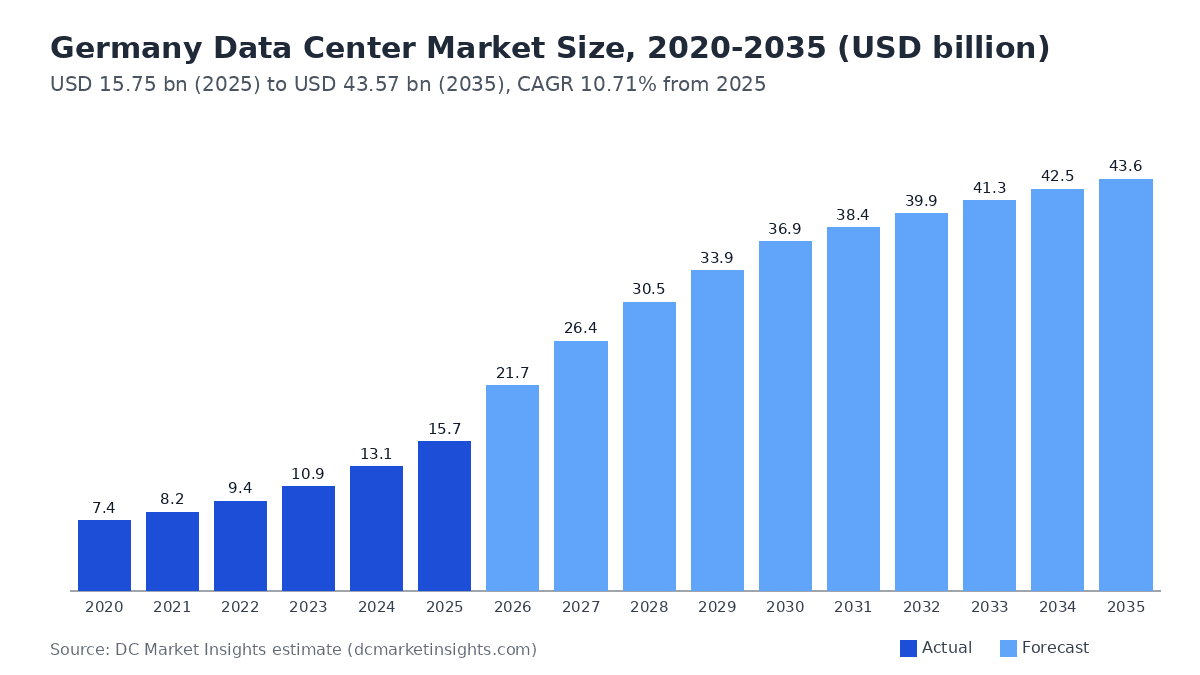
The Germany Data Center market was worth USD 15.75 billion in 2025 and is forecast to reach USD 43.57 billion by 2035, growing at a 10.71% CAGR.
 By Amit Jain, Senior Consultant, ICT & Emerging Technologies
 Reviewed by Deepti Agrawal
Last updated 18 Oct 2026
Base year 2025 PDF + Excel
What is inside the report
- 01Introduction
- 02Key Market Statistics
- 03Executive Summary
- 04Market Scope
- 05Market Drivers
- 06Market Trends
- 07Market Challenges
- 08Market Opportunities
- 09Pricing
- 10Standards and Regulation
- 22chapters
- 2020-2024Historical period
- 2026-2035Forecast period
- —Companies profiled
Segmentation
Full analysis
The Germany Data Center Market is valued at USD 21.68 billion in 2026 and is projected to reach USD 43.57 billion by 2035, up from USD 15.75 billion in 2025, a CAGR of 10.71% from 2025 to 2035 (DC Market Insights estimate). The money in Germany is moved by one physical number: IT connected load, which reached 2,980 megawatts (MW) in 2025, up 9% in a year, with roughly 530 MW of it serving artificial intelligence (AI) (Source: Bitkom, November 2025). The federal government’s National Data Center Strategy of 18 March 2026 wants that load at least doubled by 2030, yet grid connections in Frankfurt, which holds more than 1,100 MW, are the binding limit, so every MW that does get energised carries a high price tag. DC Market Insights builds the market as 290 MW of IT load under construction in 2025 (the average of 250 MW completed in 2025 and 330 MW in 2026) × USD 12.0 million per MW of facility cost, plus about 100 MW of new AI halls × USD 35 million of AI IT per MW, plus refresh and conventional IT on the installed 2,980 MW, which gives USD 15.75 billion of 2025 spend. The Germany Data Center Market covers capital spend on IT infrastructure, power, cooling and construction inside German data centers; AI workloads grow fastest at 14.95% a year and Berlin-Brandenburg is the fastest region at 15.30% because it still has grid and land that the Rhine-Main area lacks.
Key Market Statistics: What Is the Germany Data Center Market Worth in 2026?
DC Market Insights values the Germany Data Center Market at USD 21.68 billion in 2026, 37.7% above the USD 15.75 billion of 2025, because the first large AI halls of the strategy period are fitted out this year.
- Market size 2025: USD 15.75 billion (DC Market Insights estimate)
- Market size 2026: USD 21.68 billion
- Market size 2030: USD 36.92 billion
- Market size 2035: USD 43.57 billion
- CAGR 2025-2035: 10.71% (low case USD 34.85 billion, high case USD 50.97 billion in 2035)
- Largest component: IT Infrastructure, USD 12.27 billion or 77.9% of 2025 spend
- Fastest segment: AI Workloads, 14.95% a year to USD 33.41 billion by 2035
- Leading region: Hesse (Rhine-Main), USD 5.98 billion or 38.0% of 2025 spend
- Fastest region: Berlin-Brandenburg, 15.30% a year
- Largest hub: Frankfurt am Main, USD 3.94 billion in 2025
- Market leaders by capacity: NTT DATA, Equinix and Digital Realty in colocation; Amazon Web Services (AWS), Microsoft and Google in self-build cloud
How Large Is the Germany Data Center Market and How Fast Is It Growing?
The Germany Data Center Market size was valued at USD 7.36 billion in 2020, reached USD 15.75 billion in 2025, and is anticipated to reach USD 43.57 billion by 2035, at a CAGR of 10.71% during the forecast period.
| Attribute | Detail |
|---|---|
| Historical period | 2020-2024 |
| Base year | 2025 |
| Forecast period | 2026-2035 |
| Market size 2025 | USD 15.75 billion |
| Market size 2026 | USD 21.68 billion |
| CAGR 2025-2035 | 10.71% |
| Market size 2035 | USD 43.57 billion |
| Unit | USD million, nominal |
Spend grew 16.41% a year from 2020 to 2025 as connected load rose from about 2,010 MW to 2,980 MW, and it slows to 10.71% a year after 2025 because the 2026-2030 AI wave of about 1,580 MW is followed by a flatter 400-450 MW a year build-out in the 2030s. DC Market Insights estimates that AI halls carry 52.7% of spend in 2025 and 76.7% by 2035.
What Does the Germany Data Center Market Include?
The Germany Data Center Market covers USD 15.75 billion of 2025 capital spend on four layers inside German data centers: IT infrastructure (servers, storage, network), power (switchgear, uninterruptible power supply (UPS), generators), cooling and general construction.
Included
- IT hardware installed in German colocation, cloud, enterprise and government data centers, including AI accelerator servers
- Facility build cost per MW of new IT load: electrical, mechanical and shell works
- Refresh of AI hardware on the installed AI base (20% a year) and conventional IT spend on the installed conventional base
Excluded
- Land, grid reinforcement paid by network operators, electricity bills and power plants
- Colocation rent and cloud service revenue (they are the return on this spend, not extra spend)
- Carrier interconnect services and dark fibre between sites; optical transport and switching hardware for data center interconnect inside the halls is counted in IT Infrastructure (about 6% of it, DC Market Insights estimate)
- Edge micro sites under 100 kilowatts, which sit in the Germany Edge Data Center Market report
How the segments fit together
Every dimension sums to the same total: components (USD 12.27 billion IT plus USD 3.48 billion facility layers), workloads, data center types and end users each add up to USD 15.75 billion in 2025. The facility layer alone is analysed in the Germany Data Center Infrastructure Market report.
Why Do Germany Data Center Market Estimates Differ So Much?
Estimates for Germany range widely because some count colocation and cloud revenue while DC Market Insights counts only capital spend, which is USD 21.68 billion in 2026.
Broader definitions add colocation rent, managed services, network carriage and the electricity bill (21.3 terawatt-hours (TWh) in 2025 according to Bitkom), and some add data center construction land and grid upgrades. Each of these is a real flow of money, but adding them to hardware and build spend counts the same megawatt twice. Narrower definitions count only the facility shell or only colocation, which gives figures below USD 5 billion. Buyer groups in scope include hyperscale cloud operators, colocation providers, banks, carmakers and other manufacturers, public bodies including government defense and civil agencies, energy utilities, and small and medium-sized enterprises (SMEs) that run on-premises server rooms above 100 kilowatts.
| Element | In DC Market Insights scope | Why |
|---|---|---|
| IT hardware in data centers | Yes, USD 12.27 billion (2025) | Largest capital line |
| Power, cooling and construction | Yes, USD 3.48 billion (2025) | Built per MW of new load |
| Colocation rent and cloud revenue | No | Return on the spend |
| Electricity bill (21.3 TWh) | No | Operating cost |
| Land and grid reinforcement | No | Paid outside the facility |
What Is Driving Data Center Investment in Germany?
Three forces specific to the Germany Data Center Market add about USD 21.17 billion of annual spend between 2025 and 2030: a national capacity target, a wave of named hyperscale budgets and a sovereign AI cloud for industry.
National Data Center Strategy: 2,980 MW to at Least 5,960 MW by 2030
The federal cabinet adopted the National Data Center Strategy on 18 March 2026, stating: “Wir wollen die Rechenzentrumskapazitäten in Deutschland bis 2030 mindestens verdoppeln” (Source: Federal Ministry for Digital Transformation and Government Modernisation (BMDS), Nationale Rechenzentrumsstrategie). The same document targets at least a fourfold rise in AI connected load against 2025. DC Market Insights does not assume the target is met: the base case reaches 4,817 MW in 2030, which still means 2,020 MW of new IT load in five years, eight times the 250 MW added in 2025.
Hyperscale Budgets: EUR 8.8 Billion from AWS and EUR 5.5 Billion from Google
Amazon Web Services announced in June 2024 a further EUR 8.8 billion for its Frankfurt cloud region through 2026 (Source: AWS), and Google reported in November 2025 a EUR 5.5 billion plan for 2026-2029 covering a new site in Dietzenbach and expansion in Hanau, Munich, Frankfurt and Berlin (Source: Google). Microsoft committed EUR 3.2 billion in February 2024 for AI and cloud infrastructure, including new capacity in the Rhenish mining area of North Rhine-Westphalia (Source: Microsoft). At a conversion of USD 1.13 per euro, these three budgets alone equal about USD 19.78 billion, or 1.26 years of the 2025 market.
Industrial AI Cloud in Munich: Up to 10,000 Blackwell GPUs
Deutsche Telekom and NVIDIA Corporation (NVIDIA) set up an Industrial AI Cloud in Munich with up to 10,000 NVIDIA Blackwell graphics processing units (GPUs) in a partnership valued at over EUR 1 billion, with access from early 2026 (Source: Deutsche Telekom). A cluster of that size draws roughly 15-20 MW of IT load, so one project equals 6-8% of Germany’s 2025 new-build volume, and it is the template for the AI share of new load rising from 40% in 2025 to 85% in 2030 in the DC Market Insights model.
Which Trends Are Changing German Data Center Builds?
German data center builds are moving away from Frankfurt city plots toward large campuses at grid nodes, and from air-cooled racks to liquid-cooled AI halls; both raise cost per MW from USD 8.6 million in 2020 to USD 12.0 million in 2025.
Campuses Move to Former Lignite and Rail Sites
Microsoft’s North Rhine-Westphalia plan centres on the Rhenish mining area around Bergheim and Elsdorf, and operators in Brandenburg use former logistics land at Wustermark and Ludwigsfelde; DC Market Insights models these two areas growing at 23.57% and 21.81% a year, against 7.72% for Frankfurt am Main.
AI Halls Change the Cost Mix
An AI hall in the model carries USD 35 million of IT per MW against about USD 2.5 million a year of conventional IT spend per installed MW, so AI workloads rise from USD 8.30 billion in 2025 to USD 33.41 billion by 2035, while cooling grows from 20% to 24% of facility spend as direct liquid cooling spreads.
What Holds Back Data Center Growth in Germany?
Grid access and energy law are the two brakes on the Germany Data Center Market; together they explain why the DC Market Insights base case reaches 4,817 MW in 2030, 1,143 MW short of the 5,960 MW strategy goal.
Grid Connection Queues
By the third quarter of 2025 the four transmission system operators held 717 connection requests for about 270 gigawatts (GW), of which 545 requests and 211 GW were battery storage, according to the operators’ figures cited in the national debate; since 1 April 2026 transmission connections are allocated by project maturity rather than date. Most data centers connect at distribution level, for example to Mainova’s network in Frankfurt, where the new rules do not yet apply, so a Frankfurt project can wait several years for a connection.
Barriers to Entry and Supply Chain Risks
A new operator needs about USD 2.35 billion for a 50 MW AI campus in 2025 (50 MW × USD 12.0 million of facility plus 50 MW × USD 35 million of AI IT, DC Market Insights estimate), plus a grid connection that incumbents already hold; long lead times for power transformers, switchgear and accelerator servers are the main supply chain risks, and they push buyers toward framework contracts and put monitoring management software (data center infrastructure management) into every new hall.
Energy Efficiency Act Duties
Section 11 of the Energy Efficiency Act (Energieeffizienzgesetz, EnEfG) requires data centers opening from 1 July 2026 to reach a power usage effectiveness (PUE) of 1.2 or better and to reuse at least 10% of their heat, rising to 20% for sites opening from 2028 (Source: EnEfG § 11). DC Market Insights estimates that heat-reuse interfaces and higher-efficiency plant add about 4-6% to facility cost per MW, part of the rise from USD 12.0 million to USD 12.7 million per MW in 2026.
Where Are the Biggest Opportunities in the Germany Data Center Market?
The two largest openings are AI fit-out in the new campuses, worth USD 28.61 billion in 2030, and the Berlin-Brandenburg build-out, which grows from USD 1.89 billion to USD 7.84 billion by 2035.
AI Fit-Out: USD 28.61 billion in 2030
With 85% of new load going to AI in 2030, suppliers of accelerator servers, high-capacity network fabric and liquid cooling capture most of the growth; the AI slice is 52.7% of spend in 2025 and 77.5% in 2030 (DC Market Insights estimate).
Berlin-Brandenburg: USD 7.84 billion by 2035
Berlin-Brandenburg rises from a 12.0% to an 18.0% share of spend as operators follow land and renewable supply east; DC Market Insights models 15.30% a year for the region.
How Much Does It Cost to Build a Data Center in Germany per MW?
Data center facility cost in Germany is USD 12.0 million per MW of IT load in 2025 (about EUR 10.6 million) and rises to USD 12.7 million in 2026, before AI IT, which adds USD 35 million per MW (DC Market Insights estimates).
| Cost line (USD million per MW) | 2020 | 2025 | 2030 | 2035 |
|---|---|---|---|---|
| Facility (power, cooling, construction) | 8.60 | 12.00 | 14.29 | 16.57 |
| AI IT fit-out per new AI MW | 35.00 | 35.00 | 32.50 | 30.00 |
| Conventional IT spend per installed MW per year | 2.20 | 2.50 | 2.65 | 2.80 |
The German facility figure sits about 12% above the USD 10.7 million global average used in the Data Center Market model because of higher construction wages, EnEfG efficiency duties and longer grid lead times. Bitkom puts 2025 investment at EUR 3.5 billion in buildings and building services and EUR 12 billion in IT hardware; the model’s facility line of USD 3.48 billion (EUR 3.08 billion) and IT line of USD 12.27 billion sit at 88% and 90% of those figures.
Which Rules and Standards Govern Data Centers in Germany?
Four rule sets shape a German data center project (Source: EnEfG § 11, EUR-Lex and BMDS): the EnEfG (PUE 1.2 and 10% heat reuse for new sites from July 2026), the EU energy-performance reporting scheme, the national strategy’s grid measures, and the EN 50600 design standard for Tier III and Tier IV class builds.
- Energy Efficiency Act § 11: PUE 1.2 or better for new data centers from 1 July 2026, 10% heat reuse rising to 20% from 2028, renewable electricity duty (Source: Federal Ministry of Justice)
- Commission Delegated Regulation (EU) 2024/1364: data centers of 500 kilowatts and above report energy and water data every year to the European database (Source: EUR-Lex)
- National Data Center Strategy, 18 March 2026: revised allocation for transmission and distribution connections and a sector standard for flexible connection agreements (Source: BMDS)
- EN 50600 / ISO/IEC 22237: design and operation classes used in German tenders for availability and energy efficiency (Source: CENELEC)
Which Segment Carries the Most Value in the Germany Data Center Market?
IT Infrastructure carries the most value at USD 12.27 billion, or 77.9% of 2025 spend, and AI Workloads are the fastest-growing segment at 14.95% a year.
By Component
| Component | 2025 (USD million) | Share 2025 | 2035 (USD million) | CAGR 2025-2035 |
|---|---|---|---|---|
| IT Infrastructure | 12,265.31 | 77.9% | 37,022.96 | 11.68% |
| Power Solutions | 1,566.00 | 9.9% | 2,945.43 | 6.52% |
| Cooling Systems | 696.00 | 4.4% | 1,570.89 | 8.48% |
| General Construction | 1,218.00 | 7.7% | 2,029.07 | 5.24% |
| Total | 15,745.31 | 100.0% | 43,568.35 | 10.71% |
By Workload
AI workloads reach USD 33.41 billion by 2035 because each new AI MW carries 14 times the annual IT spend of a conventional MW.
| Workload | 2025 (USD million) | Share 2025 | 2035 (USD million) | CAGR 2025-2035 |
|---|---|---|---|---|
| AI Workloads | 8,298.02 | 52.7% | 33,409.96 | 14.95% |
| Conventional Workloads | 7,447.29 | 47.3% | 10,158.39 | 3.15% |
| Total | 15,745.31 | 100.0% | 43,568.35 | 10.71% |
By Data Center Type
| Data Center Type | 2025 (USD million) | Share 2025 | 2035 (USD million) | CAGR 2025-2035 |
|---|---|---|---|---|
| Cloud and Hyperscale | 8,187.56 | 52.0% | 23,962.59 | 11.34% |
| Colocation | 5,195.95 | 33.0% | 15,248.92 | 11.37% |
| Enterprise and Government | 2,361.80 | 15.0% | 4,356.84 | 6.31% |
| Total | 15,745.31 | 100.0% | 43,568.35 | 10.71% |
By End User
| End User | 2025 (USD million) | Share 2025 | 2035 (USD million) | CAGR 2025-2035 |
|---|---|---|---|---|
| IT and Telecom | 9,132.28 | 58.0% | 26,141.01 | 11.09% |
| BFSI | 2,204.34 | 14.0% | 4,792.52 | 8.08% |
| Manufacturing and Automotive | 1,731.98 | 11.0% | 5,663.89 | 12.58% |
| Government and Public Sector | 1,417.08 | 9.0% | 3,921.15 | 10.71% |
| Healthcare and Others | 1,259.62 | 8.0% | 3,049.78 | 9.25% |
| Total | 15,745.31 | 100.0% | 43,568.35 | 10.71% |
DC Exclusive: The Germany 2030 Capacity Gap Tracker (2,980 MW Today, 5,960 MW Target)
DC Market Insights estimates that German data centers will reach 4,817 MW of IT connected load in 2030, 1,143 MW short of the 5,960 MW the national strategy implies; this tracker is a DC Market Insights model built from 18 inputs (Bitkom regional load, the strategy target, five hyperscale budgets, regional land and grid notes).
| Region | IT load 2025 (MW) | Modelled IT load 2030 (MW) | Added 2026-2030 (MW) |
|---|---|---|---|
| Hesse (Rhine-Main) | 1,130 | 1,640 | 510 |
| North Rhine-Westphalia | 445 | 780 | 335 |
| Bavaria | 420 | 640 | 220 |
| Berlin-Brandenburg | 360 | 820 | 460 |
| Rest of Germany | 625 | 937 | 312 |
| Germany | 2,980 | 4,817 | 1,837 |
Hesse keeps the largest base but adds only 510 MW because of distribution-grid queues, while Berlin-Brandenburg adds 460 MW from a base of 360 MW. Closing the 1,143 MW gap would lift the 2035 value by about USD 7.41 billion (the high case), and the five named budgets in the tracker are listed below.
| Commitment | Amount | Period | Region |
|---|---|---|---|
| AWS Frankfurt region | EUR 8.8 billion | 2024-2026 | Hesse |
| EUR 5.5 billion | 2026-2029 | Hesse, Bavaria, Berlin | |
| Microsoft AI infrastructure | EUR 3.2 billion | 2024-2025 | North Rhine-Westphalia |
| Deutsche Telekom and NVIDIA Industrial AI Cloud | over EUR 1 billion | from early 2026 | Bavaria |
| All German data centers (Bitkom) | EUR 15.5 billion | 2025 | Germany |
Which German Region Leads Data Center Spending and Which Grows Fastest?
Hesse (Rhine-Main) leads with USD 5.98 billion in 2025, and Berlin-Brandenburg is the fastest-growing region at 15.30% a year to USD 7.84 billion by 2035.
| Region | 2025 (USD million) | Share 2025 | 2035 (USD million) | CAGR 2025-2035 |
|---|---|---|---|---|
| Hesse (Rhine-Main) | 5,983.22 | 38.0% | 14,377.56 | 9.16% |
| North Rhine-Westphalia | 2,361.80 | 15.0% | 7,406.62 | 12.11% |
| Bavaria | 2,204.34 | 14.0% | 5,663.89 | 9.90% |
| Berlin-Brandenburg | 1,889.44 | 12.0% | 7,842.30 | 15.30% |
| Rest of Germany | 3,306.52 | 21.0% | 8,277.99 | 9.61% |
Hesse (Rhine-Main)
Greater Frankfurt holds more than 1,100 MW, over a third of German capacity, according to Bitkom; its spend grows 9.16% a year as new load shifts to Hanau, Dietzenbach and the Main-Kinzig district.
North Rhine-Westphalia
Microsoft’s EUR 3.2 billion programme and the Rhenish mining area lift North Rhine-Westphalia to USD 7.41 billion by 2035, 12.11% a year.
Bavaria
Bavaria held about 420 MW in 2025 (DC Market Insights estimate from published regional load figures), the second-largest base, and the Munich Industrial AI Cloud anchors its AI demand; spend grows 9.90% a year.
Berlin-Brandenburg
Berlin-Brandenburg adds about 460 MW by 2030 in the tracker, the fastest rate in Germany at 15.30% a year, because land and renewable supply are available near the Berlin ring.
Rest of Germany
Hamburg, Stuttgart and eastern states such as Saxony share USD 3.31 billion in 2025, growing 9.61% a year.
Which German Cities and Hubs Carry the Most Data Center Spend?
Frankfurt am Main is the largest data center hub in Germany at USD 3.94 billion in 2025, and Brandenburg (Wustermark and Ludwigsfelde) is the fastest large hub at 21.81% a year.
| Rank | Hub | Region | 2025 (USD million) | 2035 (USD million) | CAGR |
|---|---|---|---|---|---|
| 1 | Frankfurt am Main | Hesse (Rhine-Main) | 3,936.33 | 8,277.99 | 7.72% |
| 2 | Munich | Bavaria | 1,417.08 | 3,485.47 | 9.42% |
| 3 | Berlin | Berlin-Brandenburg | 1,259.62 | 4,356.84 | 13.21% |
| 4 | Hanau and Main-Kinzig | Hesse (Rhine-Main) | 944.72 | 3,049.78 | 12.43% |
| 5 | Dusseldorf | North Rhine-Westphalia | 944.72 | 2,614.10 | 10.71% |
| 6 | Hamburg | Rest of Germany | 787.27 | 1,960.58 | 9.55% |
| 7 | Offenbach and Dietzenbach | Hesse (Rhine-Main) | 629.81 | 2,178.42 | 13.21% |
| 8 | Cologne | North Rhine-Westphalia | 472.36 | 1,307.05 | 10.71% |
| 9 | Nuremberg | Bavaria | 472.36 | 1,307.05 | 10.71% |
| 10 | Brandenburg (Wustermark and Ludwigsfelde) | Berlin-Brandenburg | 393.63 | 2,831.94 | 21.81% |
| 11 | Stuttgart | Rest of Germany | 393.63 | 1,089.21 | 10.71% |
| 12 | Rhenish Mining Area (Bergheim and Elsdorf) | North Rhine-Westphalia | 314.91 | 2,614.10 | 23.57% |
The 12 hubs carry 76.0% of 2025 spend; the rest is spread across smaller enterprise and public sites.
How Could the Germany Data Center Market Forecast for 2035 Change?
The 2035 value ranges from USD 34.85 billion if grid queues hold 2030 load near 4,400 MW to USD 50.97 billion if the 5,960 MW strategy target is met, around a base case of USD 43.57 billion.
| Scenario | 2035 (USD million) | Assumption |
|---|---|---|
| Low | 34,854.68 | Distribution-grid queues persist; AI share of new load 70% |
| Base | 43,568.35 | 4,817 MW in 2030; AI share 85% of new load in 2030 |
| High | 50,974.97 | Strategy target of 5,960 MW met; faster AI refresh |
Who Are the Leading Companies in the Germany Data Center Market?
The market is moderately concentrated: DC Market Insights estimates that the top five operators (AWS, Microsoft, Google, NTT DATA and Equinix) account for about 45% of 2025 spend, based on their announced budgets and the MW they operate in Frankfurt, Berlin and Munich.
- Amazon Web Services (AWS)
- Microsoft
- NTT DATA (formerly e-shelter)
- Equinix
- Digital Realty
- Vantage Data Centers
- Deutsche Telekom (T-Systems)
- maincubes
- Data4
- CyrusOne
- Hetzner Online
- Telehouse (KDDI Corporation)
- NVIDIA
- Schneider Electric
- Vertiv
- Siemens
AWS budgeted EUR 8.8 billion for its Frankfurt region and Google EUR 5.5 billion for 2026-2029, according to the companies; colocation providers such as NTT DATA, Equinix and Digital Realty run the multi-tenant campuses in Frankfurt that host most of the 1,100 MW there.
Investors, Venture Capital and M&A
The 2,020 MW added in 2026-2030 needs about USD 28.07 billion of facility capital alone (DC Market Insights estimate), so infrastructure funds, private equity and venture-backed AI cloud operators supply most new colocation money, usually through joint ventures on Hesse and Brandenburg land and through acquisitions of existing colocation platforms rather than greenfield start-ups.
What Has Happened Recently in the Germany Data Center Market?
Six dated events in the Germany Data Center Market since 2024 add up to more than EUR 18 billion of named spending and a new national capacity target.
- In March 2026, the federal government adopted the National Data Center Strategy, aiming to at least double capacity by 2030 (Source: BMDS).
- In November 2025, Bitkom reported 2,980 MW of IT connected load for 2025, up 9%, and EUR 15.5 billion of investment (Source: Bitkom).
- In November 2025, Google announced EUR 5.5 billion for German data centers over 2026-2029 (Source: Google).
- In November 2025, Deutsche Telekom and NVIDIA announced the Industrial AI Cloud in Munich with up to 10,000 Blackwell GPUs (Source: Deutsche Telekom).
- In June 2024, AWS announced EUR 8.8 billion for its Frankfurt region through 2026 (Source: AWS).
- In February 2024, Microsoft committed EUR 3.2 billion to AI infrastructure in Germany (Source: Microsoft).
What Should Investors and Suppliers Take Away from the Germany Data Center Market?
DC Market Insights draws four conclusions from the USD 15.75 billion 2025 base.
- Grid access, not demand, sets the pace: the base case falls 1,143 MW short of the 2030 target because distribution connections in Frankfurt are slow.
- AI fit-out is the growth engine: AI workloads rise 14.95% a year because each AI MW carries USD 35 million of IT.
- Spend is moving east and west of Frankfurt: Berlin-Brandenburg grows 15.30% a year because it still has land and power.
- Efficiency law raises build cost: EnEfG duties from July 2026 add 4-6% to facility cost per MW (DC Market Insights estimate), which favours experienced builders.
How the Model Was Built: Methodology for the Germany Data Center Market
DC Market Insights built the model bottom-up from 16 yearly capacity cohorts (2020-2035), 3 unit costs and 2,980 MW of 2025 IT load, giving USD 15.75 billion for 2025.
- Capacity: installed IT load 2,980 MW in 2025 (Bitkom), 250 MW added in 2025, 2,020 MW added in 2026-2030, 400-450 MW a year after 2030, 1% a year retired; AI load 512 MW in 2025 and 2,038 MW in 2030 (Bitkom: 530 MW and 2,020 MW).
- Unit values: facility USD 12.0 million per MW in 2025, +3% a year after 2026; AI IT USD 35 million per new AI MW, falling to USD 30 million by 2035; 20% a year AI refresh; conventional IT USD 2.5 million per installed MW a year.
- Check 1 (ceiling): model facility spend USD 3.48 billion vs Bitkom EUR 3.5 billion (USD 3.96 billion) in buildings, 88%.
- Check 2 (ceiling): model IT spend USD 12.27 billion vs Bitkom EUR 12 billion (USD 13.56 billion) in IT hardware, 90%.
- Check 3 (floor): AWS’s EUR 8.8 billion over 2024-2026 alone is about USD 3.3 billion a year, 21% of the model’s 2025 total.
Euro figures are converted at USD 1.13 per EUR. The full approach is described on the research methodology page; AI-specific figures are broken out in the Germany AI Data Center Market report.
Table of contents
- 01Introduction
- 1.1Market Definition
- 1.2Report Scope and Units
- 1.3Research Approach
- 02Key Market Statistics
- 2.1Market Size 2025, 2026, 2030 and 2035
- 2.2Leading and Fastest Segments and Regions
- 03Executive Summary
- 3.1Market Snapshot, 2025, 2026 and 2035
- 3.2Germany Data Center Market Size, 2020-2035 (Figure)
- 04Market Scope
- 4.1Included
- 4.2Excluded
- 4.3How the Segments Fit Together
- 4.4Why Estimates Differ
- 05Market Drivers
- 5.1National Data Center Strategy: 2,980 MW to at Least 5,960 MW by 2030
- 5.2Hyperscale Budgets: EUR 8.8 Billion from AWS and EUR 5.5 Billion from Google
- 5.3Industrial AI Cloud in Munich: Up to 10,000 Blackwell GPUs
- 06Market Trends
- 6.1Campuses Move to Former Lignite and Rail Sites
- 6.2AI Halls Change the Cost Mix
- 07Market Challenges
- 7.1Grid Connection Queues
- 7.2Energy Efficiency Act Duties
- 08Market Opportunities
- 8.1AI Fit-Out in 2030
- 8.2Berlin-Brandenburg by 2035
- 09Pricing
- 9.1Cost per MW, 2020, 2025, 2030 and 2035
- 10Standards and Regulation
- 10.1Energy Efficiency Act § 11
- 10.2Delegated Regulation (EU) 2024/1364
- 10.3National Data Center Strategy
- 10.4EN 50600 / ISO/IEC 22237
- 11Market Segmentation by Component
- 11.1IT Infrastructure
- 11.2Power Solutions
- 11.3Cooling Systems
- 11.4General Construction
- 12Market Segmentation by Workload
- 12.1AI Workloads
- 12.2Conventional Workloads
- 13Market Segmentation by Data Center Type
- 13.1Cloud and Hyperscale
- 13.2Colocation
- 13.3Enterprise and Government
- 14Market Segmentation by End User
- 14.1IT and Telecom
- 14.2BFSI
- 14.3Manufacturing and Automotive
- 14.4Government and Public Sector
- 14.5Healthcare and Others
- 15DC Exclusive: The Germany 2030 Capacity Gap Tracker
- 15.1IT Load by Region, 2025 and 2030
- 15.2Named Investment Commitments
- 16Regional Insights
- 16.1Hesse (Rhine-Main)
- 16.2North Rhine-Westphalia
- 16.3Bavaria
- 16.4Berlin-Brandenburg
- 16.5Rest of Germany
- 17Hub Analysis
- 17.1Frankfurt am Main
- 17.2Munich
- 17.3Berlin
- 17.4Hanau and Main-Kinzig
- 17.5Dusseldorf
- 17.6Hamburg
- 17.7Offenbach and Dietzenbach
- 17.8Cologne
- 17.9Nuremberg
- 17.10Brandenburg (Wustermark and Ludwigsfelde)
- 17.11Stuttgart
- 17.12Rhenish Mining Area (Bergheim and Elsdorf)
- 18Forecast Scenarios
- 18.1Low Case
- 18.2Base Case
- 18.3High Case
- 19Competitive Insights
- 19.1Amazon Web Services (AWS)
- 19.2Microsoft
- 19.3Google
- 19.4NTT DATA
- 19.5Equinix
- 19.6Digital Realty
- 19.7Vantage Data Centers
- 19.8Deutsche Telekom (T-Systems)
- 19.9maincubes
- 19.10Data4
- 19.11CyrusOne
- 19.12Hetzner Online
- 19.13NVIDIA
- 19.14Schneider Electric
- 19.15Vertiv
- 19.16Siemens
- 20Recent Developments
- 20.1Dated Events, 2024-2026
- 21Analyst Takeaways
- 21.1Grid Access
- 21.2AI Fit-Out
- 21.3Regional Shift
- 21.4Efficiency Law
- 22Methodology
- 22.1Capacity Cohorts
- 22.2Unit Values
- 22.3Bound Checks
- Fig. 1Germany Data Center Market Size, 2020-2035 (USD billion)
- Table 1Market Snapshot
- Table 2Scope Comparison
- Table 3Cost per MW, 2020-2035
- Table 4Market by Component, 2025 and 2035
- Table 5Market by Workload, 2025 and 2035
- Table 6Market by Data Center Type, 2025 and 2035
- Table 7Market by End User, 2025 and 2035
- Table 8IT Load by Region, 2025 and 2030 (MW)
- Table 9Named Investment Commitments
- Table 10Market by Region, 2025 and 2035
- Table 11Top 12 Hubs, 2025 and 2035
- Table 12Forecast Scenarios, 2035
About this report
Written by Amit Jain and reviewed by Deepti Agrawal, Senior Editor, Research. Figures are built top-down and bottom-up and reconciled before publication, with 2025 as the base year.
Read our methodologyHow we built this
- Historical period2020-2024
- Base year2025
- Forecast period2026-2035
- Sizing approachTop-down + bottom-up
Need more than the report?
Advisory on this market
Due diligence, site selection and market entry work, by the analysts who wrote this report.
See consulting servicesFrequently asked questions
USD 21.68 billion in 2026, up 37.7% from USD 15.75 billion in 2025, according to DC Market Insights estimates. The market is projected to reach USD 43.57 billion by 2035, a CAGR of 10.71% from 2025, as AI halls take 85% of new IT load by 2030.
2,980 MW of IT connected load in 2025, up 9% in a year, according to the Bitkom study of November 2025; about 530 MW serves AI. DC Market Insights models 4,817 MW by 2030, against a national strategy goal of at least 5,960 MW.
IT Infrastructure, at USD 12.27 billion or 77.9% of 2025 spend, because servers, storage and network hardware cost far more per MW than the building around them.
AI Workloads, at 14.95% a year from USD 8.30 billion in 2025 to USD 33.41 billion by 2035, because each new AI MW carries USD 35 million of IT hardware.
USD 12.0 million per MW of IT load in 2025 for the facility (about EUR 10.6 million), rising to USD 12.7 million in 2026, plus USD 35 million per MW of AI IT for an AI hall (DC Market Insights estimates).
Berlin-Brandenburg, at 15.30% a year from USD 1.89 billion in 2025 to USD 7.84 billion by 2035, because land and grid capacity are available there while Frankfurt faces distribution-grid queues.
Frankfurt holds more than 1,100 MW, over a third of German capacity, according to Bitkom; Hesse (Rhine-Main) carries USD 5.98 billion or 38.0% of 2025 spend thanks to its internet exchange and cloud regions.
At least a doubling of German data center capacity by 2030 against 2025 and a fourfold rise in AI capacity, set by the federal cabinet on 18 March 2026, with faster grid connection procedures.
About 45% of 2025 spend sits with five operators (AWS, Microsoft, Google, NTT DATA and Equinix), DC Market Insights estimates; Digital Realty, Vantage, Deutsche Telekom and maincubes follow.
USD 21.68 billion in 2026 is capital spend only; estimates that add colocation rent, cloud revenue or the 21.3 TWh electricity bill come out higher, and facility-only estimates come out below USD 5 billion.
Get this report
How do I get the full report?
Request a quote; we reply by email within one business day.
How and when will I receive the report?
By email, within 24–48 business hours of payment.
How can I pay?
Once you accept the quote, we email you a secure payment link.
Can I see a sample first?
Yes. Request a free sample and we will email it to you.
Can the report be tailored to my needs?
Yes. We can add countries, segments or data cuts. Talk to an analyst about the scope you need.
Can I get an invoice or pay against a purchase order?
Write to sales@dcmarketinsights.com and our team will help.