
Malaysia Data Center Colocation Market Size, Share & Forecast to 2035
Market at a glance
The Malaysia Data Center Colocation market was worth USD 934.2 million in 2025 and is forecast to reach USD 5,680.0 million by 2035, growing at a 19.77% CAGR.
 By Amit Jain, Senior Consultant, ICT & Emerging Technologies
 Reviewed by Deepti Agrawal
Last updated 22 Oct 2026
Base year 2025 PDF + Excel
What is inside the report
- 01Introduction
- 02Research Methodology
- 03Executive Summary
- 04Market Dynamics
- 05Pricing Analysis
- 06Standards and Regulation
- 07Market Segmentation by Colocation Type
- 08Market Segmentation by Rack Density
- 09Market Segmentation by End User
- 10Market Segmentation by Enterprise Size
- 16chapters
- 2020-2024Historical period
- 2026-2035Forecast period
- —Companies profiled
Segmentation
Full analysis
The Malaysia Data Center Colocation Market is valued at USD 1.47 billion in 2026 and is projected to reach USD 5.68 billion by 2035, up from USD 934.15 million in 2025, a CAGR of 19.77% from 2025 to 2035 (DC Market Insights estimate). What moves the money in Malaysian colocation is grid access in Johor: hyperscale and AI tenants lease whole halls in Kulai, Sedenak and Iskandar Puteri, and YTL Power International (YTL Power), part of the Yeoh Tiong Lay (YTL) group, alone had 298 MW of data center capacity under contract by the March 2026 quarter, when its data center segment billed RM225 million in three months (Source: YTL Power International, May 2026). The Malaysia Data Center Colocation Market covers the fees that third-party operators charge for space, cooling and power infrastructure, from 5 kW retail racks in Kuala Lumpur to 100 MW build-to-suit campuses in Johor; electricity is billed on top and is not counted. The 2025 receipt is 564 MW of billed colocation capacity × a blended USD 129 per kW per month = USD 874.06 million, plus USD 60.09 million of cross-connects and managed services. AI liquid-cooled halls above 40 kW per rack are the fastest segment at 32.12% a year, and Negeri Sembilan is the fastest region at 35.10% a year, because hyperscale campuses are moving to Port Dickson and Seremban where land and 275 kV transmission lines are still open.
Malaysia Colocation in Numbers: What Will Operators Bill in 2026?
DC Market Insights values Malaysian colocation fees at USD 1.47 billion in 2026, 57.28% above 2025, as operational IT capacity rises from about 1,000 MW at the end of 2025 to 1,450 MW at the end of 2026.
- Market size 2025: USD 934.15 million
- Market size 2026: USD 1.47 billion
- Market size 2030: USD 3.77 billion
- Market size 2035: USD 5.68 billion
- CAGR 2025-2035: 19.77% (low case 16.83%, high case 21.67%)
- Largest colocation type: Wholesale and Hyperscale Colocation, 70.76% of 2025 value (USD 661.04 million)
- Fastest rack-density segment: AI Liquid-Cooled (Above 40 kW per Rack) at 32.12% a year
- Largest buyer group: Hyperscale Cloud Providers, USD 569.83 million in 2025
- Leading region: Johor, 72.00% of 2025 value; fastest region: Negeri Sembilan at 35.10%
- Five largest operators: about 52% of 2025 value (DC Market Insights estimate)
Key Takeaways: What Should a Tenant or Investor Take From Malaysian Colocation in 2026?
DC Market Insights draws four takeaways from a Malaysian colocation market that grows six-fold from USD 934.15 million in 2025 to USD 5.68 billion in 2035.
- Wholesale decides the market because halls leased by the megawatt carry 70.76% of 2025 fees, as Microsoft, Google, Amazon Web Services (AWS) and Oracle placed their Malaysian cloud regions mostly in leased Johor and Selangor capacity.
- Power costs as much as the space, because at the 45.40 sen per kWh average base tariff and a design power usage effectiveness (PUE) of 1.4, a fully used kilowatt costs about USD 108 a month in electricity, close to the USD 115 wholesale fee (Source: Energy Commission).
- AI changes the rack, not only the volume, because graphics processing unit (GPU) tenants need 80-130 kW racks: AI liquid-cooled halls rise from 18.00% of fees in 2025 to 48.00% in 2035, after the Ministry of Investment, Trade and Industry (MITI) put US-origin AI chips under a Strategic Trade Permit in July 2025 (Source: MITI).
- Johor’s share peaks because water rules tighten: Johor holds 72.00% of 2025 value but falls to 63.00% by 2035 as Negeri Sembilan takes overflow.
How Much Did Tenants Pay for Malaysian Colocation in 2025?
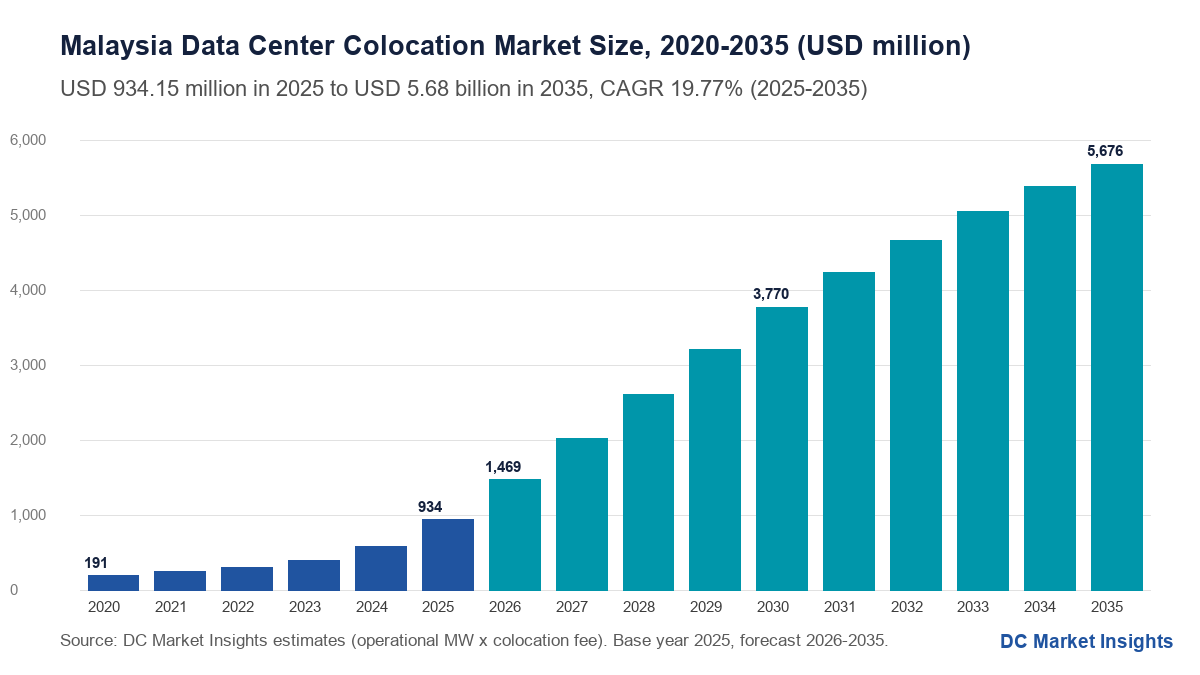
Tenants paid USD 934.15 million for colocation in Malaysia in 2025. The Malaysia Data Center Colocation Market size was valued at USD 190.78 million in 2020, reached USD 934.15 million in 2025, and is anticipated to reach USD 5.68 billion by 2035, at a CAGR of 19.77% during the forecast period. From 2020 to 2025 fees grew 37.40% a year as operational IT capacity rose from about 150 MW to about 1,000 MW, most of it in Johor.
| Report attribute | Details |
|---|---|
| Historical period | 2020-2024 |
| Base year | 2025 |
| Forecast period | 2026-2035 |
| Market size 2025 | USD 934.15 million |
| Market size 2026 | USD 1.47 billion |
| CAGR 2025-2035 | 19.77% |
| Market size 2035 | USD 5.68 billion |
Growth peaks at 57.28% in 2026, when halls signed in 2024 and 2025 start billing, and slows to 5.49% by 2035 as new capacity per year falls from about 550 MW to about 350 MW. The wider picture of Malaysian data center spending sits in the Malaysia Data Center Market, and construction spend on the halls in the Malaysia Data Center Infrastructure Market.
What Is Data Center Colocation in Malaysia, and What Is Left Out?
Malaysia data center colocation covers the fees third-party operators charge tenants for space, cooling and power infrastructure in Malaysian data centers, worth USD 934.15 million in 2025.
Included
- Wholesale and hyperscale colocation: halls and build-to-suit buildings leased by the megawatt, USD 661.04 million in 2025.
- Retail colocation: racks, cages and suites up to about 1 MW, USD 213.02 million.
- Interconnection and value-added services: cross-connects, remote hands and managed services sold by the colocation operator, USD 60.09 million.
Excluded
- Electricity resold at cost, data centers that hyperscalers own and run themselves, servers and network equipment, cloud services, land sales and construction contracts.
How the Segments Fit Together
The three colocation types add to the total in every year; the rack-density, end-user and enterprise-size splits divide the same total. The global Data Center Colocation Market counts colocation fees in every country; this estimate keeps only fees billed at sites inside Malaysia, and Singapore tenants who lease halls in Johor are counted here.
Why Do Figures for Malaysian Colocation Range So Widely?
Published figures for Malaysian colocation differ because some count electricity and construction while others count only fees; DC Market Insights puts the 2026 market at USD 1.47 billion on a fee-only basis.
Broader definitions add the electricity that operators pass through, which at USD 108 per kW-month would almost double the headline, plus construction spend, land sales and self-built hyperscale data centers. MIDA, the Malaysian Investment Development Authority, recorded RM385.7 billion of data-center-related investment from 2021 to the first half of 2026; that is capital committed over many years, not yearly colocation revenue. Small and medium enterprises (SMEs), banks, government agencies and telecom firms are in scope as tenants, with SMEs at 7.00% of 2025 fees. DC Market Insights raised its own earlier 2025 estimate of USD 299.14 million after Johor’s operational capacity passed 1 GW.
| Element | In this estimate | Why |
|---|---|---|
| Wholesale and retail colocation fees | Yes, USD 874.06 million | Core operator revenue |
| Cross-connects and managed services | Yes, USD 60.09 million | Billed by the colocation operator |
| Electricity passed through to tenants | No | Pass-through cost, set by the tariff |
| Self-built hyperscale data centers | No | No colocation fee is paid |
| Construction and land | No | Capital spend, counted in infrastructure |
Why Are Hyperscalers and AI Firms Leasing So Much Space in Johor?
Three Malaysia-specific forces lift colocation fees from USD 934.15 million in 2025 to USD 3.77 billion in 2030, a 32.18% annual rate.
Cloud Regions Built on Leased Halls: USD 16.9 Billion of Pledges
Microsoft pledged USD 2.2 billion over four years in May 2024, Google USD 2 billion for its first data center and cloud region at Elmina in Selangor, AWS about USD 6.2 billion through 2038 and Oracle more than USD 6.5 billion (Source: Microsoft, Google, AWS and Oracle announcements). DC Market Insights estimates that hyperscale cloud providers paid 61.00% of Malaysian colocation fees in 2025, because most of these regions launched in wholesale halls before the owners’ own buildings were ready.
Johor’s Grid Queue: More Than 1 GW Operational by Mid-2026
Johor’s operational IT capacity reached about 1,110 MW in the first half of 2026, up 24% from the second half of 2025, with about 602 MW under construction (DC Market Insights estimate from operator disclosures); Tenaga Nasional Berhad (TNB) reported electricity supply agreements for about 61 data center projects and 8.35 GW of maximum demand in its August 2026 briefing. DC Market Insights uses these figures to set billed colocation capacity at 875 MW in 2026, up from 564 MW in 2025.
AI Clouds Lease Liquid-Cooled Halls: 298 MW Contracted at YTL Power
YTL Power completed Malaysia’s first liquid-cooled Nvidia GB200 NVL72 data center at its Kulai park in October 2025 and had 298 MW of data center capacity under contract by the March 2026 quarter, with plans to take the park from 600 MW to 1,000 MW (Source: YTL Power International). DC Market Insights puts AI and GPU cloud operators at 9.00% of 2025 fees, rising to 23.00% by 2035 at a 31.56% CAGR.
How Are Malaysian Colocation Contracts and Campuses Changing?
Malaysia data center colocation campuses are getting larger and denser: wholesale contracts rise from 70.76% of fees in 2025 to 78.48% in 2035, and racks above 15 kW carry 48.00% of 2025 value.
Campuses Pass the Gigawatt Mark in Johor
AirTrunk’s JHB1 (Johor Bahru 1) and JHB2 (Johor Bahru 2) campuses add more than 420 MW of IT load at a combined cost of over RM9.7 billion (Source: AirTrunk, February 2025), and YTL Power and JLand agreed in August 2026 to develop a new campus at Sedenak Tech Park, taking YTL’s Kulai plans to up to 1.2 GW (Source: YTL Power International). DC Market Insights counts campuses above 50 MW as the cheapest rung of the price ladder at USD 100-112 per kW per month.
Retail Colocation Returns to Kuala Lumpur
Equinix announced KL2 (Kuala Lumpur 2) in May 2026, a purpose-built facility of more than 2,200 cabinets and over USD 190 million of investment in Kuala Lumpur (Source: Equinix, May 2026), after expanding KL1 by 450 cabinets in 2025. DC Market Insights expects retail colocation to grow 15.86% a year to 2035, as banks and digital platforms need interconnected racks near Kuala Lumpur.
Data Center Land Is Now Priced Like a Utility
Crescendo sold 40.10 acres at Bandar Cemerlang, Kota Tinggi, for RM200.88 million in November 2025, RM115 per sq ft, on a title restricted to data center use (Source: Crescendo Corporation Bursa Malaysia circular, January 2026). Sime Darby Property’s two 20-year Elmina leases are worth up to RM7.6 billion, about RM380 million a year (Source: Sime Darby Property).
What Could Slow Colocation Growth in Malaysia?
Two constraints could cut 2035 Malaysia data center colocation fees to the USD 4.43 billion low case, 22.00% below the base case.
Electricity at 45.40 Sen per kWh Doubles a Tenant’s Bill
The Energy Commission (Suruhanjaya Tenaga) set the average base tariff at 45.40 sen per kWh from 1 July 2025 for Peninsular Malaysia, with a new category for ultra-high voltage users (Source: Energy Commission). At a PUE of 1.4, each fully used kilowatt draws about 1,022 kWh a month, costing about RM464 or USD 108 at RM 4.30 to the U.S. dollar, which DC Market Insights estimates lifts a Johor tenant’s total bill to about USD 223 per kW per month.
Water and Approval Rules Narrow Johor Sites
MITI’s Guidelines for Sustainable Development of Data Centre cap design PUE at 1.4 for hyperscale sites above 21.25 MW and water usage effectiveness at 2.2 cubic meters per MWh, and advise against sites with a water stress index of 0.8 or more (Source: MITI). Johor’s water operator applies a data center water tariff of RM5.33 per cubic meter from August 2025 (Source: Ranhill). DC Market Insights models a 22% lower 2035 outcome if approvals slow to about 250 MW a year.
Where Will the Next Billion Ringgit of Colocation Revenue Come From?
Two pools could add about USD 3.10 billion of yearly Malaysia data center colocation fees between 2025 and 2035.
Sovereign and GPU Cloud Halls: USD 2.72 billion by 2035
AI liquid-cooled halls grow from USD 168.15 million in 2025 to USD 2.72 billion in 2035, a 32.12% CAGR, as GPU cloud operators and the sovereign AI programs that YTL Power briefed to the Prime Minister in October 2025 need 80-130 kW racks that few older halls can host. The Malaysia AI Data Center Market sizes the AI facilities themselves.
Negeri Sembilan as Johor’s Overflow
Negeri Sembilan rises from USD 28.02 million in 2025 to USD 567.61 million in 2035, a 35.10% CAGR, as hyperscale campuses around Port Dickson and Seremban sit 60-100 km from Kuala Lumpur with open land and TNB 275 kV lines.
How Much Does a Kilowatt of Colocation Cost in Malaysia?
DC Market Insights estimates Malaysia data center colocation at wholesale rates of USD 115 per kW per month in 2025 and retail at USD 210, both before electricity.
| Year | Wholesale fee (USD per kW-month) | Retail fee (USD per kW-month) | Blended billed fee (USD per kW-month) |
|---|---|---|---|
| 2020 | 120 | 200 | 156 |
| 2025 | 115 | 210 | 129 |
| 2030 | 122 | 220 | 133 |
| 2035 | 120 | 225 | 130 |
Public anchors: the 45.40 sen per kWh average base tariff adds about USD 108 per kW-month of electricity at a PUE of 1.4; data center land in Kota Tinggi sold at RM115 per sq ft in November 2025; and Equinix’s KL2 budget of over USD 190 million for more than 2,200 cabinets works out to about USD 86,000 of investment per cabinet. Wholesale fees fell from USD 120 in 2020 to USD 115 in 2025 as Johor campuses competed for hyperscale tenants, and rise to USD 122 by 2030 as liquid cooling and grid connection costs pass through.
Which Malaysian Rules Decide Where a Colocation Hall Can Be Built?
Six rules shape where USD 1.47 billion of 2026 Malaysia data center colocation fees are earned.
- MITI Strategic Trade Permit for US-origin high-performance AI chips (14 July 2025): every export, transhipment and transit needs a permit under the Strategic Trade Act 2010 (Source: MITI, July 2025).
- MITI Guidelines for Sustainable Development of Data Centre: PUE caps of 1.4 (hyperscale), 1.6 (purpose-built colocation) and 1.7 (older colocation), WUE of 2.2 cubic meters per MWh, binding on tax-incentive applications until 31 December 2027.
- MITI and Ministry of Digital decision of 22 July 2025: MIDA is the single approving agency for new and expanding data center projects.
- Cyber Security Act 2024 (Act 854), in force since 26 August 2024, administered by the National Cyber Security Agency (NACSA).
- Personal Data Protection (Amendment) Act 2024, in force in phases from 1 January to 1 June 2025, with a new cross-border transfer regime.
- Energy Commission tariff of 1 July 2025: 45.40 sen per kWh average base tariff and an ultra-high voltage category.
Which Type of Colocation Earns the Most in Malaysia?
Wholesale and Hyperscale Colocation earns the most, USD 661.04 million or 70.76% of 2025 fees, and AI Liquid-Cooled halls grow fastest at 32.12% a year.
By Colocation Type
| Colocation type | 2025 (USD million) | Share 2025 | 2035 (USD million) | CAGR 2025-2035 |
|---|---|---|---|---|
| Wholesale and Hyperscale Colocation | 661.04 | 70.76% | 4,454.72 | 21.02% |
| Retail Colocation | 213.02 | 22.80% | 928.07 | 15.86% |
| Interconnection and Value-Added Services | 60.09 | 6.43% | 293.27 | 17.18% |
By Rack Density
| Rack density | 2025 (USD million) | Share 2025 | 2035 (USD million) | CAGR 2025-2035 |
|---|---|---|---|---|
| Standard Density (Under 15 kW per Rack) | 485.76 | 52.00% | 1,248.73 | 9.90% |
| High Density (15 kW to 40 kW per Rack) | 280.25 | 30.00% | 1,702.82 | 19.77% |
| AI Liquid-Cooled (Above 40 kW per Rack) | 168.15 | 18.00% | 2,724.50 | 32.12% |
By End User
| End user | 2025 (USD million) | Share 2025 | 2035 (USD million) | CAGR 2025-2035 |
|---|---|---|---|---|
| Hyperscale Cloud Providers | 569.83 | 61.00% | 3,121.83 | 18.54% |
| AI and GPU Cloud Operators | 84.07 | 9.00% | 1,305.49 | 31.56% |
| BFSI | 74.73 | 8.00% | 340.56 | 16.38% |
| Telecom and Digital Platforms | 93.42 | 10.00% | 397.32 | 15.58% |
| Government and Public Sector | 37.37 | 4.00% | 227.04 | 19.77% |
| Other Enterprises | 74.73 | 8.00% | 283.80 | 14.27% |
By Enterprise Size
| Enterprise size | 2025 (USD million) | Share 2025 | 2035 (USD million) | CAGR 2025-2035 |
|---|---|---|---|---|
| Large Enterprises and Hyperscalers | 868.76 | 93.00% | 5,392.25 | 20.03% |
| Small and Medium Enterprises | 65.39 | 7.00% | 283.80 | 15.81% |
Standard-density racks under 15 kW still earn USD 485.76 million in 2025 but grow only 9.90% a year, because enterprise and bank workloads move to the cloud regions that lease the larger halls.
DC Exclusive: The Johor-to-Kuala Lumpur Colocation Price Ladder, 6 Rungs From USD 100 to USD 240 per kW
DC Market Insights prices six rungs of Malaysian colocation, from a Johor build-to-suit campus at USD 100-112 per kW per month to a single Kuala Lumpur retail rack at USD 200-240, all before electricity of about USD 108 per kW-month. The ladder is a DC Market Insights model built on 9 inputs: six fee bands, the 45.40 sen tariff, the 1.4 PUE cap and an exchange rate of RM 4.30 per U.S. dollar.
| Rung | Contract size | Fee (USD per kW-month, before power) | Operators active |
|---|---|---|---|
| Hyperscale build-to-suit campus, Johor | Above 50 MW | 100-112 | AirTrunk, YTL Power, DayOne, Vantage |
| Wholesale hall, Johor | 5 MW to 50 MW | 112-125 | Princeton Digital Group, STT GDC, Bridge Data Centres |
| Wholesale suite, Klang Valley | 1 MW to 5 MW | 125-145 | NTT DATA, Vantage, Bridge Data Centres |
| AI liquid-cooled hall | Above 40 kW per rack | 140-170 | YTL Power, DayOne |
| Retail cage, Cyberjaya or Kuala Lumpur | 100 kW to 1 MW | 180-220 | Equinix, TM, AIMS |
| Single retail rack, Kuala Lumpur | 5 kW rack | 200-240 | Equinix, AIMS, TM |
Reading the ladder: a tenant moving from a single rack to a 50 MW campus cuts the fee per kW by more than half, but the electricity bill of about USD 108 per kW stays the same, so power becomes about half of a hyperscale tenant’s total cost against about a third of a retail tenant’s.
Which Malaysian Region Earns the Most From Colocation?
In the Malaysia data center colocation market, Johor leads with USD 672.59 million in 2025 (72.00%), and Negeri Sembilan grows fastest at 35.10% a year to USD 567.61 million by 2035.
| Region | 2025 (USD million) | Share 2025 | 2035 (USD million) | CAGR 2025-2035 |
|---|---|---|---|---|
| Johor | 672.59 | 72.00% | 3,575.91 | 18.19% |
| Klang Valley (Selangor, Kuala Lumpur and Putrajaya) | 200.84 | 21.50% | 1,248.73 | 20.05% |
| Negeri Sembilan | 28.02 | 3.00% | 567.61 | 35.10% |
| Northern Region (Penang, Kedah and Perak) | 18.68 | 2.00% | 170.28 | 24.73% |
| East Malaysia and Other States | 14.01 | 1.50% | 113.52 | 23.27% |
Johor
Kulai, Sedenak, Iskandar Puteri and Kota Tinggi host AirTrunk, YTL Power, DayOne, Vantage, Princeton Digital Group and STT GDC; TM’s Nxera campus in Iskandar Puteri signed a 280 MW power deal with TNB in January 2026 (Source: TM). Johor grows 18.19% a year to USD 3.58 billion by 2035.
Klang Valley
Cyberjaya, Elmina and Kuala Lumpur hold USD 200.84 million in 2025, led by retail and enterprise tenants; Google’s Elmina region and Equinix KL2 lift the Klang Valley to USD 1.25 billion by 2035.
Negeri Sembilan
The fastest region at 35.10% a year, as hyperscale campuses take land near Port Dickson and Seremban.
Northern Region
Penang, Kedah and Perak earn USD 18.68 million in 2025, serving semiconductor and electronics firms that need low-latency racks, and grow 24.73% a year.
East Malaysia and Other States
Sarawak, Melaka, Sabah and Pahang earn USD 14.01 million in 2025; Sarawak’s hydropower supply supports 24.73% annual growth in the state.
Which Malaysian States Lead in Colocation Fees?
Among states, Johor leads Malaysia data center colocation with USD 672.59 million in 2025, Negeri Sembilan is the fastest large state at 35.10% a year, and the 12 states below hold 99.9% of 2025 value.
| Rank | State | Region | 2025 (USD million) | 2035 (USD million) | CAGR 2025-2035 |
|---|---|---|---|---|---|
| 1 | Johor | Johor | 672.59 | 3,575.91 | 18.19% |
| 2 | Selangor | Klang Valley (Selangor, Kuala Lumpur and Putrajaya) | 126.11 | 851.41 | 21.04% |
| 3 | Kuala Lumpur | Klang Valley (Selangor, Kuala Lumpur and Putrajaya) | 60.72 | 312.18 | 17.79% |
| 4 | Negeri Sembilan | Negeri Sembilan | 28.02 | 567.61 | 35.10% |
| 5 | Putrajaya | Klang Valley (Selangor, Kuala Lumpur and Putrajaya) | 14.01 | 85.14 | 19.77% |
| 6 | Penang | Northern Region (Penang, Kedah and Perak) | 11.21 | 102.17 | 24.73% |
| 7 | Sarawak | East Malaysia and Other States | 5.60 | 51.08 | 24.73% |
| 8 | Kedah | Northern Region (Penang, Kedah and Perak) | 4.67 | 45.41 | 25.54% |
| 9 | Melaka | East Malaysia and Other States | 4.67 | 34.06 | 21.98% |
| 10 | Perak | Northern Region (Penang, Kedah and Perak) | 2.80 | 22.70 | 23.27% |
| 11 | Sabah | East Malaysia and Other States | 1.87 | 17.03 | 24.73% |
| 12 | Pahang | East Malaysia and Other States | 1.40 | 8.51 | 19.77% |
Forecast Scenarios: What Could Change the Malaysia Data Center Colocation Market by 2035?
DC Market Insights puts 2035 fees between USD 4.43 billion and USD 6.64 billion, around a base case of USD 5.68 billion.
| Scenario | 2035 (USD million) | CAGR 2025-2035 | What it assumes |
|---|---|---|---|
| Low | 4,427.32 | 16.83% | Johor approvals slow to about 250 MW a year on water and grid limits; AI chip permits delay GPU halls |
| Base | 5,676.05 | 19.77% | Operational IT capacity reaches 5,600 MW; 72% leased from third parties; wholesale fee USD 120 per kW-month |
| High | 6,640.98 | 21.67% | Most of TNB’s 8.35 GW of contracted demand is built; Singapore and regional AI tenants keep leasing Johor halls |
Key Players and Market Share: Which Operators Hold the Most Malaysia Data Center Colocation Capacity?
The five largest Malaysia data center colocation operators hold about 52% of 2025 fees, on DC Market Insights estimates built from published MW and campus figures; YTL Power alone holds about 14%, based on data center revenue of RM408 million in the nine months to March 2026.
- AirTrunk: JHB1 and JHB2 in Johor, more than 420 MW and over RM9.7 billion (Source: AirTrunk, February 2025).
- YTL Power International: YTL Green Data Center Park at Kulai, 298 MW contracted; data center profit before tax up 422% in the March 2026 quarter (Source: YTL Power International).
- DayOne: Johor campuses with more than 390 MW in service; Malaysia financing raised to about USD 7.2 billion in October 2026 (Source: DayOne).
- Vantage Data Centers: JHB1 campus in Johor, more than 300 MW on 73 acres (Source: Vantage).
- Bridge Data Centres: Johor and Cyberjaya halls, including a 400 MW power agreement with TNB for Ulu Tiram.
- Princeton Digital Group: 150 MW JH1 campus at Sedenak Tech Park (Source: Princeton Digital Group).
- ST Telemedia Global Data Centres (STT GDC): STT Johor 1, a 16 MW first building on a 120 MW campus (Source: STT GDC).
- Equinix: JH1, KL1 and KL2, plus JH2 with 2,225 cabinets and USD 201 million topped out in November 2025 (Source: Equinix).
- TM (Telekom Malaysia) with Singtel: Nxera Iskandar Puteri, 64 MW scalable to 200 MW (Source: TM).
- NTT DATA: Cyberjaya campus for enterprise and cloud tenants.
- AIMS Data Centre: carrier-neutral retail colocation and interconnection in Kuala Lumpur.
- EdgeConneX: Malaysian entry with nearly 300 MW planned across three markets (Source: EdgeConneX).
- Open DC: carrier-neutral data centers, including PE2 in Penang.
Concentration basis: DC Market Insights allocates each operator’s published operational MW to billed capacity and prices it at the wholesale or retail fee in the pricing section; no operator holds more than 20%.
What Changed in Malaysian Colocation Between July 2025 and October 2026?
Seven dated events in Malaysia data center colocation since July 2025 added more than 1 GW of planned campus capacity and about USD 7.6 billion of disclosed financing and investment.
- In July 2025, MITI made US-origin high-performance AI chips subject to a Strategic Trade Permit (Source: MITI).
- In October 2025, YTL Power completed its first liquid-cooled Nvidia GB200 NVL72 data center at Kulai (Source: YTL Power International).
- In November 2025, Equinix topped out JH2 in Johor, a USD 201 million, 2,225-cabinet facility (Source: Equinix).
- In January 2026, TM’s Nxera signed a 280 MW power deal with TNB for its Iskandar Puteri campus (Source: TM).
- In May 2026, Equinix announced KL2 in Kuala Lumpur, over USD 190 million for more than 2,200 cabinets (Source: Equinix).
- In August 2026, YTL Power and JLand agreed to develop a gigawatt-scale campus at Sedenak Tech Park (Source: YTL Power International).
- In October 2026, DayOne raised its Malaysia financing to about USD 7.2 billion (Source: DayOne).
Methodology: How the Model Sizes Malaysia Data Center Colocation Fees
DC Market Insights built the Malaysia Data Center Colocation Market bottom-up from 22 inputs: year-end operational IT capacity (150 MW in 2020, 1,000 MW in 2025, 5,600 MW in 2035), the third-party share of that capacity (85% in 2025, 72% in 2035), the billed share (85%), the wholesale share of billed capacity (85%), wholesale and retail fees per kW-month and service add-ons of 22% on retail and 2% on wholesale. The 2025 receipt is 780 MW of average operational capacity × 85% third-party × 85% billed = 564 MW × USD 129 per kW-month × 12 = USD 874.06 million, plus USD 60.09 million of services = USD 934.15 million. All segment, region and state splits add to the total in every year.
- Ceiling 1: 564 MW of billed capacity in 2025 sits below the 0.86-1 GW of Malaysian capacity that the ASEAN+3 Macroeconomic Research Office (AMRO) reports for the end of 2025.
- Ceiling 2: YTL Power’s data center revenue of RM408 million in nine months, about USD 127 million a year, is 14% of the 2025 market for an operator with 298 MW contracted, in line with its share of capacity.
- Floor: Johor’s 1,110 MW of operational capacity in mid-2026 at the model’s third-party and billed shares and the USD 118 wholesale fee gives about USD 1.12 billion a year from Johor wholesale alone, consistent with USD 1.47 billion for the whole country in 2026.
The full approach is set out in the DC Market Insights research methodology.
Table of contents
- 01Introduction
- 1.1Market Definition and Scope
- 1.2Included and Excluded Elements
- 1.3How the Segments Fit Together
- 1.4Why Malaysian Colocation Figures Differ
- 02Research Methodology
- 2.1Bottom-Up Model: Billed MW × Fee per kW
- 2.2Bound Checks
- 2.3Source Ledger
- 03Executive Summary
- 3.1Market Snapshot, 2025, 2026 and 2035
- 3.2Malaysia Colocation in Numbers
- 3.3Key Takeaways
- 04Market Dynamics
- 4.1Driver: Cloud Regions Built on Leased Halls
- 4.2Driver: Johor's Grid Queue
- 4.3Driver: AI Clouds Lease Liquid-Cooled Halls
- 4.4Trend: Campuses Pass the Gigawatt Mark in Johor
- 4.5Trend: Retail Colocation Returns to Kuala Lumpur
- 4.6Trend: Data Center Land Priced Like a Utility
- 4.7Challenge: Electricity at 45.40 Sen per kWh
- 4.8Challenge: Water and Approval Rules in Johor
- 4.9Opportunity: Sovereign and GPU Cloud Halls
- 4.10Opportunity: Negeri Sembilan as Johor's Overflow
- 05Pricing Analysis
- 5.1Wholesale and Retail Fee per kW-Month, 2020-2035
- 5.2Electricity Cost per kW-Month
- 5.3Public Price Anchors
- 06Standards and Regulation
- 6.1MITI Strategic Trade Permit for AI Chips
- 6.2MITI Guidelines for Sustainable Development of Data Centre
- 6.3MIDA Single Approving Agency
- 6.4Cyber Security Act 2024
- 6.5Personal Data Protection (Amendment) Act 2024
- 6.6Energy Commission Tariff of July 2025
- 07Market Segmentation by Colocation Type
- 7.1Wholesale and Hyperscale Colocation
- 7.2Retail Colocation
- 7.3Interconnection and Value-Added Services
- 08Market Segmentation by Rack Density
- 8.1Standard Density (Under 15 kW per Rack)
- 8.2High Density (15 kW to 40 kW per Rack)
- 8.3AI Liquid-Cooled (Above 40 kW per Rack)
- 09Market Segmentation by End User
- 9.1Hyperscale Cloud Providers
- 9.2AI and GPU Cloud Operators
- 9.3BFSI
- 9.4Telecom and Digital Platforms
- 9.5Government and Public Sector
- 9.6Other Enterprises
- 10Market Segmentation by Enterprise Size
- 10.1Large Enterprises and Hyperscalers
- 10.2Small and Medium Enterprises
- 11DC Exclusive: Johor-to-Kuala Lumpur Colocation Price Ladder
- 11.1Hyperscale build-to-suit campus, Johor
- 11.2Wholesale hall, Johor
- 11.3Wholesale suite, Klang Valley
- 11.4AI liquid-cooled hall
- 11.5Retail cage, Cyberjaya or Kuala Lumpur
- 11.6Single retail rack, Kuala Lumpur
- 12Regional Analysis
- 12.1Johor
- 12.2Klang Valley (Selangor, Kuala Lumpur and Putrajaya)
- 12.3Negeri Sembilan
- 12.4Northern Region (Penang, Kedah and Perak)
- 12.5East Malaysia and Other States
- 13State Analysis
- 13.1Johor
- 13.2Selangor
- 13.3Kuala Lumpur
- 13.4Negeri Sembilan
- 13.5Putrajaya
- 13.6Penang
- 13.7Sarawak
- 13.8Kedah
- 13.9Melaka
- 13.10Perak
- 13.11Sabah
- 13.12Pahang
- 14Forecast Scenarios
- 14.1Low Case
- 14.2Base Case
- 14.3High Case
- 15Key Players
- 15.1AirTrunk
- 15.2YTL Power International
- 15.3DayOne
- 15.4Vantage Data Centers
- 15.5Bridge Data Centres
- 15.6Princeton Digital Group
- 15.7STT GDC
- 15.8Equinix
- 15.9TM (Telekom Malaysia)
- 15.10NTT DATA
- 15.11AIMS Data Centre
- 15.12EdgeConneX
- 15.13Open DC
- 15.14Market Concentration
- 16Recent Developments
- 16.1July 2025 to October 2026
- Fig. 11. Malaysia Data Center Colocation Market Size, 2020-2035 (USD million)
- Table 11. Report Attributes
- Table 22. Scope Comparison
- Table 33. Wholesale and Retail Fee per kW-Month, 2020-2035
- Table 44. Market by Colocation Type, 2025 and 2035
- Table 55. Market by Rack Density, 2025 and 2035
- Table 66. Market by End User, 2025 and 2035
- Table 77. Market by Enterprise Size, 2025 and 2035
- Table 88. Colocation Price Ladder
- Table 99. Market by Region, 2025 and 2035
- Table 1010. Top 12 States
- Table 1111. Forecast Scenarios, 2035
About this report
Written by Amit Jain and reviewed by Deepti Agrawal, Senior Editor, Research. Figures are built top-down and bottom-up and reconciled before publication, with 2025 as the base year.
Read our methodologyHow we built this
- Historical period2020-2024
- Base year2025
- Forecast period2026-2035
- Sizing approachTop-down + bottom-up
Need more than the report?
Advisory on this market
Due diligence, site selection and market entry work, by the analysts who wrote this report.
See consulting servicesFrequently asked questions
USD 1.47 billion in 2026, up 57.28% from USD 934.15 million in 2025, according to DC Market Insights estimates. The market is projected to reach USD 5.68 billion by 2035, a CAGR of 19.77% from 2025.
19.77% a year from 2025 to 2035, after 37.40% a year from 2020 to 2025, as operational IT capacity rises from about 1,000 MW to 5,600 MW.
Fees that third-party operators charge for space, cooling and power infrastructure, from 5 kW retail racks to 100 MW build-to-suit campuses; worth USD 934.15 million in 2025, with electricity billed on top.
About USD 115 per kW per month for wholesale and USD 210 for retail in 2025 (DC Market Insights estimate), plus about USD 108 of electricity at the 45.40 sen per kWh base tariff.
Wholesale and Hyperscale Colocation, with USD 661.04 million or 70.76% of 2025 fees, because cloud providers lease whole halls in Johor and Selangor.
AI Liquid-Cooled halls above 40 kW per rack, at 32.12% a year from USD 168.15 million in 2025 to USD 2.72 billion in 2035, as GPU clouds lease 80-130 kW racks.
Johor holds 72.00% of 2025 fees, USD 672.59 million, because of land, TNB grid connections and proximity to Singapore; its operational IT capacity reached about 1,110 MW in mid-2026.
Negeri Sembilan, at 35.10% a year from USD 28.02 million in 2025 to USD 567.61 million in 2035, as hyperscale campuses move to Port Dickson and Seremban.
AirTrunk, YTL Power, DayOne, Vantage and Bridge Data Centres hold about 52% of 2025 fees together (DC Market Insights estimate); Equinix, Princeton Digital Group, STT GDC, NTT DATA and TM also compete.
USD 1.47 billion in 2026 is the DC Market Insights fee-only figure. Estimates that add electricity, construction, land or self-built hyperscale data centers come out several times higher.
Get this report
How do I get the full report?
Request a quote; we reply by email within one business day.
How and when will I receive the report?
By email, within 24–48 business hours of payment.
How can I pay?
Once you accept the quote, we email you a secure payment link.
Can I see a sample first?
Yes. Request a free sample and we will email it to you.
Can the report be tailored to my needs?
Yes. We can add countries, segments or data cuts. Talk to an analyst about the scope you need.
Can I get an invoice or pay against a purchase order?
Write to sales@dcmarketinsights.com and our team will help.