
Cloud GPU Management Software Market Size, Share & Forecast to 2035
Market at a glance
The Cloud GPU Management Software market was worth USD 1,590.0 million in 2025 and is forecast to reach USD 9,690.0 million by 2035, growing at a 19.79% CAGR.
 By Amit Jain, Senior Consultant, ICT & Emerging Technologies
 Reviewed by Deepti Agrawal
Last updated 5 Nov 2026
Base year 2025 PDF + Excel
Key findings
16.2 Million Installed Data Center GPUs Make Idle Time a Board-Level Cost
NVIDIA Open-Sources the Scheduler Layer: KAI in April 2025, Full Run:ai in October 2026
Hyperscalers Spent Over USD 295 Billion on Capex in 2025 and Run Their Own Schedulers
Sovereign and Research Clusters Reach USD 2.33 billion by 2035
What is inside the report
- 01Introduction
- 02Key Market Statistics and Takeaways
- 03Executive Summary
- 04Market Scope
- 05Why Estimates Differ
- 06Market Drivers
- 07Market Trends
- 08Market Challenges
- 09Market Opportunities
- 10Pricing Analysis
- 19chapters
- 2020-2024Historical period
- 2026-2035Forecast period
- 7Companies profiled
Segmentation
Companies profiled
- Nutanix: Nutanix Enterprise AI for any Kubernetes platform (November 2024)
- Hewlett Packard Enterprise: private cloud AI systems with GPU management
- Dell Technologies: AI factory software bundles for on-premises GPU clusters
- Canonical: Kubernetes and GPU operator distributions
- Mirantis: Kubernetes platforms for GPU clouds
- IBM: Spectrum LSF workload scheduling for high-performance computing (HPC)
- Altair (Siemens): PBS Professional scheduler for HPC clusters
Recent developments
NVIDIA released the full Run:ai platform as open source as part of NVIDIA DSX, and Nebius made it available in Nebius Applications (Source: NVIDIA, Nebius).
Rafay named sovereign and GPU cloud deployments with Yotta, Cassava Technologies, Firmus and TELUS (Source: Rafay).
CoreWeave reported more than USD 5 billion of 2025 revenue and a USD 66.8 billion revenue backlog (Source: CoreWeave).
NVIDIA acquired SchedMD, the developer of Slurm (Source: NVIDIA).
Red Hat launched Red Hat AI 3 with distributed inference across accelerators (Source: Red Hat).
Broadcom made VMware Private AI Services standard in VMware Cloud Foundation 9.0 (Source: Broadcom).
Full analysis
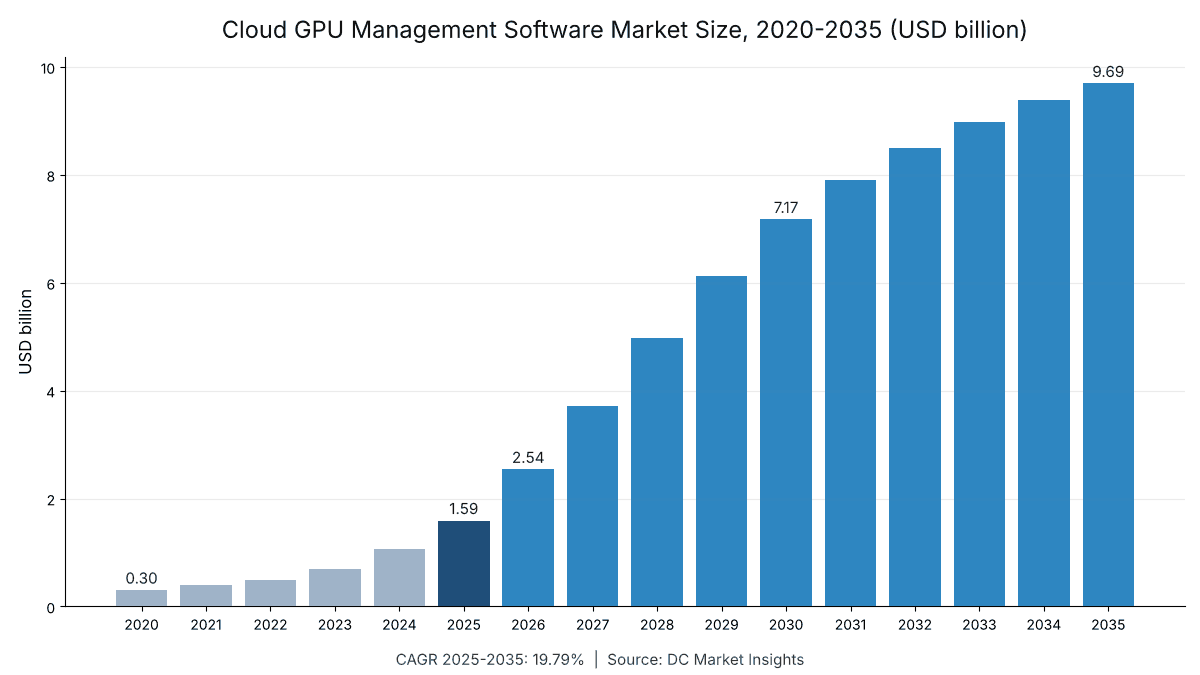
The Cloud GPU Management Software Market is valued at USD 2.54 billion in 2026 and is projected to reach USD 9.69 billion by 2035, up from USD 1.59 billion in 2025, a CAGR of 19.79% from 2025 to 2035 (DC Market Insights estimate). What sets the money here is the price of an idle graphics processing unit (GPU): a data center GPU sold for about USD 22,060 on average in 2025, so a scheduler that lifts fleet use by a few points pays for itself within months, and buyers outside the largest clouds now pay for that software. The supply side is consolidating fast: NVIDIA agreed to buy Run:ai in April 2024, bought SchedMD, the developer of the Slurm scheduler, in December 2025, and in October 2026 released the full Run:ai platform as open source inside its DSX AI factory stack, which moves vendor revenue from licences toward support, control planes and metering.
The market covers paid software that schedules, partitions, monitors and meters data center GPU fleets, plus the services to deploy it. The 2025 receipt is 16.2 million installed data center GPUs × 9% under paid management = 1.46 million GPUs × USD 950 per GPU-year = USD 1.39 billion of software, plus USD 207.76 million of implementation and support. GPU Cloud Control Plane and Metering grows fastest among components at 23.25% a year because every new GPU cloud needs tenant isolation and billing, and Middle East and Africa is the fastest region at 23.89% as sovereign AI clusters in Saudi Arabia and the United Arab Emirates come online.
Key Market Statistics: How Big Is the Cloud GPU Management Software Market in 2026?
The Cloud GPU Management Software Market reaches USD 2.54 billion in 2026, 59.50% above the USD 1.59 billion of 2025, as the installed data center GPU base rises from 16.2 million to 23.6 million units in one year (DC Market Insights estimate).
- Market size 2025: USD 1.59 billion
- Market size 2026: USD 2.54 billion
- Market size 2030: USD 7.17 billion
- Market size 2035: USD 9.69 billion
- CAGR 2025-2035: 19.79% (low case 14.37%, high case 24.34%)
- Largest component: Cluster Scheduling and Orchestration, 32.17% of 2025 value
- Fastest component: GPU Cloud Control Plane and Metering, 23.25% a year
- Leading region: North America, 52.00% of 2025 value; fastest region: Middle East and Africa, 23.89%
- Largest country: United States, USD 748.64 million in 2025
- GPUs under paid management software: 1.46 million in 2025, 13.96 million by 2035
- Market leader: NVIDIA, about 35% of 2025 value through NVIDIA AI Enterprise, Run:ai and Slurm support (DC Market Insights estimate)
Key Takeaways: Why Do GPU Owners Pay for Management Software?
- Cluster Scheduling and Orchestration leads with 32.17% of 2025 value, because queueing jobs across thousands of GPUs decides how much of a USD 22,060 asset sits idle.
- Only 9% of installed data center GPUs ran under paid management software in 2025, because the largest clouds write their own schedulers; the share rises to 20% by 2035 as enterprises and governments own more GPUs.
- AI Inference grows 24.75% a year, because serving models needs autoscaling and GPU partitioning that training clusters did not.
- Revenue per managed GPU falls from USD 950 to USD 620 a year by 2035, because NVIDIA open-sourced its Run:ai scheduler in 2025 and the full platform in 2026.
Executive Summary: What Is the Cloud GPU Management Software Market Worth?
The Global Cloud GPU Management Software Market size was valued at USD 303.73 million in 2020, reached USD 1.59 billion in 2025, and is anticipated to reach USD 9.69 billion by 2035, at a CAGR of 19.79% during the forecast period.
| Attribute | Value |
|---|---|
| Historical period | 2020-2024 |
| Base year | 2025 |
| Forecast period | 2026-2035 |
| Market size 2025 | USD 1.59 billion |
| Market size 2026 | USD 2.54 billion |
| CAGR 2025-2035 | 19.79% |
| Market size 2035 | USD 9.69 billion |
| Segments covered | Component, Deployment Model, End User, Workload |
Growth from 2020 to 2025 ran at 39.30% a year as the installed data center GPU base grew from 3.3 million to 16.2 million units; NVIDIA alone reported Data Center revenue of USD 193.7 billion for fiscal 2026, 68% above the year before. Growth after 2025 slows to 19.79% because unit prices of the software fall while paid coverage widens from 1.46 million to 13.96 million GPUs. DC Market Insights expects USD 7.17 billion in 2030, when about 53.9 million GPUs are installed in data centers.
What Does the Cloud GPU Management Software Market Include?
The Cloud GPU Management Software Market counts USD 1.59 billion of 2025 spending on software and services that decide which job runs on which data center GPU, how a GPU is shared, and how its use is measured and billed.
Included
- Cluster scheduling and orchestration: Slurm support, Kubernetes GPU schedulers, NVIDIA Run:ai and NVIDIA Base Command style job managers.
- GPU virtualization and partitioning: virtual GPU (vGPU) licences, Multi-Instance GPU (MIG) management and the GPU share of private AI platforms such as VMware Private AI Foundation, Red Hat OpenShift AI and Nutanix Enterprise AI.
- Monitoring and observability: GPU health, telemetry, failure prediction and utilisation dashboards.
- GPU cloud control plane and metering: tenant isolation, provisioning, quota, usage metering and billing software sold to or run by GPU cloud providers, such as CoreWeave Mission Control and Rafay.
- Implementation, integration and paid support, including support contracts for open source schedulers.
Excluded
- GPU hardware (counted in the Data Center Accelerator Market), GPU rental revenue, and model development tools such as training frameworks and model registries.
- General data center orchestration of servers, storage and networks (counted in the Data Center Orchestration Market), data center infrastructure management (DCIM) for power and cooling, and schedulers that hyperscale clouds build and run only for themselves.
How the segments fit together
Each managed GPU carries one software subscription split across scheduling, partitioning, monitoring and control-plane functions, and each new deployment adds an implementation job. In 2025 the split was 32.17% scheduling, 22.17% control plane and metering, 20.00% virtualization, 12.61% monitoring and 13.04% services.
Why Do Cloud GPU Management Software Market Estimates Differ?
The DC Market Insights figure of USD 2.54 billion for 2026 counts only paid software and services for data center GPU fleets, so it is smaller than estimates for AI infrastructure software as a whole.
Broader definitions add machine learning operations (MLOps) platforms, AI development suites, the full NVIDIA AI Enterprise bundle including inference microservices and frameworks, GPU rental revenue, or the internal engineering cost of hyperscale schedulers. Some also count workstation and gaming GPU utilities, or general cloud management platforms that manage central processing units (CPUs) as well. DC Market Insights keeps only the management layer of data center GPUs, so the figure adds up with the accelerator and orchestration reports.
| Element | In this report | Why |
|---|---|---|
| GPU scheduling, partitioning, monitoring and metering software | Yes, USD 1.39 billion in 2025 | Bought only to run GPU fleets |
| Implementation and paid support | Yes, USD 207.76 million in 2025 | Needed to put the software in service |
| MLOps and model development tools | No | Bought for models, not for GPUs |
| GPU rental revenue | No | A cloud service, not software |
| In-house hyperscale schedulers | No | No market transaction |
Small buyers are in scope: university research clusters and enterprise teams with fewer than 100 GPUs buy Slurm support or Run:ai seats, and they sit inside the Enterprises and Government Sovereign AI and Research segments, which together held 56.00% of 2025 value.
Market Drivers: Why Are GPU Owners Buying Management Software Now?
Three changes lift the Cloud GPU Management Software Market from USD 1.59 billion in 2025 to USD 2.54 billion in 2026: a larger installed GPU base, the rise of GPU clouds outside the big three, and private AI platforms that ship GPU management as standard.
16.2 Million Installed Data Center GPUs Make Idle Time a Board-Level Cost
NVIDIA reported fiscal 2026 Data Center revenue of USD 193.7 billion, including a record USD 62.3 billion in the fourth quarter (NVIDIA fiscal 2026 results). DC Market Insights counts 16.2 million GPUs installed in data centers at the end of 2025, rising to 53.9 million by 2030. At about USD 22,060 per GPU, each percentage point of utilisation gained on a 10,000-GPU cluster is worth about USD 2.2 million of hardware put back to work, which is why Cluster Scheduling and Orchestration earned USD 512.49 million in 2025.
GPU Clouds Need Their Own Control Planes: CoreWeave Ran 850 MW Across 43 Sites at End-2025
CoreWeave reported in its 2025 annual report that it “operated 43 data centers with over 850 MW of active power” and held about 3.1 gigawatts (GW) of contracted power, and that CoreWeave Mission Control “integrates security, observability, and services”. The company passed USD 5 billion of annual revenue in 2025, and Nebius reported 2025 revenue of USD 529.8 million, up 479%, according to its results release. Each new GPU cloud needs multi-tenant provisioning, quotas and usage billing, so Neocloud and GPU Cloud Providers bought USD 477.86 million of software and services in 2025 (DC Market Insights estimate).
Private AI Platforms Make GPU Management Standard: VMware Cloud Foundation 9.0 From August 2025
Broadcom said on 26 August 2025 that “VMware Private AI Services will become a standard component of VMware Cloud Foundation 9.0”, with support for NVIDIA Blackwell and AMD Instinct MI350 GPUs (Broadcom, August 2025). Red Hat added distributed inference across different accelerators in Red Hat AI 3 in October 2025, and Nutanix launched Nutanix Enterprise AI for any Kubernetes platform in November 2024, according to both companies. Enterprises therefore get GPU partitioning inside platforms they already license, which supports Private Cloud On-Premises spending of USD 605.29 million in 2025.
Market Trends: How Is GPU Fleet Software Changing?
Licences are moving to open source while paid value moves to support, control planes and inference serving, which is why GPU Cloud Control Plane and Metering rises from 22.17% of value in 2025 to 29.46% by 2035.
NVIDIA Open-Sources the Scheduler Layer: KAI in April 2025, Full Run:ai in October 2026
NVIDIA released the KAI Scheduler, the core of Run:ai, under the Apache 2.0 licence on 1 April 2025, and said on 13 October 2026 that it is “making the full NVIDIA Run:ai platform available as open source software” as part of the DSX AI factory platform, according to the NVIDIA developer blog. Nebius made the open source Run:ai available in Nebius Applications the same day. DC Market Insights models revenue per managed GPU falling from USD 950 in 2025 to USD 760 in 2030 as licence fees give way to support contracts.
Schedulers Become Vendor-Neutral Across NVIDIA and AMD GPUs
NVIDIA said on 15 December 2025 that Slurm “is used in more than half of the top 10 and top 100 systems in the TOP500 list” and that it will keep Slurm “open-source, vendor-neutral software” (NVIDIA, December 2025). VMware Cloud Foundation supports AMD ROCm Enterprise AI software beside NVIDIA, and AMD bought Silo AI for about USD 665 million in August 2024 to add AI software staff. Buyers running mixed fleets need one scheduler for both, which supports Hybrid deployments growing 21.21% a year.
Market Challenges: What Holds Back GPU Management Software Revenue?
Two limits keep paid coverage at 9% of installed data center GPUs in 2025: the largest buyers write their own software, and open source lowers the price of what is left.
Hyperscalers Spent Over USD 295 Billion on Capex in 2025 and Run Their Own Schedulers
Amazon reported USD 131.8 billion of purchases of property and equipment in 2025, Alphabet USD 91.4 billion and Meta USD 72.22 billion, according to their full-year results releases; Alphabet expects USD 175 to 185 billion in 2026 and Meta USD 115 to 135 billion. Most GPUs bought with this money run on in-house schedulers and never generate a software sale, so Hyperscale Cloud Marketplaces, where these clouds resell third-party GPU tools, held only 14.00% of 2025 value and fall to 11.00% by 2035.
Open Source Cuts Revenue per Managed GPU by About 35% to 2035
With KAI Scheduler, Slurm and the full Run:ai platform free to download, paid offers must sell support, security and fleet operations instead of the scheduler itself. DC Market Insights models revenue per managed GPU-year at USD 950 in 2025 and USD 620 in 2035, a fall of 35%, so the market grows 19.79% a year while managed GPUs grow 25.35% a year.
Market Opportunities: Where Will GPU Management Software Earn the Most?
Sovereign AI clusters and inference serving add the most value to 2035: together they lift Government Sovereign AI and Research and AI Inference spending by USD 6.90 billion between 2025 and 2035 (DC Market Insights estimate, the two overlap in part).
Sovereign and Research Clusters Reach USD 2.33 billion by 2035
Government-funded clusters buy software rather than build it, and Rafay listed national and sovereign deployments with Yotta in India, Cassava Technologies in Africa, Firmus in Australia and TELUS in Canada in June 2026, according to the company. Government Sovereign AI and Research grows from USD 350.43 million in 2025 to USD 2.33 billion by 2035, at 20.84% a year, the fastest end user in the model.
Inference Serving Needs GPU Partitioning: AI Inference Reaches USD 5.53 billion by 2035
Inference traffic rises and falls through the day, so operators split GPUs with MIG and scale replicas up and down. Red Hat AI 3 added the llm-d distributed inference project for “different hardware accelerators” in October 2025, according to Red Hat. AI Inference grows from 38.00% of 2025 value to 57.00% by 2035 in the DC Market Insights model.
Pricing: What Does GPU Management Software Cost per GPU?
List prices run up to USD 4,500 per GPU a year for NVIDIA AI Enterprise, while the blended paid rate for the management layer was about USD 950 per GPU-year in 2025 (DC Market Insights estimate).
| Unit rate (DC Market Insights estimate) | 2020 | 2025 | 2030 | 2035 |
|---|---|---|---|---|
| Software per managed GPU-year (USD) | 1,300 | 950 | 760 | 620 |
| Share of installed GPUs under paid management | 6.0% | 9.0% | 15.5% | 20.0% |
| Services as share of software | 18.0% | 15.0% | 13.0% | 12.0% |
Public price anchors: NVIDIA lists NVIDIA AI Enterprise at USD 4,500 per GPU for a one-year subscription, USD 22,500 per GPU as a perpetual licence with five years of support, and USD 1 per GPU-hour on cloud marketplaces (NVIDIA AI Enterprise licensing guide). The suite covers far more than fleet management, so DC Market Insights counts about a fifth of a typical paid price as the management layer.
Standards and Regulation: Which Rules Shape GPU Fleet Software?
At least five rules adopted between 2024 and 2025 shape the USD 2.54 billion market of 2026, mostly by forcing GPU owners to measure and report what their fleets do.
- EU Delegated Regulation 2024/1364: operators of data centres with at least 500 kilowatts (kW) of IT power report energy and performance data by 15 September 2024, then by 15 May 2025 and every year after (EUR-Lex).
- EU Artificial Intelligence Act, Regulation 2024/1689: general-purpose AI models above a training-compute threshold of 10^25 floating point operations carry extra duties, so providers log compute per training run (Source: EUR-Lex).
- United States Bureau of Industry and Security (BIS) AI Diffusion rule (15 January 2025): split the data center validated end-user authorisation into universal and national versions with a 15 May 2025 compliance date (Source: Federal Register).
- BIS rescission of the AI Diffusion rule (13 May 2025): the rule was withdrawn before compliance, but GPU export licences still require end-user records (Source: BIS).
- ISO/IEC 42001 (December 2023): the AI management system standard asks organisations to document AI resources, including compute (Source: International Organization for Standardization).
Market Segmentation: Which Segments Lead the Cloud GPU Management Software Market?
Cluster Scheduling and Orchestration leads with USD 512.49 million in 2025, while GPU Cloud Control Plane and Metering, Public GPU Cloud, Government Sovereign AI and Research and AI Inference grow fastest in their dimensions.
Cloud GPU Management Software Market by Component
| Component | 2025 (USD million) | Share 2025 | 2035 (USD million) | CAGR 2025-2035 |
|---|---|---|---|---|
| Cluster Scheduling and Orchestration | 512.49 | 32.17% | 2,856.22 | 18.74% |
| GPU Virtualization and Partitioning | 318.57 | 20.00% | 1,557.94 | 17.20% |
| Monitoring and Observability | 200.84 | 12.61% | 1,384.83 | 21.30% |
| GPU Cloud Control Plane and Metering | 353.20 | 22.17% | 2,856.22 | 23.25% |
| Implementation and Support Services | 207.76 | 13.04% | 1,038.62 | 17.46% |
GPU Cloud Control Plane and Metering grows fastest at 23.25% a year and matches scheduling at 29.46% of value by 2035.
Cloud GPU Management Software Market by Deployment Model
| Deployment Model | 2025 (USD million) | Share 2025 | 2035 (USD million) | CAGR 2025-2035 |
|---|---|---|---|---|
| Public GPU Cloud | 732.72 | 46.00% | 5,040.79 | 21.27% |
| Private Cloud On-Premises | 605.29 | 38.00% | 2,908.15 | 16.99% |
| Hybrid | 254.86 | 16.00% | 1,744.89 | 21.21% |
Public GPU Cloud rises from 46.00% to 52.00% of value as more enterprise GPU work moves to GPU clouds.
Cloud GPU Management Software Market by End User
| End User | 2025 (USD million) | Share 2025 | 2035 (USD million) | CAGR 2025-2035 |
|---|---|---|---|---|
| Neocloud and GPU Cloud Providers | 477.86 | 30.00% | 3,102.02 | 20.57% |
| Enterprises | 541.57 | 34.00% | 3,198.96 | 19.44% |
| Government Sovereign AI and Research | 350.43 | 22.00% | 2,326.52 | 20.84% |
| Hyperscale Cloud Marketplaces | 223.00 | 14.00% | 1,066.32 | 16.94% |
Enterprises remain the largest end user at 33.00% of 2035 value; enterprise server buying is covered in the Cloud Servers Market.
Cloud GPU Management Software Market by Workload
| Workload | 2025 (USD million) | Share 2025 | 2035 (USD million) | CAGR 2025-2035 |
|---|---|---|---|---|
| AI Training | 828.29 | 52.00% | 3,489.78 | 15.47% |
| AI Inference | 605.29 | 38.00% | 5,525.48 | 24.75% |
| HPC and Simulation | 159.29 | 10.00% | 678.57 | 15.60% |
AI Inference overtakes AI Training in 2029 in the DC Market Insights model.
DC Exclusive: The GPU Fleet Software Price Ladder, 6 Price Points From USD 0 to USD 8,760 per GPU-Year
This ladder is a DC Market Insights estimate built on 6 public inputs; it converts published licence terms into annual cost per GPU so that buyers can compare open source, subscription and cloud metering.
| Rung | Offer | Basis | USD per GPU-year |
|---|---|---|---|
| 1 | Open source KAI Scheduler, Slurm or Run:ai | Free licence, Apache 2.0 or open source | 0 |
| 2 | DC Market Insights blended paid rate, 2025 | Management layer only, all buyers | 950 |
| 3 | NVIDIA AI Enterprise, one-year subscription | List price per GPU | 4,500 |
| 4 | NVIDIA AI Enterprise, perpetual licence | USD 22,500 over 5 years of support | 4,500 |
| 5 | NVIDIA AI Enterprise on cloud, 50% use | USD 1 per GPU-hour × 4,380 hours | 4,380 |
| 6 | NVIDIA AI Enterprise on cloud, full use | USD 1 per GPU-hour × 8,760 hours | 8,760 |
The gap between rung 2 and rungs 3 to 6 explains the size of the market: list prices cover a whole software suite, and only part of it pays for fleet management. On a 1,024-GPU cluster, moving from rung 3 to rung 1 saves about USD 4.6 million a year in licences, but buyers that need support and multi-tenant billing stay near rung 2. DC Market Insights expects the blended rate to fall to USD 620 by 2035.
Regional Insights: Which Region Spends Most on GPU Management Software?
North America leads with 52.00% of 2025 value, and Middle East and Africa grows fastest at 23.89% a year to 2035.
North America Cloud GPU Management Software Market
North America earned USD 828.29 million in 2025, 52.00% of value, and grows 18.33% a year to USD 4.46 billion by 2035 (DC Market Insights estimate). The United States holds most of the GPU clouds, including CoreWeave’s 43 data centers, and most enterprise Run:ai and Slurm support contracts.
Asia Pacific Cloud GPU Management Software Market
Asia Pacific earned USD 366.36 million in 2025, 23.00% of value, and grows 21.50% a year to USD 2.57 billion by 2035 (DC Market Insights estimate). India grows fastest in the region as Yotta and government-backed GPU clusters buy fleet software, while sales in China are held back by export controls on advanced GPUs.
Europe Cloud GPU Management Software Market
Europe earned USD 254.86 million in 2025, 16.00% of value, and grows 20.16% a year to USD 1.60 billion by 2035 (DC Market Insights estimate). Annual reporting under EU Delegated Regulation 2024/1364 for sites above 500 kW pushes operators to meter GPU use, and Nebius runs its GPU cloud from Europe.
Middle East and Africa Cloud GPU Management Software Market
Middle East and Africa earned USD 79.64 million in 2025, 5.00% of value, and grows 23.89% a year to USD 678.57 million by 2035, the fastest region (DC Market Insights estimate). Sovereign AI clusters in Saudi Arabia and the United Arab Emirates buy software rather than build it, and Cassava Technologies runs GPU capacity in Africa with Rafay software.
Latin America Cloud GPU Management Software Market
Latin America earned USD 63.71 million in 2025, 4.00% of value, and grows 19.79% a year to USD 387.75 million by 2035 (DC Market Insights estimate). Brazil and Mexico lead, with university and research clusters as early buyers of Slurm support.
Country Analysis: Which Countries Lead GPU Management Software Spending?
The United States leads with USD 748.64 million in 2025, and India is the fastest large country at 27.05% a year.
| Rank 2025 | Country | Region | 2025 (USD million) | 2035 (USD million) | CAGR 2025-2035 |
|---|---|---|---|---|---|
| 1 | United States | North America | 748.64 | 4,022.94 | 18.31% |
| 2 | China | Asia Pacific | 95.57 | 533.16 | 18.76% |
| 3 | Canada | North America | 79.64 | 436.22 | 18.54% |
| 4 | Japan | Asia Pacific | 71.68 | 484.69 | 21.06% |
| 5 | United Kingdom | Europe | 63.71 | 387.75 | 19.79% |
| 6 | Germany | Europe | 57.34 | 358.67 | 20.12% |
| 7 | South Korea | Asia Pacific | 44.60 | 310.20 | 21.40% |
| 8 | France | Europe | 41.41 | 271.43 | 20.68% |
| 9 | India | Asia Pacific | 39.82 | 436.22 | 27.05% |
| 10 | Saudi Arabia | Middle East and Africa | 30.26 | 271.43 | 24.53% |
| 11 | Australia | Asia Pacific | 28.67 | 193.88 | 21.06% |
| 12 | United Arab Emirates | Middle East and Africa | 25.49 | 222.96 | 24.22% |
India moves from ninth place in 2025 to joint fourth with Canada by 2035 in the model as national GPU programmes and Indian GPU clouds scale; Saudi Arabia and the United Arab Emirates grow above 24% a year for the same reason.
Forecast Scenarios: How Large Could the Cloud GPU Management Software Market Be by 2035?
The Cloud GPU Management Software Market reaches USD 9.69 billion by 2035 in the base case, within a range of USD 6.10 billion to USD 14.07 billion.
| Scenario | Paid share of installed GPUs 2035 | Software per GPU-year 2035 | Market 2035 | CAGR 2025-2035 |
|---|---|---|---|---|
| Low | 15% | USD 520 | USD 6.10 billion | 14.37% |
| Base | 20% | USD 620 | USD 9.69 billion | 19.79% |
| High | 25% | USD 720 | USD 14.07 billion | 24.34% |
The low case assumes open source Run:ai and Slurm replace most paid licences; the high case assumes enterprises and governments own a larger share of GPUs and buy fleet operations as a managed subscription.
Competitive Insights: Who Leads the Cloud GPU Management Software Market?
NVIDIA holds about 35% of 2025 value and the five largest suppliers about 58% (DC Market Insights estimate based on list prices, product scope and disclosed deployments).
- NVIDIA: NVIDIA AI Enterprise (USD 4,500 per GPU-year list), Run:ai (agreement April 2024, open source October 2026), SchedMD and Slurm (acquired December 2025), DSX OS.
- Broadcom (VMware): Private AI Services standard in VMware Cloud Foundation 9.0 (August 2025).
- Red Hat: OpenShift AI and Red Hat AI 3 with llm-d distributed inference (October 2025).
- Nutanix: Nutanix Enterprise AI for any Kubernetes platform (November 2024).
- Rafay Systems: GPU cloud and sovereign AI control plane; Yotta, Cassava Technologies, Firmus and TELUS deployments (June 2026).
- CoreWeave: Mission Control fleet operations across 43 data centers and more than 850 MW (end-2025).
- Nebius: GPU cloud with open source Run:ai in Nebius Applications (October 2026); 2025 revenue USD 529.8 million.
- AMD: ROCm Enterprise AI software; Silo AI acquired for about USD 665 million (August 2024).
- Hewlett Packard Enterprise: private cloud AI systems with GPU management.
- Dell Technologies: AI factory software bundles for on-premises GPU clusters.
- Canonical: Kubernetes and GPU operator distributions.
- Mirantis: Kubernetes platforms for GPU clouds.
- IBM: Spectrum LSF workload scheduling for high-performance computing (HPC).
- Altair (Siemens): PBS Professional scheduler for HPC clusters.
Market shares are DC Market Insights estimates; open source schedulers run on far more GPUs than any paid product, but only support contracts count as revenue.
Recent Developments in the Cloud GPU Management Software Market
- In October 2026, NVIDIA released the full Run:ai platform as open source as part of NVIDIA DSX, and Nebius made it available in Nebius Applications (Source: NVIDIA, Nebius).
- In June 2026, Rafay named sovereign and GPU cloud deployments with Yotta, Cassava Technologies, Firmus and TELUS (Source: Rafay).
- In February 2026, CoreWeave reported more than USD 5 billion of 2025 revenue and a USD 66.8 billion revenue backlog (Source: CoreWeave).
- In December 2025, NVIDIA acquired SchedMD, the developer of Slurm (Source: NVIDIA).
- In October 2025, Red Hat launched Red Hat AI 3 with distributed inference across accelerators (Source: Red Hat).
- In August 2025, Broadcom made VMware Private AI Services standard in VMware Cloud Foundation 9.0 (Source: Broadcom).
Research Methodology: How DC Market Insights Sized the Cloud GPU Management Software Market
DC Market Insights built the Cloud GPU Management Software Market bottom-up from installed data center GPUs: 3.3 million in 2020, 16.2 million in 2025, 53.9 million in 2030 and 69.8 million in 2035, each year’s base being the last five years of GPU shipments (6.30 million GPUs shipped in 2025).
Software = installed GPUs × share under paid management (9% in 2025, 20% in 2035) × software per managed GPU-year (USD 950 in 2025, USD 620 in 2035). Services = 15% of software in 2025, 12% in 2035. Segments, 5 regions and 12 countries are shares of the total that sum to it every year. Read more in our research methodology; the wider AI build-out is covered in the AI Data Center Market.
Bound checks: (1) ceiling: 2025 software of USD 1.39 billion is 0.72% of NVIDIA’s USD 193.7 billion fiscal 2026 Data Center revenue; (2) ceiling: the USD 950 blended rate is 21% of the USD 4,500 NVIDIA AI Enterprise list price; (3) floor: the 1.46 million GPUs under paid management are fewer than the 23.5% of 2025 accelerator value bought by enterprises, governments and research in the Data Center Accelerator Market model, so paid coverage is not overstated.
Table of contents
- 01Introduction
- 1.1Report Description
- 1.2Market Definition and Scope
- 1.3Research Methodology
- 02Key Market Statistics and Takeaways
- 2.1Market Size 2025, 2026, 2030 and 2035
- 2.2Key Takeaways
- 03Executive Summary
- 3.1Market Snapshot, 2025, 2026 and 2035
- 3.2Market Size 2020-2035
- 04Market Scope
- 4.1Included
- 4.2Excluded
- 4.3How the Segments Fit Together
- 05Why Estimates Differ
- 5.1Scope Comparison Table
- 06Market Drivers
- 6.116.2 Million Installed Data Center GPUs
- 6.2GPU Clouds Need Their Own Control Planes
- 6.3Private AI Platforms Make GPU Management Standard
- 07Market Trends
- 7.1NVIDIA Open-Sources the Scheduler Layer
- 7.2Schedulers Become Vendor-Neutral
- 08Market Challenges
- 8.1Hyperscalers Run Their Own Schedulers
- 8.2Open Source Cuts Revenue per Managed GPU
- 09Market Opportunities
- 9.1Sovereign and Research Clusters
- 9.2Inference Serving and GPU Partitioning
- 10Pricing Analysis
- 10.1Unit Rates 2020-2035
- 10.2Public Price Anchors
- 11Standards and Regulation
- 11.1EU Delegated Regulation 2024/1364
- 11.2EU Artificial Intelligence Act
- 11.3BIS AI Diffusion Rule and Rescission
- 11.4ISO/IEC 42001
- 12Market Segmentation
- 12.1By Component: Cluster Scheduling and Orchestration
- 12.2By Component: GPU Virtualization and Partitioning
- 12.3By Component: Monitoring and Observability
- 12.4By Component: GPU Cloud Control Plane and Metering
- 12.5By Component: Implementation and Support Services
- 12.6By Deployment Model: Public GPU Cloud
- 12.7By Deployment Model: Private Cloud On-Premises
- 12.8By Deployment Model: Hybrid
- 12.9By End User: Neocloud and GPU Cloud Providers
- 12.10By End User: Enterprises
- 12.11By End User: Government Sovereign AI and Research
- 12.12By End User: Hyperscale Cloud Marketplaces
- 12.13By Workload: AI Training
- 12.14By Workload: AI Inference
- 12.15By Workload: HPC and Simulation
- 13DC Exclusive: The GPU Fleet Software Price Ladder
- 13.1Six Price Points per GPU-Year
- 14Regional Insights
- 14.1North America
- 14.2Asia Pacific
- 14.3Europe
- 14.4Middle East and Africa
- 14.5Latin America
- 15Country Analysis
- 15.1United States
- 15.2China
- 15.3Canada
- 15.4Japan
- 15.5United Kingdom
- 15.6Germany
- 15.7South Korea
- 15.8France
- 15.9India
- 15.10Saudi Arabia
- 15.11Australia
- 15.12United Arab Emirates
- 16Forecast Scenarios
- 16.1Low Case
- 16.2Base Case
- 16.3High Case
- 17Competitive Insights
- 17.1NVIDIA
- 17.2Broadcom (VMware)
- 17.3Red Hat
- 17.4Nutanix
- 17.5Rafay Systems
- 17.6CoreWeave
- 17.7Nebius
- 17.8AMD
- 17.9Hewlett Packard Enterprise
- 17.10Dell Technologies
- 17.11Canonical
- 17.12Mirantis
- 17.13IBM
- 17.14Altair (Siemens)
- 18Recent Developments
- 18.1October 2026 to August 2025
- 19Research Methodology
- 19.1Model in Numbers
- 19.2Bound Checks
- Fig. 1Cloud GPU Management Software Market Size, 2020-2035 (USD million)
- Table 1Executive Summary Attributes
- Table 2Scope Comparison
- Table 3Unit Rates 2020-2035
- Table 4Market by Component
- Table 5Market by Deployment Model
- Table 6Market by End User
- Table 7Market by Workload
- Table 8GPU Fleet Software Price Ladder
- Table 9Top 12 Countries
- Table 10Forecast Scenarios 2035
About this report
Written by Amit Jain and reviewed by Deepti Agrawal, Senior Editor, Research. Figures are built top-down and bottom-up and reconciled before publication, with 2025 as the base year.
Read our methodologyHow we built this
- Historical period2020-2024
- Base year2025
- Forecast period2026-2035
- Sizing approachTop-down + bottom-up
Need more than the report?
Advisory on this market
Due diligence, site selection and market entry work, by the analysts who wrote this report.
See consulting servicesFrequently asked questions
USD 2.54 billion in 2026, up 59.50% from USD 1.59 billion in 2025, according to DC Market Insights estimates. The market is projected to reach USD 9.69 billion by 2035, a CAGR of 19.79% from 2025.
19.79% a year from 2025 to 2035, after 39.30% a year from 2020 to 2025, as GPUs under paid management rise from 1.46 million to 13.96 million (DC Market Insights estimate).
About USD 950 per managed GPU-year for the management layer in 2025 (DC Market Insights estimate). NVIDIA lists NVIDIA AI Enterprise at USD 4,500 per GPU a year or USD 1 per GPU-hour on cloud marketplaces.
Cluster Scheduling and Orchestration, with USD 512.49 million or 32.17% of 2025 value. GPU Cloud Control Plane and Metering grows fastest at 23.25% a year.
Yes. NVIDIA released the KAI Scheduler, the core of Run:ai, under Apache 2.0 in April 2025 and said in October 2026 that the full Run:ai platform is available as open source within NVIDIA DSX.
NVIDIA acquired SchedMD, the developer of Slurm, in December 2025 and said Slurm stays open source and vendor-neutral. Slurm runs on more than half of the top 100 TOP500 supercomputers, according to NVIDIA.
North America, with USD 828.29 million or 52.00% of 2025 value. Middle East and Africa grows fastest at 23.89% a year, and India is the fastest large country at 27.05%.
Only 9% of the 16.2 million installed data center GPUs ran under paid management software in 2025, because hyperscale clouds write their own schedulers (DC Market Insights estimate).
NVIDIA holds about 35% of 2025 value and the top five suppliers about 58% (DC Market Insights estimate). Broadcom (VMware), Red Hat, Nutanix, Rafay, CoreWeave, Nebius and AMD are also active.
The DC Market Insights figure of USD 2.54 billion for 2026 counts only paid software and services that manage data center GPU fleets. Estimates that add MLOps tools, full AI software suites or GPU rental revenue are larger.
Get this report
How do I get the full report?
Request a quote; we reply by email within one business day.
How and when will I receive the report?
By email, within 24–48 business hours of payment.
How can I pay?
Once you accept the quote, we email you a secure payment link.
Can I see a sample first?
Yes. Request a free sample and we will email it to you.
Can the report be tailored to my needs?
Yes. We can add countries, segments or data cuts. Talk to an analyst about the scope you need.
Can I get an invoice or pay against a purchase order?
Write to sales@dcmarketinsights.com and our team will help.