
Russia Data Center Infrastructure Market Size, Share & Forecast to 2035
Market at a glance
The Russia Data Center Infrastructure market was worth USD 1,200.0 million in 2025 and is forecast to reach USD 3,650.0 million by 2035, growing at a 11.75% CAGR. Central Federal District accounts for 61.9% of the market.
 By Priyanka Mor, Senior Consultant
 Reviewed by Deepti Agrawal
Last updated 8 Oct 2026
Base year 2025 PDF + Excel
Source: DC Market Insights analysis
Key findings
Power and Cooling Take 60.1% of 2025 Spending as Racks Climb to 20 kW
Russian UPS and Cooling Overtake Western Equipment at 35.9%
Moscow Data Centers Are About 95% Full
Colocation Facility Spend Grows to USD 1.29 Billion by 2035
What is inside the report
- 01Introduction
- 02Research Methodology
- 03Executive Summary
- 04Market Dynamics
- 05Pricing Analysis
- 06Standards and Regulation
- 07Supply Chain Analysis
- 08Market Size and Forecast
- 09Market by Component
- 10Market by Power Infrastructure
- 21chapters
- 2020-2024Historical period
- 2026-2035Forecast period
- 16Companies profiled
Regional insights
- Central Federal District61.9%
- Northwestern Federal District13.8%
- Volga Federal District9.7%
- Ural Federal District5.6%
- Siberian Federal District5.4%
- Southern, North Caucasian and Far Eastern Districts3.6%
Segmentation
Companies profiled
- Systeme Electric
- Impuls (Sistemotekhnika)
- Bastion
- Nerpa
- REFKUL
- Smart DCIM
- Rosel (Rostec)
- K2Tech
- Rubytech
- Rostelecom Data Centers (RTK-DPC)
- IXcellerate
- Key Point
- Atomdata (Rosatom)
- Selectel
- Cloud.ru
- Yandex
Recent developments
Federal Law No. 244-FZ introduced a legal definition of a data center, a data center registry and a ban on crypto-mining equipment in registered data centers (Source: ppt.ru legal review).
IXcellerate announced its Veshki campus in the Moscow region, with 7,500 rack spaces and more than 130 MW of total power (Source: IXcellerate press release).
Systeme Electric expanded its Excelente VX three-phase UPS series with modular models of 800, 1,000 and 1,200 kVA (Source: Elec.ru news report).
the national data center registry began operating, and the Ministry of Digital Development later included Rostelecom's Medvedkovo-2 data center (Source: ComNews news report).
REFKUL confirmed Russian-manufacturer status for its precision air conditioners in the Ministry of Industry and Trade registry (Source: Termokul group news).
Cloud.ru began building an 11 MW Tier III data center in the Moscow region for up to 890 racks of up to 20 kW, with commissioning planned for 2027 (Source: ComNews news report).
Full analysis
The Russia Data Center Infrastructure Market covers the physical facility layer of Russian data centers: power infrastructure such as uninterruptible power supplies (UPS), batteries, diesel generators, switchgear and power distribution; cooling systems; racks and containment; monitoring and management hardware; fire suppression and physical security; and civil construction and fit-out. DC Market Insights values the Russia Data Center Infrastructure Market at USD 1.20 billion in 2025 and forecasts USD 3.65 billion by 2035, a CAGR of 11.75%. The 2025 value is built from two blocks: 64 MW of new conventional IT load at USD 10.50 million of facility spend per MW gives USD 672.00 million, upgrades on an installed conventional base of about 580 MW add USD 91.32 million, and the facility layer of 58 MW of new AI capacity adds USD 439.73 million. Monitoring and management is the fastest-growing segment at 13.64% a year because operators instrument every rack as densities rise, and the Siberian Federal District is the fastest-growing region at 18.12% a year because cheaper power and government siting proposals pull large halls east.
Executive Summary
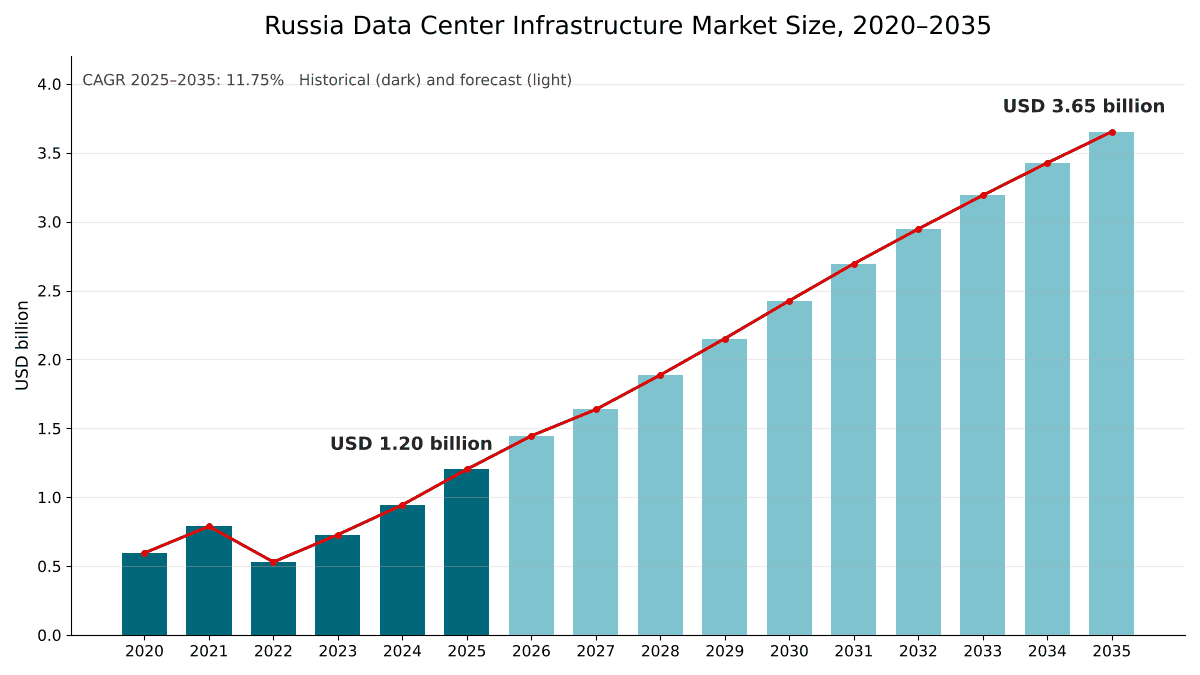
The Russia Data Center Infrastructure Market size was valued at USD 0.60 billion in 2020, reached USD 1.20 billion in 2025, and is anticipated to reach USD 3.65 billion by 2035, at a CAGR of 11.75% during the forecast period.
| Report attribute | Details |
|---|---|
| Historical Period | 2020-2024 |
| Base Year | 2025 |
| Forecast Period | 2026-2035 |
| Russia Data Center Infrastructure Market Size 2025 | USD 1.20 Billion |
| Russia Data Center Infrastructure Market, CAGR | 11.75% |
| Russia Data Center Infrastructure Market Size 2035 | USD 3.65 Billion |
The market grew at 15.10% a year between 2020 and 2025, but not in a straight line. Facility spending fell 32.8% in 2022 to USD 529.99 million as Western equipment vendors left and projects stalled, recovered to USD 944.65 million in 2024 and rose 27.4% in 2025 as AI halls with higher power and cooling content moved into construction. The AI facility layer is 36.6% of 2025 value and 54.4% of 2035 value.
Growth slows to 11.75% a year because grid capacity, not demand, sets the pace. Data center connection requests in the capital region reached 2.2 GW against 0.53 GW of planned commissioning, and the Bank of Russia kept its key rate at 14.00% on 11 September 2026 (Source: Bank of Russia key rate decision). The figures reconcile with the DC Market Insights Russia Data Center Market report: this market equals that report’s power infrastructure, cooling systems and general construction segments, and excludes servers, storage and networking.
Market Scope: What Does the Russia Data Center Infrastructure Market Cover?
The Russia Data Center Infrastructure Market covers USD 1.20 billion of 2025 capital spending on the facility layer of data centers in the Russian Federation, valued in current US dollars at a planning rate of RUB 82.50 per USD, with 2025 as the base year and forecasts to 2035.
Included. UPS systems and batteries, diesel generators, switchgear and power distribution; chillers, precision and in-row air conditioners, dry coolers and liquid cooling; racks, enclosures and aisle containment; sensors, metered power distribution and data center infrastructure management (DCIM) hardware; fire suppression, access control and video surveillance; and construction and fit-out of halls and plant rooms, for new builds, expansions and upgrades.
Excluded. Servers, accelerators, storage and network switches, DCIM software licenses, land, electricity and other operating costs, colocation and cloud service revenue, and crypto-mining farms. Public, private and community cloud services in Russia are counted only through the power, cooling and building systems of the data centers that host them.
How the segments fit together. Every dimension re-cuts the same USD 1.20 billion. Racks, monitoring, fire and security, and construction and fit-out together equal the USD 479.79 million general construction segment of the Russia Data Center Market model. The power sub-split, which answers the backup power question, divides the USD 410.01 million power segment into UPS and batteries, diesel generators, and switchgear and power distribution.
Market Drivers: What Drives the Russia Data Center Infrastructure Market?
Rising rack density, a government forecast of 2.5 GW of data center power demand by 2030 and a move to campuses of 40 MW and more drive the Russia Data Center Infrastructure Market to 11.75% annual growth.
Power and Cooling Take 60.1% of 2025 Spending as Racks Climb to 20 kW
Power infrastructure and cooling systems account for USD 723.26 million, or 60.1% of the market, in 2025, and DC Market Insights forecasts 63.2% by 2035. Cloud.ru’s new Moscow-region data center is designed for up to 890 racks of up to 20 kW, IXcellerate’s MOS11 averages 12 kW per rack with scalability up to 44 kW, and IXcellerate’s MOS3 runs up to 22 kW per rack. Each step up in rack power adds UPS capacity, switchgear and heat rejection per square meter.
Data Center Power Demand Rises from 1 GW to 2.5 GW by 2030
The Ministry of Digital Development and the government’s analytical center expect data center power consumption in Russia to grow at least 2.5 times by 2030, from 1 GW to 2.5 GW. The share of data centers in Russian electricity consumption rose from 1.4% in 2022 to 2.2% in 2025, and data center power demand is growing 30% to 40% a year against 2% to 4% growth in generation, according to a ComNews report on the power system. Every added MW of IT load needs its own UPS, switchgear and heat rejection. DC Market Insights models new conventional IT capacity rising from 64 MW in 2025 to 118 MW a year by 2035, and new AI capacity from 58 MW to 273 MW a year.
Campuses of 40 MW to 154 MW Replace 1 MW City Sites
IXcellerate’s Veshki campus in the Moscow region will deliver 7,500 rack spaces and more than 130 MW of total power across two buildings (Source: IXcellerate press release). Yandex Cloud plans a new availability zone in 2026 on a new Yandex data center of more than 40 MW, Sber is building a data center of up to 82 MW in the Saratov region, and Cloud X plans a 154 MW AI data center in the Irkutsk region. In 2025, by contrast, MegaFon’s new sites in Yekaterinburg and Tver offered 1 MW each.
Market Trends: How Is Russian Data Center Infrastructure Changing?
Domestic and Asian equipment has replaced Western suppliers, free cooling and liquid cooling push power usage effectiveness (PUE) toward 1.1, and monitoring spreads to every rack.
Russian UPS and Cooling Overtake Western Equipment at 35.9%
Integrator K2Tech reported, based on its spare-parts warehouse statistics, that the Russian share of UPS and cooling systems rose from 24.9% in 2024 to 35.9% in 2025, overtaking Western vendors at 25.9%, while Asian equipment stayed the largest group at 38.2%. Integrator Rubytech said that in new projects Western engineering equipment is on average no more than 5%, Chinese makers cover about 70% to 80% and Russian makers 15% to 20%. Systeme Electric says it has localized production of single- and three-phase UPS and cooling systems.
Free Cooling and Liquid Cooling Push PUE Toward 1.1
Yandex says its data center racks are cooled by outside air all year, that its new data center reaches an average PUE of 1.1, and it is introducing liquid cooling. IXcellerate’s MOS11 uses an integrated energy storage system to help hold an annual average PUE of 1.33. Systeme Electric presents factory-built power modules, in-row air conditioners and dry coolers as its portfolio for AI loads, and says liquid cooling as a standard is already a market reality. Cooling systems grow at 12.44% a year in the model, slightly faster than power infrastructure at 12.19%.
Monitoring and Management Grows Fastest at 13.64%
Monitoring and management hardware is worth USD 46.06 million in 2025 and USD 165.46 million by 2035. Russian DCIM vendor Smart DCIM has reported its 25th data center deployment, across banks, science and the public sector, and Systeme Electric offers its DC Guard monitoring platform. Denser racks leave less thermal margin, so operators add sensors and metered power rack by rack.
Market Challenges: What Holds the Russia Data Center Infrastructure Market Back?
Grid capacity around Moscow, long lead times for large UPS systems and a 14.00% key rate are the three constraints that DC Market Insights expects to hold the market below its demand potential until new generation arrives after 2027.
Moscow Data Centers Are About 95% Full
An adviser to the Vladimir region governor said in February 2026 that Moscow data centers were about 95% full, with no more than 1,400 free rack spaces in the region (Source: 3DNews report). New generation for the Moscow region is scheduled for 2027 to 2030 and new high-voltage lines for 2030 to 2032, according to energy expert Dmitry Stapran. DC Market Insights forecasts the Central Federal District’s share to fall from 61.9% in 2025 to 54.1% by 2035.
Large UPS Systems Take 6 to 8 Months to Commission
An expert at UPS supplier Bastion said in May 2025 that commissioning complex UPS systems now takes 6 to 8 months instead of 3 to 4, and that supply remains difficult above 500 kVA. Sistemotekhnika, maker of the Impuls brand, said local production of high-power UPS remains economically unviable, and Nerpa said most Russian UPS makers use Asian components. A January 2025 Delovoy Peterburg report said cooling systems, UPS and diesel generators had become more expensive, mainly because of equipment shortages and rising prices.
A 14.00% Key Rate Pauses Speculative Builds
Some 38 Russian data center projects were paused in the last three years, against 128 projects worth about RUB 1 trillion announced over the same period, with about 42 under construction. Atomdata said 2025 commissioning of new data center capacity was at a record low. DC Market Insights lets conventional additions recover only gradually, from 64 MW in 2025 to 90 MW a year in 2030.
Market Opportunities: Where Are the New Revenue Pools?
Colocation facilities, growing at 13.69% a year, and power-led sites outside Moscow are the two largest new revenue pools in the Russia Data Center Infrastructure Market.
Colocation Facility Spend Grows to USD 1.29 Billion by 2035
Colocation data centers spend USD 358.34 million on infrastructure in 2025, and DC Market Insights forecasts USD 1.29 billion by 2035, the fastest growth of any data center type, because banks and cloud providers lease space when their own grid queues are long. Rostelecom Data Centers filled its Nizhny Novgorod site to 93% less than a year after it opened in June 2025, and Rostelecom targets data center revenue of RUB 169 billion in 2030 against RUB 76 billion in 2025.
Siberia, the Urals and the Volga Offer Power for 30 MW to 200 MW Sites
The Ministry of Energy has proposed building AI data centers in Siberia, where, according to Stolypin Institute materials, the power base allows several data centers of up to 200 MW each; free capacity for 30 MW sites is available in the Urals and on the Volga. DC Market Insights forecasts the Siberian Federal District to grow from USD 64.96 million in 2025 to USD 343.36 million by 2035.
Pricing: How Much Does Data Center Infrastructure Cost per MW in Russia?
A conventional data center in Russia needs about USD 10.50 million of facility spending per MW of IT load in 2025, about RUB 866 million at the planning rate, according to DC Market Insights estimates. The figure covers power, cooling, racks, monitoring, fire and security, and construction, but not IT equipment.
| Cost reference | Quoted cost | Per MW (USD million) |
|---|---|---|
| DC Market Insights estimate, conventional facility, 2025 | USD 10.50 million per MW | 10.50 |
| MegaFon, market average per kW of IT capacity | RUB 1.2-1.5 million per kW | 14.55-18.18 |
| Komfortel, 20 MW facility | RUB 10-12 billion | 6.06-7.27 |
| Rostelecom Data Centers, 100-200 MW Tier III campus | RUB 110-150 billion | 6.67-18.18 |
| Atomdata Innopolis, first phase of 8 MW | RUB 8 billion | 12.12 |
Ruble figures are converted at RUB 82.50 per USD; the quoted costs use different bases, total power in some cases and IT load in others. DC Market Insights raises facility cost per MW from USD 9.00 million in 2020 to USD 10.50 million in 2025, then by 1.5% a year to USD 12.19 million in 2035, as density, redundancy and liquid cooling content rise.
Standards and Regulation: Which Rules Shape Russian Data Center Infrastructure?
Five sets of rules, led by the 2025 data center law and its registry, shape the Russia Data Center Infrastructure Market.
Federal Law No. 244-FZ (July 2025). The law of 23 July 2025 added a definition of a data center, as buildings or premises for data processing and storage including their engineering systems, to the Law on Communications, created a data center registry and banned crypto-mining equipment in registered data centers. Some provisions took effect on 1 March 2026.
Government Decree No. 1932 (November 2025). The decree of 28 November 2025 sets the rules for the registry, which records the technical characteristics of each data center and has operated since 1 March 2026; the Ministry of Digital Development has added Rostelecom’s Medvedkovo-2 data center.
Grid tariff rules and investment support. A government initiative reported in March 2026 would, from 2027, bill data centers and mining sites above 670 kW for grid transmission on 90% of maximum declared capacity rather than actual consumption, which rewards phased power infrastructure. Under Federal Law No. 69-FZ, 50% of the actual cost of building supporting infrastructure is reimbursed for qualifying projects.
Industrial registry and procurement. Makers confirm Russian-manufacturer status through the Ministry of Industry and Trade registry under Decree No. 719. From 1 January 2026, public procurement lots may not mix Russian registry-listed products with foreign products.
Data localization and Tier design. Federal Law No. 242-FZ has required personal data of Russian citizens to be processed and stored in Russia since 1 September 2015. Several new commercial builds are designed to Tier III, including Cloud.ru’s Moscow-region site and Rostelecom’s Nizhny Novgorod and Yekaterinburg sites.
Market Segmentation: Which Segment Leads the Russia Data Center Infrastructure Market?
Power infrastructure leads the Russia Data Center Infrastructure Market with 34.1% of 2025 value, hyperscale and cloud providers lead data center types with 33.2%, and Tier III facilities take 66.2%. Monitoring and management is the fastest-growing segment at 13.64% a year, against 9.94% for civil construction and fit-out, because new high-density halls are instrumented rack by rack while the building shell is a smaller part of each new MW.
By Component: Power Infrastructure Leads with 34.1%
| Component | 2025 (USD billion) | Share 2025 | 2035 (USD billion) | CAGR 2025-2035 |
|---|---|---|---|---|
| Power Infrastructure | 0.41 | 34.1% | 1.30 | 12.19% |
| Cooling Systems | 0.31 | 26.0% | 1.01 | 12.44% |
| Civil Construction and Fit-Out | 0.24 | 19.9% | 0.62 | 9.94% |
| Racks, Enclosures and Containment | 0.13 | 10.9% | 0.40 | 11.72% |
| Fire Suppression and Physical Security | 0.06 | 5.2% | 0.16 | 10.07% |
| Monitoring and Management | 0.05 | 3.8% | 0.17 | 13.64% |
Power infrastructure is worth USD 410.01 million and cooling systems USD 313.25 million in 2025. Civil construction and fit-out, worth USD 239.42 million, loses 3.0 points of share by 2035.
By Power Infrastructure: UPS and Batteries Lead Backup Power with 41.8%
UPS systems and batteries account for USD 171.39 million (41.8% of power infrastructure) in 2025 and grow at 12.95% a year to USD 579.12 million by 2035. Switchgear and power distribution account for USD 141.86 million (34.6%) and grow at 12.45%. Diesel generators account for USD 96.76 million (23.6%) and grow slowest at 10.30%, because generator capacity scales with facility load while UPS and distribution content scales with rack density.
By Data Center Type: Hyperscale and Cloud Providers Lead with 33.2%
| Data center type | 2025 (USD billion) | Share 2025 | 2035 (USD billion) | CAGR 2025-2035 |
|---|---|---|---|---|
| Hyperscale and Cloud Providers | 0.40 | 33.2% | 1.17 | 11.35% |
| Colocation Data Centers | 0.36 | 29.8% | 1.29 | 13.69% |
| Enterprise and Bank-Owned Data Centers | 0.34 | 28.2% | 0.86 | 9.73% |
| Government and Research Data Centers | 0.11 | 8.8% | 0.33 | 12.07% |
Colocation overtakes hyperscale and cloud providers before 2035 and reaches 35.4% of the market, because colocation budgets carry far more facility and far fewer servers than cloud budgets. Enterprise and bank-owned data centers grow slowest at 9.73% a year as workloads move to colocation and Russian clouds.
By Tier Type: Tier III Leads with 66.2%
Tier III facilities account for USD 796.42 million in 2025 and USD 2.54 billion by 2035, growing at 12.28% a year. Tier IV grows fastest at 15.13% a year, from USD 145.57 million to USD 595.44 million, as banks and AI campuses specify fault-tolerant power paths. Tier I and II facilities account for USD 261.06 million and grow at 7.18%.
By End User: Internet and IT Services Lead with 31.6%
Internet and IT services companies account for USD 380.17 million (31.6%) of 2025 spending and grow at 11.95% a year. Banking, financial services and insurance (BFSI) follows with USD 269.48 million (22.4%), then telecom with 14.1%, government and research with 13.8%, industrial and energy with 8.3%, others with 5.7% and retail and e-commerce with 4.1%. Industrial and energy grows fastest at 14.30% a year as manufacturers and energy companies add on-site and edge capacity.
DC Exclusive: The Russia Facility Cost Stack
At USD 133.95 million in 2025, power infrastructure for hyperscale and cloud providers is the largest cell of the matrix and 11.1% of the whole market. The matrix cross-tabulates what is bought against who buys it.
| 2025, USD million | Power | Cooling | Racks and Containment | Monitoring | Fire and Security | Construction and Fit-Out | Total |
|---|---|---|---|---|---|---|---|
| Hyperscale and Cloud Providers | 133.95 | 108.29 | 43.94 | 14.36 | 16.78 | 81.71 | 399.03 |
| Colocation Data Centers | 128.22 | 91.39 | 41.62 | 15.13 | 20.14 | 61.84 | 358.34 |
| Enterprise and Bank-Owned Data Centers | 114.81 | 86.66 | 35.04 | 12.68 | 19.51 | 70.77 | 339.47 |
| Government and Research Data Centers | 33.03 | 26.91 | 10.86 | 3.89 | 6.42 | 25.10 | 106.21 |
| Total | 410.01 | 313.25 | 131.46 | 46.06 | 62.85 | 239.42 | 1,203.05 |
Colocation data centers spend 35.8% of their infrastructure budget on power, the highest share of any type, because they sell guaranteed power to tenants. Hyperscale and cloud providers spend the most on cooling at 27.1% of their budget, reflecting AI hall density. Government and research data centers spend 23.6% on construction and fit-out and 6.0% on fire and security, the highest shares of any type.
The Russia Facility Cost Stack is a DC Market Insights model, built from 55 inputs: 16 conventional capacity cohorts, 16 annual AI facility values from the DC Market Insights Russia AI Data Center Market model, 3 cost and rate assumptions, 6 component splits, 4 data center type splits, 6 federal district splits and 4 published build-cost references used as a check. The model is explained on our research methodology page.
Regional Insights: Which Region Leads the Russia Data Center Infrastructure Market?
The Central Federal District leads the Russia Data Center Infrastructure Market with 61.9% of 2025 value because Moscow hosts most commercial and cloud capacity, and the Siberian Federal District is the fastest-growing region at 18.12% a year because of cheaper power and government siting proposals.
Central Federal District Leads with 61.9% Share
The Central Federal District is worth USD 744.69 million in 2025 and USD 1.98 billion by 2035, a CAGR of 10.25%. Projects include IXcellerate’s MOS11 with 40 MW and 2,500 rack spaces, whose first phase is scheduled for summer 2026, and Cloud.ru’s 11 MW data center due in 2027.
Northwestern Federal District Holds 13.8% Share
The Northwestern Federal District is worth USD 166.02 million in 2025 and USD 526.20 million by 2035, a CAGR of 12.23%. Key Point plans a 20 MW, 1,650-rack data center in St Petersburg, with a first phase of 5 MW and 330 racks in the first quarter of 2027, and two further planned St Petersburg data centers will offer 22 MW between them.
Volga Federal District Holds 9.7% Share
The Volga Federal District is worth USD 116.70 million in 2025 and USD 410.85 million by 2035, a CAGR of 13.41%. Rostelecom Data Centers invested RUB 3.6 billion in its Nizhny Novgorod site in 2025, with 401 racks and 5 MW, and Atomdata’s Innopolis data center in Tatarstan has a first phase of 1,000 racks and 8 MW.
Ural Federal District Holds 5.6% Share
The Ural Federal District is worth USD 67.37 million in 2025 and USD 240.47 million by 2035, a CAGR of 13.57%. In Yekaterinburg, Key Point’s data center has 11 MW of design capacity and 880 IT racks, financed with RUB 3.2 billion from VTB, and Rostelecom Data Centers added a third phase of 214 racks and 2 MW for about RUB 1 billion.
Siberian Federal District Holds 5.4% Share
The Siberian Federal District is worth USD 64.96 million in 2025 and USD 343.36 million by 2035, a CAGR of 18.12%, the fastest of any district, and its share rises to 9.4% by 2035 as AI campuses such as Cloud X’s planned 154 MW site in the Irkutsk region move east.
Southern, North Caucasian and Far Eastern Districts Hold 3.6% Share
The Southern, North Caucasian and Far Eastern federal districts together are worth USD 43.31 million in 2025 and USD 156.70 million by 2035, a CAGR of 13.72%, mainly regional telecom capacity such as Rostelecom’s 200 kW, 24-rack Tier III data center in Stavropol, with a PUE of 1.3 to 1.5.
Forecast Scenarios: How Could the 2035 Forecast Change?
The Russia Data Center Infrastructure Market reaches USD 3.65 billion by 2035 in the base case, with a range of USD 2.76 billion to USD 4.49 billion across the low and high scenarios.
| Scenario | Assumption from 2026 | 2035 (USD billion) | CAGR 2025-2035 |
|---|---|---|---|
| Low | Conventional additions 14% below base and facility prices 5% lower; AI capacity follows the low AI case | 2.76 | 8.68% |
| Base | Conventional additions rise to 118 MW a year; AI additions reach 273 MW a year | 3.65 | 11.75% |
| High | Conventional additions 14% above base and facility prices 5% higher; AI capacity follows the high AI case | 4.49 | 14.07% |
The low case reflects a longer period of high interest rates and slow grid connections. The high case assumes new Moscow-region generation arrives on schedule between 2027 and 2030 and registry benefits speed up construction. Longer UPS and chiller lead times mostly delay revenue rather than remove it.
Competitive Insights: Who Leads the Russia Data Center Infrastructure Market?
- Systeme Electric
- Impuls (Sistemotekhnika)
- Bastion
- Nerpa
- REFKUL
- Smart DCIM
- Rosel (Rostec)
- K2Tech
- Rubytech
- Rostelecom Data Centers (RTK-DPC)
- IXcellerate
- Key Point
- Atomdata (Rosatom)
- Selectel
- Cloud.ru
- Yandex
Among operators that disclose their spending, Rostelecom Data Centers accounts for about 7.7% of 2025 market value (DC Market Insights estimate: more than RUB 38 billion invested in data center expansion and equipment upgrades over five years, averaged to RUB 7.6 billion or USD 92.12 million a year, against the USD 1.20 billion market), and its rack base has doubled to 27,637. Selectel spent RUB 2.9 billion, about USD 35.15 million or 2.9% of the market, on new data center infrastructure in 2025, out of capital spending of RUB 7.9 billion. On the supply side, Systeme Electric competes in UPS, cooling and monitoring, Impuls, Bastion and Nerpa supply UPS systems, REFKUL makes precision air conditioners, and Smart DCIM and Rosel offer monitoring and compact liquid-cooled data centers.
Recent Developments
- In July 2025, Federal Law No. 244-FZ introduced a legal definition of a data center, a data center registry and a ban on crypto-mining equipment in registered data centers (Source: ppt.ru legal review).
- In November 2025, IXcellerate announced its Veshki campus in the Moscow region, with 7,500 rack spaces and more than 130 MW of total power (Source: IXcellerate press release).
- In December 2025, Systeme Electric expanded its Excelente VX three-phase UPS series with modular models of 800, 1,000 and 1,200 kVA (Source: Elec.ru news report).
- In March 2026, the national data center registry began operating, and the Ministry of Digital Development later included Rostelecom’s Medvedkovo-2 data center (Source: ComNews news report).
- In May 2026, REFKUL confirmed Russian-manufacturer status for its precision air conditioners in the Ministry of Industry and Trade registry (Source: Termokul group news).
- In June 2026, Cloud.ru began building an 11 MW Tier III data center in the Moscow region for up to 890 racks of up to 20 kW, with commissioning planned for 2027 (Source: ComNews news report).
We follow these launches, laws and capacity announcements in our data center industry updates.
Methodology: How We Built the Russia Data Center Infrastructure Market Model
DC Market Insights built the model bottom-up in two blocks. The conventional block uses 16 annual cohorts of new IT capacity (64 MW in 2025 rising to 118 MW in 2035), each priced at a facility cost per MW (USD 10.50 million in 2025), plus upgrades at 1.5% of the facility value of the installed base each year, with 2.5% of the base retired each year. The AI block takes the facility layer, power and cooling infrastructure plus facility construction, of the DC Market Insights Russia AI data center model year by year. The total was split by 6 components, 3 power sub-segments, 4 data center types, 3 tiers, 7 end users and 6 federal district groups, and every split sums to the market total. Power infrastructure, cooling systems and the other four components together equal the matching segments of the Russia Data Center Market model in 2025 and 2035. The result was checked against 4 published build-cost references and the government forecast of 2.5 GW of data center power demand by 2030. The analyst named on this page built the model, and the reviewer checked the arithmetic, the sources and the dates before publication.
Table of contents
- 01Introduction
- 1.1Market Definition and Scope
- 1.2Research Objectives
- 1.3Currency, Units and Planning Exchange Rate
- 1.4Report Structure
- 02Research Methodology
- 2.1Bottom-Up Capacity Cohort Model
- 2.2Facility Cost per MW Assumptions
- 2.3Top-Down Checks Against Published Build Costs
- 2.4Data Sources and Fact Verification
- 03Executive Summary
- 3.1Market Size, 2020, 2025 and 2035
- 3.2Key Findings
- 3.3Analyst View
- 04Market Dynamics
- 4.1Market Drivers
- 4.2Market Trends
- 4.3Market Challenges
- 4.4Market Opportunities
- 05Pricing Analysis
- 5.1Facility Cost per MW, 2020-2035
- 5.2Published Build-Cost References
- 5.3Equipment Cost and Lead-Time Pressures
- 06Standards and Regulation
- 6.1Federal Law No. 244-FZ and the Data Center Registry
- 6.2Government Decree No. 1932
- 6.3Grid Tariff Rules and Investment Support
- 6.4Industrial Registry and Procurement Rules
- 6.5Data Localization and Tier Design
- 07Supply Chain Analysis
- 7.1Domestic, Asian and Western Equipment Sources
- 7.2UPS and Cooling Manufacturing in Russia
- 7.3Role of System Integrators
- 08Market Size and Forecast
- 8.1Market Size, 2020-2035
- 8.2Conventional and AI Facility Blocks
- 8.3Year-on-Year Growth
- 09Market by Component
- 9.1Power Infrastructure
- 9.2Cooling Systems
- 9.3Racks, Enclosures and Containment
- 9.4Monitoring and Management
- 9.5Fire Suppression and Physical Security
- 9.6Civil Construction and Fit-Out
- 10Market by Power Infrastructure
- 10.1UPS and Batteries
- 10.2Diesel Generators
- 10.3Switchgear and Power Distribution
- 11Market by Data Center Type
- 11.1Hyperscale and Cloud Providers
- 11.2Colocation Data Centers
- 11.3Enterprise and Bank-Owned Data Centers
- 11.4Government and Research Data Centers
- 12Market by Tier Type
- 12.1Tier I and II
- 12.2Tier III
- 12.3Tier IV
- 13Market by End User
- 13.1Internet and IT Services
- 13.2BFSI
- 13.3Telecom
- 13.4Government and Research
- 13.5Industrial and Energy
- 13.6Retail and E-commerce
- 13.7Others
- 14DC Exclusive: The Russia Facility Cost Stack
- 14.1Component by Data Center Type Matrix, 2025
- 14.2Model Inputs and Construction
- 15Market by Region
- 15.1Central Federal District
- 15.2Northwestern Federal District
- 15.3Volga Federal District
- 15.4Ural Federal District
- 15.5Siberian Federal District
- 15.6Southern, North Caucasian and Far Eastern Federal Districts
- 16Regional Cross-Sections
- 16.1Federal District Share and Growth, 2025 and 2035
- 16.2Federal District Capacity Projects
- 17Forecast Scenarios
- 17.1Low Scenario
- 17.2Base Scenario
- 17.3High Scenario
- 18Competitive Landscape
- 18.1Market Structure and Buyer Concentration
- 18.2Equipment Suppliers
- 18.3Operators and Builders
- 19Company Profiles
- 19.1Systeme Electric
- 19.2Impuls (Sistemotekhnika)
- 19.3Bastion
- 19.4Nerpa
- 19.5REFKUL
- 19.6Smart DCIM
- 19.7Rosel (Rostec)
- 19.8K2Tech
- 19.9Rubytech
- 19.10Rostelecom Data Centers (RTK-DPC)
- 19.11IXcellerate
- 19.12Key Point
- 19.13Atomdata (Rosatom)
- 19.14Selectel
- 19.15Cloud.ru
- 19.16Yandex
- 20Recent Developments
- 20.1Laws and Registry
- 20.2Capacity Announcements
- 20.3Product Launches
- 21Analyst Recommendations
- 21.1For Equipment Suppliers
- 21.2For Operators and Investors
- 21.3For Enterprise Buyers
- Fig. 1Russia Data Center Infrastructure Market Size, 2020-2035
- Fig. 2Russia Data Center Infrastructure Market by Component, 2025 and 2035
- Fig. 3Russia Data Center Infrastructure Market by Power Infrastructure, 2025 and 2035
- Fig. 4Russia Data Center Infrastructure Market by Data Center Type, 2025 and 2035
- Fig. 5Russia Data Center Infrastructure Market by Tier Type, 2025 and 2035
- Fig. 6Russia Data Center Infrastructure Market by End User, 2025 and 2035
- Fig. 7Russia Data Center Infrastructure Market by Federal District, 2025 and 2035
- Fig. 8Russia Data Center Infrastructure Market Forecast Scenarios, 2035
- Table 1Russia Data Center Infrastructure Market Size, 2020-2035
- Table 2Facility Cost per MW and Published Build-Cost References
- Table 3Market by Component, 2025 and 2035
- Table 4Market by Power Infrastructure, 2025 and 2035
- Table 5Market by Data Center Type, 2025 and 2035
- Table 6Market by Tier Type, 2025 and 2035
- Table 7Market by End User, 2025 and 2035
- Table 8Russia Facility Cost Stack: Component by Data Center Type, 2025
- Table 9Market by Federal District, 2025 and 2035
- Table 10Forecast Scenarios, 2035
- Table 11Recent Developments
About this report
Written by Priyanka Mor and reviewed by Deepti Agrawal, Senior Editor, Research. Figures are built top-down and bottom-up and reconciled before publication, with 2025 as the base year.
Read our methodologyHow we built this
- Historical period2020-2024
- Base year2025
- Forecast period2026-2035
- Sizing approachTop-down + bottom-up
Need more than the report?
Advisory on this market
Due diligence, site selection and market entry work, by the analysts who wrote this report.
See consulting servicesFrequently asked questions
USD 1.20 billion in 2025, rising to USD 3.65 billion by 2035 at a CAGR of 11.75%, according to DC Market Insights estimates. The market covers power, cooling, racks, monitoring, fire and security, and construction and fit-out, but not servers, storage or networking.
11.75% a year from 2025 to 2035, slower than the 15.10% a year recorded from 2020 to 2025, because grid capacity around Moscow and a 14.00% key rate limit how fast new halls can be built.
Power infrastructure, with USD 410.01 million or 34.1% of 2025 value, followed by cooling systems at USD 313.25 million. Together they take 60.1% of spending, and monitoring and management grows fastest at 13.64% a year.
USD 171.39 million for UPS systems and batteries and USD 96.76 million for diesel generators in 2025, according to DC Market Insights estimates. UPS and batteries grow at 12.95% a year to USD 579.12 million by 2035.
About USD 10.50 million of facility spending per MW of IT load in 2025, excluding IT equipment, according to DC Market Insights estimates. MegaFon put the average market cost at RUB 1.2 million to RUB 1.5 million per kW of IT capacity.
The Central Federal District, with USD 744.69 million or 61.9% of 2025 value, because Moscow hosts most commercial capacity. The Siberian Federal District grows fastest at 18.12% a year.
About 95% full in February 2026, with no more than 1,400 free rack spaces in the region, according to an adviser to the Vladimir region governor. Energy expert Dmitry Stapran said new generation for the Moscow region is scheduled for 2027 to 2030.
About 7.7% of 2025 market value comes from Rostelecom Data Centers (DC Market Insights estimate). Systeme Electric, Impuls, Bastion, Nerpa, REFKUL and Smart DCIM supply equipment, and IXcellerate, Key Point, Atomdata, Selectel, Cloud.ru and Yandex build capacity.
2.5 GW by 2030, up from 1 GW today, according to the Ministry of Digital Development and the government's analytical center, which expect consumption to grow at least 2.5 times. The share of data centers in Russian electricity consumption rose from 1.4% in 2022 to 2.2% in 2025.
36.6% of 2025 value is the AI facility layer, rising to 54.4% of 2035 value. For 2025 the layer is USD 439.73 million, built from 58 MW of new AI capacity, according to DC Market Insights estimates.
2.2 GW of data center connection requests in the capital region compare with 0.53 GW of planned commissioning. New generation for the Moscow region is scheduled for 2027 to 2030 and new high-voltage lines for 2030 to 2032, according to energy expert Dmitry Stapran.
Get this report
How do I get the full report?
Request a quote; we reply by email within one business day.
How and when will I receive the report?
By email, within 24–48 business hours of payment.
How can I pay?
Once you accept the quote, we email you a secure payment link.
Can I see a sample first?
Yes. Request a free sample and we will email it to you.
Can the report be tailored to my needs?
Yes. We can add countries, segments or data cuts. Talk to an analyst about the scope you need.
Can I get an invoice or pay against a purchase order?
Write to sales@dcmarketinsights.com and our team will help.