Executive summary:
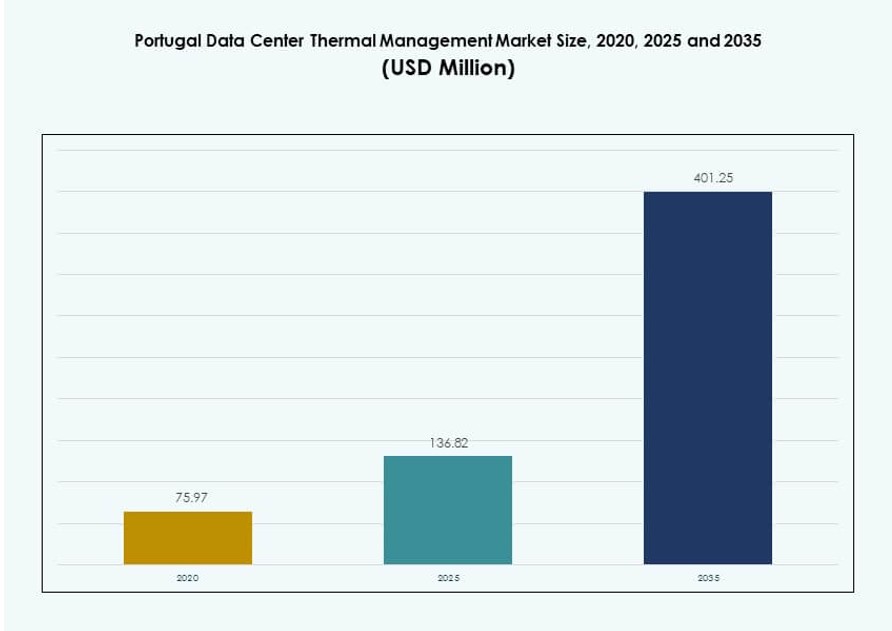
The Portugal Data Center Thermal Management Market size was valued at USD 75.97 million in 2020 to USD 136.82 million in 2025 and is anticipated to reach USD 401.25 million by 2035, at a CAGR of 11.30% during the forecast period.
| REPORT ATTRIBUTE |
DETAILS |
| Historical Period |
2020-2023 |
| Base Year |
2024 |
| Forecast Period |
2025-2035 |
| Portugal Data Center Thermal Management Market Size 2025 |
USD 136.82 Million |
| Portugal Data Center Thermal Netherlands Market, CAGR |
11.30% |
| Portugal Data Center Thermal Management Market Size 2035 |
USD 401.25 Million |
The market is driven by high-density compute environments, AI workloads, and sustainability mandates. Liquid cooling, AI-based control systems, and modular thermal layers are gaining traction. Data center operators adopt precision cooling to reduce energy use and downtime. Vendors innovate across rack, row, and facility-level systems to meet workload demands. The Portugal Data Center Thermal Management Market plays a strategic role in supporting uptime, regulatory compliance, and green infrastructure investment. Its evolution is shaped by power
Lisbon leads market growth due to its concentration of hyperscale, colocation, and cloud facilities. Northern Portugal, including Porto, follows with industrial digitalization and strong regional cloud activity. Central and southern areas are emerging with modular and edge deployments. These zones support latency-sensitive applications and smart city rollouts. The Portugal Data Center Thermal Management Market aligns with digital infrastructure expansion across both dense metros and underserved regions, offering balanced opportunity across the country.
Market Dynamics:
Market Drivers
Rapid Data Center Expansion Demanding High-Performance and Scalable Thermal Infrastructure
The Portugal Data Center Thermal Management Market benefits from growing digital infrastructure across enterprise and hyperscale deployments. High-density compute loads demand precision cooling to avoid downtime. Rack-level power usage continues to increase, stressing conventional HVAC systems. Operators adopt scalable thermal layers spanning chip to facility level. Modernization supports thermal efficiency and uptime improvement. Power-hungry AI and big data workloads add pressure on thermal zones. Vendors develop compact, high-performance cooling units. The market gains strategic importance for ensuring business continuity. It provides investors with entry into the digital infrastructure asset class.
Adoption of Liquid Cooling and Direct-to-Chip Technology Transforming Efficiency Benchmarks
Traditional air cooling cannot meet next-gen rack power requirements. Portugal data centers shift to direct-to-chip and immersion cooling to manage thermal loads. Liquid cooling supports up to 100 kW+ per rack with lower energy use. Colocation providers and hyperscalers lead adoption of rear-door heat exchangers and liquid loops. Energy savings and thermal reliability boost ROI across data center estates. AI-based orchestration helps modulate cooling flow in real time. The Portugal Data Center Thermal Management Market incorporates these innovations for long-term sustainability. Enterprises gain performance stability across hybrid cloud workloads. Investors align with ESG goals through energy-efficient assets.
- For instance, Voltekko’s Alcochete facility targets a PUE below 1.3 with renewable energy and waste heat reuse across its 6 MW IT capacity.
Smart Sensors, Digital Twins, and AI Drive Intelligent Cooling and Fault Prevention
Sensor-based telemetry and thermal mapping enhance visibility across cooling layers. Operators deploy digital twins to simulate airflow and hot spot risk. AI modules optimize temperature thresholds, airflow patterns, and fluid flow. These tools reduce manual intervention and cut energy waste. Predictive maintenance extends cooling system life. Smart software integrates with DCIM for real-time control and alerts. The Portugal Data Center Thermal Management Market benefits from this shift to software-defined cooling. Innovation reduces failure risks in edge and core facilities. Smart infrastructure appeals to enterprise clients seeking long-term reliability.
Rising Colocation and Edge Investments Create Opportunities for Modular and Flexible Cooling
Colocation growth in Lisbon and Porto increases demand for flexible thermal solutions. Clients require rack- or row-based cooling for specific power densities. Edge sites need modular systems with small footprints and high cooling precision. Prefabricated cooling units support rapid deployment cycles. The market expands through turnkey deployments in new edge zones. Vendors design retrofit-friendly solutions to support older facilities. Integration with renewable energy systems also gains relevance. The Portugal Data Center Thermal Management Market enables colocation players to offer uptime guarantees and compliance. Strategic alignment with low-latency use cases strengthens its competitive position.
- For instance, Merlin Properties and Edged Energy are developing a hyperscale AI data center campus near Lisbon with a planned capacity of up to 180 MW, featuring sustainable, waterless cooling technologies aimed at minimizing environmental impact.
Market Trends
Integration of Renewable Energy with Thermal Management Infrastructure for ESG Alignment
Portugal’s abundant solar and wind resources support green data center operations. Operators integrate renewable sources with thermal systems to reduce carbon impact. Hybrid thermal systems optimize performance based on power availability. Battery-backed cooling units stabilize temperature during grid fluctuations. Smart grid integration enables dynamic thermal load adjustments. ESG-driven investors prefer facilities with green thermal solutions. The Portugal Data Center Thermal Management Market tracks this trend closely. Cooling systems adapt to power mix variations, ensuring uninterrupted performance. Energy-conscious clients drive demand for sustainable infrastructure.
Shift Toward Zero-Touch and Autonomous Cooling Management Systems
Operators deploy AI-enabled control loops for autonomous thermal regulation. Smart cooling adjusts in real time without human intervention. Self-learning algorithms reduce energy use and manage workload-induced heat surges. These systems reduce technician errors and manual recalibration needs. Zero-touch operations gain traction in hyperscale and multi-tenant setups. DCIM platforms integrate autonomous thermal modules into dashboards. The Portugal Data Center Thermal Management Market adopts these innovations to support future-ready facilities. Edge zones particularly benefit from remote cooling automation. Reliability and efficiency converge under autonomous control.
Convergence of Power and Cooling Management for Holistic Energy Optimization
Data centers move toward unified orchestration of power and cooling systems. Real-time energy telemetry informs dynamic thermal decisions. Liquid and air systems operate based on IT load variation and power input. This reduces unnecessary overcooling during idle cycles. Unified platforms consolidate control for cost and uptime gains. Colocation providers standardize convergence practices across sites. The Portugal Data Center Thermal Management Market reflects this trend in both greenfield and retrofit deployments. Operators improve PUE and reduce water usage through synergy. Market players co-develop cooling-power convergence modules with energy vendors.
Growing Popularity of Compact and Mobile Cooling Units for Edge Deployments
Edge computing pushes demand for transportable, efficient cooling units. Space-constrained environments require compact designs with high thermal output. Vendors launch container-based and wall-mounted solutions for micro data centers. These systems offer plug-and-play cooling for quick rollouts. Urban and rural edge zones adopt such units to support local latency needs. Remote control features enable unmanned operation across distributed networks. The Portugal Data Center Thermal Management Market integrates these solutions into smart city initiatives. It provides agility for low-latency applications across 5G and IoT workloads. Compact solutions gain popularity among telcos and public agencies.
Market Challenges
High Capital Expenditure and ROI Constraints for Liquid-Based Cooling Adoption
Despite efficiency benefits, liquid cooling systems face upfront cost hurdles. Direct-to-chip and immersion systems require redesigning server hardware and racks. Retrofit integration can involve complex site-specific modifications. SMEs and regional colocation players often delay adoption due to funding limitations. ROI realization depends on energy savings, which may vary across sites. Regulatory incentives for thermal modernization remain limited in Portugal. The Portugal Data Center Thermal Management Market must navigate these cost-performance dynamics. Vendors offering modular, phased rollout models are better positioned to address adoption hesitancy. Bridging the cost gap is critical to expanding thermal innovation access.
Skilled Workforce Shortages and System Complexity Hampering Operational Efficiency
Advanced thermal systems require specialized installation and maintenance skills. Portugal’s workforce development in this niche is still evolving. AI and digital twin systems demand software expertise beyond traditional HVAC knowledge. Operators struggle to fill roles in remote or edge locations. Complex integrations increase system risk if improperly managed. Training costs raise TCO for thermal modernization projects. Without proper workforce alignment, systems fail to achieve optimal efficiency. The Portugal Data Center Thermal Management Market faces operational risks due to this gap. Workforce partnerships and vendor-led training programs remain crucial to industry growth.
Market Opportunities
AI-Driven Thermal Intelligence and Predictive Cooling Enable Operational Cost Savings
AI modules optimize cooling settings to align with dynamic IT loads. Smart systems reduce energy waste by 10–30% in many facilities. Predictive maintenance alerts operators before component failures occur. These tools help extend hardware lifespan and lower service costs. The Portugal Data Center Thermal Management Market captures value through software-centric innovation. DCIM platforms integrating AI gain traction among enterprise and hyperscale clients. Vendors offering thermal analytics as a service find growth in both urban and edge zones.
Heat Reuse and Water-Free Cooling Systems Open New Investment Pathways
Rising sustainability goals drive interest in heat reuse and closed-loop cooling. Operators explore partnerships with industrial zones and district heating networks. Water-free cooling systems reduce environmental impact and comply with local regulations. These models appeal to ESG-aligned investors targeting clean infrastructure. The Portugal Data Center Thermal Management Market can scale these solutions to differentiate facility designs. Municipal cooperation supports deployment in high-density regions. Early adopters gain visibility and policy support across the digital infrastructure ecosystem.
Market Segmentation
By Data Center Size
Large data centers dominate the Portugal Data Center Thermal Management Market due to their higher compute density and thermal complexity. Hyperscale operators drive advanced cooling adoption across rack and row levels. Medium data centers follow with scalable hybrid cooling setups, especially in regional hubs. Small facilities prefer modular systems for low-density use cases. Growth is strongest in large-scale deployments near Lisbon, where fiber and power access support cloud zones.
By Cooling Technology
Liquid-based cooling leads growth, driven by direct-to-chip and immersion methods that support high rack power densities. Rear door heat exchangers and hot/cold aisle containment remain common in air-based systems. Hybrid models are gaining share due to flexible deployment in edge and urban environments. Phase-change and thermoelectric methods are still emerging. The Portugal Data Center Thermal Management Market reflects a balanced mix across cooling layers, with liquid-based expected to gain more share by 2030.
By Component
Hardware holds the largest share in the Portugal Data Center Thermal Management Market due to its essential role in infrastructure. Cooling units, distribution piping, and fans account for significant investment. Software is growing faster, supported by AI, digital twins, and CFD simulation tools. Services like monitoring, commissioning, and preventive maintenance ensure uptime and SLA compliance. Enterprises increasingly adopt bundled offerings to reduce integration gaps.
By Hardware
Cooling units and chillers account for the largest revenue share among hardware components. These are critical for heat removal in both air and liquid-based systems. Heat exchangers and distribution components follow closely in large deployments. Fans and airflow devices dominate in small and medium setups. Other components, such as modular racks and leak-proof manifolds, address niche requirements. Portugal’s infrastructure expansion fuels demand for all subcategories.
By Software
DCIM dashboards and AI thermal optimization dominate the software segment. Enterprises adopt AI tools to adjust cooling flow and manage energy use in real time. CFD simulation supports thermal design validation and retrofits. BMS thermal modules help integrate HVAC with IT loads. Software supports predictive cooling and operational intelligence. The Portugal Data Center Thermal Management Market sees fast adoption across hyperscale and enterprise categories.
By Services
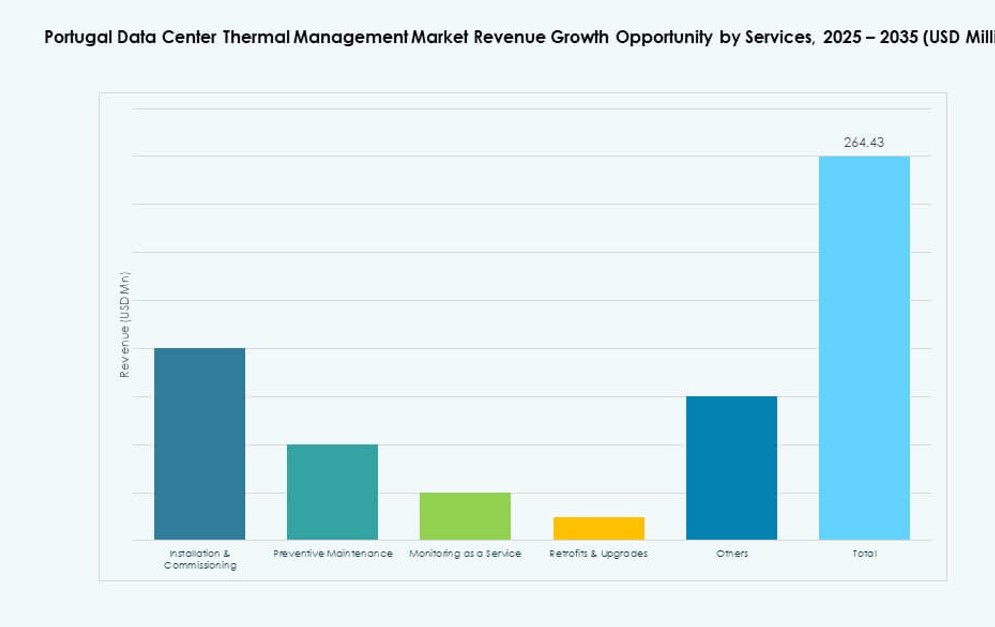
Preventive maintenance and retrofits lead the services segment. Installation and commissioning services follow closely, especially in new projects. Monitoring as a Service gains adoption for edge and unmanned facilities. Vendors also provide lifecycle upgrades and system optimization. Service portfolios expand as complexity increases across hybrid cooling zones. Portugal’s demand for reliability and uptime fuels robust growth in thermal services.
By Data Center Type
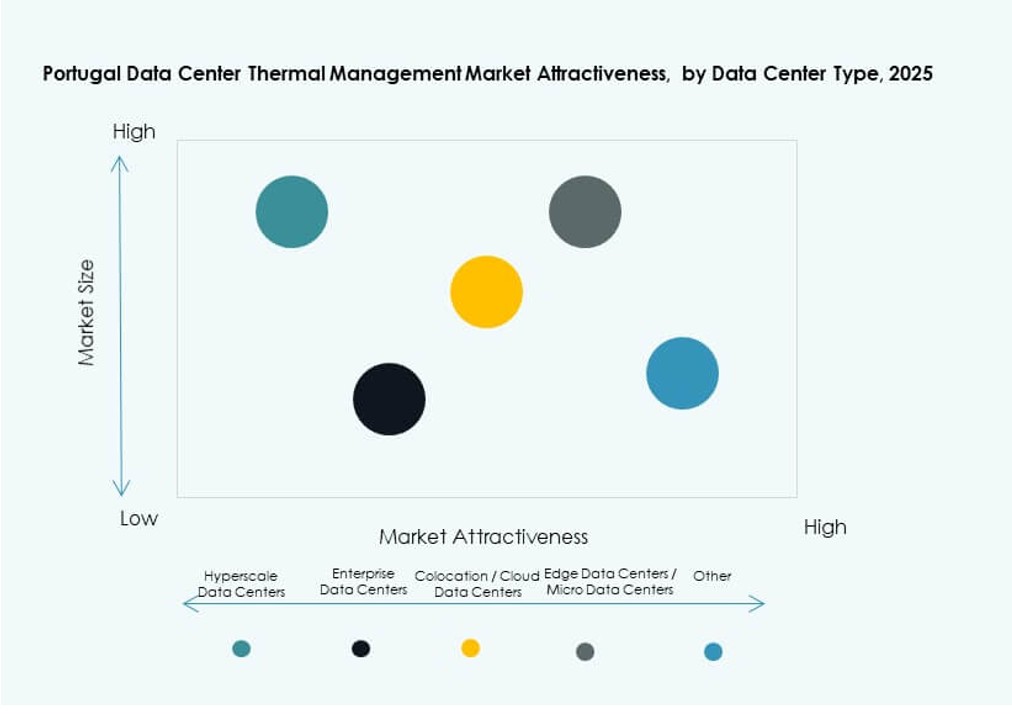
Hyperscale and colocation data centers drive most demand for advanced thermal systems. Enterprise data centers adopt AI-driven cooling to improve cost control. Edge and micro facilities demand compact, modular cooling solutions. The Portugal Data Center Thermal Management Market caters to all types but focuses on hyperscale and colocation segments due to higher thermal output and operational complexity.
By Structure
Room-based cooling is widely used in legacy and large-scale facilities. Rack-based and row-based systems are growing due to higher power density needs. Rack-level cooling offers better precision and modular scalability. Row-level setups balance footprint and airflow efficiency. Structure choices depend on layout, density, and retrofit feasibility. The market reflects this diversity in both new and existing builds.
Regional Insights
Lisbon Metropolitan Area Leads Thermal Infrastructure Deployment with 42% Market Share
Lisbon dominates the Portugal Data Center Thermal Management Market due to strong fiber access, renewable power supply, and high hyperscale activity. Most new colocation and cloud builds concentrate in this metro zone. Favorable policies and connectivity to submarine cables boost Lisbon’s edge. It accounts for 42% of the market share. Strong presence of global cloud providers and local operators drives demand for high-performance thermal systems.
- For instance, Equinix’s global data centers, including Lisbon facilities, achieved an average annual PUE of 1.39 in 2024, improving from 1.42 in 2023 through efficiency initiatives like advanced cooling.
Northern Portugal Holds 31% Share Backed by Industrial Digitization and Regional Hubs
Northern Portugal ranks second with a 31% market share, driven by manufacturing-led digitization and enterprise cloud adoption. Porto serves as the core regional data center cluster. Colocation facilities and telecom edge nodes expand across Braga and Aveiro. Local governments promote digital infrastructure to support regional innovation. The Portugal Data Center Thermal Management Market benefits from energy availability and growing demand for smart cooling in this zone.
Southern and Central Portugal Emerging with 27% Share Through Edge Deployments and Modular Builds
Southern and central Portugal hold a combined 27% market share, primarily through small-scale and modular data center builds. Edge deployments support smart city projects and latency-sensitive applications. These areas attract public-private investments to expand digital access. Compact and water-efficient cooling systems gain traction in rural and remote zones. The Portugal Data Center Thermal Management Market sees rising interest in prefabricated thermal modules across emerging subregions.
- For instance, Start Campus’s SIN01 in Sines uses seawater cooling to achieve a PUE of 1.1, eliminating freshwater use for cooling in its sustainable design.
Competitive Insights:
- Mitsubishi Electric Corporation
- Nortek Air Solutions, LLC
- Trane Technologies plc
- Daikin Industries Ltd.
- Delta Electronics, Inc.
- Eaton Corporation
- Airedale International Air Conditioning Ltd.
- Asetek, Inc.
- Black Box Corporation
- Vertiv Group Corp.
The competitive landscape shows strong participation from global HVAC and thermal solution providers focused on data center needs. Leading companies differentiate through product performance, service portfolios, and regional presence. Vendors compete on energy efficiency, modular design, and integration with digital control systems. Several players tailor hardware and software bundles for high-density racks and liquid-cooling adoption. Strategic partnerships and channel networks help firms secure colocation and hyperscale projects. Market entrants invest in local service capabilities to support installation and maintenance demands. The Portugal Data Center Thermal Management Market benefits from this competition, which drives innovation and price optimization. Buyers gain broader choice and support options. It pushes legacy providers and new entrants to refine offerings and expand value propositions across segments.
Recent Developments:
- In December 2025, Trane Technologies plc announced the acquisition of Stellar Energy Digital’s business strengthening its liquid-to-chip cooling capabilities for data centers. This move integrates Stellar’s modular chiller and CDU expertise into Trane’s portfolio, targeting high-growth thermal management needs.
- In November 2025, Eaton Corporation signed an agreement to acquire Boyd Thermal, for $9.5 billion, expanding liquid cooling technologies from chip to grid for data centers. This enhances Eaton’s power management with Boyd’s high-performance solutions amid AI power surges.
- In August 2025, Daikin Industries Ltd. acquired Dynamic Data Centers Solutions, Inc. (DDC Solutions) to integrate server-level cooling into its air conditioning lineup for AI data centers.
- In May 2025, Nortek Air Solutions, LLC unveiled the StatePoint 2025 hybrid cooling system and C-Force lifecycle model addressing AI-driven data center demands with scalable liquid and air solutions. These updates build on Nortek’s CDU and CRAH expansions, offering efficiency for modular deployments.
- In October 2024, JetCool partnered with Start Campus to introduce advanced micro-convective liquid cooling technology at the 1.2 GW Sines DC facility in Portugal, expanding high-efficiency cooling options for AI GPUs and high-density systems while targeting a PUE of 1.1 and Net Zero by 2030.