Executive summary:
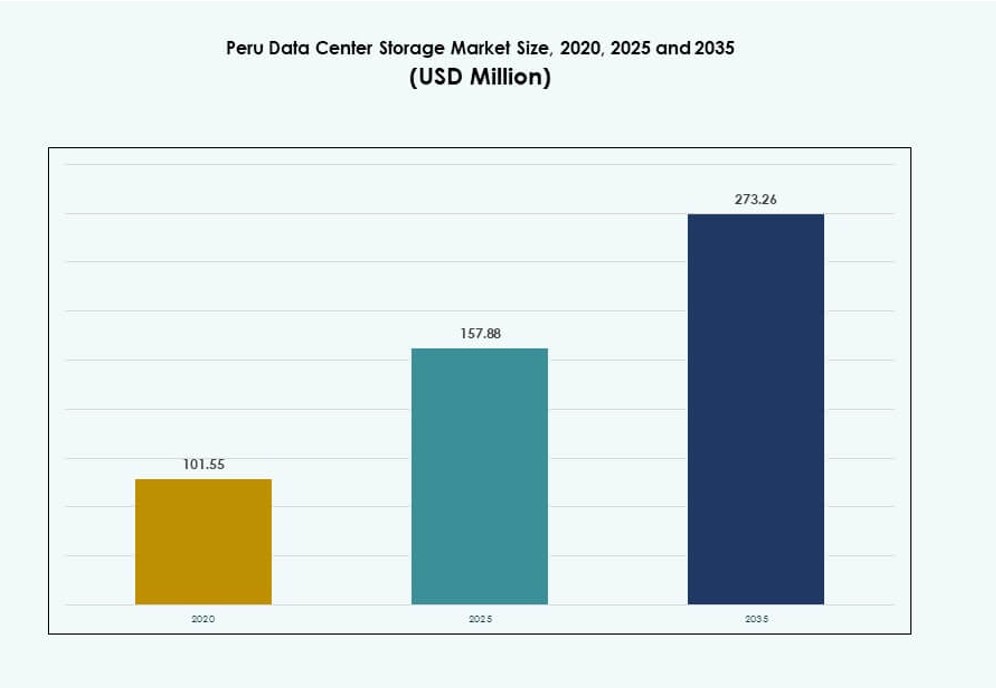
The Peru Data Center Storage Market size was valued at USD 101.55 million in 2020 to USD 157.88 million in 2025 and is anticipated to reach USD 273.26 million by 2035, at a CAGR of 5.59% during the forecast period.
| REPORT ATTRIBUTE |
DETAILS |
| Historical Period |
2020-2023 |
| Base Year |
2024 |
| Forecast Period |
2025-2035 |
| Peru Data Center Storage Market Size 2025 |
USD 157.88 Million |
| Peru Data Center Storage Market, CAGR |
5.59% |
| Peru Data Center Storage Market Size 2035 |
USD 273.26 Million |
Cloud adoption, hybrid storage models, and growing demand for digital services are fueling infrastructure upgrades. Enterprises are investing in software-defined storage to handle rising data loads across financial services, telecom, and government. The shift toward AI integration, real-time analytics, and virtual workloads is pushing modernization. Investors see the market as a strategic hub for enterprise IT, with demand for scalable, secure, and resilient storage platforms continuing to rise. Businesses align storage investments with long-term growth and regulatory compliance.
Lima leads the market due to its dense enterprise base, fiber network, and presence of large-scale data centers. It supports most hyperscale and Tier III facilities catering to national and international clients. Arequipa and Trujillo are emerging regions, driven by smart city efforts, growing regional enterprise activity, and digital infrastructure expansion. These areas show rising potential for edge storage and disaster recovery deployments.
Market Dynamics:
Market Drivers
Digital Expansion Driving Investments in Enterprise Storage Modernization
Peru is seeing increased demand for real-time data storage due to digitization in banking, retail, and government. Enterprises are shifting away from legacy systems to adopt scalable, high-performance platforms. This need for faster data access and backup is fueling the move toward all-flash and hybrid storage. The rise in digital services and mobile users requires robust back-end infrastructure. Cloud-based workloads are growing, demanding secure and compliant storage environments. The Peru Data Center Storage Market supports mission-critical services across public and private sectors. It offers business continuity, reduces latency, and improves disaster recovery readiness. Businesses are aligning storage decisions with long-term digital strategies. Investors view the sector as stable and responsive to modernization.
Emerging Technology Integration Creating Storage Demand Across Data Workflows
Data center modernization in Peru now includes AI, analytics, and edge computing, increasing the need for low-latency and high-capacity storage. These technologies require responsive systems that manage large and complex datasets. Storage architecture is evolving to support distributed workloads and new data governance frameworks. Organizations are implementing faster storage mediums to keep up with AI model training and digital workflow automation. Edge devices, IoT platforms, and surveillance systems also generate data that must be stored securely. The Peru Data Center Storage Market supports digital transformation and innovation across industries. It strengthens operational continuity while reducing energy and hardware inefficiencies. Demand is growing for modular and software-defined solutions that scale with demand. These shifts open up new opportunities for vendors targeting niche enterprise needs.
Cloud Migration Accelerating Storage Infrastructure Deployment in Tier-1 and Tier-2 Zones
The rapid adoption of cloud and hybrid cloud services has increased storage infrastructure deployments across Peru. Enterprises require highly available platforms to support distributed operations and mobile access. Telecom and IT players are investing in data center expansions to localize workloads and reduce network strain. Cloud-native applications have pushed demand for integrated storage that handles structured and unstructured data. As companies adopt SaaS, PaaS, and IaaS models, secure backend storage becomes a business enabler. The Peru Data Center Storage Market helps bridge regional digital gaps and ensures local data control. Government regulations supporting data sovereignty reinforce storage platform upgrades. Service providers compete to offer low-latency, scalable solutions near end users. This creates a highly competitive and fast-evolving business environment.
- For instance, WIN Empresas began expanding its La Molina data center in 2025 to support hybrid cloud and enterprise workloads, aligning with Tier-2 regional hosting needs. The initiative responds to rising demand for integrated storage supporting structured and unstructured data in the Peru Data Center Storage Market.
Strategic Storage Enablement for Public Services, BFSI, and Telecom Operations
Public agencies in Peru now depend on fast storage to deliver e-services, health records, and tax systems. The banking and financial services sector needs compliant, high-speed systems to manage digital transactions. Telecom firms require centralized storage to support 4G and 5G rollouts and expanding broadband networks. These needs have pushed investment in software-defined and SAN-based solutions. The Peru Data Center Storage Market plays a central role in enabling secure, high-volume data flows. It supports real-time analytics and strengthens fraud detection and cybersecurity. Mission-critical applications need low-latency storage that integrates easily into cloud platforms. This makes storage a foundational component of Peru’s national digital infrastructure.
- For instance, Cirion Technologies expanded its data center operations in Peru in 2024 as part of a broader 20MW capacity development plan, supporting telecom and cloud service providers.
Market Trends
Rising Adoption of All-Flash Storage Solutions in Financial and Public Sectors
Enterprises in Peru are turning to all-flash storage for speed and reliability in mission-critical workloads. Flash systems improve access times, reduce power use, and support high-density virtualization. Financial firms and government agencies require this performance for analytics, transaction processing, and digital public services. The Peru Data Center Storage Market reflects this shift through rising flash storage adoption. Demand is highest in workloads needing real-time insight or rapid data backup. Cloud service providers also deploy flash to support latency-sensitive applications. Flash is replacing traditional disk systems in primary storage environments. This trend is reshaping procurement strategies in both public and private sectors. IT teams favor solutions that deliver consistent performance and operational efficiency.
Software-Defined Storage Gaining Ground for Flexibility and Lower TCO
Software-defined storage (SDS) is emerging as a preferred solution for enterprises seeking flexibility and lower hardware dependence. SDS separates hardware from control layers, enabling scalability and automation. Businesses in Peru use it to manage diverse workloads across cloud, edge, and on-premises systems. It reduces CAPEX and offers greater control over storage allocation. The Peru Data Center Storage Market is seeing rapid SDS integration, especially in telecom and managed service operations. Enterprises deploy SDS platforms to unify storage across hybrid environments. It also allows vendors to deliver value-added services with custom configurations. Organizations are aligning storage choices with broader virtualization and orchestration strategies. This shift helps meet future-ready infrastructure goals.
Demand Rising for Storage Solutions That Support Edge and Remote Deployments
Growth in regional digitization is fueling demand for decentralized and edge-ready storage solutions. Applications in mining, healthcare, logistics, and rural governance need fast local storage with cloud sync capabilities. Enterprises and government departments are deploying micro data centers and compact storage systems in remote zones. The Peru Data Center Storage Market addresses these needs by supporting compact and rugged solutions. Edge-friendly platforms reduce latency and improve continuity in bandwidth-constrained areas. Vendors are introducing plug-and-play and modular systems for remote site deployments. This trend aligns with broader efforts to extend digital services beyond Lima. Regional development programs also promote data localization, reinforcing storage investments outside capital zones.
Growing Use of AI-Driven Storage Management and Predictive Maintenance
AI-based monitoring tools are becoming common across enterprise storage platforms to improve availability and control. These systems enable predictive failure detection, workload optimization, and real-time performance tuning. The Peru Data Center Storage Market is adopting AI-enabled storage to reduce downtime and manual intervention. Large enterprises deploy AI to manage multi-tier and multi-site storage environments. It also enhances data classification and improves backup prioritization. AI tools help optimize storage costs and plan upgrades based on usage patterns. Vendors offer integrated AI support in NAS, SAN, and cloud-based platforms. Adoption is strongest in financial, telecom, and digital media industries seeking storage intelligence.
Market Challenges
Fragmented Infrastructure and Uneven Regional Access to High-Quality Storage Services
Peru faces challenges from the lack of uniform storage infrastructure across its regions. Major deployments are concentrated around Lima, while outer regions lack Tier-III or IV facilities. This limits storage service availability and raises latency for users in underserved zones. The Peru Data Center Storage Market contends with gaps in connectivity and infrastructure standardization. In remote areas, high transport and power costs make data center expansion harder. Enterprises must balance centralization with regional storage demands. Vendors also face difficulties maintaining SLAs outside core cities. These limitations impact digital equity and affect service delivery in public and private sectors.
Budget Constraints, Skills Shortage, and Legacy System Compatibility Issues
Many enterprises operate with restricted IT budgets that limit investments in modern storage technologies. Transitioning from legacy storage to scalable models requires upfront capital and skilled staff. The Peru Data Center Storage Market must address a growing gap in local expertise for managing hybrid and software-defined systems. Organizations often struggle with outdated infrastructure that resists cloud integration. Security and compliance risks further complicate adoption. Inadequate technical support and slow procurement cycles reduce deployment agility. Smaller businesses delay upgrades due to complexity and unclear ROI. These factors slow digital progress and reduce competitiveness in fast-moving sectors.
Market Opportunities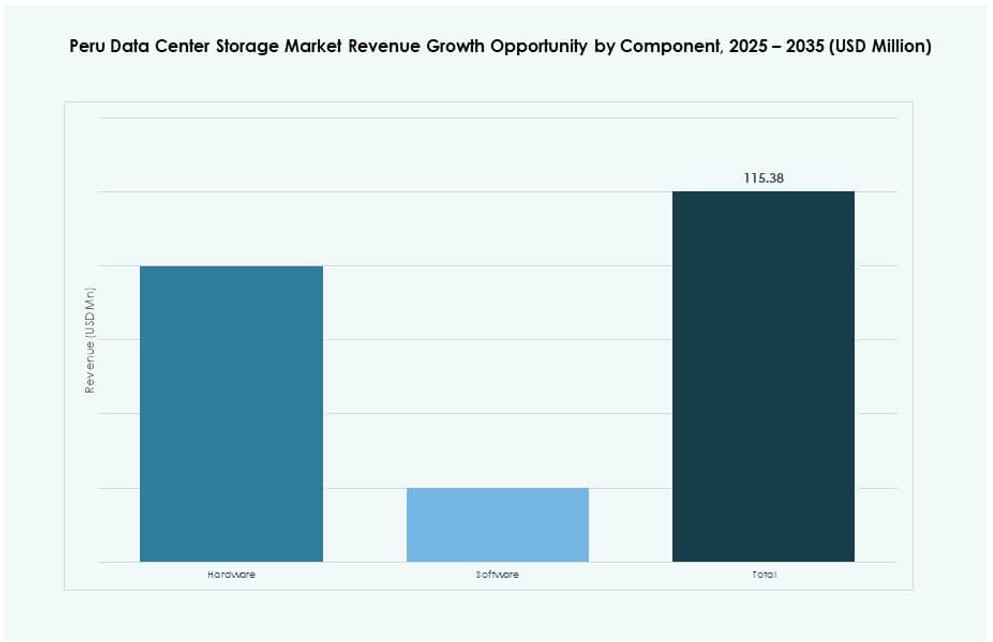
Expansion of Cloud Zones and Regional Hubs Offering Edge Storage Potential
Cloud providers are exploring new regional hubs across Peru to support latency-sensitive applications. These expansions create room for localized edge storage, tailored to remote business needs. The Peru Data Center Storage Market benefits from this trend through new revenue streams and infrastructure scaling. Energy incentives and policy support enable growth beyond major cities. Vendors can offer modular and cloud-synced solutions to meet these needs.
E-Governance, Fintech, and Healthcare Digitalization Unlocking Sector-Specific Demand
The digitalization of governance, finance, and health platforms requires compliant, secure, and scalable storage. These sectors need reliable back-end systems to handle sensitive and high-volume data. The Peru Data Center Storage Market is positioned to support national transformation programs and citizen services. Vendors can capitalize on tailored solutions aligned with public and private priorities.
Market Segmentation
By Storage Type
Traditional storage systems currently dominate due to legacy installations across financial and public institutions. However, hybrid and all-flash storage segments are gaining market share due to speed and efficiency. Hybrid models are popular in cost-sensitive sectors needing performance and capacity. The Peru Data Center Storage Market is shifting toward flash-based solutions for mission-critical workloads, but traditional systems still hold relevance for archival and backup use.
By Storage Deployment
Storage Area Network (SAN) systems lead in high-performance enterprise environments due to scalability and speed. Network-attached Storage (NAS) is common among mid-sized organizations requiring shared access. Direct-attached Storage (DAS) solutions remain relevant for edge and localized needs. The Peru Data Center Storage Market shows growing interest in SAN systems for data-intensive applications, while NAS supports file-level access in distributed teams.
By Component
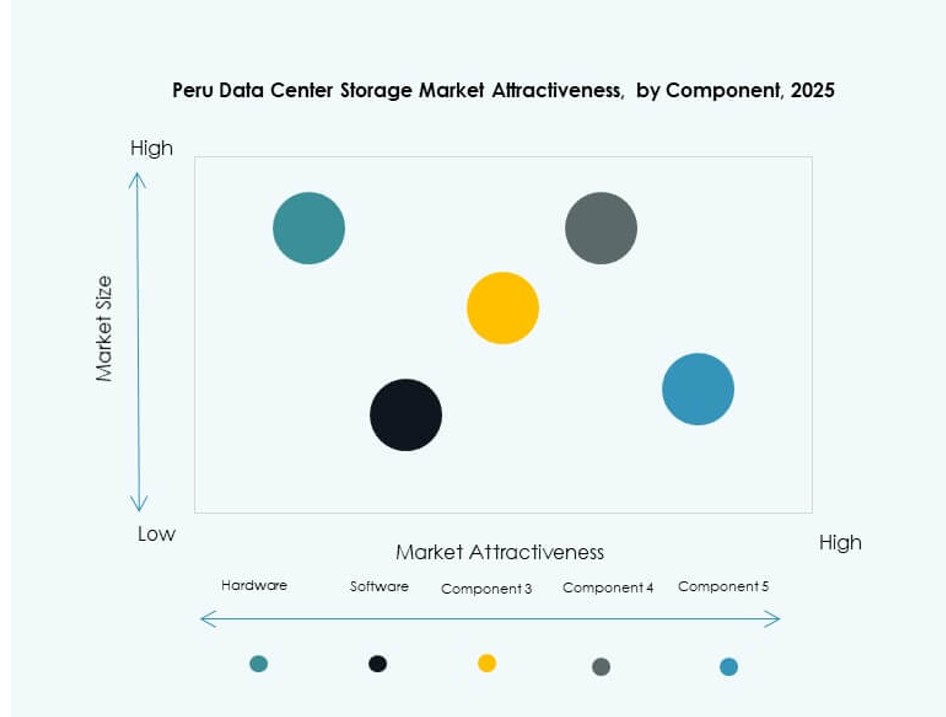
Hardware remains the dominant segment, especially in core data center expansions and upgrades. Software is gaining traction as SDS platforms become central to agile storage architecture. Many vendors now offer bundled hardware-software packages to address varied deployment needs. The Peru Data Center Storage Market reflects this shift as software control becomes a key value differentiator, particularly in hybrid and cloud-ready setups.
By Medium
Hard Disk Drives (HDDs) are still widely used due to their lower cost per GB for bulk storage. However, Solid-State Drives (SSDs) are rapidly growing in adoption for high-speed workloads and virtualized environments. Tape storage remains niche, used mainly for long-term archival in government and compliance-heavy sectors. The Peru Data Center Storage Market continues to favor SSD growth due to performance, though HDDs still dominate in backup systems.
By Deployment Model
On-premises storage models remain prevalent across sectors with strict data control requirements. Cloud-based models are expanding due to demand for scalability and flexibility. Hybrid deployments are increasingly popular, offering control and cloud agility. The Peru Data Center Storage Market supports this mix, with enterprises adopting hybrid-first strategies to manage regulatory compliance and business continuity.
By Application
IT and Telecommunications lead adoption, driving storage demand for mobile data, broadband growth, and cloud platforms. BFSI follows closely due to digital banking and cybersecurity needs. Government applications contribute through digital identity, records, and taxation systems. Healthcare is emerging with increasing electronic health records and diagnostic imaging. The Peru Data Center Storage Market caters to each with sector-specific infrastructure requirements.
Regional Insights
Lima Region Dominates with Over 65% Market Share Due to Data Density and Infrastructure
Lima leads the Peru Data Center Storage Market with more than 65% market share due to its strong connectivity, enterprise concentration, and power availability. Most large-scale data centers are based here, offering low-latency access to critical services. It serves as the hub for telecom, finance, and government storage needs. The region’s infrastructure maturity attracts both domestic and foreign investments. Demand from cloud service providers and public institutions drives continual upgrades. Its dominance will likely persist as a core storage and interconnection zone.
- For instance, Claro Peru announced in 2023 the start of a $50 million investment program to expand its digital infrastructure, including a new data center project in Lima aimed at enhancing enterprise cloud and connectivity services. This aligns with growing demand for secure storage and hosting in the Peru Data Center Storage Market.
Arequipa and Trujillo Jointly Hold Around 25% Share Driven by Regional Digital Expansion
Arequipa and Trujillo together contribute approximately 25% of the market, supported by regional government projects and industrial digitization. Public universities, healthcare facilities, and local financial institutions drive demand for localized storage. These cities are becoming hubs for disaster recovery and secondary data hosting. Connectivity improvements and digital equity programs increase their market relevance. The Peru Data Center Storage Market supports these regions through micro and mid-scale facility deployment. Growth is expected from edge applications and regional data retention initiatives.
- For instance, GTD Peru launched its second data center in Lurín near Lima in October 2024 as part of regional expansion efforts supporting secondary hosting.
Northern and Jungle Regions Account for 10% Market Share, Representing Untapped Potential
The northern and Amazonian zones of Peru account for nearly 10% of the market but remain underdeveloped due to infrastructure gaps. Rural healthcare, e-learning, and logistics applications are starting to create demand for edge storage. The Peru Data Center Storage Market sees potential in deploying compact solutions and cloud gateways to support these needs. Local digital hubs and smart village initiatives are creating groundwork for future growth. Government incentives could drive private partnerships to build regional data capabilities.
Competitive Insights:
- Dell Technologies
- Hewlett Packard Enterprise (HPE)
- IBM Corporation
- Cisco Systems, Inc.
- NetApp
- Huawei Technologies Co., Ltd.
- Lenovo Group
- Win Empresas
- Gtd
- Adexus
The Peru Data Center Storage Market features a diverse mix of global hardware vendors and regional service providers. Dell Technologies, HPE, IBM, and Cisco lead in enterprise storage deployments due to their integrated hardware-software offerings. Huawei and Lenovo support hybrid cloud and modular deployments across telco and public sectors. Local players like Win Empresas and Gtd serve small to mid-sized enterprises with tailored infrastructure. The market is evolving with growing interest in software-defined storage, all-flash systems, and NVMe. Vendors compete on performance, cost efficiency, and regional support. Many form partnerships to expand reach and meet data sovereignty requirements. It offers new opportunities for players with scalable, energy-efficient, and compliance-ready storage products.
Recent Developments:
- In November 2025, Vertiv announced a distribution agreement with DACAS Peru to enhance its channel reach across Latin America. The collaboration focuses on supplying critical infrastructure components, including power and cooling systems that support storage and data center reliability in the Peru Data Center Storage Market.
- In October 2025, GTD announced plans to invest $13 million in 2026 for expanding its Lurín data center to a total 20MW capacity. This follows the initial launch and underscores ongoing growth in Peru’s data storage infrastructure.