Executive summary:
The Spain Data Center Storage Market size was valued at USD 1,346.83 million in 2020 to USD 2,009.29 million in 2025 and is anticipated to reach USD 3,688.71 million by 2035, at a CAGR of 6.21% during the forecast period.
| REPORT ATTRIBUTE |
DETAILS |
| Historical Period |
2020-2023 |
| Base Year |
2024 |
| Forecast Period |
2025-2035 |
| Spain Data Center Storage Market Size 2025 |
USD 2,009.29 Million |
| Spain Data Center Storage Market, CAGR |
6.21% |
| Spain Data Center Storage Market Size 2035 |
USD 3,688.71 Million |
The market is advancing rapidly with rising adoption of cloud-native platforms, AI-driven workloads, and edge deployments. Enterprises are modernizing infrastructure to support real-time analytics, secure data governance, and scalable storage architectures. Demand for software-defined storage and hyperconverged infrastructure is growing across sectors like IT, finance, and healthcare. This shift creates strategic value for businesses seeking operational agility and compliance. The Spain Data Center Storage Market supports digital transformation by enabling low-latency, resilient, and sustainable storage solutions.
Madrid leads the market due to strong connectivity, power availability, and hyperscale presence. Barcelona follows, backed by edge data growth and smart city projects. Cities like Valencia and Bilbao are emerging as new hubs due to digital economy incentives and infrastructure investments. These regions attract both global operators and domestic firms looking to expand their storage footprint. Geographic expansion strengthens the overall resilience and accessibility of Spain’s data infrastructure landscape.

Market Dynamics:
Market Drivers:
Cloud Workload Expansion Driving Demand for Agile and Scalable Storage Infrastructure
Enterprises in Spain are rapidly migrating from legacy systems to cloud-native environments. This shift demands storage systems that can scale quickly and manage diverse workloads. The rise of containerization and microservices boosts reliance on flexible data infrastructure. Organizations require high throughput and low-latency access to support real-time applications. Storage vendors are delivering agile solutions with centralized control and seamless scalability. The Spain Data Center Storage Market benefits from investments in hybrid cloud setups across key sectors. It is becoming essential for business continuity and compliance. Growing digital ecosystems in finance, healthcare, and government intensify demand for smart storage management.
- For instance, MAPFRE partnered with Logicalis Spain to deploy a high-performance Azure Landing Zone in 2025, enabling scalable multi-cloud storage for enterprise workloads with automated governance across hybrid setups.
Shift Toward Hyperconverged Infrastructure for Efficiency and Cost Optimization
Hyperconverged infrastructure (HCI) adoption is accelerating as enterprises seek simplicity and cost reduction. HCI combines compute, storage, and networking in a single appliance, enabling easier deployment and management. Businesses reduce overhead by eliminating siloed systems and manual operations. Software-defined capabilities streamline workflows and enhance agility. The Spain Data Center Storage Market embraces HCI to support rapid scaling in colocation and hyperscale environments. It also allows IT teams to manage workloads with fewer tools. Storage becomes elastic and policy-driven, boosting operational efficiency. These advantages make HCI a strategic choice for digital transformation roadmaps.
Data-Intensive Workloads Fueling Growth in High-Performance Storage Technologies
AI, machine learning, and analytics applications require high-throughput, low-latency storage solutions. All-flash storage and NVMe systems gain traction to meet these performance needs. Businesses prioritize speed and predictability to support real-time processing. Large enterprises in telecom and research deploy high-bandwidth systems to reduce data bottlenecks. The Spain Data Center Storage Market responds with increased use of parallel I/O, optimized file systems, and tiered storage. These technologies support complex workloads such as video rendering, financial modeling, and language processing. Demand for scalable performance drives investment in premium storage infrastructure. Performance-driven architecture becomes a competitive asset for digital leaders.
Rising Regulatory Compliance and Data Localization Boosting Secure Storage Deployments
Spain’s data privacy regulations and EU-wide GDPR compliance push enterprises toward secure storage models. Businesses must ensure data is stored and processed within specific jurisdictions. This leads to stronger interest in local storage deployment and encrypted storage solutions. Regulatory requirements shape how companies choose infrastructure partners and deployment locations. The Spain Data Center Storage Market aligns with regional data residency mandates by offering customizable, compliant storage platforms. Storage vendors integrate encryption, audit trails, and access controls for risk mitigation. This supports industries like healthcare and government that handle sensitive information. Compliance readiness becomes a key driver of market differentiation.
- For instance, Telefónica secured an €80m Spanish defense contract in 2024 deploying a secure dark fiber network with physical infrastructure for compliant data handling.
Market Trends:
Growth of Edge Data Centers Accelerating Demand for Distributed Storage Architectures
Edge data centers are gaining traction to process data closer to users and devices. This decentralization reduces latency and supports applications like IoT and AR/VR. Storage systems must deliver performance at remote sites with minimal human intervention. Lightweight, high-density storage arrays become essential in space-constrained environments. The Spain Data Center Storage Market responds with compact, ruggedized systems for edge deployments. These solutions integrate seamlessly with core infrastructure and cloud services. Businesses use edge setups to improve customer experience and reduce data transit costs. Growth of 5G and real-time analytics strengthens the relevance of edge storage.
Demand for Green Storage Solutions Supporting Sustainability Goals in Data Operations
Sustainability is now a core focus for data infrastructure design. Storage vendors are developing energy-efficient products with low power consumption and reduced cooling needs. Enterprises adopt storage solutions that align with carbon reduction targets. Energy-saving features such as automated tiering, deduplication, and high-capacity SSDs gain adoption. The Spain Data Center Storage Market supports sustainable operations through eco-certified solutions. Companies pursue green certifications by optimizing storage density and thermal profiles. Investors view energy-efficient systems as part of ESG commitments. Sustainability-driven procurement reshapes storage vendor selection criteria across industries.
Artificial Intelligence Integration into Storage Management Enhancing Operational Intelligence
AI and machine learning are transforming how storage systems are managed and optimized. Predictive analytics identify performance anomalies before they impact operations. Storage infrastructure becomes self-healing, adaptive, and resource-aware. Vendors embed AI into software-defined storage for proactive capacity planning and intelligent tiering. The Spain Data Center Storage Market incorporates these features to support autonomous infrastructure strategies. Businesses reduce downtime, streamline administration, and extend asset life. AI-driven management is now a key value differentiator in competitive storage deployments. Smarter infrastructure accelerates enterprise decision-making.
Rising Use of Object-Based Storage to Handle Unstructured Data Growth Across Sectors
Object storage is becoming essential for handling massive volumes of unstructured data. Enterprises store images, videos, logs, backups, and documents in scalable object formats. This structure supports metadata tagging and easier access across applications. The Spain Data Center Storage Market witnesses growing use of object storage in healthcare, media, and surveillance. It supports data lakes, analytics pipelines, and archival workloads. Object storage offers durability, scalability, and cloud-native compatibility. This makes it ideal for organizations handling exponential data growth. Vendors focus on multi-petabyte deployments to accommodate expanding repositories.
Market Challenges:
Data Sovereignty and Infrastructure Fragmentation Limiting Seamless Storage Integration Across Jurisdictions
Varying regional policies and compliance frameworks create complexity for cross-border storage deployment. Businesses must align infrastructure to local laws while ensuring global data access. Data sovereignty rules complicate centralization, especially in cloud environments. Integrating on-prem, private, and public storage under unified governance remains a challenge. The Spain Data Center Storage Market faces these hurdles while balancing user expectations for real-time access. Fragmented networks reduce visibility and increase risk in multi-site setups. Enterprises need interoperable storage platforms that comply with local regulations without limiting functionality. Achieving this balance requires sustained investment in management frameworks.
Cost Constraints and Legacy Infrastructure Slowing Storage Modernization Across Mid-Sized Enterprises
Many mid-sized organizations operate on tight budgets with limited IT staff. Upgrading legacy systems to modern storage solutions can be cost-prohibitive. Initial capital expenses and migration risks delay adoption, especially in traditional sectors. Legacy hardware may lack compatibility with cloud or AI-driven tools. The Spain Data Center Storage Market must address these economic limitations with flexible financing and modular designs. Vendors offering consumption-based models or pay-as-you-grow plans have better traction. Mid-market digital transformation depends on lowering entry barriers for advanced storage. Solutions must offer long-term ROI while easing operational overhead.

Market Opportunities:
Expansion of Cloud-Native Applications Creating New Opportunities for Storage Optimization and Migration
Cloud-native development reshapes how enterprises build and deploy applications. These environments require dynamic, high-performance storage infrastructure. The Spain Data Center Storage Market can capitalize on this by offering container-aware, scalable, and multi-tenant systems. Storage vendors with Kubernetes-integrated features and API-driven platforms gain competitive advantage. Growth in SaaS, microservices, and serverless computing strengthens the demand for tailored storage architecture. Companies that support agile storage provisioning and granular control will benefit from rising cloud investments.
Digital Infrastructure Investments in Underserved Regions Unlocking Demand for Tier 2 and Tier 3 Storage Hubs
Government-backed digitalization programs and EU funding boost infrastructure development in secondary cities. These areas require localized storage facilities to reduce latency and enable regional data hosting. The Spain Data Center Storage Market can tap into these initiatives by deploying modular, low-footprint solutions. Expansion in Tier 2 cities like Valencia and Bilbao creates room for edge storage deployments. Localized data hubs support regional businesses and improve resilience during network disruptions.
Market Segmentation:
By Storage Type
All-flash storage leads in adoption due to its superior speed, reliability, and lower latency. Enterprises favor it for AI, analytics, and virtualization workloads. Hybrid storage follows as firms balance performance with cost-efficiency. Traditional storage is still relevant in legacy setups. The Spain Data Center Storage Market increasingly shifts toward flash and hybrid options to support modern digital workloads and optimize power usage.
By Storage Deployment
Storage Area Network (SAN) systems dominate the deployment landscape, especially in large enterprises needing high-speed and centralized access. Network-attached Storage (NAS) appeals to SMEs due to its ease of use and flexibility. Direct-attached Storage (DAS) remains common for entry-level setups. The Spain Data Center Storage Market shows a preference for SAN in mission-critical environments, while NAS and DAS support edge and secondary data centers.
By Component
Hardware forms the core of market revenues, driven by physical infrastructure demand across colocation and hyperscale setups. However, software components are gaining importance for orchestration, analytics, and automation. Vendors integrate AI and machine learning into software-defined storage solutions. The Spain Data Center Storage Market reflects this balance as companies seek smarter, more autonomous operations through software innovations.
By Medium
Solid-State Drives (SSDs) lead the market due to their performance and efficiency in high IOPS workloads. HDDs still hold value in archival and cold storage use cases, especially in budget-sensitive sectors. Tape storage remains niche, mainly in long-term backup. The Spain Data Center Storage Market increasingly invests in SSDs for primary workloads, improving responsiveness in cloud and virtualization platforms.
By Deployment Model
Hybrid models are gaining traction as companies combine on-premises control with cloud scalability. Cloud-based storage also grows rapidly, especially in startups and SaaS businesses. On-premises deployment remains critical for regulated sectors like healthcare and finance. The Spain Data Center Storage Market supports this diversity by offering flexible deployment models tailored to varying compliance and performance needs.
By Application
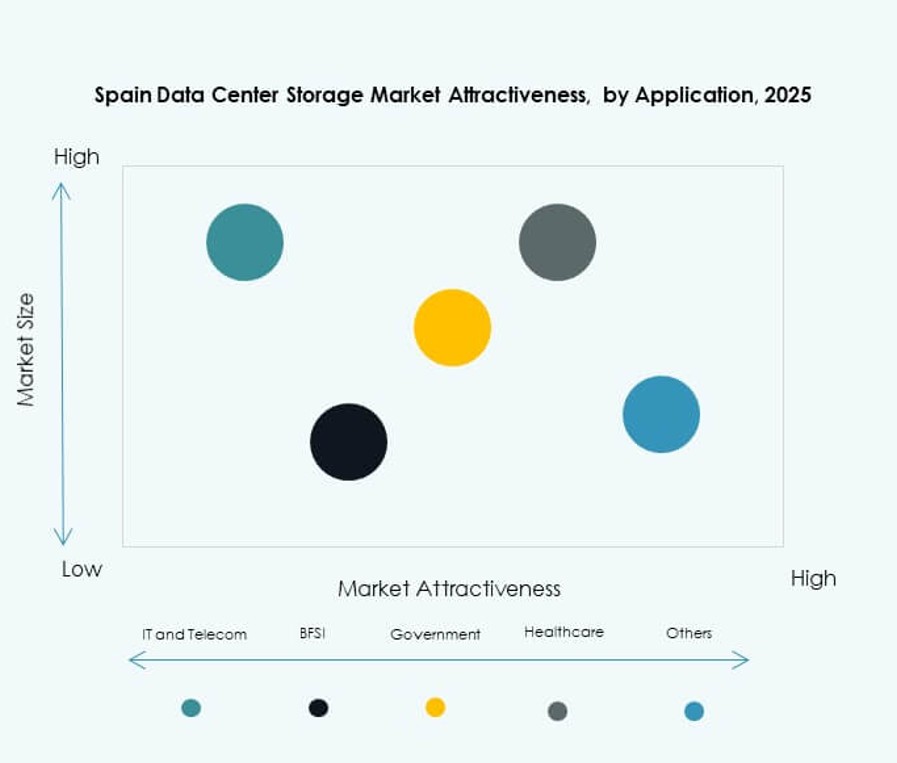
IT and telecommunications lead in storage consumption due to massive user data generation and 24/7 service needs. BFSI follows closely, driven by high data volumes, security, and compliance. Government and healthcare sectors require secure, localized storage. The Spain Data Center Storage Market serves these verticals by offering scalable and sector-specific solutions for workload optimization and regulatory alignment.
Regional Insights:
Madrid Leading the Market with Over 40% Share Due to Hyperscale Investments and Infrastructure Maturity
Madrid holds the largest share in the Spain Data Center Storage Market due to robust connectivity, power availability, and hyperscale presence. Major cloud providers and colocation firms have established hubs around the city. Its central location and strong fiber network support high data throughput. Enterprises prefer Madrid for latency-sensitive and critical workloads. The region benefits from ecosystem maturity, skilled workforce, and regulatory alignment, making it the core of Spain’s digital infrastructure.
- For instance, Digital Realty’s MAD1 facility at Calle Albasanz 71 provides 11,000 m² of colocation space with 2N power redundancy.
Barcelona Holding Second Position with Around 25% Share Driven by Innovation and Edge Growth
Barcelona ranks second in market share due to its growing role in edge data center deployment and smart city initiatives. It supports digital industries, startups, and media production that require agile, localized storage. Proximity to Southern Europe and Mediterranean routes boosts cross-border connectivity. The city promotes innovation through public-private partnerships. The Spain Data Center Storage Market gains from Barcelona’s push toward distributed storage infrastructure and low-latency access.
- For instance, Equinix launched its BA2 facility adjacent to BA1 in 2024, providing 3.4 MW across 2,522 m².
Valencia, Bilbao, and Málaga Emerging with a Combined Share of 20% Due to Regional Expansion
Secondary cities like Valencia, Bilbao, and Málaga are expanding their data center footprints through regional development programs. These cities benefit from growing local demand, better fiber access, and reduced operational costs. EU recovery funds and national digitalization plans drive investment in Tier 2 markets. The Spain Data Center Storage Market sees new opportunities in these regions for edge deployments and regional disaster recovery nodes. Growth here supports broader national resilience and data decentralization goals.
Competitive Insights:
- Indra
- Telefónica Tech
- Dell Technologies
- Hewlett Packard Enterprise (HPE)
- Cisco Systems, Inc.
- Lenovo Group
- NetApp
- IBM Corporation
- Seagate Technology
- Huawei Technologies Co., Ltd.
The Spain Data Center Storage Market features a mix of domestic integrators and global storage technology providers competing across enterprise and hyperscale deployments. Telefónica Tech and Indra play leading roles in local cloud and data infrastructure projects. Global vendors like Dell Technologies, HPE, and NetApp dominate high-performance, hybrid, and software-defined storage deployments. These firms invest in all-flash arrays, NVMe integration, and autonomous storage management platforms. Cisco and Lenovo focus on converged infrastructure while Seagate and Huawei lead in hardware innovation. The market prioritizes partnerships, regulatory alignment, and green storage solutions. It remains dynamic with players differentiating through innovation, workload optimization, and regional customization.
Recent Developments:
- In November 2025, ACS, a major Spanish construction group, partnered with BlackRock’s Global Infrastructure Partners to launch a joint venture focused on data center development in Spain. The venture committed an initial €2 billion investment, with plans to expand the portfolio up to €23 billion. This initiative supports long-term infrastructure growth and increases storage demand across Tier I and Tier II regions.
- In September 2025, EdgeMode Inc. entered a binding agreement with Blackberry AIF to acquire a portfolio of hyperscale data center development assets in Spain. The deal established a joint venture targeting 1.5 GW of sustainable AI infrastructure capacity.
- In October 2024, the Damac Group from Dubai announced a €400 million investment to build a 40MW data center in Madrid. This marked the company’s entry into Spain’s cloud and storage market. The facility aims to strengthen Madrid’s position as a regional digital hub and scale enterprise storage capabilities to meet rising digital workloads.