Executive summary:
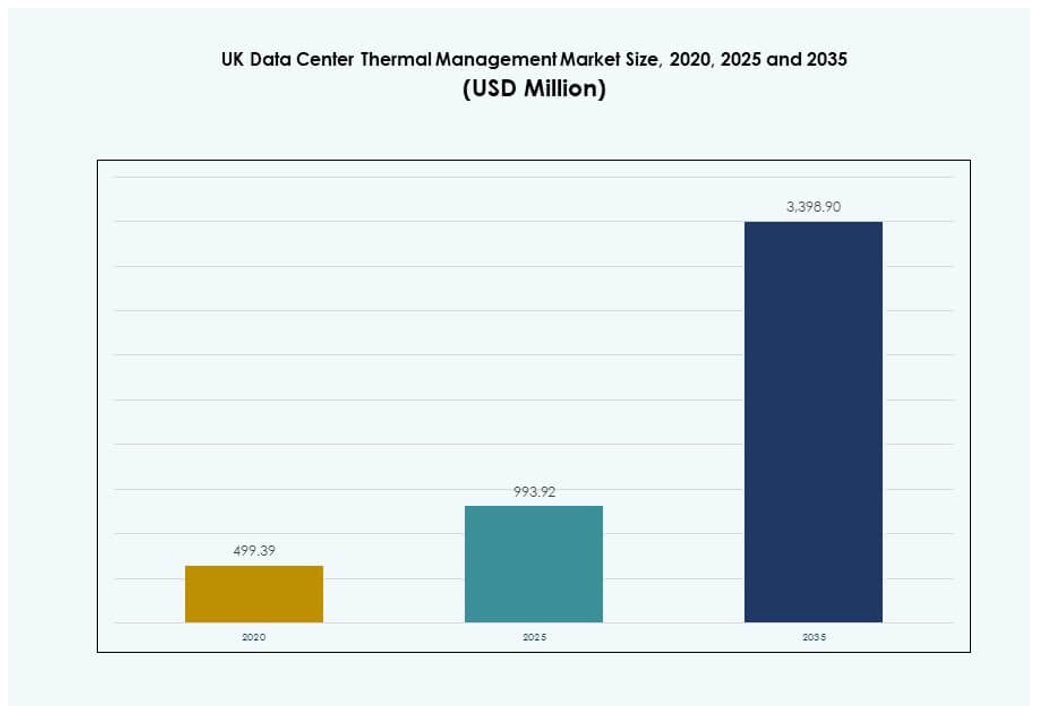
The UK Data Center Thermal Management Market size was valued at USD 499.39 million in 2020, reached USD 993.92 million in 2025, and is anticipated to reach USD 3,398.90 million by 2035, at a CAGR of 13.00% during the forecast period.
| REPORT ATTRIBUTE |
DETAILS |
| Historical Period |
2020-2023 |
| Base Year |
2024 |
| Forecast Period |
2025-2035 |
| UK Data Center Thermal Management Market Size 2025 |
USD 993.92 Million |
| UK Data Center Thermal Management Market, CAGR |
13.00% |
| UK Data Center Thermal Management Market Size 2035 |
USD 3,398.90 Million |
Growth in high-density AI computing, rising adoption of liquid and hybrid cooling systems, and stronger regulatory focus on energy efficiency are key market drivers. Enterprises are shifting toward direct-to-chip and immersion cooling technologies to support GPU-intensive workloads. AI-driven thermal control systems are gaining traction in large colocation and hyperscale facilities. This market is strategically important for investors due to its alignment with net-zero targets, infrastructure resilience goals, and long-term digital transformation across sectors.
London and Slough remain the dominant regional hubs due to dense hyperscale and cloud deployments. These areas continue to attract investments due to established connectivity, power availability, and regulatory compliance frameworks. Manchester, Birmingham, and Leeds are emerging with edge deployments and enterprise data centers. Cooler climates in Scotland and Wales support longer free cooling cycles, encouraging passive system adoption in secondary zones. This geographic spread shapes a distributed and resilient thermal management ecosystem.
Market Dynamics:
Market Drivers
Rising High-Density Computing and Artificial Intelligence Workloads Across Enterprise and Hyperscale Sites
The UK Data Center Thermal Management Market is seeing strong momentum due to increasing high-density compute workloads driven by AI, machine learning, and GPU-heavy applications. New builds across London and Slough are designed to support over 20 kW per rack. These deployments demand precision cooling technologies and containment systems. Businesses invest in liquid cooling, direct-to-chip, and hybrid designs for operational efficiency. This evolution shifts capital toward thermal innovation over legacy air systems. The integration of workload-aware cooling software boosts reliability in dynamic server environments. Investments are shifting to designs that lower both PUE and carbon footprints. Enterprises prioritize sustainability while meeting compute demands. Strategic investors see long-term value in intelligent thermal design assets.
- For instance, Equinix’s LD6 facility in Slough offers 4-15 kW per cabinet with adiabatic cooling for high-density racks, supporting over 2,770 cabinets across its phases.
Adoption of Liquid-Based and Immersion Cooling Technologies Across Mission-Critical Environments
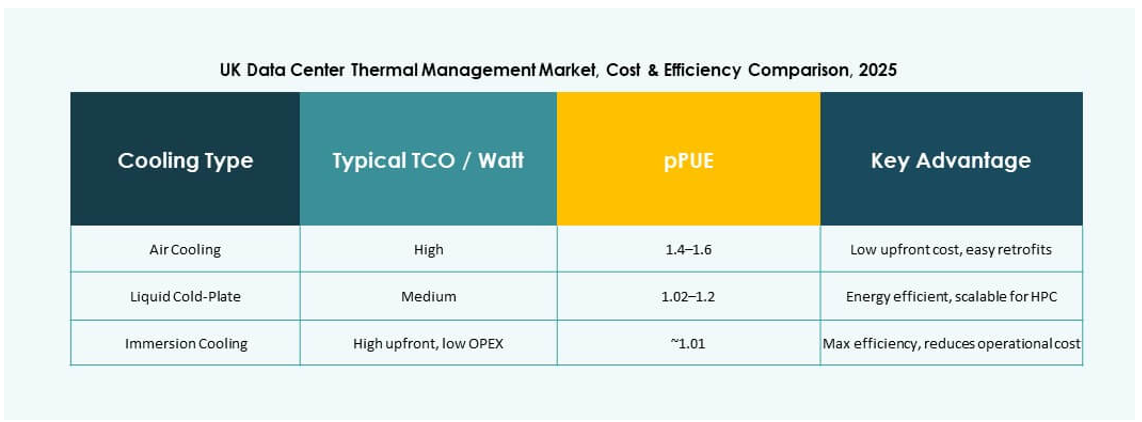
Liquid-based cooling is expanding in hyperscale and colocation sites where rack densities exceed 30 kW. The UK market supports advanced cooling systems such as direct-to-chip and immersion setups to enhance energy efficiency. Immersion cooling reduces mechanical load, noise, and space use. Data centers integrate modular cooling blocks and isolated liquid loops to streamline operations. Operators seek systems that allow flexibility during expansion phases. The technology reduces the dependence on chillers and large HVAC units. The UK Data Center Thermal Management Market is shifting toward thermal systems that handle sudden power load changes. These systems help meet compliance and performance requirements. Businesses view these solutions as key to scaling future-ready infrastructure.
Integration of AI-Based Thermal Monitoring and Predictive Control to Improve Efficiency
Artificial intelligence is becoming central to optimizing cooling performance in real-time. AI models analyze sensor data, airflow rates, humidity, and rack power use to guide thermal behavior. Predictive control tools help forecast thermal load peaks before they impact uptime. Operators are applying AI to DCIM platforms for energy savings. Smart cooling supports remote monitoring and issue resolution without manual input. These systems also allow predictive maintenance, reducing repair costs. The UK Data Center Thermal Management Market uses AI to balance efficiency and compliance. Software integration reduces human error in temperature-sensitive environments. Businesses with large-scale deployments benefit from centralized, AI-driven thermal orchestration.
- For instance, Equinix LD6 employs mass air cooling with indirect heat exchange and 100% natural ventilation, targeting LEED Platinum status for AI-optimized energy efficiency in its 86,000 sq ft facility.
Government Regulations and Corporate Carbon Reduction Targets Are Reshaping Cooling Infrastructure
UK data centers must comply with energy reporting rules and net-zero carbon goals. Regulations such as SECR and local sustainability mandates require facilities to improve energy use transparency. Operators adopt low-GWP refrigerants and use renewable-powered cooling. Modular chillers and free cooling systems align with environmental policies. Enterprises aim to lower Scope 1 and 2 emissions from thermal infrastructure. The UK Data Center Thermal Management Market faces growing investor pressure to meet ESG standards. It accelerates demand for cooling systems that enable low Power Usage Effectiveness (PUE) and Water Usage Effectiveness (WUE). This regulatory shift makes green thermal management a key strategic priority.
Market Trends
Growing Use of Rear Door Heat Exchangers in Both Air and Liquid Configurations
Rear door heat exchangers are gaining preference in medium and large data centers across the UK. These systems offer high thermal efficiency without major structural changes. Air- and liquid-based units reduce hot spots and optimize airflow at the rack level. Operators deploy hybrid configurations to manage growing rack density in limited spaces. They allow phased cooling upgrades aligned with hardware scaling. Rear door solutions also support variable load profiles across colocation and enterprise sites. The UK Data Center Thermal Management Market benefits from this modular and space-saving trend. Vendors focus on rack-level solutions over full-room retrofits. The approach offers a balance between cost and performance.
Rise in Rack-Based and Row-Based Architectures Over Traditional Room-Based Layouts
Infrastructure design is evolving from room-based cooling to rack- and row-based approaches. These models allow localized thermal control with faster response times. Row-based units improve airflow efficiency in confined environments. Operators deploy them to meet zoning constraints and retrofit needs. Rack-based cooling also enables precision delivery at high density zones. This layout flexibility supports colocation firms that require tenant-specific cooling profiles. The UK Data Center Thermal Management Market sees strong uptake in row-focused designs in edge and cloud deployments. They suit modular deployments and Tier III environments. This architectural shift enhances efficiency and deployment speed.
Integration of Renewable Energy and Aquifer Cooling for Lower Operational Emissions
Thermal systems now align with green power sourcing across the UK. Facilities use ambient conditions and aquifer systems to lower energy demand. Some operators leverage rainwater and groundwater storage to cut chiller reliance. These passive cooling systems help reduce both emissions and long-term costs. Renewable integration supports the wider push for carbon-neutral data operations. Systems also meet government-backed incentives for energy-efficient retrofits. The UK Data Center Thermal Management Market supports sustainability-driven retrofits in key hubs. Integration of clean power with advanced cooling is central to next-generation designs. Vendors embed sustainability metrics into their value proposition.
Growth of CFD Simulation and Virtual Testing in Cooling System Planning
Operators use Computational Fluid Dynamics (CFD) to model airflow and temperature scenarios before deployment. This trend reduces on-site errors and improves cooling layout optimization. CFD simulation tools help operators predict heat buildup and test containment strategies virtually. It supports better ROI in capital planning. The models factor in IT load, airflow paths, ceiling height, and humidity. The UK Data Center Thermal Management Market adopts simulation tools across hyperscale and enterprise environments. Software integration enables proactive thermal adjustments during layout shifts. Providers align system design with simulation outcomes to reduce thermal risk.
Market Challenges
Rising Power Densities Are Outpacing Existing Thermal Design Capabilities in Legacy Facilities
Many UK data centers were built for workloads under 10 kW per rack and struggle to scale efficiently. Older sites face spatial and structural limits in deploying liquid cooling or containment systems. Upgrades require downtime and capital investments that many operators avoid. Lack of hot aisle containment and outdated airflow control hampers performance. Operators must balance tenant needs with shared infrastructure limits. The UK Data Center Thermal Management Market faces difficulty in standardizing upgrades across older footprints. Legacy HVAC systems cannot meet modern AI and GPU workload heat loads. Limited floor space further restricts deployment of modular chillers or immersion tanks.
Cost Pressures and Talent Shortages Limit Deployment of Advanced Cooling Infrastructure
Advanced thermal systems such as immersion cooling, AI-based optimization, or hybrid loops involve high upfront costs. Many mid-sized operators lack funding to replace air-based units. Installation and integration require skilled technicians in airflow mapping, liquid system maintenance, and thermal modeling. The UK faces a shortage of data center engineers with specialized thermal skills. Small providers struggle to compete with hyperscale operators for talent. Complex retrofits also extend lead times and create vendor dependency. The UK Data Center Thermal Management Market deals with slow rollout in regions outside of London. Budget limits and long ROI cycles delay advanced cooling adoption across the sector.
Market Opportunities
Expansion of Edge and Modular Data Centers Across Regional Zones in the UK
Edge computing growth opens opportunities for compact, rack-based cooling solutions in non-urban areas. These systems support smart city deployments, IoT, and 5G networks. Compact form factors require efficient thermal designs with remote monitoring. The UK Data Center Thermal Management Market benefits from edge and modular facilities needing agile thermal control. These formats allow standardized cooling packages that scale quickly. Growth of low-latency applications supports demand for localized, high-efficiency cooling.
Emerging Use Cases in High-Performance Computing and AI Labs Across Research Institutions
Universities and research labs are installing high-performance computing clusters with heavy thermal needs. These projects require custom cooling infrastructure and energy reuse systems. The UK Data Center Thermal Management Market can support advanced use cases through vendor partnerships. It opens niche demand in education, bioinformatics, and fintech hubs. These facilities prefer liquid-based solutions for temperature-sensitive workloads.
Market Segmentation
By Data Center Size
Large data centers dominate the UK Data Center Thermal Management Market due to the scale of hyperscale and cloud investments across London and Slough. These sites demand modular chillers, liquid cooling, and advanced airflow management. Medium centers are growing with enterprise upgrades. Small facilities remain limited to air-based systems but are targets for edge deployments. Growth in large facilities drives vendor focus toward high-density, high-efficiency systems.
By Cooling Technology
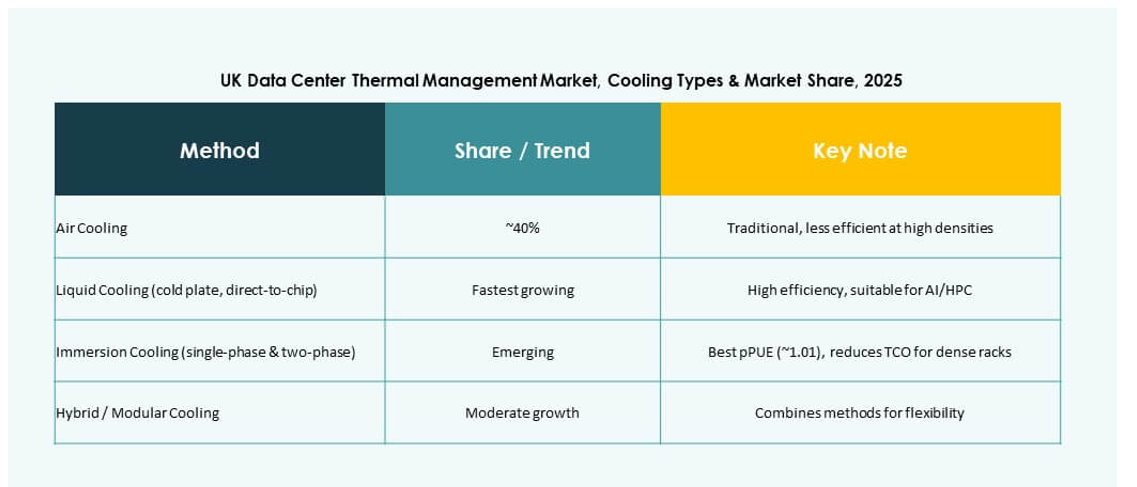
Air-based cooling remains widespread, especially hot/cold aisle containment and rear door heat exchangers. Liquid cooling, including direct-to-chip and immersion, is rising with AI workloads. Hybrid systems that combine both dominate new deployments. The UK Data Center Thermal Management Market sees rear door liquid-based units gaining popularity in dense zones. Phase-change and thermoelectric options remain niche but growing in lab settings.
By Component
Hardware accounts for the largest share of spending, with chillers, airflow units, and distribution systems leading. Software such as AI optimization tools and CFD modules sees fast growth in hyperscale environments. Services play a vital role in retrofits and energy audits. The UK Data Center Thermal Management Market increasingly values integrated software and services alongside physical hardware.
By Hardware
Cooling units and chillers are the backbone of the infrastructure, used in all Tier-certified data centers. Heat exchangers and airflow devices are essential for containment systems. Piping networks enable efficient distribution in both air and liquid systems. The UK Data Center Thermal Management Market demands robust hardware with modular and scalable configurations.
By Software
AI optimization platforms help automate thermal adjustments and reduce energy use. DCIM dashboards with real-time visualization are common in enterprise sites. CFD simulation is growing in design stages to validate cooling layouts. BMS modules enable centralized monitoring and control. The UK Data Center Thermal Management Market prioritizes software that supports predictive and remote cooling control.
By Services
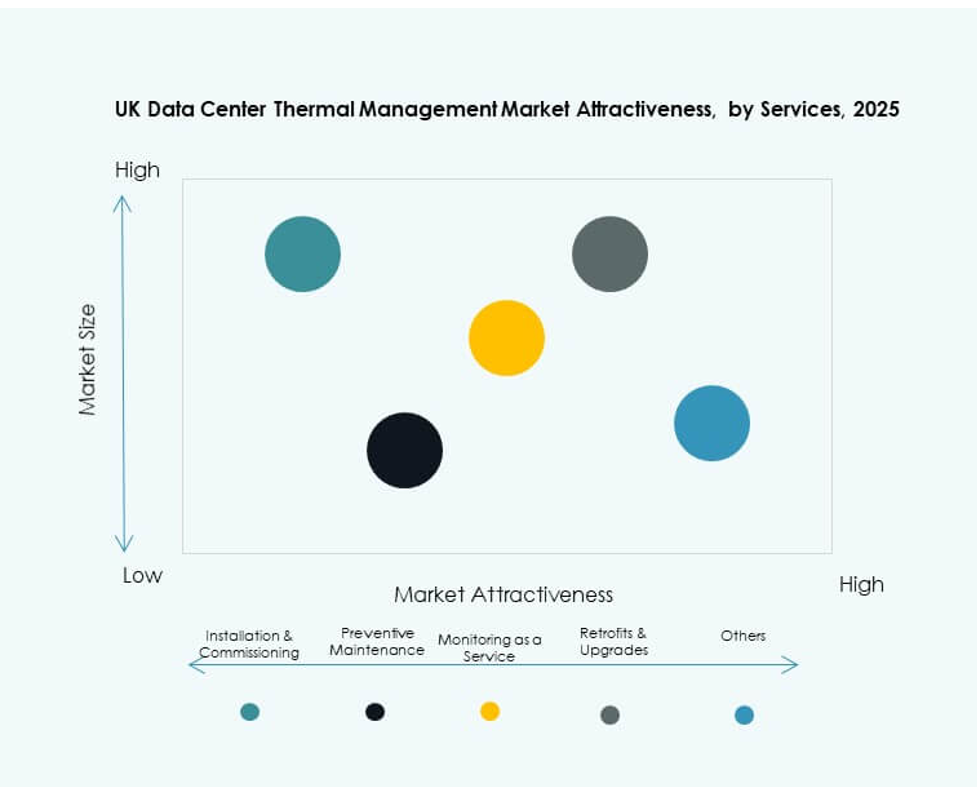
Installation and commissioning services are essential for new builds and retrofits. Preventive maintenance ensures uptime across thermal systems. Monitoring as a service supports smaller operators lacking in-house teams. Retrofits and upgrades offer long-term cost savings. The UK Data Center Thermal Management Market sees growing service demand driven by compliance and energy efficiency mandates.
By Data Center Type
Hyperscale facilities lead due to major cloud and AI deployments. Colocation centers also see strong adoption, especially in power-constrained zones. Edge and micro sites are emerging as 5G and IoT scale. Enterprise facilities are modernizing with hybrid cooling systems. The UK Data Center Thermal Management Market aligns innovation with hyperscale and colocation players.
By Structure
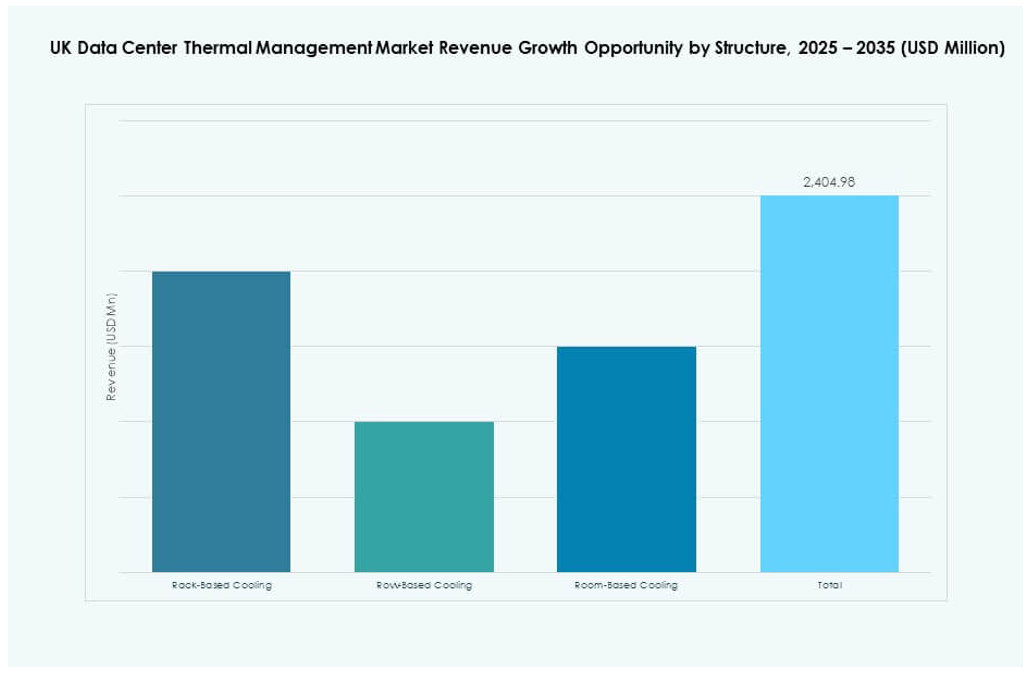
Rack-based structures are growing fastest due to space-saving and precision cooling benefits. Row-based systems support modular zones and retrofits. Room-based models persist in legacy environments but are being replaced. The UK Data Center Thermal Management Market focuses on rack and row systems for high-density efficiency and quick deployment.
Regional Insights
London and Slough Form the Core Cluster Driving Over 65% Market Share
London remains the largest subregion due to hyperscale, financial, and colocation concentration. Slough supports several major data parks catering to AI and enterprise workloads. These hubs prioritize modular chillers, liquid cooling, and AI-enabled monitoring tools. The UK Data Center Thermal Management Market sees most retrofit and expansion activity in these zones. Dense deployments and compliance needs drive aggressive cooling upgrades. Power constraints push operators toward energy-efficient thermal designs.
- For instance, a 10 MW London facility achieved 44% energy savings after upgrading airflow management, chillers, and control systems. Power constraints push operators toward energy-efficient thermal designs.
Midlands and North England Contribute About 20% as Secondary Expansion Zones
Birmingham, Manchester, and Leeds see growing data center investments from cloud and retail sectors. Lower land costs and favorable regulations support mid-sized builds. Operators deploy row- and rack-based systems to manage energy budgets. These zones are suitable for edge deployments supporting real-time services. The UK Data Center Thermal Management Market sees potential for modular thermal systems in these regions. Regional data hubs align with decentralization trends.
- For instance, Stellium’s Newcastle facility (in North England) maintained cooling within design tolerances during 32°C heatwaves using minimal extra energy, achieving a PUE of 1.24.
Scotland, Wales, and Northern Ireland Hold the Remaining 15% Market Share
These areas benefit from cool climates that extend free cooling hours. Lower energy costs and sustainability incentives attract colocation providers. Data centers in Edinburgh and Cardiff use aquifer and rainwater-based cooling designs. The UK Data Center Thermal Management Market supports passive and hybrid systems in these low-density regions. They serve niche markets, backup, and edge services across underserved zones. Strategic policies may boost thermal innovation and green cooling pilots.
Competitive Insights:
- Vertiv Group Corp.
- Schneider Electric
- Daikin Industries Ltd.
- Johnson Controls International plc
- Delta Electronics, Inc.
- Mitsubishi Electric Corporation
- Airedale International Air Conditioning Ltd.
- Munters Group AB
- Rittal GmbH & Co. KG
- Eaton Corporation
The competitive landscape reflects intense focus on efficiency, innovation, and service breadth. Vertiv and Schneider hold significant share due to broad portfolios and deep service networks across enterprise and hyperscale sites. Daikin and Johnson Controls drive adoption of advanced HVAC and liquid cooling solutions. Delta and Mitsubishi expand footprint through energy‑efficient hardware and modular designs. Mid‑tier players such as Airedale and Munters target niche segments with specialized thermal systems. Rittal and Eaton strengthen offerings with integrated power and cooling solutions. The UK Data Center Thermal Management Market favors vendors that offer scalable solutions with strong support frameworks. Partnerships and strategic alliances accelerate product reach. Companies invest in R&D to address rising rack densities and stricter sustainability goals. This competitive push improves technology and lowers total cost of ownership.
Recent Developments:
- In November 2025, Eaton Corporation signed an agreement to acquire Boyd Thermal for $9.5 billion expanding its liquid cooling solutions to address surging AI data center power demands from chip to grid.
- In September 2025, Johnson Controls International plc expanded its thermal management portfolio with a new scalable series of Coolant Distribution Unit (CDU) technology, tailored for next-generation AI training and inference in data centers.
- In April 2025, Daikin launched the Pro-C computer room air handler (CRAH) manufactured in UK facilities, offering cooling capacities from 30 kW to 210 kW with AI-supported efficiency for data center thermal needs