
Spain Data Center Thermal Management Market Size, Share & Forecast to 2035
Market at a glance
The Spain Data Center Thermal Management market was worth USD 523.4 million in 2025 and is forecast to reach USD 1,529.9 million by 2035, growing at a 11.26% CAGR. Catalonia and Valencia account for 25% of the market.
 By Satyabrat Rajawat, Senior Research Analyst, Strategic Advisory
 Reviewed by Deepti Agrawal
Last updated 16 Apr 2026
Base year 2024 PDF + Excel
Reviewed by Deepti Agrawal
Last updated 16 Apr 2026
Base year 2024 PDF + Excel
Source: DC Market Insights analysis
Key findings
Growing Implementation of Rear Door Heat Exchangers and Row-Based Cooling Layouts
Geographic Cooling Inefficiencies in Warmer Southern Regions Increase Operational Pressure
Shift Toward Liquid Cooling in AI Workloads Offers a Long-Term Growth Path
Regional insights
- Catalonia and Valencia25%
- Southern Spain and Emerging Locations20%
Segmentation
Companies profiled
- Vertiv Group Corp
- Daikin Industries Ltd
- Delta Electronics, Inc
- Johnson Controls International plc
- Mitsubishi Electric Corporation
- Eaton Corporation
- Airedale International Air Conditioning Ltd
- Huawei Technologies Co., Ltd
- Salicru
- Grupo Elecnor
Recent developments
Delta Electronics partnered with Siemens for prefabricated modular power solutions to accelerate data center deployment.
Ecolab (via its Nalco Water unit) officially launched 3D TRASAR™ Technology for Direct-to-Chip Liquid Cooling to address the escalating thermal demands of AI and high-performance computing (HPC).
Airedale by Modine (Airedale International Air Conditioning Ltd.) obtained $180 million in orders for data center cooling systems from an AI infrastructure developer.
Full analysis
Executive summary
The Spain Data Center Thermal Management Market size was valued at USD 291.16 million in 2020, increased to USD 523.38 million in 2025, and is anticipated to reach USD 1,529.89 million by 2035, at a CAGR of 11.26% during the forecast period.
| REPORT ATTRIBUTE | DETAILS |
|---|---|
| Historical Period | 2020-2023 |
| Base Year | 2024 |
| Forecast Period | 2025-2035 |
| Singapore Data Center Thermal Management Market Size 2025 | USD 523.38 Million |
| Singapore Data Center Thermal Netherlands Market, CAGR | 11.26% |
| Singapore Data Center Thermal Management Market Size 2035 | USD 1,529.89 Million |
The market is driven by rising hyperscale and colocation activity, increased AI workloads, and higher rack densities. Operators adopt advanced thermal systems, including liquid cooling and hybrid designs, to ensure uptime and energy efficiency. Vendors integrate AI-based monitoring and automation into cooling infrastructure to optimize performance and reduce PUE. Demand for modular, scalable solutions continues to rise, aligning with green building initiatives and ESG targets. These trends make the market strategically important for stakeholders investing in Spain’s digital and cloud infrastructure ecosystem.
Madrid dominates the market due to its concentration of data centers and network hubs. The region supports large-scale colocation and cloud operations, driving demand for advanced thermal infrastructure. Catalonia and Valencia are emerging with steady growth in enterprise deployments and tech park developments. Southern regions such as Andalusia show potential for edge and green data center projects due to land availability and renewable integration. This regional spread supports nationwide expansion of thermal management systems.

Market Dynamics
Market Drivers
Rising Demand for Energy-Efficient Thermal Solutions in High-Density Colocation and Hyperscale Environments
The Spain Data Center Thermal Management Market benefits from the rapid expansion of colocation and hyperscale facilities. These deployments support rising cloud workloads, AI applications, and digital transformation efforts across Spain. Power densities now frequently exceed 20 kW per rack, driving demand for advanced cooling solutions. Operators prefer systems that minimize power usage effectiveness (PUE) while supporting 24/7 uptime. Free cooling, adiabatic cooling, and indirect evaporative techniques see wider adoption. Liquid-based systems are also entering larger deployments for high-performance zones. Sustainability mandates from the European Union influence procurement strategies. Thermal systems that integrate well with renewable-powered infrastructure attract stronger interest.
Adoption of Liquid Cooling for AI Workloads and Edge Infrastructure Modernization
The market gains from investments in direct-to-chip and immersion cooling technologies. AI and machine learning models generate higher thermal loads, requiring more localized heat extraction. In Spain, hyperscale providers and cloud players retrofit existing sites with liquid cooling to meet performance demands. Colocation players build liquid-ready suites to attract new-generation workloads. Edge data centers also upgrade cooling systems to maintain reliability in non-industrial environments. This shift drives innovation in compact, modular thermal units. Local system integrators adapt global technologies to suit regional power and climate conditions. Spain Data Center Thermal Management Market evolves in sync with Europe’s AI infrastructure roadmap.
- For instance, Telefónica deployed Submer’s immersion cooling technology at its Bellas Vistas central office in Madrid, aiming to improve energy efficiency and reduce environmental impact through reduced power usage and elimination of traditional refrigerants.
Integration of Renewable Energy with Cooling Infrastructure to Meet ESG Targets
Thermal systems that integrate with renewable energy sources attract investor and enterprise attention. Spain’s access to solar and wind energy enables greener cooling operations. Operators implement systems that reduce reliance on compressors and leverage outside air. In areas like Aragon, Valencia, and Andalusia, data centers utilize free cooling with solar-assisted fans. Government policies incentivize ESG-compliant infrastructure, boosting demand for sustainable thermal products. Efficient systems support ISO 50001 certifications and LEED standards. Developers increasingly seek vendor solutions with lifecycle carbon analysis. The Spain Data Center Thermal Management Market supports the national energy transition goals by enabling low-carbon operations.
Digital Transformation of Thermal Management Through Smart Software and Predictive Control
Operators deploy AI-based software to manage and optimize thermal loads in real-time. Digital twins, CFD modeling, and predictive analytics help reduce cooling inefficiencies. Integrated building management systems (BMS) streamline HVAC, airflow, and thermal performance data. Spain’s data centers rely on automated alerts and AI logic to shift between cooling modes. Smart sensors track component-level heat to adjust settings precisely. These systems lower operational costs and improve service-level agreements (SLAs). Enterprises prioritize predictive maintenance to prevent thermal faults. The Spain Data Center Thermal Management Market supports this transition through software-driven upgrades and modular deployments.
- For instance, Siemens opened a data center technology hub in Madrid equipped with advanced thermal optimisation and digital simulation tools to enhance cooling efficiency and resource performance across digital infrastructure.
Market Trends
Growing Implementation of Rear Door Heat Exchangers and Row-Based Cooling Layouts
Rear door heat exchangers see strong deployment across Spain’s medium and large data centers. They support high-density computing while minimizing airflow disruption. Operators value these units for their space-saving benefits and modularity. Row-based cooling setups also gain preference in retrofitting scenarios. These configurations support targeted cooling aligned with specific workload zones. Many facilities implement aisle containment with rear-door units for dual-effect cooling. This setup balances energy use while maintaining thermal control. The Spain Data Center Thermal Management Market adopts these designs to balance flexibility and performance.
Software-Centric Thermal Monitoring Systems Powering Operational Efficiency
Thermal management software tools become a core investment across facilities. AI-based monitoring platforms help optimize load distribution and rack-level heat control. Spanish operators utilize software for multi-site energy visibility. Custom dashboards present temperature fluctuations, fan speed efficiency, and airflow analytics. Vendors offer tailored solutions compatible with legacy and next-gen hardware. Software-as-a-service models enable real-time updates and remote intervention. The Spain Data Center Thermal Management Market benefits from this digital pivot, where intelligent control improves both uptime and energy metrics.
Edge and Micro Data Centers Using Passive and Hybrid Cooling in Compact Locations
Edge deployments are rising in urban and remote locations across Spain. These sites rely on passive and hybrid cooling systems for cost and space efficiency. Thermosiphons, phase-change materials, and indirect air units reduce infrastructure complexity. Rack-based cooling becomes critical to fit thermal systems in space-constrained areas. Smart cooling enclosures with solar-compatible modules are being deployed. Integration with local renewable grids ensures continuous operations during outages. The Spain Data Center Thermal Management Market expands with edge infrastructure requiring low-touch, efficient cooling.
Circular Design and Reuse of Thermal Equipment Driving Sustainability Compliance
Thermal equipment reuse and modularity support environmental targets. Spanish data centers begin reusing pipes, ducts, and fans during upgrades. Circular economy frameworks promote vendor participation in take-back schemes. Recyclable thermal components and extended service warranties gain traction. Operators prefer suppliers that track environmental impact across the thermal equipment lifecycle. Refurbished chillers and cooling units are refurbished for secondary deployments. The Spain Data Center Thermal Management Market aligns with circularity mandates through extended product value cycles.
Market Challenges
Geographic Cooling Inefficiencies in Warmer Southern Regions Increase Operational Pressure
Southern Spain experiences high ambient temperatures, limiting free cooling windows. Data centers in these regions consume more power to maintain optimal thermal conditions. Operators face higher costs for mechanical cooling and backup power. Adiabatic and evaporative systems require significant water resources, raising environmental concerns. Local restrictions on water usage constrain adoption in some provinces. Systems must be engineered for temperature extremes and part-load efficiency. Rural setups face additional grid limitations, impacting cooling reliability. The Spain Data Center Thermal Management Market must address regional climate variability with adaptive thermal strategies.
Skilled Workforce and Integration Complexity Affect Smooth Deployment of Advanced Systems
Thermal management systems require specialized integration with facility controls, energy systems, and IT loads. Lack of skilled personnel limits the ability to manage AI-optimized systems. Medium-size operators struggle to manage BMS-CFD-DCIM integration. Frequent system upgrades create compatibility challenges with legacy equipment. Training and certification gaps hinder widespread adoption of smart cooling solutions. Vendors must offer localized support, but talent shortages slow expansion. Delays in commissioning raise project timelines and affect return on investment. The Spain Data Center Thermal Management Market needs skill development initiatives to scale digital thermal systems.

Market Opportunities
Shift Toward Liquid Cooling in AI Workloads Offers a Long-Term Growth Path
AI and GPU-heavy workloads require thermal solutions beyond traditional air systems. Direct-to-chip and immersion cooling allow precise heat removal. Operators upgrading core zones can achieve lower PUE and higher server performance. Vendors offering liquid-ready infrastructure gain market entry. The Spain Data Center Thermal Management Market captures this trend through hyperscale expansion and AI colocation builds.
Public and Private Incentives for Sustainable Data Center Cooling Enable Innovation
Government green tech grants and EU decarbonization funds support R&D in eco-efficient thermal systems. Localized cooling-as-a-service (CaaS) models attract mid-tier operators. The market benefits from policies aligned with carbon neutrality goals. It opens investment avenues in heat reuse, aquifer cooling, and smart chillers. Spain Data Center Thermal Management Market unlocks value from its regulatory shift toward green innovation.
Market Segmentation
By Data Center Size
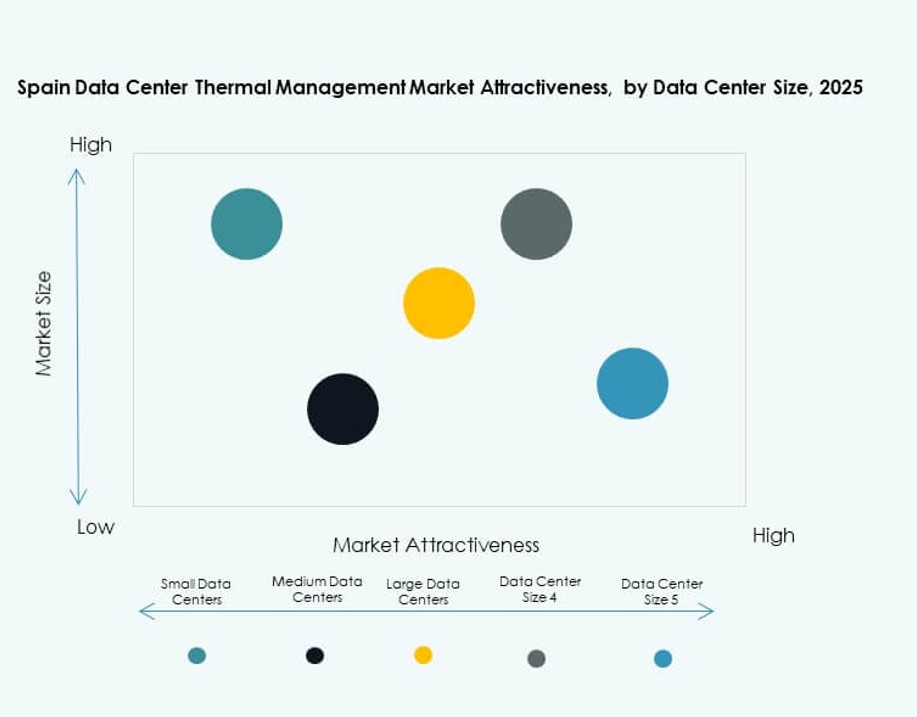
Large data centers dominate the Spain Data Center Thermal Management Market due to hyperscale and colocation demand. These facilities operate at high densities and require scalable thermal infrastructure. Medium-size centers support regional enterprises and also adopt efficient thermal units. Small data centers rely on rack-based systems with passive or hybrid cooling. Growth in edge and retail IT infrastructure supports this mix of deployments.
By Cooling Technology
Air-based cooling, especially hot/cold aisle and direct air systems, leads in installed base. Rear-door heat exchangers see higher growth for localized high-density cooling. Liquid-based cooling grows with AI adoption, particularly direct-to-chip systems. Immersion cooling enters pilot and HPC zones. Hybrid cooling mixes dominate retrofits and multi-zone sites. Emerging technologies like phase-change and thermoelectric solutions see early trials.
By Component
Hardware holds the largest share due to the physical nature of cooling systems. Cooling units, airflow devices, and heat exchangers dominate budgets. Software grows rapidly with AI monitoring and DCIM dashboards. Services such as preventive maintenance and retrofits also see recurring demand, especially across multi-tenant facilities. The Spain Data Center Thermal Management Market reflects a balanced mix of hardware intensity and software intelligence.
By Hardware
Cooling units and chillers lead hardware demand. Heat exchangers and fans follow closely, especially in large and medium data centers. Piping and distribution systems support modular expansion. High-growth lies in airflow optimization tools and rear-door liquid components. The hardware ecosystem evolves to enable quick deployment, redundancy, and minimal downtime.
By Software
AI-based optimization and DCIM platforms lead software growth. CFD simulations assist with facility design and retrofitting. BMS modules integrate HVAC, power, and thermal layers. Dashboards allow real-time visibility and granular control. The Spain Data Center Thermal Management Market sees high demand for software that supports predictive maintenance and adaptive cooling shifts.
By Services
Preventive maintenance and retrofits hold the largest share. Monitoring-as-a-service gains traction across cloud and enterprise setups. Installation and commissioning remain essential in greenfield projects. Smart upgrades and vendor-led SLAs create a stable services ecosystem. Long-term service contracts create recurring revenue for thermal vendors.
By Data Center Type
Hyperscale dominates due to major cloud and AI investments. Colocation and cloud providers follow with rising thermal customization. Enterprise data centers invest in standardized retrofits. Edge and micro centers demand compact, efficient thermal systems. Thermal strategies vary based on IT load, location, and operational model.
By Structure
Room-based cooling remains common but is declining. Rack-based and row-based structures grow due to their adaptability and energy efficiency. Modular zones often combine both for optimal outcomes. The Spain Data Center Thermal Management Market increasingly favors rack-based systems in new builds and high-density zones.
Regional Insights
Madrid as the Core Data Center Cluster with Over 55% Market Share in Thermal Installations
Madrid leads Spain’s data center industry with hyperscale, cloud, and enterprise hubs. It hosts a dense colocation ecosystem with ongoing thermal modernization. Urban heat islands push adoption of low-PUE, liquid-assisted systems. Free cooling is limited due to warmer climates and air quality. Government and telecom data hubs also concentrate in this zone. The Spain Data Center Thermal Management Market sees Madrid as its strategic epicenter.
- For instance, CyrusOne’s MAD1 facility in Alcobendas deploys a resilient ring chilled water-cooling system with 9 MW IT capacity cooling per floor and N+1 free cooling air-cooled chillers for low PUE.
Catalonia and Valencia Account for 25% Share with Mixed Edge and Cloud Deployments
Barcelona and Valencia attract regional cloud deployments and startup-friendly colocation zones. These markets support medium and small data centers with efficient, modular thermal systems. Hybrid air-liquid solutions serve varied enterprise needs. Renewable energy integration is higher due to proximity to wind and solar farms. Growing industrial activity and smart city projects support sustained growth in thermal solutions.
Southern Spain and Emerging Locations Represent 20% Share with Strong Renewable Synergies
Andalusia, Murcia, and Canary Islands witness growth in edge and AI infrastructure. These regions experiment with solar-powered thermal solutions and water-efficient cooling. Emerging data centers leverage hybrid cooling to address temperature extremes. Expansion projects often rely on government zones or university R&D hubs. The Spain Data Center Thermal Management Market benefits from distributed demand and diverse thermal design needs.
- For instance, Nabiax powers its data center facilities with 100% renewable energy and implements waste heat reuse strategies to support sustainability goals across its campuses in Madrid and Barcelona.
Competitive Insights
- Vertiv Group Corp.
- Daikin Industries Ltd.
- Delta Electronics, Inc.
- Johnson Controls International plc
- Mitsubishi Electric Corporation
- Eaton Corporation
- Airedale International Air Conditioning Ltd.
- Huawei Technologies Co., Ltd.
- Salicru
- Grupo Elecnor
The competitive landscape shows strong participation from global HVAC and data center infrastructure vendors, supported by several active local players. Vertiv, Daikin, and Delta lead with broad thermal portfolios and deep service networks across Spain and Europe. Johnson Controls and Mitsubishi Electric bring integrated building controls that appeal to enterprise and colocation operators. Eaton and Airedale compete on modular, scalable solutions suited for medium and large sites. Huawei and Salicru focus on energy-efficient and digital thermal systems that align with sustainability goals. Grupo Elecnor leverages local project execution strength in critical infrastructure. The Spain Data Center Thermal Management Market favors competitors that combine hardware, software control, and lifecycle services. Market share gains depend on fast deployment, service reliability, and tailored cooling solutions for AI and high‑density workloads.
Recent Developments
- In November 2025, Delta Electronics partnered with Siemens for prefabricated modular power solutions to accelerate data center deployment.
- In May 2025, Ecolab (via its Nalco Water unit) officially launched 3D TRASAR™ Technology for Direct-to-Chip Liquid Cooling to address the escalating thermal demands of AI and high-performance computing (HPC).
- In February 2025, Airedale by Modine (Airedale International Air Conditioning Ltd.) obtained $180 million in orders for data center cooling systems from an AI infrastructure developer.
Table of contents
Table of Content
- Introduction
- Market Definition & Scope
- Research Methodology
- Primary Research
- Secondary Research
- Data Validation & Assumptions
- Market Segmentation Framework
- Executive Summary
- Market Snapshot
- Key Findings
- Analyst Recommendations
- Market Outlook (2025–2035)
- Market Dynamics
- Market Drivers
- Market Restraints
- Market Opportunities
- Challenges & Risks
- Value Chain Analysis
- Porter’s Five Forces Analysis
- PESTEL Analysis
- Market Attractiveness Analysis
- Cooling Technology
- Component
- Hardware
- Software
- Services
- Data Center Type
- Structure
- Thermal Layer / Cooling Zone Analysis
- External cooling infrastructure & building-level HVAC integration
- Room-level cooling distribution & containment integrity
- Rack-level & server-level thermal management (air / liquid / immersion)
- Multi-layer cooling stack evaluation (facility → room → row → rack → chip)
- Thermal risk modeling (hot spots, load spikes, redundancy failure modes)
- Technology Adoption & Trends
- Liquid cooling adoption trends (Direct-to-Chip / Immersion / Rear-Door)
- Thermal control software & AI automation tech
- Sensor network integration (CFD, smart telemetry, digital twins)
- Convergence of power + cooling orchestration / co-optimization
- OT–IT convergence in thermal analytics & remote cooling management
- Benchmarking / KPIs
- Thermal incident rate / overheating events / alarm frequency
- Hot-spot mitigation / recovery time
- Cooling cost per rack / per kW
- Cooling effectiveness index (CEI) / Heat removal index (HRI)
- Cost Analysis & TCO
- Cooling hardware vs software vs services costs
- Cooling CapEx vs OpEx ROI (air → liquid migration models)
- Predictive cooling maintenance / energy savings / water savings
- Competitive Benchmarking
- Cooling vendor share by region / vertical
- Vertiv vs Schneider vs Stulz vs LiquidStack vs CoolIT etc.
- Partnerships & M&A in cooling / power-thermal convergence
- Future Outlook & Innovation
- AI-based thermal analytics, adaptive workload-aware cooling
- Autonomous cooling & self-optimising control loops
- Zero-touch cooling management (autonomous DCIM + digital twin)
- Smart coolant systems / leak-proof manifolds / modular cooling blocks
- Next-gen cooling fluids for immersion & plate cooling (non-conductive, low-GWP)
- Heat reuse technologies (district heating / industrial reuse)
- Spain Data Center Thermal Management Market – Market Sizing & Forecast
- Historical Market Size (2020–2025)
- Forecast Market Size (2026–2035)
- Market Growth Rate Analysis
- Market Outlook by Region
- Spain Data Center Thermal Management Market – By Data Center Size
- Small Data Centers
- Medium Data Centers
- Large Data Centers
- Spain Data Center Thermal Management Market – By Cooling Technology
- Air-Based Cooling
- Direct Air Cooling
- Rear Door Heat Exchangers
- Hot/Cold Aisle Containment
- Liquid-Based Cooling
- Direct-to-Chip Cooling
- Immersion Cooling
- Rear Door Heat Exchangers (Liquid)
- Hybrid / Combined Cooling
- Others
- Thermoelectric Cooling
- Phase-Change Coolin
- Air-Based Cooling
- Spain Data Center Thermal Management Market – By Component
- Hardware
- Software
- Services
- Spain Data Center Thermal Management Market – By Hardware
- Cooling Units / Chillers
- Cooling Infrastructure / Piping & Distribution
- Heat Exchangers / Heat Sinks
- Fans & Airflow Management Devices
- Other Components
- Spain Data Center Thermal Management Market – By Software
- DCIM thermal dashboards
- AI thermal optimization
- CFD simulation
- BMS thermal modules
- Spain Data Center Thermal Management Market – By Services
- Installation & commissioning
- Preventive maintenance
- Monitoring as a Service
- Retrofits & upgrades
- Others
- Spain Data Center Thermal Management Market – By Data Center Type
- Hyperscale Data Centers
- Enterprise Data Centers
- Colocation / Cloud Data Centers
- Edge Data Centers / Micro Data Centers
- Other
- Spain Data Center Thermal Management Market – By Structure
- Rack-Based Cooling
- Row-Based Cooling
- Room-Based Cooling
- Competitive Landscape
- Market Share Analysis
- Key Player Strategies
- Mergers, Acquisitions & Partnerships
- Product & Service Launches
- Company Profiles
- Salicru
- Grupo Elecnor
- Ezentis
- Indra Sistemas
- Airedale International Air Conditioning Ltd.
- Asetek, Inc.
- Black Box Corporation
- Daikin Industries Ltd.
- Delta Electronics, Inc.
- Eaton Corporation
- Fujitsu Limited
- Huawei Technologies Co., Ltd.
- Johnson Controls International plc
- Mitsubishi Electric Corporation
- Nortek Air Solutions, LLC
- Trane Technologies plc
- Vertiv Group Corp.
- Others
About this report
Written by Satyabrat Rajawat and reviewed by Deepti Agrawal, Senior Editor, Research. Figures are built top-down and bottom-up and reconciled before publication, with 2024 as the base year.
Read our methodologyHow we built this
- Historical period2020-2023
- Base year2024
- Forecast period2025-2035
- Sizing approachTop-down + bottom-up
Need more than the report?
Advisory on this market
Due diligence, site selection and market entry work, by the analysts who wrote this report.
See consulting servicesFrequently asked questions
The Spain Data Center Thermal Management Market reached USD 523.38 million in 2025.
The market is projected to expand to USD 1,529.89 million by 2035, reflecting strong long-term demand.
The Spain Data Center Thermal Management Market is projected to grow at a CAGR of 11.26%.
This growth reflects sustained investments in cooling upgrades and new data center builds.
Large data centers held the largest share of the Spain Data Center Thermal Management Market in 2025. Hyperscale and major colocation facilities drove higher demand for advanced thermal systems.
Growth of the Spain Data Center Thermal Management Market is driven by hyperscale expansion and AI workloads. Energy efficiency mandates and adoption of liquid and hybrid cooling systems further support demand.
Key players in the Spain Data Center Thermal Management Market include Vertiv, Daikin, and Delta Electronics. Other major participants include Johnson Controls, Mitsubishi Electric, Eaton, and Airedale.
Madrid commanded the largest share of the Spain Data Center Thermal Management Market in 2025. The region benefits from dense colocation clusters, cloud hubs, and core network connectivity.
Licences, delivery and payment
Which licence should I choose?
Single User is a view-only PDF for one person. Multi User adds a printable PDF and the Excel data for unlimited users at one location. Enterprise covers your whole company and includes 100 free analyst hours.
How and when will I receive the report?
By email, within 24–48 business hours of payment, in the formats of your licence.
How can I pay?
Securely through PayPal: with a PayPal account, a debit or credit card, or PayPal Pay Later where available. Prices are in US dollars.
Can I see a sample first?
Yes. Request a free sample and we will email it to you.
Can the report be tailored to my needs?
Yes. We can add countries, segments or data cuts. Talk to an analyst about the scope you need.
Can I get an invoice or pay against a purchase order?
Write to sales@dcmarketinsights.com and our team will help.